How Food and Luring Work Together in Dog Training
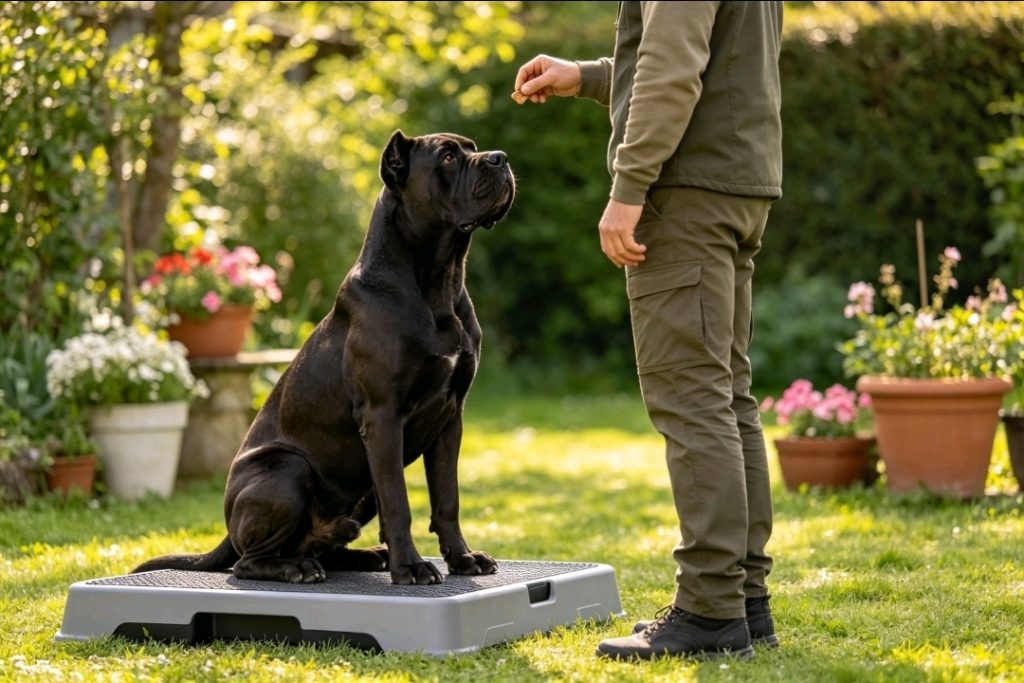
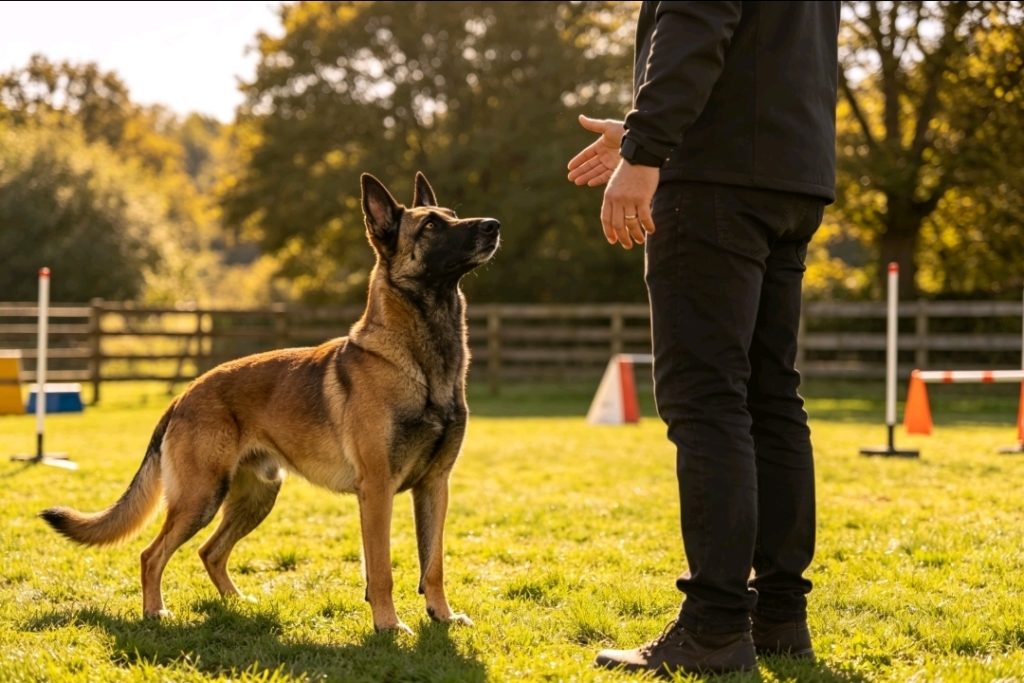
Create a professional, realistic educational dog-training photograph showing a 6-month-old female Rottweiler with a short black coat, clear tan markings on the muzzle, chest and legs, during a structured food-luring exercise. The dog should be standing attentively in front of an adult female handler, with its eyes focused on a small food reward held directly in front of its nose. The handler should use one hand to position the food lure close to the dog’s muzzle and begin a controlled movement to guide the dog’s head and body. Show the dog with attentive eyes, relaxed ears, closed mouth and balanced posture, demonstrating concentration rather than excessive excitement. The handler should stand upright with relaxed shoulders and controlled hand movement, with a small treat pouch attached to the waist. The setting should be a professional indoor dog-training facility with a dark-grey rubberised floor, neutral walls, black metal fencing and subtle industrial features. Use professional overhead lighting and an eye-level camera viewpoint that clearly shows the relationship between the food, the handler’s hand and the dog’s movement. The image should communicate the connection between food as a reward and the lure as a guide during structured training. Professional realistic educational photography, no logos, watermarks, unnecessary text, unrelated people or distracting objects.
How Food and Luring Work Together in Dog Training
How Food and Luring Work Together in Dog Training is important because food and luring can serve different but connected purposes during an exercise. Food can provide a reward that encourages engagement, while a lure can help guide the dog’s attention and movement towards a particular position or action. Problems can develop when the handler treats the two as exactly the same thing, moves the food too quickly, rewards at the wrong moment or allows the dog to focus entirely on obtaining the food. The dog may begin chasing the hand, jumping for the reward, losing position or becoming confused about what behaviour is actually being developed.
RECOMMENDED PRODUCTS
Training Treats — Small, suitable training treats can be used as food rewards during lure-based exercises while allowing the handler to maintain a consistent training flow.
Common Problems When Combining Food and Luring
One of the most common problems occurs when the handler moves food without a clear training purpose.
The dog may naturally follow a piece of food, but following food does not automatically mean the dog understands the exercise.
If the handler repeatedly moves the reward around without clear direction, the dog may learn to chase the hand rather than develop the intended movement.
Another problem occurs when the food is presented too early. The dog may become focused on obtaining the reward before the handler has established the movement or position required.
This can make the exercise appear successful while creating an unclear learning process.
Common Issues With Food and Lure Position
The position of the food can influence the dog’s physical response.
If the lure is held too high, the dog may lift its head, jump or move backwards. If it is too low, the dog may lower its head or move towards the floor.
If the food is positioned too far away, the dog may stretch towards it or move excessively. If it is held too close, the dog may attempt to grab it before the intended movement has been completed.
The handler therefore needs to understand how food position influences movement rather than simply holding the reward wherever it is easiest to reach.
Common Mistakes When Using Food as a Lure
A common mistake is keeping food visible throughout the entire exercise.
This can make the dog increasingly dependent on seeing the reward before responding.
Another mistake is moving the food continuously. If the lure never stops, the dog may learn that the objective is to chase the hand rather than perform a controlled behaviour.
Handlers can also make the mistake of delivering the food without considering exactly what the dog was doing at that moment.
If the dog moves away from the intended position before receiving the reward, the timing of delivery may reinforce an unwanted response.
RECOMMENDED PRODUCTS
Treat Pouch — A suitable treat pouch allows the handler to keep rewards accessible while reducing unnecessary food movement and helping separate preparation of the reward from the actual lure movement.
Frustration When Food and Luring Are Combined
Frustration can develop when the dog can see the reward but cannot understand how the lure is being used.
The handler may move the food faster when the dog does not respond, while the dog may become more excited as it tries to obtain the reward.
This can create jumping, grabbing, pawing or rushing.
The handler can then become frustrated and make further changes to the movement, position or timing of the food.
The exercise can quickly become less structured because both dog and handler are reacting to the previous mistake instead of following a clear training sequence.
Timing and the Relationship Between Food and Luring
Timing is central to understanding how food and luring work together.
The lure can guide the dog towards the intended movement, while the food can then be delivered as the reward for the appropriate response.
If the reward is delivered too early, the dog may not complete the movement. If it is delivered too late, the dog may have already changed position.
The handler therefore needs to recognise the moment when the dog’s behaviour matches the intended exercise.
This creates an important distinction between using food to guide movement and delivering food to reinforce behaviour.
Both can happen within the same exercise, but they serve different functions.
Misunderstanding and Miscommunication
A major misunderstanding occurs when the handler assumes that because the dog follows the food, the dog understands the behaviour.
A dog can be highly motivated by food and still have little understanding of the exercise.
The handler may therefore progress too quickly, remove the lure unexpectedly or assume that the behaviour has been learned simply because the dog followed the reward successfully.
This can create confusion when the food is no longer visible.
The handler needs to observe what the dog is actually learning rather than judging success only by whether the dog follows the food.
GPK9’S FIVE GOLDEN RULES
The GPK9 Five Golden Rules provide a connected system for understanding how food, luring, behaviour, structure and communication work together.
Food and luring are particularly relevant to obedience, but their effectiveness can also depend on the dog’s home structure, level of arousal, routine and ability to remain manageable around distractions.
The Five Golden Rules place these techniques within a wider training system rather than treating them as isolated exercises.
Golden Rule One — Home and Social
How Food and Luring Work Together in Dog Training is influenced by the dog’s ability to concentrate within an appropriate environment.
A dog that is constantly unsettled, given excessive freedom or unable to remain calm may struggle to understand a lure-based exercise.
The progression of crate → placemat → playpen provides different levels of structure.
The crate provides safety, reset and toilet support. The placemat introduces calm home freedom, while the playpen provides monitored freedom.
This structure can help the handler understand whether the dog is ready for focused food-based training rather than relying on food to overcome every distraction.
Golden Rule Two — Obedience
Golden Rule Two provides the clearest connection between food and luring.
Food can be used as a reward while the lure guides the dog’s attention and movement during structured obedience.
The handler needs to understand the difference between the two functions.
The lure helps communicate where the dog should move, while the food can be delivered as the reward for an appropriate response.
Working in the same area and around the same time can help create consistency. Food can be hand-delivered, while praise, shaping and movement form part of the wider exercise.
This helps prevent food from becoming simply something the dog chases and instead places it within a structured obedience process.
Golden Rule Three — Prey Drive / Play
Food and play can both create engagement, but they should not be treated as identical forms of training.
Golden Rule Three provides a separate area for tug, toys, movement and play.
This allows the handler to distinguish between using food to guide and reward behaviour and using play to develop engagement and manage activity.
If play or movement produces excessive arousal, the handler needs to recognise the change rather than continuing to increase activity simply because the dog remains interested.
Golden Rule Four — Toilet
Golden Rule Four focuses on consistency, timing, location and communication.
Food and luring are not the central focus of toilet training, but the wider principle of clear timing remains relevant.
The handler needs to establish predictable routines rather than expecting food to compensate for a lack of structure.
This reinforces the principle that different behaviours require different forms of communication and management within the wider GPK9 system.
Golden Rule Five — Social Walking / Ignore the World
Food and luring also need to remain appropriate when the dog moves into different environments.
Golden Rule Five focuses on calm, relaxed and manageable walking without constantly placing the dog under command.
A handler should not need to continually move food in front of the dog simply to manage every environmental distraction.
Understanding when food-based training is appropriate and when calm walking should take priority helps prevent the lure from becoming a constant management tool.
Solution Connection
The problems associated with combining food and luring often involve unclear lure movement, excessive food focus, poor positioning, incorrect timing, frustration and misunderstanding.
The GPK9 Five Golden Rules provide a structure for placing these issues into the wider training system.
Problem → Issue → Mistake / Timing / Frustration / Misunderstanding → GPK9 Five Golden Rules → Structured Solution
Golden Rule One provides home and social structure.
Golden Rule Two connects food, luring, obedience, shaping, praise and movement.
Golden Rule Three provides an appropriate place for play, engagement and arousal management.
Golden Rule Four reinforces routine, timing and consistency.
Golden Rule Five considers how food-based training fits within calm and manageable social walking.
Together, these rules help the handler understand that food and luring are connected tools with different functions rather than simply two names for the same process.
Final Connection
How Food and Luring Work Together in Dog Training is about understanding the relationship between the food reward and the movement of the lure.
The lure can help guide the dog’s attention and movement, while the food can provide the reward associated with the appropriate behaviour. Problems can occur when the food is moved without purpose, delivered at the wrong time, positioned incorrectly or used so frequently that the dog becomes focused primarily on the reward.
The GPK9 Five Golden Rules provide the wider structure for understanding where food and luring fit into the complete training process.
From crate → placemat → playpen, through structured obedience, play, toilet routines and calm social walking, each part contributes to clearer structure and communication.
The objective is not simply to make a dog follow food. The objective is to understand when food is being used to guide, when it is being used to reward, and how both functions can work together within a structured GPK9 training system.