How to Use a Dog Crate During Busy Household Activity
How to Use a Dog Crate During Busy Household Activity is about the difficulties that can occur when normal life at home suddenly becomes much busier.
People may be walking between rooms, opening doors, carrying shopping, cleaning, preparing food, collecting children, receiving visitors or repeatedly coming in and out of the property.
For some dogs, this increase in movement can make settling extremely difficult.
The owner may then try to solve the situation by placing the dog into the crate quickly.
The problem can begin when the crate becomes part of the rush rather than part of a calm household environment.
RECOMMENDED PRODUCTS
Why Can Busy Household Activity Be Difficult?
A normally quiet home can become completely different when several people are moving around at the same time.
The dog may follow people from room to room, become excited by doors opening, investigate bags and belongings, jump at people or continually seek attention.
The owner may feel that the dog needs to be put away immediately.
However, rushing the dog into a crate can create another difficult situation.
The dog may resist entering, become more excited or associate the crate with the sudden increase in household pressure.
The issue is not necessarily the crate.
The issue can be how the crate is introduced and used during a busy moment.
What Happens When People Are Constantly Coming In and Out?
Repeated movement through the front or internal doors can be particularly stimulating.
A dog may hear a door open and immediately get up.
Another person walks through.
The dog follows.
Another door opens.
The dog becomes interested again.
This can create a constant cycle of movement.
The owner may repeatedly attempt to place the dog back into the crate, only for the dog to become interested in the next person entering the room.
When learning how to use a dog crate during busy household activity, it is important to recognise that constant interruptions can make it difficult for a dog to settle.
RECOMMENDED PRODUCTS
Is the Owner Forcing the Dog Into the Crate?
One of the more significant mistakes can occur when the owner becomes frustrated.
The dog does not enter immediately.
The owner becomes impatient.
The dog is pushed or physically forced towards the crate.
This can make the crate feel like something the dog has to escape from rather than somewhere associated with calmness.
The more rushed the situation becomes, the more difficult it can be for the dog to respond appropriately.
A crate should not become a battle between the owner and dog.
If a dog is repeatedly resisting the crate, the underlying training should be reviewed rather than increasing physical pressure.
Why Might the Dog Struggle to Settle?
Another common difficulty is expecting the dog to settle immediately while the household remains highly active.
People are walking past.
Doors are opening.
Children may be moving around.
Household equipment may be running.
The owner may be repeatedly checking the dog.
All of this can keep the dog alert.
The owner may then assume the dog is refusing to settle.
In reality, the environment itself may be providing constant stimulation.
A suitable crate location can therefore make a difference.
Placing the crate directly in the middle of a busy walkway may give the dog very little opportunity to disengage from the activity.
RECOMMENDED PRODUCTS

What If the Owner Keeps Letting the Dog Out?
The opposite problem can also occur.
The owner places the dog into the crate, waits briefly and then releases the dog because the dog appears restless.
The dog immediately returns to the household activity.
A few minutes later, the dog becomes overexcited again and the process starts again.
This can create an inconsistent pattern.
The dog may never experience a predictable period where the environment becomes calmer.
The owner can become frustrated because the same situation keeps repeating.
The positive side is that recognising this pattern helps identify whether the difficulty is coming from the dog’s behaviour, the environment or the way the situation is being managed.
Can Too Much Household Activity Make the Crate Difficult?
Yes.
If the crate is surrounded by constant movement, the dog may continue watching everything happening around it.
A person walks past.
The dog looks up.
A door opens.
The dog becomes alert.
Someone speaks.
The dog watches again.
A bag is carried across the room.
The dog becomes interested.
The dog may technically be inside the crate but still be mentally involved in everything happening around it.
This is why the location and surrounding environment are important when considering how to use a dog crate during busy household activity.
RECOMMENDED PRODUCTS

Training Pouches
Training pouches can provide convenient access to suitable rewards during positive reinforcement training sessions.
What If the Dog Becomes Overexcited?
Busy household activity can increase excitement quickly.
A dog may begin pacing, barking, jumping, mouthing, grabbing objects or continually attempting to leave the crate.
The owner’s response can determine whether the situation becomes calmer or more chaotic.
Repeated shouting can add more noise.
Repeatedly opening and closing the crate can add more movement.
Repeatedly moving the dog around the house can increase stimulation.
The owner may be trying to regain control, but the additional activity can make settling harder.
Why Is Consistency Important?
Another mistake is using completely different expectations from one busy day to another.
On one occasion the dog is allowed to follow everyone around.
On another, the dog is immediately placed into the crate.
On another, the dog is repeatedly moved between the crate, room and garden.
This inconsistency can make the household environment difficult for the dog to understand.
Structure works best when expectations are predictable.
This does not mean the dog must be separated from every part of family life.
It means the owner needs to consider how much activity the dog can reasonably manage at that particular time.
RECOMMENDED PRODUCTS

What Happens When Children Are Moving Around?
Children can create a particularly active environment.
They may run through rooms, open doors, play with toys, talk loudly or repeatedly approach the dog.
A dog that is already struggling to settle can become even more stimulated.
The owner may then attempt to place the dog into the crate while the children continue moving around it.
This can make the crate itself part of the activity.
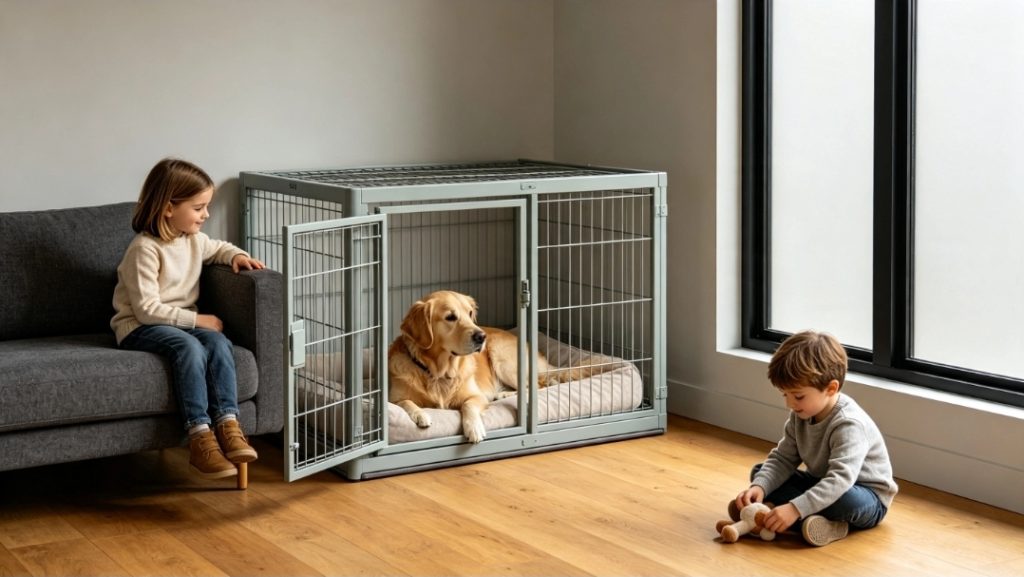
A crate should provide an appropriate resting environment, and children should be taught to respect the dog’s space.
The dog should not be repeatedly disturbed while attempting to rest.
What If People Keep Approaching the Crate?
Another common mistake is allowing people to repeatedly approach, touch or speak to the dog while it is inside the crate.
The owner may be trying to reassure the dog.
A child may want to stroke the dog.
A visitor may want to interact with it.
But repeated interaction can prevent the dog from disengaging from the activity.
The crate needs to remain a suitable area for rest rather than becoming another social gathering point.
RECOMMENDED PRODUCTS

What If the Dog Becomes Frustrated?
Some dogs may become frustrated when household activity continues around them.
They may whine, bark, paw at the crate or repeatedly attempt to gain attention.
The owner’s natural reaction may be to immediately release the dog.
However, if this happens every time the dog becomes restless, the owner may unintentionally create a pattern where vocalisation or movement results in increased interaction.
The situation needs to be considered carefully.
If the dog is showing genuine distress rather than ordinary restlessness, the owner should not simply ignore the signs.
Understanding the difference between normal difficulty settling and significant distress is important.
How Can GPK9 Golden Rules Support Different Areas of Training?
The GPK9 Golden Rules are separate areas of education, with each course focusing on a specific part of dog training.
GOLDEN RULE ONE: HOME AND SOCIAL
GPK9 Golden Rule One: Home and Social focuses on the dog’s relationship with the home environment and the development of appropriate household structure.
Busy household activity is one situation where the dog’s ability to manage its environment can become particularly noticeable.
GOLDEN RULE TWO: OBEDIENCE
GPK9 Golden Rule Two: Obedience focuses on positive reinforcement, food motivation, luring and communication during training.
This provides a separate area of education from the management of household activity.
GOLDEN RULE THREE: PREY DRIVE AND PLAY
GPK9 Golden Rule Three: Prey Drive and Play focuses specifically on engagement through play and understanding changes in arousal during play.
This is a separate training area and should not be confused with managing a dog’s rest within the home.
GOLDEN RULE FOUR: TOILET TRAINING
GPK9 Golden Rule Four: Toilet Training focuses on routine, timing and appropriate toilet habits.
Consistent household routines can be particularly important for puppies still learning how daily life is structured.
GOLDEN RULE FIVE: SOCIAL WALKING
GPK9 Golden Rule Five: Social Walking focuses on calm and manageable walking and the dog’s ability to cope with different environments outside the home.
This provides a separate area of training from household crate management.
What Are the Main Mistakes Owners Can Make?
When learning how to use a dog crate during busy household activity, several mistakes can make the situation harder.
The owner may force the dog into the crate.
The crate may be placed in the busiest part of the home.
People may continually walk past or interact with the dog.
The owner may repeatedly let the dog out whenever it becomes restless.
Children may be allowed to disturb the dog while it is resting.
The owner may become frustrated and increase the amount of noise and movement.
The crate may also be used as a way of avoiding training rather than as part of a structured environment.
Recognising these patterns gives the owner an opportunity to consider what is actually making the situation difficult.
RECOMMENDED PRODUCTS
How to Use a Dog Crate During Busy Household Activity
How to Use a Dog Crate During Busy Household Activity is not simply about putting a dog into a crate whenever the home becomes busy.
The surrounding environment, the dog’s previous experience, the crate’s location and the owner’s behaviour can all affect what happens.
People coming in and out can create repeated stimulation.
Children moving around can make settling harder.
Forcing a dog into the crate can create resistance.
Constantly checking or disturbing the dog can prevent genuine rest.
Releasing the dog every time it becomes restless can create inconsistency.
The positive approach is to recognise these difficulties and understand what is contributing to them.
A dog crate can become a useful part of household structure when it is introduced appropriately and used alongside wider positive reinforcement training.
RECOMMENDED COURSE

GPK9 Golden Rule One: Home and Social
GPK9 provides professional dog training education focused on helping owners understand the How, Why and When behind structured dog training.
Related Articles
What Is a Dog Crate? How Crate Training Works
Why Use a Dog Crate? Understanding Crate Training
When Should You Use a Dog Crate? Practical Crate Training
How to Introduce Your Dog to a Crate Step by Step
How to Use a Dog Crate to Create Structure at Home
How to Use a Dog Crate When Visitors Arrive
How to Use a Dog Crate When the Postman Arrives
How to Use a Dog Crate When Someone Comes to the Door
How to Use a Dog Crate Safely Around Children
How to Use a Dog Crate Around Other Animals
Common Dog Crate Training Mistakes and How to Avoid Them
What to Do When Your Dog Leaves the Training Mat
Dog Crate vs Training Mat vs Playpen: What Is the Difference?
How to Use a Dog Crate, Training Mat and Playpen Together
How Much Freedom Should You Give a Puppy at Home?