Dog Training Collars: Types, Uses & Choosing the Right Collar
A dog training collar is one of the most familiar pieces of equipment used by handlers, but choosing the right collar requires more consideration than simply selecting a size or style.
Different collars are designed for different purposes. Some are primarily intended for everyday identification and walking, while others provide particular features for training and handling. The dog’s size, neck shape, behaviour, training level and the intended exercise should all influence the decision.
Dog Training Collars: Types, Uses & Choosing the Right Collar explores the purpose of collars, different collar designs, correct fitting, training applications and safety considerations.
The objective is not to identify one collar that suits every dog. Instead, the aim is to understand how different collars work and how collar choice connects with leads, harnesses and effective training.

- RECOMMEND ARTICLES
- Dog Training Leads & Long Lines: What to Choose & Why
- Dog Training Harnesses: Types, Uses & How to Choose
- Obedience Dog Training: Equipment, Commands & Techniques
Understanding Collars
Purpose
A collar provides a connection around the dog’s neck and can serve several everyday purposes.
It may carry identification information, provide a point for attaching a lead and form part of a training setup.
The collar should be appropriate for the dog and the activity. A collar used for everyday walking may not necessarily be the same equipment a handler chooses for a particular training exercise.
Training applications
Collars can be incorporated into many forms of training, including loose-lead walking, obedience and controlled outdoor work.
However, the collar itself does not teach the behaviour.
The handler still needs to establish clear communication, reinforce appropriate responses and progressively develop reliability.
This is particularly important when considering Obedience Dog Training: Equipment, Commands & Techniques, where equipment is treated as part of a wider training system rather than a replacement for teaching.
Everyday use
For everyday use, comfort, security and appropriate fit should be priorities.
A collar should remain secure during normal movement without being excessively tight.
The handler should also consider whether the collar is appropriate for the environment. A collar that works well for ordinary walking may not provide everything required for a specialist training application.
Fit and comfort
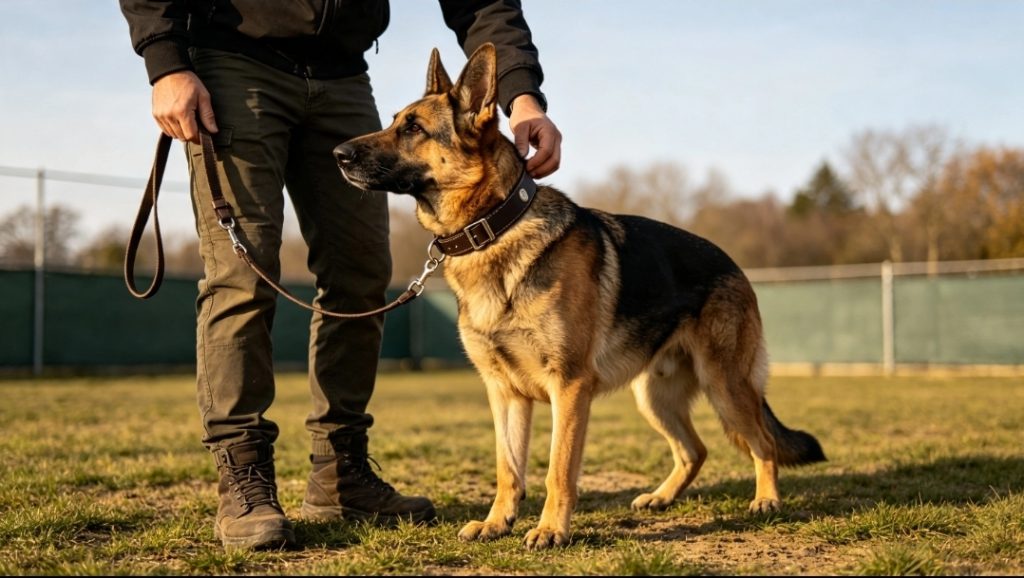
A collar must fit correctly.
An excessively loose collar may create an escape risk, while an excessively tight collar can cause discomfort.
The handler should regularly check the collar because a dog’s body condition, coat and size can change over time.
RECOMMEND PRODUCTS
- RECOMMEND ARTICLES
- Dog Training Leads & Long Lines: What to Choose & Why
- Dog Training Harnesses: Types, Uses & How to Choose
- Obedience Dog Training: Equipment, Commands & Techniques
Harnesses provide an alternative body connection and can be useful for certain walking and training applications. Understanding both collars and harnesses helps the handler choose equipment according to the individual exercise.
Types of Collars
Flat collars
Flat collars are among the most common collar designs.
They provide a straightforward connection and can be suitable for everyday identification and walking when correctly fitted.
Their simplicity makes them practical, but correct adjustment remains important.
Martingale collars
Martingale collars are designed with an additional section that allows the collar to tighten to a controlled extent when tension is applied.
They can be useful for particular dogs and situations where additional security is required.
They must still be correctly fitted and used appropriately. The handler should understand how the particular design operates before relying on it.
Slip-style equipment
Slip-style equipment can tighten when tension is applied.
Because this type of equipment can create increased pressure around the neck, it requires particular care and appropriate handling.
The handler should understand the equipment fully and avoid excessive or prolonged pressure.
Training should focus on teaching the desired behaviour rather than relying on physical pressure to produce compliance.
Head collars
Head collars provide a different point of control by positioning the connection around the dog’s head and muzzle area.
They may provide additional management for some dogs during walking, but they require careful introduction and correct fitting.
The dog should be gradually accustomed to the equipment rather than having it suddenly introduced and immediately used in a demanding environment.
Training-specific collars
Some collars are designed for particular training applications.
The handler should understand the purpose, construction and appropriate use of any specialist equipment before incorporating it into training.
Equipment should always be selected according to the dog’s needs and the training objective.
RECOMMEND PRODUCT
- RECOMMEND ARTICLES
- Dog Training Leads & Long Lines: What to Choose & Why
- Dog Training Harnesses: Types, Uses & How to Choose
- Obedience Dog Training: Equipment, Commands & Techniques
A collar and lead operate as a connected system. Understanding lead length, materials, attachments and handling helps ensure that the selected collar is being used with suitable equipment.
Choosing the Correct Collar
The correct collar depends on several factors.
Consider:
- The dog’s size.
- Neck shape.
- Coat type.
- Behaviour.
- Training experience.
- Intended exercise.
- Environment.
- Required level of security.
- Handler experience.
A collar that appears suitable in a shop may not necessarily be appropriate once the dog is moving, pulling, turning or working around distractions.
The handler should therefore assess the equipment while the dog is actually performing the intended activity.
Collar Fit
Measuring the neck
The dog’s neck should be measured according to the collar manufacturer’s guidance.
Different designs may fit differently, so measurements should not automatically be transferred between collar types.
The dog’s coat should also be considered. A heavily coated dog may require different adjustment considerations from a short-coated dog.
Correct positioning
The collar should sit where the particular design is intended to sit.
Position can affect how the collar functions and how securely it remains in place.
The handler should check the collar from different angles and observe it while the dog moves naturally.
Adjustment
Adjust the collar carefully.
It should be secure without being unnecessarily tight.
After adjustment, check that the collar remains correctly positioned during walking, turning, sitting and other normal movement.
Checking comfort
Comfort should be monitored throughout use.
Look for signs of rubbing, irritation or changes in the dog’s behaviour that may indicate the equipment is uncomfortable.
The collar should not be treated as correctly fitted simply because it fits around the neck.
Regular reassessment
Fit should be reassessed regularly.
Puppies grow rapidly, dogs can change body condition and coats can become thicker or thinner.
Equipment that fitted correctly several months ago may require adjustment or replacement.
RECOMMENDED COURSE
Fundamentals 1 is naturally connected to the introduction of basic training equipment and foundational handler-and-dog communication.
Training Applications
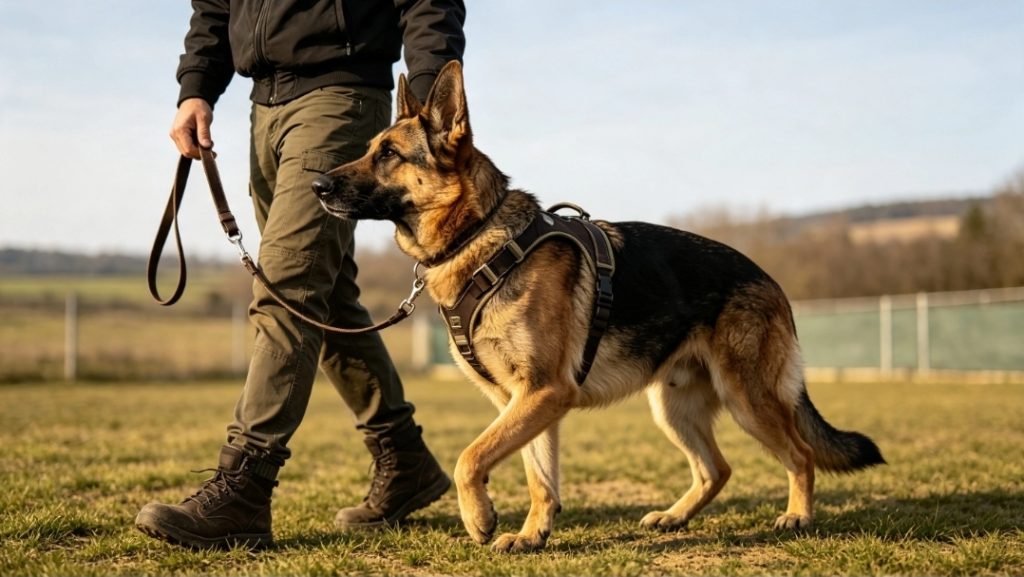
Loose-lead walking
Collars are frequently used during loose-lead walking.
The goal is to teach the dog to move with the handler without continually pulling against the lead.
The collar provides the connection, but training creates the behaviour.
Reward-based reinforcement can be used to encourage appropriate position, engagement and attention.
For further information about the equipment used during outdoor walking, Dog Walking Essentials: Equipment for Safe Outdoor Adventures provides a natural extension to this subject.
Obedience
Collars can form part of a structured obedience setup.
Exercises such as sit, down, stay, heel, recall and place all depend primarily on communication and training rather than the collar itself.
The handler should therefore avoid viewing equipment as a shortcut to reliable obedience.
RECOMMENDED COURSE
Fundamentals 2 connects with developing obedience beyond initial foundations, where equipment selection and consistent handling become part of increasingly demanding training exercises.
Recall
Recall training can involve a collar where appropriate, particularly during controlled exercises.
However, a long line and suitable harness may be preferable for some recall setups depending on the individual dog and training objective.
The key principle is to maintain appropriate management while developing the recall behaviour.
Dog Training Leads & Long Lines: What to Choose & Why provides further information about selecting and handling long lines for recall and distance work.
Handler communication
The collar should support communication rather than become the communication.
The handler’s voice, body language, timing, reward placement and consistency all contribute to the dog’s understanding.
A dog should learn what behaviour produces reinforcement rather than simply responding because tension has been applied to the collar.
RECOMMEND PRODUCTS
- RECOMMEND ARTICLES
- Dog Training Leads & Long Lines: What to Choose & Why
- Dog Training Harnesses: Types, Uses & How to Choose
- Obedience Dog Training: Equipment, Commands & Techniques
Dog Training Treats: Choosing the Right Rewards for Training
Appropriate rewards can help reinforce engagement, loose-lead walking, recall and obedience behaviours while reducing reliance on physical equipment.
Collar and Lead Handling
Good equipment becomes more effective when the handler understands how to use it.
The lead should generally be managed with awareness rather than kept unnecessarily tight.
Sudden tension should be avoided wherever possible, particularly when the dog changes direction or accelerates.
The handler should remain aware of the dog’s position and anticipate movement.
For more detailed information on lead handling, Dog Training Leads & Long Lines: What to Choose & Why connects directly with the principles discussed here.
Safety
Avoiding excessive pressure
A collar should never be treated as a reason to apply unnecessary pressure.
The objective of training is to develop understanding and reliable behaviour.
Excessive or inappropriate pressure can create discomfort and may interfere with the dog’s ability to learn effectively.
Handlers should understand the equipment they are using and select methods appropriate to the individual dog.
Equipment inspection
Collars should be inspected regularly.
Check:
- Buckles.
- Clips.
- Rings.
- Stitching.
- Material.
- Adjustment points.
Look for fraying, damaged hardware, weakened stitching or other signs of deterioration.
A collar should not be relied upon if its security has become questionable.
Correct supervision
Equipment should be supervised according to its intended use.
The handler should understand how the collar behaves when the dog moves, pulls, reverses or changes direction.
Specialist equipment requires particular attention because incorrect use can create unnecessary risk.
Recognising unsuitable equipment
A collar may be unsuitable if it repeatedly causes rubbing, discomfort, escape risk or difficulty controlling the dog appropriately.
The dog’s behaviour should also be considered.
If the equipment creates more problems than it solves, the handler should reassess the setup.
RECOMMEND PRODUCT
Dog Training Harnesses: Types, Uses & How to Choose
If a collar does not provide the most appropriate connection for a particular exercise, a correctly selected and fitted harness may offer an alternative approach.
Collars, Harnesses and Leads Together
The choice between a collar and harness does not always have to be an either-or decision.
Different equipment can serve different purposes.
A collar may be used for identification and particular training applications, while a harness may provide a body connection during walking or long-line work.
The lead then provides the connection between the handler and whichever equipment is being used.
This is why equipment should be considered as a complete system.
A handler choosing a collar should also understand the lead that will attach to it. A handler selecting a harness should understand how that harness connects with the chosen lead or long line.
RECOMMEND PRODUCT
- RECOMMEND ARTICLES
- Dog Training Leads & Long Lines: What to Choose & Why
- Dog Training Harnesses: Types, Uses & How to Choose
- Obedience Dog Training: Equipment, Commands & Techniques
Dog Training Leads & Long Lines: What to Choose & Why
Understanding lead construction, length and attachment options helps complete the equipment selection process.
Progression Through Training
Collar use should develop alongside the dog’s training.
A young or inexperienced dog may initially require simple equipment and controlled environments.
As the dog develops, the handler can gradually introduce more challenging environments, greater distance, longer duration and additional distractions.
The equipment should support that progression.
For example, a dog may begin basic obedience indoors, move into the garden, progress to quiet outdoor environments and eventually work around greater distractions.
The collar remains only one part of the process.
The dog’s understanding, engagement and reliability are the real measures of training progress.
RECOMMENDED COURSE
Fundamentals 3 provides a natural continuation for handlers developing more advanced consistency and control as foundational obedience becomes increasingly reliable.
Choosing a Collar for the Individual Dog
There is no universal collar that is automatically suitable for every dog.
A handler should consider the individual dog’s:
- Neck size.
- Body shape.
- Coat.
- Behaviour.
- Training level.
- Strength.
- Walking habits.
- Environment.
- Training objective.
The collar should then be introduced and assessed in controlled conditions.
A dog that is comfortable and responsive in one environment may behave differently in another, so equipment should be evaluated as training progresses.
The wider GPK9 topic cluster can help handlers make these decisions. Dog Training Harnesses: Types, Uses & How to Choose explores alternative body connections, while Dog Training Leads & Long Lines: What to Choose & Why explains how lead selection affects the overall training setup.
Reward-Based Collar Training
The most effective equipment setup still depends on good training methodology.
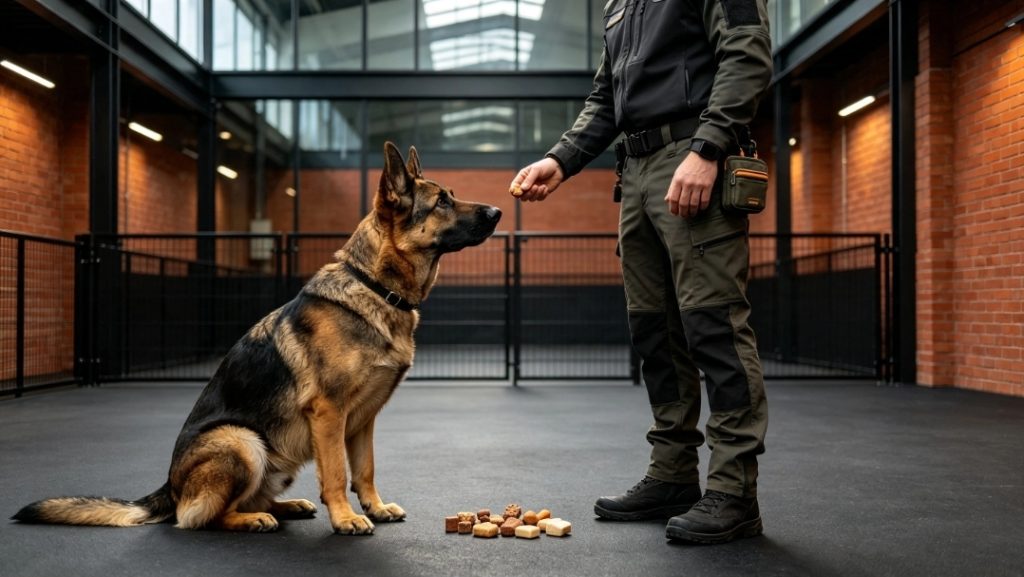
Reward-based learning can help the dog understand which behaviours the handler wants repeated.
For example, during loose-lead walking, the handler can reinforce appropriate engagement and position. During obedience exercises, correct responses can be marked and rewarded.
The collar provides a connection, but the reinforcement system provides information about what behaviour is desirable.
Dog Training Treats: Choosing the Right Rewards for Training is therefore closely connected to collar-based obedience work.
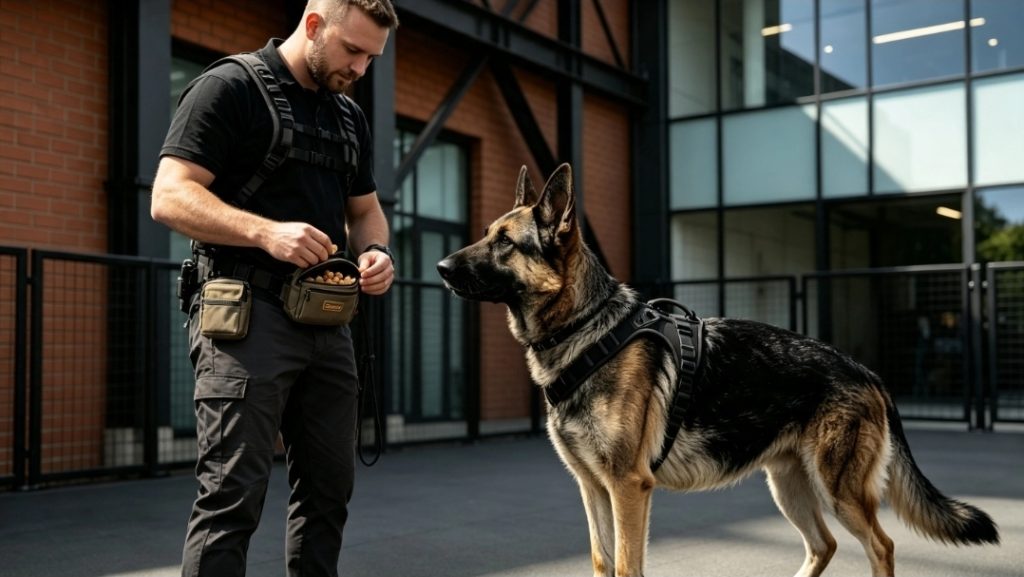
A treat pouch can also improve reward accessibility and timing. For that equipment, Dog Training Treat Pouches: How to Choose the Right One provides additional product-related information.
RECOMMEND PRODUCTS
- RECOMMEND ARTICLES
- Dog Training Leads & Long Lines: What to Choose & Why
- Dog Training Harnesses: Types, Uses & How to Choose
- Obedience Dog Training: Equipment, Commands & Techniques
Dog Training Treat Pouches: How to Choose the Right One
Keeping rewards immediately accessible can help the handler maintain timing during obedience and lead exercises.
What the Reader Learns
By understanding Dog Training Collars: Types, Uses & Choosing the Right Collar, the handler can approach collar selection as part of a complete training system.
The key principles are:
- Understand the purpose of the collar.
- Consider how it will be used.
- Choose equipment according to the individual dog.
- Understand the differences between collar designs.
- Measure the dog’s neck correctly.
- Position the collar appropriately.
- Adjust it carefully.
- Check comfort during movement.
- Reassess fit regularly.
- Inspect equipment for damage.
- Avoid excessive pressure.
- Use appropriate supervision.
- Recognise when equipment is unsuitable.
- Consider collars alongside harnesses and leads.
- Use training methods that develop communication and reliability.
Final Thoughts
Choosing the right collar is about understanding the individual dog, the intended activity and the complete equipment setup.
Flat collars, martingale collars, slip-style equipment, head collars and training-specific collars all have different characteristics. Each should be selected and used with an understanding of its purpose, fit and limitations.
Correct fitting is essential. The collar should remain secure, comfortable and appropriately positioned, with regular checks to ensure that it continues to fit correctly.
Most importantly, equipment should support training rather than replace it.
Effective obedience comes from communication, engagement, timing, reinforcement and progressive training. The collar simply forms one part of that process.
When collars, leads, harnesses and rewards are selected thoughtfully and used appropriately, they can become practical tools within a structured training system that helps the handler and dog work together with greater clarity and consistency.