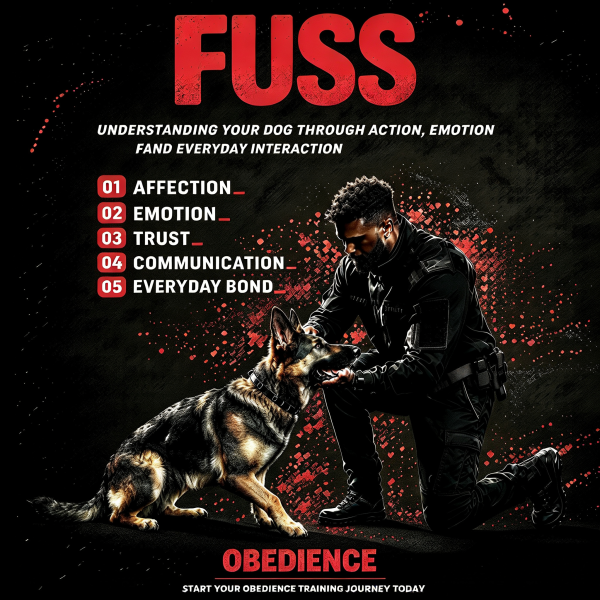
FUSS — Understanding Your Dog Through Affection, Emotion and Everyday Interaction
Learn to understand your dog’s emotions, motivation and behaviour while developing clearer communication, better everyday habits and a stronger partnership.
Course Description
The GPK9 FUSS Course helps dog owners and handlers understand how affection, physical contact, emotional responses, motivation and everyday interactions influence canine behaviour. It explores how dogs respond to people, surroundings, rewards, play, excitement and routine, helping you make better decisions based on the individual dog in front of you.
Rather than treating every behaviour as a separate problem, this course brings the bigger picture together. You will learn to recognise changes in your dog’s behaviour, consider what may be influencing the response, communicate more clearly and adapt your approach to suit the situation.
From understanding why a dog seeks attention to recognising when excitement becomes difficult to manage, the course explains how everyday interactions can support learning, confidence, appropriate boundaries and behavioural control.
You will also explore how motivation and emotional responses relate to obedience, prey drive, play, toilet training and social walking. Discover how to use suitable rewards, improve engagement, recognise when your dog needs space and understand why rest and recovery are important parts of effective training.
The course introduces the FUSS framework — Function, Understand, Structure and Support — alongside practical decision-making frameworks that help you assess situations, communicate clearly and review your dog’s response. These principles can be applied to puppies, adult dogs and handlers looking to improve their understanding of canine behaviour.
What You Will Learn
- Affection and emotional connection: Understand individual preferences for physical contact, attention and interaction.
- Canine emotions and hormones: Explore the roles of dopamine, adrenaline, cortisol and oxytocin in motivation, arousal, stress responses and social bonding.
- Body language and comfort: Recognise changes in behaviour, assess comfort levels and respond appropriately to your dog’s signals.
- Boundaries and household behaviour: Establish clear expectations, manage attention-seeking habits and support appropriate behaviour around family members and visitors.
- Obedience and communication: Improve engagement, reward timing, responsiveness and the development of reliable behaviours.
- Motivation and reinforcement: Understand how food, toys, play, praise and suitable activities can support learning.
- Prey drive and play: Explore chasing, ball play, tug, excitement management, engagement and recovery.
- Toilet training: Understand routines, timing, supervision, appropriate opportunities and rewarding success.
- Social walking: Manage distractions, recognise your dog’s responses to people and dogs, and develop more controlled everyday walks.
- Behavioural assessment: Learn when to continue, when to adjust the situation and when to stop and prioritise safety.
- Individual adaptation: Apply the principles according to your dog’s temperament, experience, motivation and current needs.
The FUSS Training Framework
FUSS provides four connected foundations for everyday interaction:
FUNCTION — Understand the purpose of the interaction and what you want to achieve.
UNDERSTAND — Consider your dog’s behaviour, emotional responses, motivation and individual needs.
STRUCTURE — Establish clear expectations, suitable boundaries and consistent communication.
SUPPORT — Provide appropriate guidance, rewards, management, space and recovery.
You will also learn to apply the GPK9 communication sequence:
OBSERVE → INTERPRET → DECIDE → COMMUNICATE → OBSERVE RESPONSE → REASSESS
This helps you move beyond reacting automatically to behaviour. Instead, you learn to observe what is happening, make an informed decision, communicate clearly and assess whether your approach is helping.
Practical Application Across Everyday Dog Training
The course connects the principles of FUSS to five important areas of everyday life:
- Home and Social: Develop appropriate household behaviour, healthy boundaries, safe interactions and consistent routines.
- Obedience: Build engagement, improve communication and use rewards to encourage reliable responses.
- Play and Prey Drive: Channel motivation through structured games while developing reconnection, appropriate control and recovery.
- Toilet Training: Support reliable habits through observation, routine, supervision and reinforcement.
- Social Walking: Improve communication outdoors and adapt your approach to distractions, excitement and social encounters.
The aim is to help you understand how the same underlying principles apply across different situations, rather than relying on isolated techniques without considering the dog’s current condition.
Who Is This Course For?
This course is suitable for dog owners and handlers who want to:
- Understand why their dog behaves differently in different situations.
- Develop a stronger relationship through appropriate interaction and communication.
- Recognise how motivation and emotional responses influence learning.
- Improve everyday obedience, play, household behaviour and walking routines.
- Understand when affection and attention are helpful and when an interaction needs to change.
- Make more informed decisions based on their dog’s individual needs.
- Build consistency and confidence in their approach to training.
The Final Lesson: Bringing Everything Together
The final lesson connects the course’s key principles, explaining how canine emotions, hormones, motivation, obedience, prey drive, toilet training and social walking fit into one practical approach.
You will learn how to apply the FUSS framework across everyday situations, recognise when your dog is ready to progress and understand when to reduce pressure, create distance or allow recovery.
The emphasis is on understanding the individual dog, using positive reinforcement, communicating clearly and building reliable behaviour through appropriate practice.
Important Training Information
Dogs differ in temperament, motivation, learning history and individual preferences. Training should be adapted to the dog and progressed at a suitable pace.
Use positive reinforcement, appropriate supervision and safe management. Do not force physical contact or deliberately overwhelm a dog to test its behaviour. Dogs displaying aggression, serious reactivity or behaviour that creates a safety concern may require assessment and support from a qualified professional.
Progress depends on consistency, appropriate practice and the individual dog. No particular behavioural outcome can be guaranteed.
Course Price
£39.99 — One-time payment
Access the GPK9 FUSS Course and develop a clearer understanding of your dog’s emotions, motivation, communication and everyday behaviour.
GPK9 PRINCIPLE: Understand the dog. Structure the interaction. Communicate clearly. Support appropriate behaviour. Reassess before progressing.