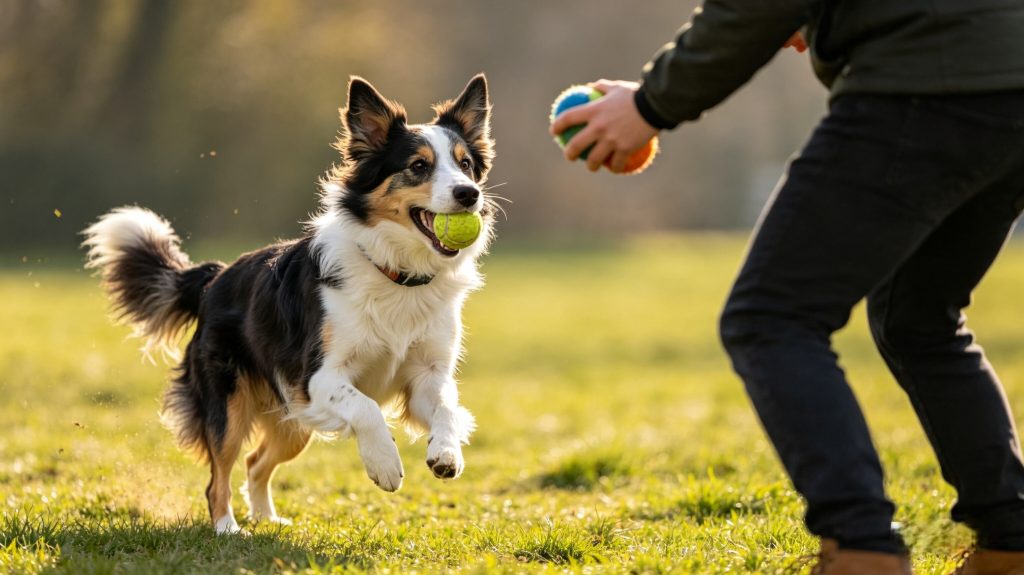
FEATURED IMAGE — DALL·E DESCRIPTION
Thank you for reading this post, don't forget to subscribe!Create a cinematic, photorealistic professional dog-training scene inside a modern GPK9 training environment. A focused handler is working with a healthy, realistically proportioned German Shepherd on a lead during an obedience exercise, with the dog maintaining eye contact and a controlled position beside the handler. The environment features dark-grey flooring, rich red-brick detailing, black metal fencing, industrial glass panels and dark structural elements. Professional cinematic lighting creates realistic highlights and detailed shadows across the dog, handler, equipment and surrounding environment. Show realistic dog anatomy, natural fur texture, authentic training collar, lead and reward equipment. The atmosphere should communicate focus, communication, control, reliability and professional obedience training. Balanced exposure, realistic materials, cinematic depth and a premium professional GPK9 aesthetic. No text, logos or watermarks.
Obedience Dog Training: Equipment, Commands & Techniques
Obedience dog training is about far more than teaching a dog to sit when asked. Effective obedience develops communication between handler and dog, builds engagement and focus, and creates behaviours that remain useful when the environment becomes more challenging.
Obedience Dog Training: Equipment, Commands & Techniques brings together the foundations of obedience, the commands commonly taught, the training methods used to establish them, the equipment that supports training and the progression required to develop reliability.
The objective is not simply for a dog to perform a behaviour once in a quiet room. The goal is to develop understanding and gradually build that behaviour through distractions, distance and duration.
Understanding Obedience
What obedience training means
Obedience training teaches a dog to understand specific cues and respond appropriately to them. The cue may be a spoken command, hand signal, body movement or another established marker.
A successful exercise begins with understanding. The dog needs to know what behaviour is being requested, recognise when it has performed correctly and understand what reinforcement follows.
This makes obedience a communication system between handler and dog rather than simply a collection of commands.
Communication between handler and dog
Clear communication is essential. If the handler changes the command, timing or expectation every time an exercise is performed, the dog receives inconsistent information.
The handler should therefore aim to be predictable.
A clear cue is followed by an opportunity for the dog to respond. Correct behaviour is identified and reinforced. With repetition, the dog begins to understand what produces the desired outcome.
This foundation connects directly with Puppy Training: Essential Skills, Equipment & Techniques, particularly when obedience behaviours are being established during early development.
Engagement and focus
Before expecting advanced obedience, the handler needs the dog’s attention.
Engagement means the dog is interested in interacting with the handler and participating in the training exercise. Focus is the ability to maintain attention despite competing information in the environment.
A dog that understands “sit” but immediately disengages when another dog appears has learned the command, but the behaviour has not yet been sufficiently developed.
Reliability
Reliability comes from progression.
A behaviour that works perfectly in the kitchen may not work in a garden. A behaviour that works in the garden may fail beside a busy road, around other dogs or in a completely unfamiliar environment.
This is why obedience training must gradually introduce new locations, distractions, distance and duration.
RECOMMEND PRODUCT
- RELATED ARTICLES
- Puppy Training: Essential Skills, Equipment & Techniques
- Dog Training Leads & Long Lines: What to Choose & Why
- Dog Training Treats: Choosing the Right Puppy Training: Essential Skills, Equipment & Techniques for Training
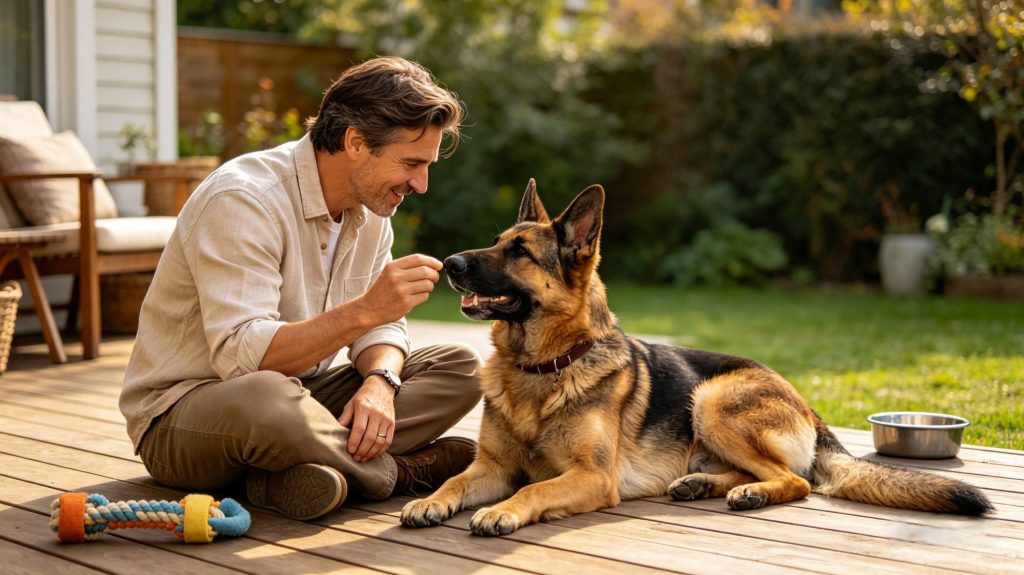
Appropriate training rewards can make it easier to reinforce engagement, focus and correct responses. The type, size and value of the reward should suit the exercise and the individual dog.
Core Commands
Sit
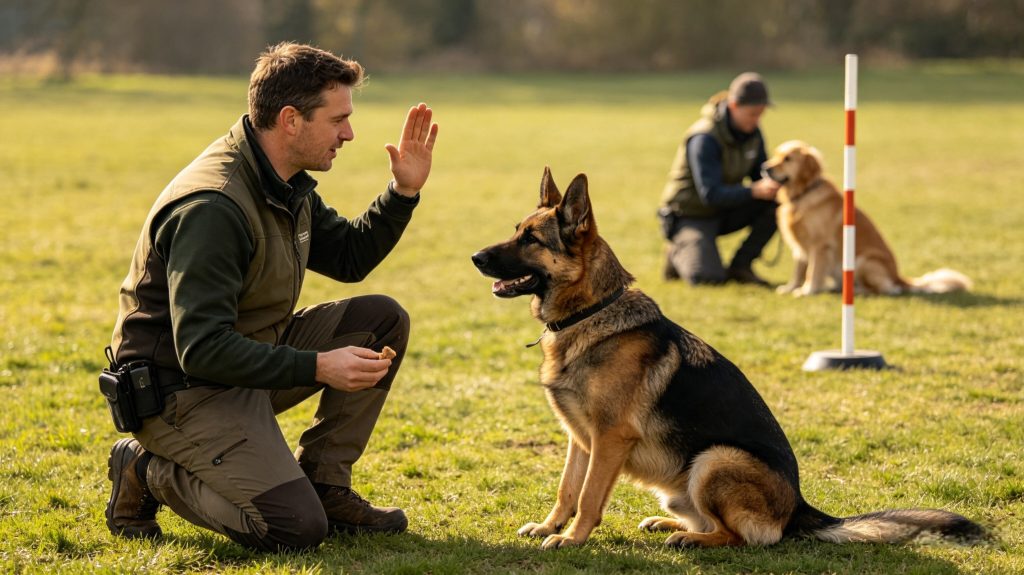
Sit is one of the most recognisable obedience behaviours and can become useful in everyday situations.
A handler may use it when preparing a dog for another exercise, waiting at a doorway or establishing a calm position before moving forward.
The important principle is not simply getting the dog’s body onto the ground. The dog should learn to associate the cue with the behaviour and eventually respond without relying entirely on a food lure.
Down
Down teaches the dog to move into a lower position and can become useful for calm control.
As with sit, the behaviour should initially be taught in a simple environment before gradually increasing distractions and duration.
Stay
Stay introduces an additional layer of understanding. The dog must maintain its position rather than immediately following the handler.
This can be developed through very small increases in duration and distance. Asking for too much too soon can create unnecessary failure.
Recall
Recall is one of the most important practical obedience behaviours.
The dog learns that a particular cue means returning towards the handler. A strong recall should be developed progressively and reinforced consistently.
Long lines can be particularly useful during the progression from controlled training to greater freedom because they provide additional management while the recall is being developed.
For equipment selection and practical use, Dog Training Leads & Long Lines: What to Choose & Why provides a natural extension to this subject.
RECOMMEND PRODUCT
Dog Training Leads & Long Lines: What to Choose & Why
A suitable lead or long line can provide useful control and management while recall, distance work and outdoor obedience are being developed.
Heel
Heel teaches the dog to move in a controlled position in relation to the handler.
The exact position can vary depending on the training system, but the fundamental principle is controlled movement while maintaining communication with the handler.
Heel should not initially be treated as a long-distance endurance exercise. Begin with short, successful repetitions and gradually increase duration and environmental difficulty.
Leave it
Leave it teaches the dog to disengage from an object, food item or other point of interest and redirect attention towards the handler.
This can support impulse control and everyday safety.
Drop it
Drop it teaches the dog to release an item when requested.
This can be particularly useful when a dog picks up something inappropriate or when toys are being incorporated into structured training.
Place
Place teaches the dog to move to and remain within a designated area.
A bed, mat or other defined location can become a useful tool for developing calmness and control within the home.
Emergency commands
Emergency commands are designed for situations where immediate response matters.
These behaviours should be trained carefully, reinforced heavily and maintained through regular practice. An emergency cue should not become a command that is repeatedly used without reinforcement or preparation.
RECOMMEND COURSE
90-Day Transformation
The 90-Day Transformation can complement obedience work by providing a structured pathway for developing training habits, communication and consistency rather than treating obedience as a collection of isolated commands.
Training Methodology
Reward-based learning
Reward-based training reinforces behaviour that the handler wants the dog to repeat.
The reward might be food, a toy, play, praise or access to something the dog values.
The reward should be meaningful to the individual dog and appropriate for the exercise.
Luring
Luring uses a reward or target to guide the dog into a desired position.
For example, a food reward can be moved upwards and backwards to encourage a dog into a sit.
Luring can be highly useful during initial teaching, but the handler should gradually reduce dependence on the lure as the dog understands the behaviour.
Capturing
Capturing involves rewarding a behaviour that the dog performs naturally.
If a dog naturally lies down and the handler marks and reinforces that behaviour, the dog begins to understand that the action has value.
Over time, a cue can be associated with the behaviour.
Shaping
Shaping breaks a complex behaviour into smaller achievable stages.
Instead of expecting the complete behaviour immediately, the handler reinforces progressive steps towards the final result.
This can be particularly valuable for dogs that need more problem-solving opportunities or for behaviours that cannot easily be taught with a simple lure.
Markers
A marker identifies the precise moment the dog has performed the desired behaviour.
The marker might be a verbal word or another consistent signal.
The closer the marker is to the correct behaviour, the clearer the communication becomes.
Timing
Timing is one of the most important skills for the handler.
If the reward arrives several seconds after the desired behaviour, the dog may not clearly understand what produced it.
Good timing makes the training message easier to understand.
Reinforcement
Reinforcement is what encourages a behaviour to happen again.
However, reinforcement does not mean simply giving the same reward every time without thought. The handler should consider what motivates the dog, how difficult the exercise is and what is happening around them.
Proofing behaviours
Proofing means developing a behaviour beyond the original training environment.
A dog might first learn recall in a quiet room. The next stage could be a garden, followed by a quiet outdoor environment and eventually more distracting locations.
The behaviour is strengthened by carefully increasing difficulty rather than immediately placing the dog into the most challenging situation.
RECOMMEND PRODUCT
Dog Training Treat Pouches: How to Choose the Right One
A practical treat pouch allows the handler to keep rewards accessible and maintain better timing during obedience exercises, particularly when moving between commands.
Equipment
Collars
Training collars should be selected according to the individual dog, the exercise and the handler’s ability to use the equipment appropriately.
A collar must fit correctly and should not interfere with the dog’s normal movement or comfort.
For a detailed comparison of collar types and their applications, see Dog Training Collars: Types, Uses & Choosing the Right Collar.
Harnesses
Harnesses can provide another option for managing a dog during walking and training.
Different harness designs distribute pressure differently and can suit different activities and dogs.
Dog Training Harnesses: Types, Uses & How to Choose provides additional information when deciding which harness may be appropriate.
Leads
A standard training lead gives the handler a connection to the dog during controlled exercises.
Lead length and construction can influence how much freedom the dog has and how easily the handler can manage the exercise.
Long lines
Long lines become particularly useful when developing recall and distance work.
They allow the handler to increase the physical distance between themselves and the dog while retaining an additional level of management.
Treats
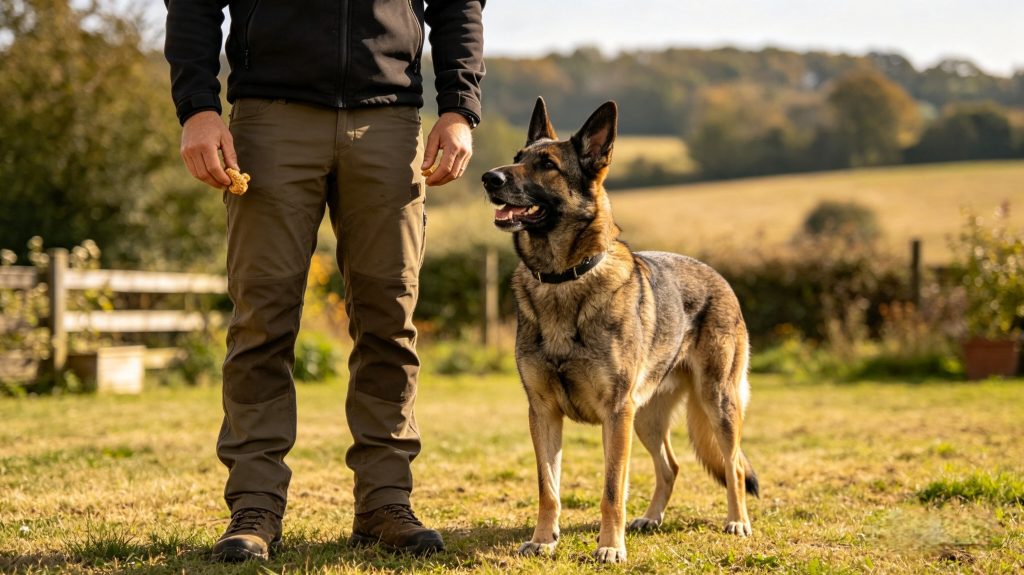
Treats are frequently used to reinforce obedience behaviours.
The reward should be appropriately sized and valuable enough to maintain motivation without unnecessarily interrupting the training exercise.
Treat pouches
A treat pouch keeps rewards immediately accessible.
This can improve timing and reduce the need for the handler to repeatedly reach into pockets or bags during a session.
Toys
Some dogs respond more strongly to toys than food.
Tug toys, balls and other suitable training rewards can therefore become valuable reinforcement tools when used appropriately.
For further information about selecting toys for structured training and play, see Dog Toys & Rewards: Choosing Toys for Training & Play.
RECOMMEND PRODUCT
Dog Training Collars: Types, Uses & Choosing the Right Collar
Choosing equipment should always begin with the exercise being performed, the dog’s individual needs and the handler’s ability to use the equipment correctly.
RECOMMEND COURSE
Fundamentals 1
Fundamentals 1 is naturally connected to the equipment and foundational obedience discussed in this section, helping establish the basic communication and behaviours on which later training can be built.
Progression
Home
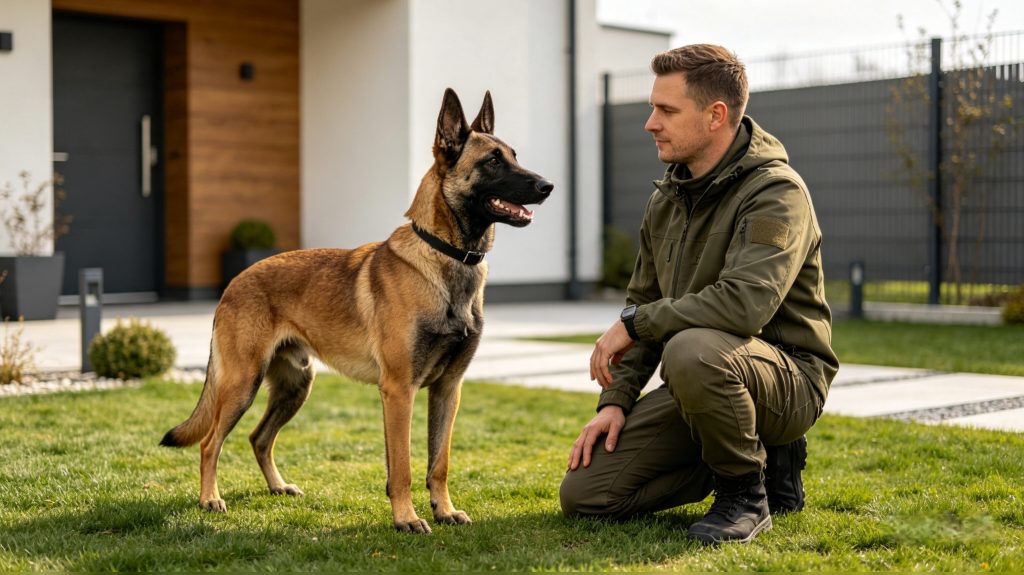
The home is often an appropriate starting environment because distractions can be controlled.
The handler can work on name recognition, engagement, sit, down, place and other foundational behaviours in short sessions.
The objective is to establish understanding rather than immediately test reliability.
Garden
The garden introduces additional smells, sounds, movement and environmental information.
This provides a natural progression without immediately exposing the dog to the full level of distraction found in public spaces.
Quiet outdoor environment
Once the dog understands the exercise, training can move into a quiet outdoor location.
The handler can gradually introduce new surfaces, sounds, people and environmental changes while maintaining manageable difficulty.
Public environments
Public environments provide considerably more competing information.
Other dogs, people, traffic, wildlife, noises and unfamiliar surroundings can all affect performance.
The handler should therefore reduce expectations when introducing a new environment rather than assuming that a behaviour learned indoors will automatically transfer perfectly outside.
Distractions
Distractions should be introduced progressively.
If a dog cannot maintain focus around a mild distraction, adding several stronger distractions at once can make the exercise unnecessarily difficult.
Progression should be controlled and measurable.
Distance
Distance changes the difficulty of many obedience behaviours.
A dog may remain perfectly reliable when the handler is standing directly beside it but struggle when the handler moves several metres away.
Increase distance gradually and reinforce successful responses.
Duration
Duration is another variable that must be developed.
A dog that can hold a stay for five seconds should not automatically be expected to maintain it for several minutes.
Small increases allow the dog to understand the new expectation while maintaining a history of success.
RECOMMEND COURSE
Fundamentals 2
Fundamentals 2 can follow foundational work by supporting progression as the dog becomes capable of responding with greater consistency and in more demanding training situations.
RECOMMEND PRODUCT
Dog Training Harnesses: Types, Uses & How to Choose
As training moves outdoors, selecting appropriate walking and training equipment becomes increasingly important. Equipment should support the exercise without replacing proper training.
Building Reliable Obedience
Reliable obedience is created through repetition, clarity and progression.
The handler should understand what behaviour is being taught, establish it in an achievable environment and then gradually increase the difficulty.
A useful training progression might look like:
Home → Garden → Quiet outdoor environment → Public environment → Distractions → Greater distance → Greater duration
This does not mean every dog must follow exactly the same sequence. Individual temperament, experience, environment and training goals all influence progression.
The key principle is to change one or more variables gradually rather than making every aspect of the exercise difficult at the same time.
This approach also connects obedience with Dog Walking Essentials: Equipment for Safe Outdoor Adventures, because successful outdoor obedience depends not only on commands but also on appropriate management and equipment.
Developing the Handler
Obedience training is not only about changing the dog’s behaviour.
The handler also needs to develop skills in timing, observation, reward placement, communication and consistency.
A handler who understands why a behaviour succeeds or fails is better positioned to make appropriate adjustments.
For example, if a dog repeatedly breaks a stay, the answer may not be to repeat the command louder. The exercise may simply have progressed too quickly in duration, distance or distraction.
Likewise, if a dog loses focus outside, the environment may currently be too difficult for the level of training achieved so far.
RECOMMEND COURSE
Fundamentals 3
Fundamentals 3 provides a natural continuation for handlers looking to develop obedience beyond basic foundations and work towards greater reliability and control.
Connecting Obedience With Everyday Life
Obedience becomes most useful when it transfers into everyday situations.
A dog that can sit inside the house but cannot wait calmly at a doorway has only learned part of the skill.
A dog that can recall from a short distance but ignores the handler when distracted needs further progression.
Training should therefore focus on practical application as well as formal exercises.
This is where the wider GPK9 topic cluster becomes valuable. Dog Training Leads & Long Lines: What to Choose & Why supports recall and distance work, Dog Training Treats: Choosing the Right Rewards for Training supports reinforcement, and Dog Toys & Rewards: Choosing Toys for Training & Play explores alternative reward systems.
RECOMMEND PRODUCT
Dog Training Leads & Long Lines: What to Choose & Why
For recall, distance and outdoor progression, the right lead or long line can provide useful management while the behaviour becomes more reliable.
What the Reader Learns
By understanding Obedience Dog Training: Equipment, Commands & Techniques, the handler can begin to see obedience as a structured training process rather than a list of commands.
The key principles are:
- Teach clear behaviours.
- Build communication between handler and dog.
- Develop engagement and focus.
- Use appropriate reinforcement.
- Improve reward timing.
- Select equipment according to the exercise.
- Start in manageable environments.
- Introduce distractions gradually.
- Increase distance progressively.
- Develop duration progressively.
- Proof behaviours in different environments.
- Maintain behaviours through regular practice.
The aim is not perfection in a single training session. Reliable obedience develops through consistent training and sensible progression.
RECOMMENDED ARTICLES
Puppy Training: Essential Skills, Equipment & Techniques
Useful for understanding how foundational behaviours are established, particularly during early training.
Dog Training Leads & Long Lines: What to Choose & Why
Relevant to recall, distance work and outdoor obedience progression.
Dog Training Harnesses: Types, Uses & How to Choose
Useful when selecting harness equipment for walking and training.
Dog Training Collars: Types, Uses & Choosing the Right Collar
Provides additional information about collar selection and appropriate applications.
Dog Training Treats: Choosing the Right Rewards for Training
Supports the reward-based training principles discussed throughout this article.
Dog Training Treat Pouches: How to Choose the Right One
Relevant to reward accessibility and accurate reinforcement timing.
Dog Toys & Rewards: Choosing Toys for Training & Play
Explores toy-based reinforcement and the role of play within training.
Dog Walking Essentials: Equipment for Safe Outdoor Adventures
Connects obedience training with practical outdoor management.
Final Thoughts
Obedience Dog Training: Equipment, Commands & Techniques is ultimately about creating a reliable communication system between dog and handler.
Sit, down, stay, recall, heel, leave it, drop it and place are useful behaviours, but the real value comes from how those behaviours are taught and developed.
Reward-based learning, luring, capturing, shaping, markers, timing and reinforcement all provide tools for teaching effectively. Equipment such as collars, harnesses, leads, long lines, treats, treat pouches and toys can support the process when selected and used appropriately.
Most importantly, progression should be gradual.
Start where the dog can succeed. Build understanding. Increase difficulty. Introduce distractions. Develop distance and duration. Then continue maintaining the behaviour across real-world environments.
That is how obedience moves from something a dog performs during a training session to a practical skill that becomes part of everyday life.