Puppy Essentials: Everything You Need for a New Puppy
Bringing a new puppy home is an exciting moment, but preparation can make the transition considerably easier for both the puppy and the handler. A puppy enters a completely unfamiliar environment filled with new smells, sounds, surfaces, people, equipment and routines. Having the right essentials prepared beforehand allows the first days to focus on settling, learning and building a relationship rather than searching for equipment at the last minute.
Puppy Essentials: Everything You Need for a New Puppy covers the practical equipment and preparation that can help create a safe, structured environment from the moment a puppy arrives.
The aim is not to buy everything available in a pet shop. Good preparation is about identifying what is genuinely useful, understanding why it is needed and knowing how each item fits into everyday puppy care and training.
RECOMMEND PRODUCTS

- RELATED ARTICLES:
- Puppy Training: Essential Skills, Equipment & Techniques
- Dog Crates & Pens: How to Choose and Use Them Correctly
- Dog Feeding & Hydration: Essential Equipment and Practical Advice
Preparing for a Puppy
Preparing the home
Before bringing a puppy home, walk through the property from the puppy’s perspective.
Look for accessible cables, small objects, unsecured doors, household chemicals, plants, gaps behind furniture and anything else that could become a problem for a curious young dog.
Puppies investigate their surroundings. They explore with their noses, mouths and paws, which means an ordinary household can contain hazards that an adult dog would simply ignore.
Preparation should therefore happen before the puppy arrives.
Create a defined area where the puppy can rest and learn without having immediate access to the entire property. This can make supervision easier while also allowing the puppy to gradually become familiar with its new environment.
Creating a safe environment
A safe puppy environment needs more than physical puppy-proofing.
It should also provide somewhere appropriate for sleep, somewhere for controlled interaction and enough space for the puppy to move, explore and learn.
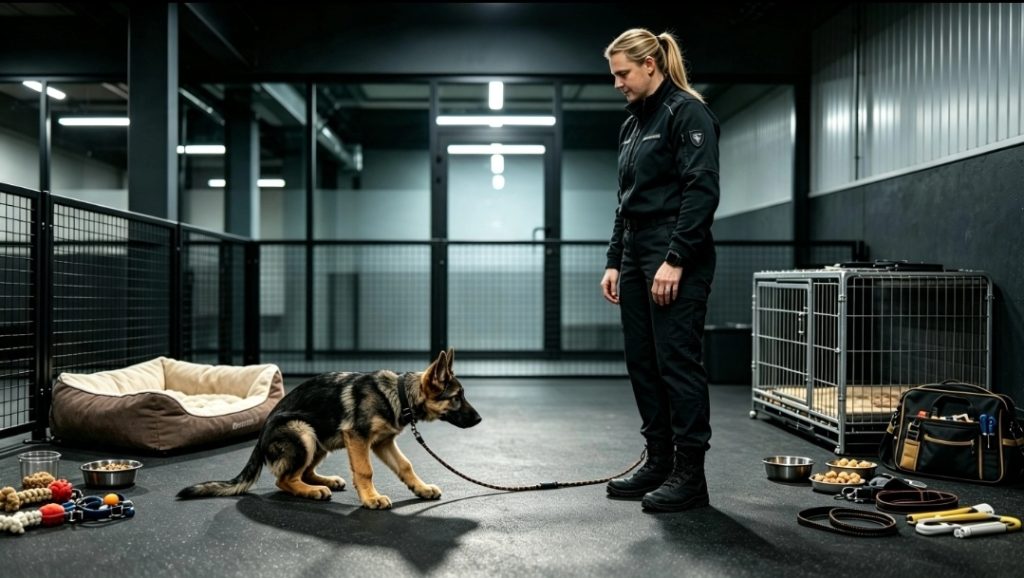
A crate or pen can help establish boundaries, while a comfortable bed can provide an area where the puppy learns that quiet behaviour is encouraged.
RECOMMEND PRODUCTS
- RELATED ARTICLES:
- Puppy Training: Essential Skills, Equipment & Techniques
- Dog Crates & Pens: How to Choose and Use Them Correctly
- Dog Feeding & Hydration: Essential Equipment and Practical Advice
Crates and pens can be useful additions to a puppy’s environment when selected appropriately and introduced gradually. They can help create structured areas for rest, management and supervised activity.
Establishing routines
Puppies benefit from predictable routines.
Feeding, toilet opportunities, rest, training, play and quiet time can all become part of the puppy’s daily pattern.
A routine does not need to mean that every activity happens at exactly the same minute every day. Instead, the puppy should begin to recognise a consistent sequence of events.
For example, waking may be followed by a toilet opportunity, then food, interaction and a short period of training before rest.
Preparing training areas
A dedicated training area can make early learning easier.
Initially, this could simply be a quiet section of the home where distractions are limited. As the puppy progresses, training can move into other areas and eventually outdoors.
Having treats, a suitable toy and the appropriate lead or harness readily available means training opportunities can happen naturally throughout the day.
Essential Equipment
There is no single shopping list that will suit every puppy perfectly. Size, breed, temperament, lifestyle and intended activities all influence equipment choices.
The important question is not simply, “What can I buy?” It is, “What will this puppy actually need?”
Collar and harness
A puppy will normally need suitable identification and walking equipment, with the exact setup depending on the individual dog and how it will be trained and managed.
A collar can provide a practical option for everyday identification and handling.
A harness can provide another way of managing a puppy during walks and training.
Fit matters. Equipment should be appropriate for the puppy’s current size and checked regularly as the puppy grows.
RECOMMEND PRODUCTS
- RELATED ARTICLES:
- Puppy Training: Essential Skills, Equipment & Techniques
- Dog Crates & Pens: How to Choose and Use Them Correctly
- Dog Feeding & Hydration: Essential Equipment and Practical Advice
Understanding collar types and their intended uses can help new owners make a more informed choice rather than selecting equipment based purely on appearance.
Lead and long line
A standard lead is one of the basic pieces of equipment required for controlled outdoor movement.
A long line can become particularly useful when a puppy begins developing recall in suitable environments.
Long lines allow the handler to practise distance and movement while maintaining an additional level of management.
This article provides a natural next step for owners who want to understand how different lead lengths and long lines can fit into puppy training and outdoor management.
Crate and pen
A crate should provide an appropriate place for rest and should be introduced positively.
A pen can provide a larger controlled area for supervised activity.
Neither should be viewed as a replacement for interaction, exercise, training or appropriate supervision. They are management tools that can become useful parts of a wider puppy routine.
Bed
A puppy needs somewhere comfortable to rest.
The bed should be placed in an area where the puppy can relax without being constantly disturbed. Some puppies will naturally move between different resting locations, so owners may eventually find that more than one appropriate resting area is useful.
Choosing a suitable bed can help owners establish comfortable resting areas while considering the puppy’s size, sleeping habits and everyday environment.
Food and water equipment
Food and water bowls should be practical, stable and easy to clean.
Feeding equipment needs to fit naturally into the puppy’s routine. Fresh water should be readily available, while feeding should follow an appropriate routine for the puppy.
This provides additional guidance on the equipment surrounding feeding and hydration and how these essentials fit into everyday dog care.
Grooming equipment
Grooming equipment should reflect the puppy’s coat and future needs.
A puppy should also gradually become comfortable with being handled around its body, paws, ears and other areas that may require routine attention.
Introducing grooming equipment slowly can help the puppy learn that brushes and other handling tools are a normal part of life.
RECOMMEND PRODUCTS
- RELATED ARTICLES:
- Puppy Training: Essential Skills, Equipment & Techniques
- Dog Crates & Pens: How to Choose and Use Them Correctly
- Dog Feeding & Hydration: Essential Equipment and Practical Advice
This connects directly with preparing grooming equipment and establishing appropriate handling routines from an early age.
Toys
Toys can provide opportunities for play, exploration and interaction.
They can also become useful training rewards.
Different puppies will show different preferences. Some may enjoy chasing, retrieving or interactive play, while others may be more motivated by food.
The important consideration is providing appropriate toys and supervising their use.
RECOMMEND PRODUCT
Dog Toys & Rewards: Choosing Toys for Training & Play
Understanding how toys can function as both enrichment and rewards can help owners make better use of play within everyday puppy training.
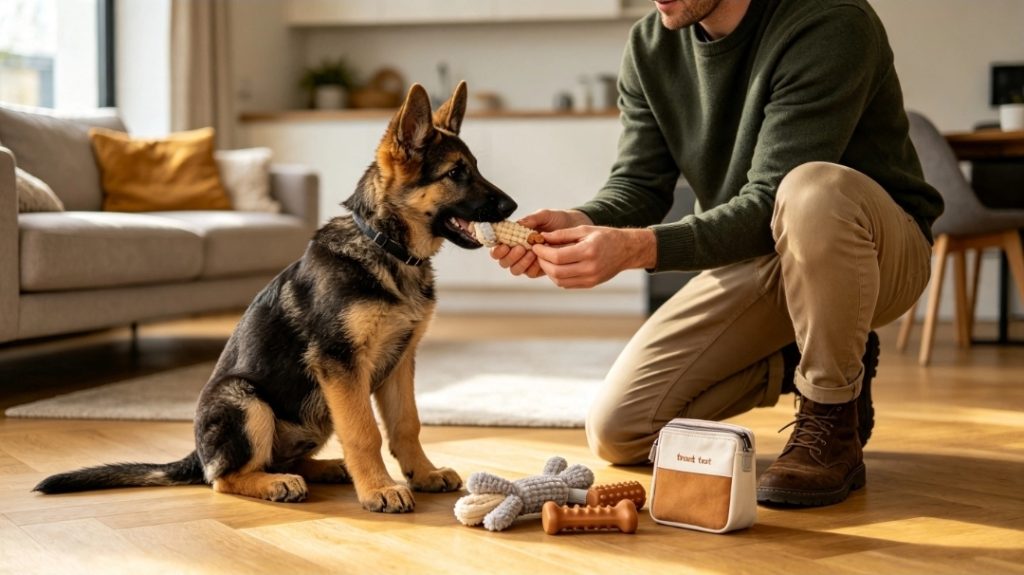
Training treats and treat pouch
Training treats are particularly useful during the early stages of teaching behaviours.
The reward needs to be practical for the puppy and manageable for the handler. Small rewards can make repeated training easier without turning every exercise into a large feeding event.
A treat pouch keeps rewards accessible and can improve the handler’s timing.
Choosing appropriate rewards helps the handler reinforce desirable behaviour consistently.
A treat pouch provides convenient access to rewards during training, particularly when the handler needs to respond quickly to correct behaviour.
First Days and Weeks
Settling into the home
The first days should not become an overwhelming schedule of introductions.
The puppy has just left a familiar environment and entered somewhere completely new. Allow time for exploration, rest and observation.
Keep the initial environment manageable and establish the puppy’s routine gradually.
The first objective is not to teach dozens of commands. It is to help the puppy understand that its new home is a safe and predictable place.
Sleep
Puppies require substantial rest.
A puppy that becomes overtired can sometimes appear more energetic, excitable or difficult to settle rather than simply looking tired.
Providing appropriate opportunities for sleep is therefore an important part of puppy care.
A quiet resting area, crate or bed can help establish a predictable place for downtime.
Toilet training
Toilet training requires supervision, timing and consistency.
Take the puppy to the appropriate toilet area regularly, particularly after waking, eating, drinking, playing and periods of excitement.
When the puppy gets it right, appropriate reinforcement can help establish the desired behaviour.
Accidents should be managed calmly. The objective is to teach the puppy where the appropriate toilet location is rather than creating confusion around mistakes.
Feeding routines
A consistent feeding routine can help create structure.
Follow appropriate feeding guidance for the puppy and monitor how the puppy responds to its diet.
Food can also become relevant to training. Some of the puppy’s daily food allowance may potentially be used as training rewards where appropriate.
Handling
Handling should be introduced gradually and calmly.
Touching paws, ears, body and other areas can become part of normal daily interaction.
The puppy should learn that handling is predictable rather than something that suddenly happens when it is restrained or uncomfortable.
This is particularly valuable because everyday care can require handling throughout a dog’s life.
Introduction to equipment
Do not assume that a puppy will immediately understand a collar, harness, lead or crate.
Introduce equipment gradually.
Allow the puppy to investigate new items. Reward calm behaviour around the equipment and keep early sessions short.
For example, a harness can initially be shown to the puppy before being placed on the body. A lead can be introduced in a controlled environment before outdoor walking begins.
The same principle applies to crates and other unfamiliar objects.
RECOMMEND COURSE
Fundamentals 1
Fundamentals 1 connects naturally with the first stages of puppy education because early training is about creating communication, introducing foundational behaviours and teaching the puppy how to engage with its handler.
Puppy Safety
Puppy-proofing
Puppy-proofing should be considered an ongoing process.
As the puppy grows, it can reach places and interact with objects that were previously inaccessible.
A room that appeared completely safe when the puppy was very small may need to be reassessed several weeks later.
Regularly inspect the home from the puppy’s perspective.
Secure outdoor areas
Outdoor areas should provide appropriate security.
Check gates, fencing, gaps and access points before allowing a puppy to explore outside.
A puppy should not be assumed to understand boundaries simply because a garden appears secure.
Supervision remains important.
Safe walking equipment
Walking equipment should be appropriate to the puppy’s size, fit correctly and be checked regularly as the puppy grows.
Early walks should also focus on teaching the puppy how to move with its handler rather than simply covering distance.
A suitable harness, collar, lead and eventually long line can all form part of a developing walking and training system.
- RELATED ARTICLES:
- Puppy Training: Essential Skills, Equipment & Techniques
- Dog Crates & Pens: How to Choose and Use Them Correctly
- Dog Feeding & Hydration: Essential Equipment and Practical Advice
Dog Walking Essentials: Equipment for Safe Outdoor Adventures
This provides a useful connection between puppy preparation and the equipment required once the puppy begins experiencing the outdoor environment.
Safe travel
Travel should also be planned before the puppy comes home.
The puppy needs a secure and appropriate method of travelling in the vehicle. The chosen setup should prevent unnecessary movement and reduce the opportunity for the puppy to interfere with the driver.
Travel can then be introduced gradually so that the vehicle becomes a familiar environment.
This article provides additional information about preparing appropriate equipment and routines for safe journeys with a dog.
Supervision
Supervision is one of the most important puppy essentials.
Equipment can help manage a puppy, but no crate, pen, gate or piece of equipment replaces responsible supervision.
A puppy is learning constantly.
Every interaction can become an opportunity for learning, which means owners should consider what behaviours they are allowing the puppy to practise repeatedly.
Connecting Puppy Preparation With Training
Preparing for a puppy and training a puppy should not be treated as two completely separate tasks.
The environment, equipment and routine can either support training or make it unnecessarily difficult.
A treat pouch allows rewards to be available at the right moment.
A suitable lead supports controlled walking.
A long line can assist recall practice.
A crate or pen can provide structured management and rest.
A comfortable bed provides an appropriate place to settle.
Toys can become rewards and outlets for play.
The equipment itself does not train the puppy. The handler’s use of that equipment is what creates the learning experience.
As the puppy becomes more capable, training can progress from quiet environments towards increasingly realistic distractions.
RECOMMEND COURSE
Fundamentals 2
Fundamentals 2 provides a natural progression once the puppy has established basic communication and foundation behaviours and is ready for more developed training.
As the dog’s maturity and training requirements continue to progress, Fundamentals 3 can provide a further connection to developing more advanced obedience foundations.
RECOMMENDED ARTICLES
Puppy Training: Essential Skills, Equipment & Techniques
This is the closest connection to the current subject, taking the equipment and preparation covered here into practical puppy training, foundation behaviours and training techniques.
Obedience Dog Training: Equipment, Commands & Techniques
Once the puppy has established its initial foundations, obedience training can build on those behaviours and develop greater reliability.
Dog Enrichment: Toys, Activities & Ideas for Mental Stimulation
This connects with the role of toys, play and appropriate activities in helping puppies explore and develop.
Dog Care & Health: Essential Everyday Care for Your Dog
Puppy equipment is only one part of responsible ownership. Everyday care and observation remain essential as the puppy grows.
What You Really Need for a New Puppy
The phrase Puppy Essentials: Everything You Need for a New Puppy does not mean buying every piece of equipment available.
The essentials are the things that allow you to provide safety, care, rest, feeding, hygiene, appropriate exercise, training and supervision.
Before the puppy arrives, prepare the home.
Create a safe environment.
Establish appropriate resting and training areas.
Have suitable walking equipment ready.
Prepare food and water equipment.
Choose an appropriate crate, pen and bed.
Have grooming equipment available.
Prepare suitable toys and training rewards.
And, most importantly, understand how you intend to use each item.
The first days and weeks should be about creating a predictable environment in which the puppy can settle, learn and develop.
Equipment supports that process, but communication, consistency and supervision remain at the centre of good puppy care.
When preparation and training work together, the puppy has a clearer foundation from which to develop.
That is the purpose of Puppy Essentials: Everything You Need for a New Puppy: not simply to create a shopping list, but to help owners understand what their puppy genuinely needs and how those essentials fit into everyday life.