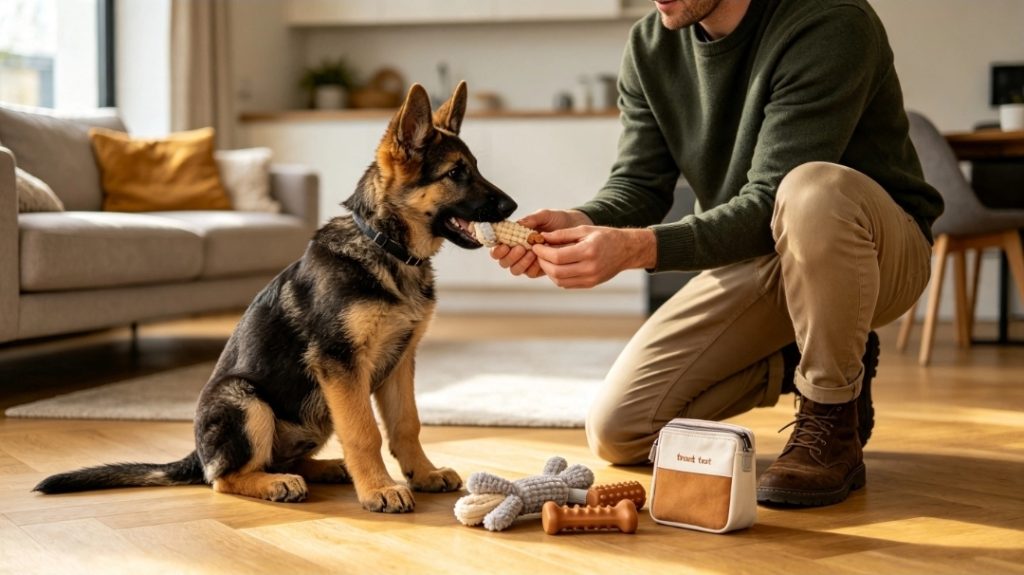
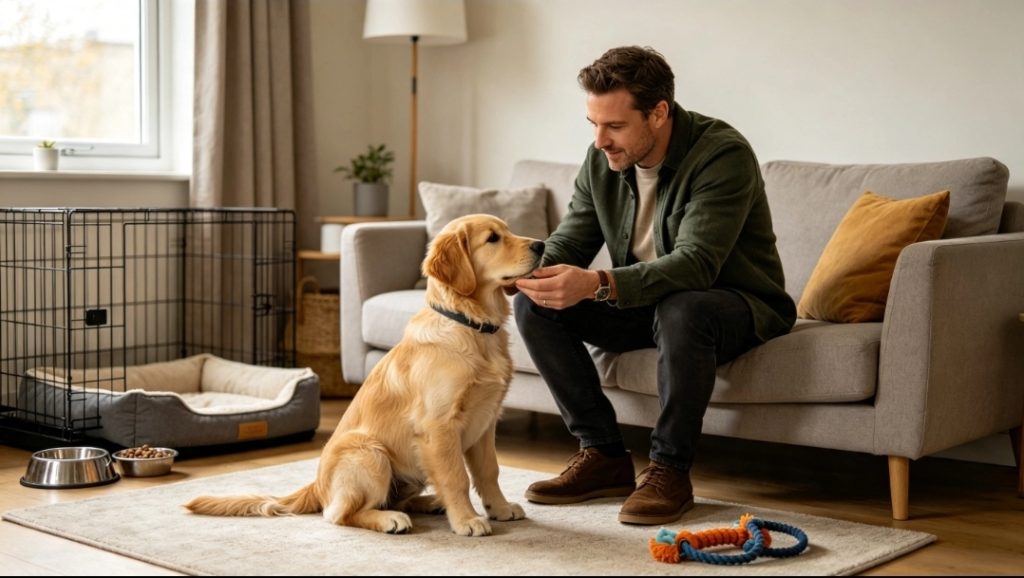
Bringing a new puppy home is an exciting experience, but it also comes with the responsibility of teaching your puppy how to settle, relax and feel comfortable when they are alone.
One of the most useful skills you can teach a puppy is to become comfortable in a crate.
When introduced correctly, a crate can become a safe and comfortable place where your puppy can sleep, relax and take a break from the excitement of everyday life.
However, crate training a puppy shouldn’t be about forcing a puppy into a crate and shutting the door.
The objective is to gradually teach your puppy that the crate is a positive, safe and predictable place.
In this guide, we’ll explain how to crate train a puppy, how to introduce the crate, how to progress with closing the door, what to do if your puppy cries and some of the most common crate-training mistakes to avoid.
What Is Crate Training?
Crate training involves teaching your puppy to feel comfortable spending appropriate periods of time inside a crate.
The crate should become a familiar part of your puppy’s environment.
It can provide your puppy with a place to rest while also helping you manage situations where you cannot safely supervise them.
A crate can be particularly useful for:
- Sleeping
- Rest periods
- Safe management
- Travelling
- Short periods when supervision isn’t possible
- Establishing a routine
- Helping a puppy settle
However, a crate shouldn’t be used as punishment.
Your puppy should learn that the crate is a safe place rather than somewhere they are sent because they’ve done something wrong.
Choosing the Right Crate for Your Puppy
Before learning how to crate train a puppy, you need an appropriate crate.
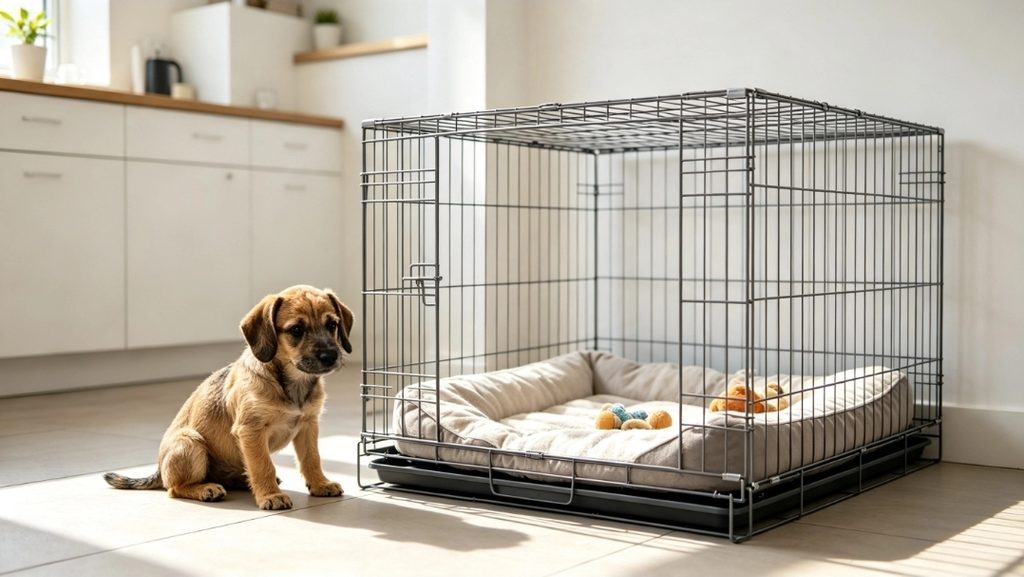
The crate should be large enough for your puppy to stand up, turn around, lie down and move comfortably.
At the same time, it shouldn’t be excessively large.
If you have a puppy that will grow significantly, a crate with an appropriate divider can allow the usable space to increase as the puppy grows.
Consider the puppy’s expected adult size when selecting a crate.
The crate should also be positioned somewhere suitable.
Choose an area where your puppy can be part of the household without being constantly disturbed.
Make the Crate Comfortable
Your puppy should want to spend time in the crate.
Add comfortable bedding that is appropriate for your puppy.
You can also provide a suitable puppy-safe toy or chew where appropriate.
Avoid filling the crate with unnecessary objects.
The space should remain comfortable and easy to clean.
The location is important too.
Some puppies settle better when the crate is positioned near their owner or family.
Others may need a quieter area when they are trying to sleep.
You can adjust the location according to your puppy’s behaviour and routine.
Introduce Your Puppy to the Crate Slowly
Don’t rush the process.
Leave the crate door open and allow your puppy to investigate it.
Your puppy may immediately walk inside.
They may sniff it and walk away.
They may take several attempts before becoming interested.
That’s fine.
Let your puppy investigate at their own pace.
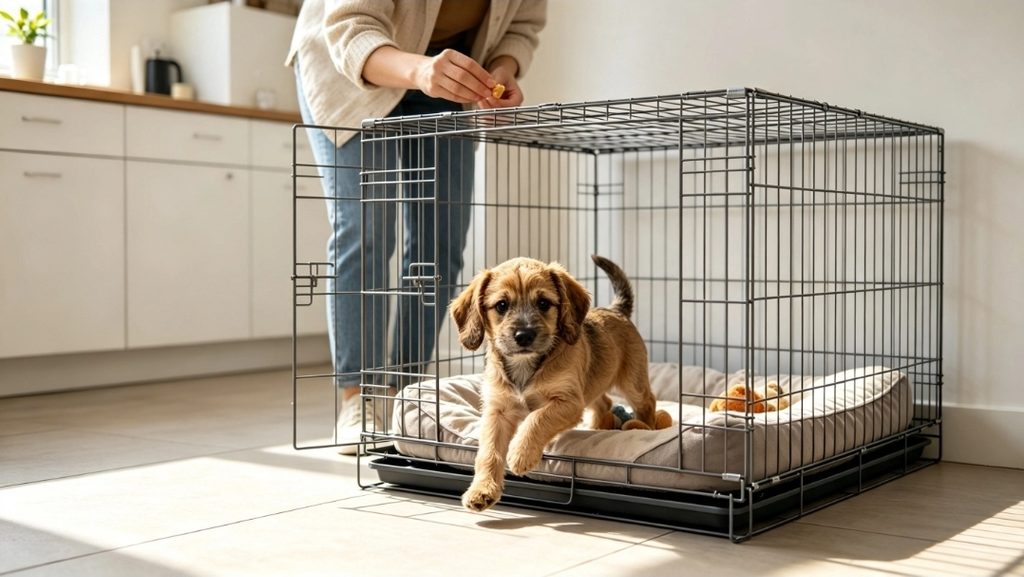
You can place appropriate rewards near the entrance and gradually encourage your puppy to explore further inside.
The objective is to create positive experiences.
Never Force Your Puppy Into the Crate
Forcing a puppy into a crate can create a negative association.
Instead, encourage voluntary entry.
Reward your puppy for approaching the crate.
Reward them for putting their head inside.
Reward them for stepping inside.
Eventually, reward them for relaxing inside.
The process should be gradual.
Your puppy should learn:
Going into the crate produces good things.
Feed Your Puppy Near the Crate
Food can help create positive associations.
Initially, you can feed your puppy near the crate.
As your puppy becomes comfortable, you can gradually move the food closer to the entrance.
Eventually, you can place the food inside the crate.
Allow your puppy to eat comfortably.
There is no need to rush towards closing the door.
Your puppy’s confidence is more important than progressing quickly.
Teach Your Puppy to Stay in the Crate With the Door Open
Once your puppy is voluntarily entering the crate, begin rewarding them for remaining inside.
Don’t immediately close the door.
Let your puppy walk in.
Reward.
Allow them to come out.
Repeat.
Then gradually encourage longer periods inside.
Your puppy should learn that entering the crate doesn’t mean they’re trapped.
This is an important part of successful crate training a puppy.
Begin Closing the Crate Door
Once your puppy is comfortable inside, you can begin introducing the closed door.
Close it for a very short period.
Reward your puppy while they remain calm.
Then open the door.
Repeat.
Gradually increase the amount of time the door remains closed.
Don’t make every repetition significantly longer than the previous one.
If your puppy becomes distressed, you’ve probably progressed too quickly.
Make the next session easier.
Don’t Only Use the Crate When You Leave
If the crate only appears when you’re going out, your puppy may quickly learn that entering the crate means you’re about to disappear.
Use the crate during normal household life as well.
Your puppy can relax in the crate while you’re nearby.
You can sit in the same room.
You can move around the house.
You can allow your puppy to sleep in the crate while you remain nearby.
This helps make the crate a normal part of everyday life.
Teach Your Puppy to Settle
Crate training isn’t simply about getting your puppy to stay behind a closed door.
It’s about teaching your puppy to relax.
After play, training or activity, your puppy may need time to settle.
Encourage calm behaviour.
Provide an appropriate place to rest.
If your puppy voluntarily settles inside the crate, allow them to enjoy that calm period.
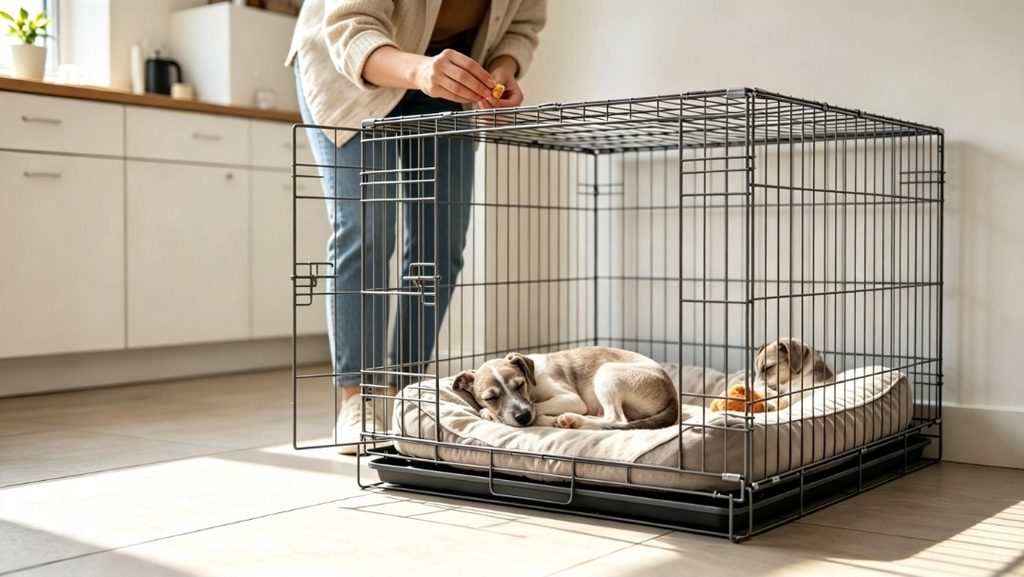
How Long Can a Puppy Stay in a Crate?
There isn’t one universal timeframe that applies to every puppy.
Young puppies have limited bladder control and need frequent opportunities to toilet.
They also need plenty of sleep, movement, interaction and mental stimulation.
A crate should never become a substitute for exercise, training, social interaction or appropriate supervision.
The amount of time your puppy can comfortably spend in the crate depends on factors including age, development, individual needs and whether they are sleeping or awake.
Always consider your individual puppy rather than relying on a rigid timetable.
Crate Training at Night
Many owners use a crate as part of their puppy’s night-time routine.
Initially, your puppy may feel unsettled because they have just left their mother and littermates and are experiencing a completely new environment.
Keeping the crate near your sleeping area initially can help you monitor your puppy and recognise when they need to toilet.
If your puppy wakes and needs to go outside, take them out calmly.
Keep the interaction quiet and boring.
Once they have toileted, return them to their sleeping area.
Over time, your puppy should gradually become more comfortable sleeping through the night.
What If Your Puppy Cries in the Crate?
Crying can have different causes.
Your puppy might:
- Need to toilet
- Be uncomfortable
- Be overtired
- Be frightened
- Want attention
- Not yet understand the crate
- Have been left for too long
Don’t automatically assume that every cry should simply be ignored.
First consider why your puppy is vocalising.
If they are young and may need to toilet, take that into account.
If they are showing genuine distress, reassess the training process.
You may have progressed too quickly.
Go back to shorter, easier sessions and rebuild their confidence.
Don’t Use the Crate as Punishment
This is one of the most important rules of how to crate train a puppy.
Never turn the crate into a place where your puppy is sent because they have been naughty.
If your puppy associates the crate with punishment, you can undermine the positive association you’re trying to create.
Instead, make the crate predictable and positive.
Calm entry.
Calm settling.
Rest.
Sleep.
Appropriate rewards.
The crate should become a safe place rather than a prison.
Crate Training During the Day
Daytime training gives you many opportunities to practise.
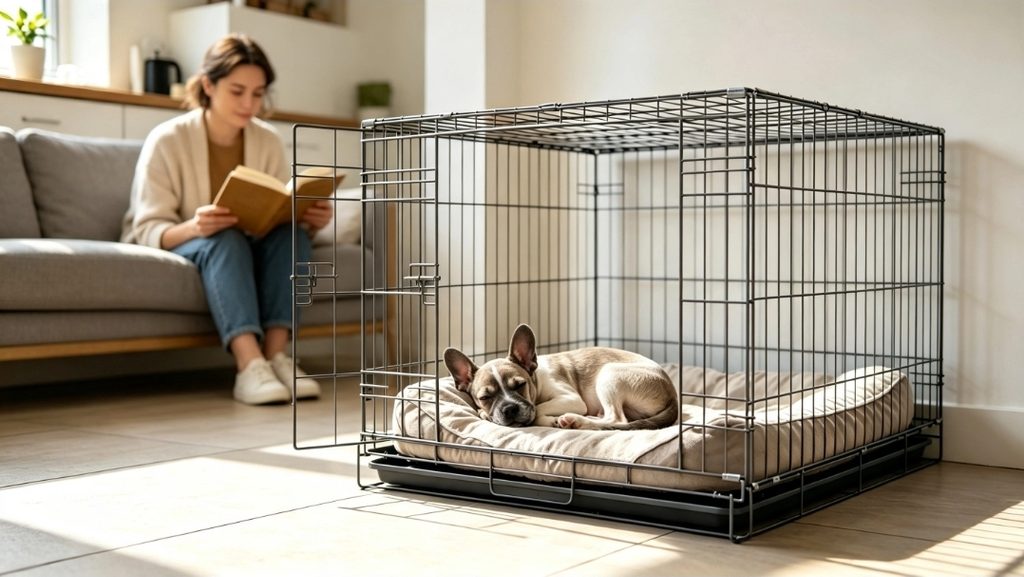
Your puppy can spend short periods relaxing in the crate while you remain nearby.
You can gradually move around the room.
Then move briefly out of sight.
Return before your puppy becomes distressed.
Over time, gradually increase the distance and duration.
This teaches your puppy that you can leave and return without the crate becoming a frightening experience.
Give Your Puppy Appropriate Things to Do
If your puppy is awake in the crate, an appropriate puppy-safe toy or chew can help provide something constructive to do.
Always consider the individual puppy and supervise appropriately when introducing new items.
Remove anything that becomes damaged or unsafe.
The crate should remain a calm environment rather than becoming a place where your puppy becomes frustrated or bored.
Don’t Rush Crate Training
One of the biggest mistakes owners make is progressing too quickly.
The puppy enters the crate once.
The owner closes the door.
Then they leave the house for an hour.
That’s a huge jump.
Instead, build gradually.
Enter → reward → exit.
Enter → reward → short door closure → release.
Enter → short calm period → release.
Enter → longer calm period → release.
Enter → owner moves away briefly → return.
The exact progression depends on the puppy.
Crate Training and Separation
A crate can help with management, but it isn’t a cure for separation anxiety.
If a puppy becomes extremely distressed whenever separated from its owner, simply putting them into a crate for longer periods isn’t an appropriate solution.
The underlying problem needs to be understood.
If your puppy shows severe distress when alone, seek professional behavioural guidance.
The crate should be introduced as a positive place independently of any separation difficulties.
Crate Training and Toilet Training
A crate can be useful as part of a broader puppy-management routine, but it doesn’t replace toilet training.
Young puppies still need frequent opportunities to go outside.
If your puppy is left in a crate longer than they can comfortably hold their bladder, accidents may occur.
Take your puppy outside regularly, particularly after sleeping, eating, drinking and playing.
Reward appropriate toileting.
Combine crate training with a consistent toilet-training routine.
Common Crate-Training Mistakes
Using the Crate as Punishment
This can create a negative association.
Leaving the Puppy for Too Long
Young puppies have physical and emotional needs that must be considered.
Progressing Too Quickly
Closing the door and immediately leaving can overwhelm a puppy that hasn’t learned to settle.
Only Using the Crate When Leaving
This can create an association between the crate and your departure.
Forcing the Puppy Inside
Voluntary entry and positive associations are much better foundations.
Ignoring Signs of Distress
Always consider why your puppy is crying or becoming unsettled.
Expecting the Crate to Solve Every Behaviour Problem
A crate is a management and training tool, not a solution for every behavioural issue.
A Simple Step-by-Step Crate Training Routine
If you’re learning how to crate train a puppy, keep the process straightforward.
Step 1: Choose the Correct Crate
Make sure it is appropriately sized and positioned.
Step 2: Make It Comfortable
Provide suitable bedding and appropriate puppy-safe items.
Step 3: Leave the Door Open
Allow your puppy to investigate voluntarily.
Step 4: Reward Entry
Reward your puppy whenever they willingly enter.
Step 5: Build Duration
Encourage your puppy to remain inside calmly with the door open.
Step 6: Introduce the Closed Door
Close it for very short periods.
Step 7: Gradually Increase Duration
Only progress when your puppy remains comfortable.
Step 8: Move Around the Room
Teach your puppy that you can move away and return.
Step 9: Practise Brief Absences
Gradually introduce very short periods when you are out of sight.
Step 10: Make the Crate Part of Everyday Life
Use it for appropriate rest and calm periods rather than only when leaving the house.
How GPK9 Can Help With Puppy Training
Crate training is one part of raising a well-trained puppy.
During the early months, your puppy is also learning how to communicate with you, focus, settle, respond to training and behave appropriately in different situations.
Establishing those foundations early can make everyday life much easier as your puppy grows.
GPK9 Fundamentals 1 – 6 Weeks to 6 Months
For puppies between 6 weeks and 6 months, GPK9 Fundamentals 1 – 6 Weeks to 6 Months is the most relevant GPK9 course for this stage of development.
The course provides structured training foundations during the early stages of your puppy’s development.
This complements crate training because a puppy isn’t simply learning to stay in a crate. They are learning broader skills such as communication, engagement, obedience, focus and appropriate behaviour.
You can find the course here:
GPK9 Fundamentals 1 – 6 Weeks to 6 Months
When Should You Get Professional Help?
Most puppies need time to become comfortable with crate training.
However, professional help may be appropriate if your puppy:
- Shows extreme distress in the crate.
- Attempts to injure themselves trying to escape.
- Becomes increasingly fearful.
- Cannot settle despite gradual training.
- Shows severe distress whenever separated from you.
- Develops other concerning behaviours.
A qualified professional can assess your puppy’s individual behaviour and help you establish an appropriate training plan.
Final Thoughts: How to Crate Train a Puppy
Learning how to crate train a puppy isn’t about putting your puppy into a crate and expecting them to accept it immediately.
It’s a gradual process.
Choose an appropriate crate.
Make it comfortable.
Allow your puppy to investigate.
Reward voluntary entry.
Build positive associations.
Introduce the closed door gradually.
Teach your puppy to settle.
Increase duration slowly.
Use the crate as part of everyday life.
Most importantly, never use the crate as punishment.
Your puppy should learn that the crate is somewhere they can relax and feel safe.
Go slowly. Build confidence. Reward calm behaviour. Stay consistent.
With the right approach, a crate can become a valuable part of your puppy’s daily routine and a place where your dog is comfortable resting, sleeping and settling.
For puppies between 6 weeks and 6 montohs, continue building those essential early foundations with GPK9 Fundamentals 1 – 6 Weeks to 6 Months