Bringing a new puppy home is exciting, but there is one part of puppy ownership that can test even the most patient owner: toilet training.
Accidents on the floor are normal during the early stages.
Your puppy is learning.
They don’t automatically understand where they are supposed to go to the toilet, how long they can hold themselves or how to tell you that they need to go outside.
The good news is that how to potty train a puppy becomes much easier when you establish a clear routine and consistently reward the behaviour you want.
This step-by-step guide explains how to potty train a puppy, how to recognise the signs that your puppy needs to go, how to handle accidents and how to establish reliable toilet habits.
When Should You Start Potty Training a Puppy?
You can begin teaching appropriate toilet habits as soon as your puppy comes home.
You don’t need to wait until your puppy is older.
In fact, establishing a routine from the beginning can make the process easier.
However, young puppies have limited bladder control.
They may need to toilet frequently, particularly after:
- Waking up
- Eating
- Drinking
- Playing
- Training
- Excitement
- Sleeping
- Physical activity
Expecting a very young puppy to hold their bladder for long periods can result in unnecessary accidents.
The objective isn’t to expect perfection.
It is to create as many opportunities as possible for your puppy to get it right.
How to Potty Train a Puppy: Establish a Routine
The foundation of how to potty train a puppy is consistency.
Take your puppy to the appropriate toilet area regularly rather than simply waiting for an accident to happen.
A predictable routine helps your puppy understand what happens after waking, eating, playing and resting.
Take your puppy outside at appropriate intervals.
Use the same general toilet area where possible.
Give your puppy time to investigate and toilet without turning the trip into an exciting play session.
When they finish, immediately reward the correct behaviour.
Over time, your puppy begins to associate going to the appropriate place with a positive outcome.
Take Your Puppy Outside After Waking
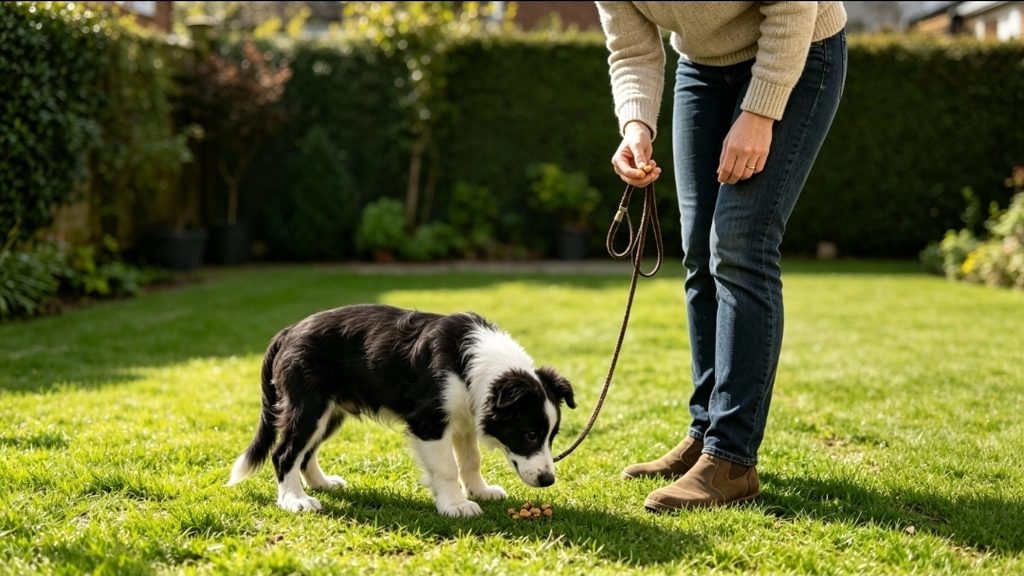
One of the most important moments in how to potty train a puppy is immediately after your puppy wakes up.
Puppies often need to toilet soon after sleeping.
Rather than allowing your puppy to wander around the house first, calmly take them to their designated toilet area.
Give them the opportunity to go.
When they finish, reward them.
This creates a predictable pattern:
Wake up → go outside → toilet → reward.
Repeat this consistently.
Take Your Puppy Outside After Eating and Drinking
Food and water can stimulate your puppy’s need to toilet.
After meals, allow your puppy an appropriate opportunity to go outside.
The exact timing will vary from puppy to puppy.
Pay attention to your individual puppy and learn their routine.
The more familiar you become with your puppy’s patterns, the easier it becomes to anticipate when they need to go.
Take Your Puppy Outside After Play
Excitement and physical activity can increase the likelihood that your puppy needs to toilet.
After an energetic play session, take your puppy outside.
This is particularly useful when your puppy is young and still developing bladder control.
Don’t wait until they are already showing obvious signs of needing to go.
Give them the opportunity beforehand.
Learn Your Puppy’s Toilet Signals
Every puppy is different.
Some puppies may:
- Sniff the floor
- Circle
- Wander away
- Become restless
- Whine
- Scratch at a door
- Walk towards the area where they previously toileted
- Suddenly stop playing
- Search for a quiet corner
Learn your puppy’s individual signals.
Once you recognise them, take your puppy outside immediately.
Use the Same Toilet Area
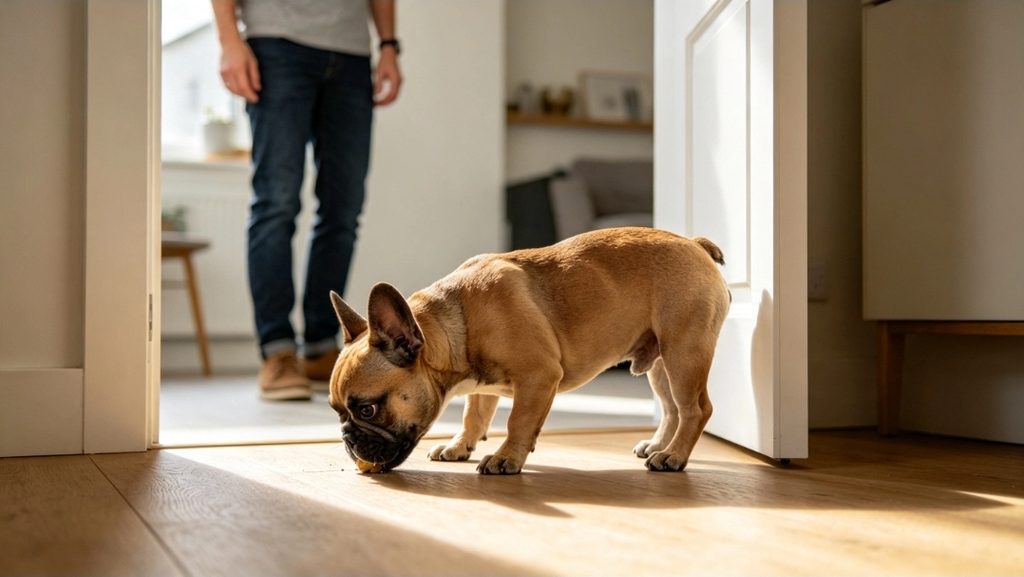
Using the same general toilet area can help establish a routine.
Your puppy can become familiar with the location and associated smells.
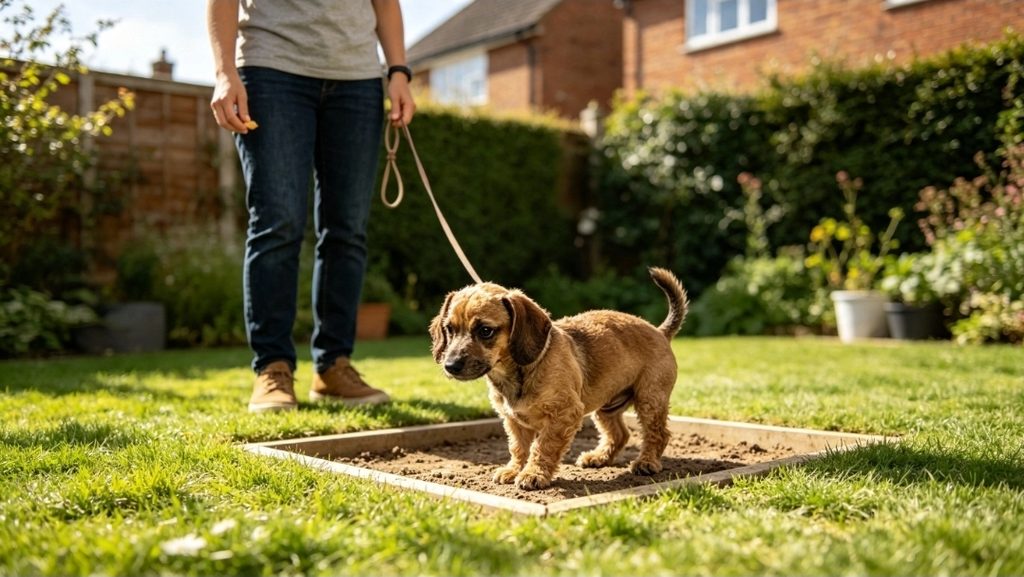
Take them to the area and give them time to toilet.
Try not to distract them with play immediately.
Once they have finished, reward them.
The toilet area should be safe, clean and appropriate for your puppy.
Reward Your Puppy Immediately
Timing matters.
When your puppy toilets in the correct place, reward them promptly.
You can use:
- Calm praise
- Food rewards
- Positive attention
- A combination of appropriate rewards
The puppy needs to understand what behaviour earned the reward.
If you wait several minutes before rewarding them, the connection may not be as clear.
Make the reward part of the routine.
Toilet in the correct place → immediate reward.
Don’t Punish Accidents
Accidents will happen.
Your puppy is learning and their bladder control is still developing.
Punishing your puppy after an accident doesn’t teach them where they should go.
Shouting, hitting or intimidating your puppy can create fear without teaching the desired behaviour.
Instead, clean the area thoroughly and focus on preventing the next accident.
Ask yourself:
Why did the accident happen?
Perhaps the puppy had been left too long.
Perhaps they had just woken up.
Perhaps they had been playing.
Perhaps you missed their signal.
Use the accident as information.
What Should You Do If You Catch Your Puppy Having an Accident?
If you see your puppy beginning to toilet somewhere inappropriate, calmly interrupt them without frightening them.
Take them outside to the appropriate area.
If they finish outside, reward them.
Avoid turning the situation into a frightening confrontation.
The objective is to teach your puppy where they should go rather than simply teaching them that toileting in front of you is dangerous.
Clean Accidents Thoroughly
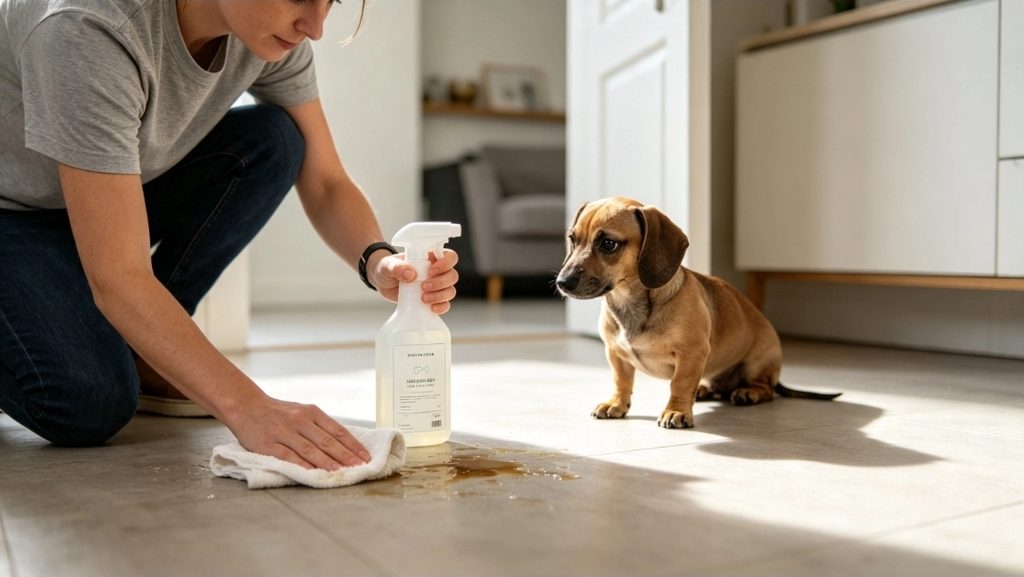
If your puppy has an accident indoors, clean the area thoroughly.
Dogs have a strong sense of smell.
If traces of the previous accident remain, the area may continue to attract your puppy.
Use an appropriate pet-safe cleaning product designed to deal with urine and other biological messes.
Avoid simply masking the smell.
The objective is to remove the odour as thoroughly as possible.
Supervision Is One of the Most Important Parts of Potty Training
If your puppy has free access to the entire house, it can be much harder to prevent accidents.
During the early stages, supervise your puppy carefully.
Keep them close enough that you can recognise the signs that they need to toilet.
You can gradually give your puppy more freedom as their reliability improves.
Think of it as increasing freedom based on demonstrated behaviour.
More reliable behaviour = more freedom.
Use a Puppy Crate Appropriately
A crate can be useful as part of a wider puppy-management routine when introduced correctly.
It should be a safe, comfortable place where your puppy can relax.
It should never be used as punishment.
Young puppies should not be expected to remain confined for excessive periods, particularly when they need to toilet.
A crate doesn’t replace toilet training.
It helps with management while your puppy learns.
How Often Does a Puppy Need to Go Outside?
There isn’t one exact schedule that works for every puppy.
Age, size, individual development, food, water intake, activity and routine can all affect how frequently a puppy needs to toilet.
Very young puppies generally need much more frequent opportunities than older puppies.
Instead of relying solely on a clock, combine a routine with observation.
Take your puppy outside after key events and whenever you notice their individual toilet signals.
Potty Training During the Night
Night-time toilet training can take longer than daytime training.
Young puppies may not be able to hold their bladder throughout the entire night.
Keep the night-time routine calm.
If your puppy wakes and needs to toilet, take them to the appropriate area without turning it into playtime.
Once they’ve finished, return them to their sleeping area.
Over time, as bladder control develops, many puppies become capable of sleeping for longer periods without needing to go outside.
Should You Use Puppy Pads?
Puppy pads can be useful in some circumstances, particularly where getting a very young puppy outside immediately isn’t practical.
However, they can also create an additional step if your long-term objective is for your puppy to toilet exclusively outdoors.
If you use pads, establish a clear and consistent system.
If your ultimate goal is outdoor toilet training, gradually transition towards using the appropriate outdoor area when your puppy is developmentally ready and it is safe to do so.
Potty Training in Bad Weather
Rain doesn’t change the need for your puppy to learn appropriate toilet habits.
Some puppies may initially dislike rain.
Make the experience calm and positive.
Take your puppy to the toilet area.
Give them time.
Reward them when they finish.
Don’t turn bad weather into a reason to abandon the routine.
Consistency matters in all weather conditions.
Potty Training When You Live in a Flat
Living in a flat can make how to potty train a puppy more challenging because you may need to travel further to reach an outdoor toilet area.
This makes planning particularly important.
Watch your puppy carefully.
Learn their signals.
Prepare before they become desperate.
Keep your route outside clear and predictable.
If your puppy is very young, accidents may happen because of the time required to reach the appropriate location.
This isn’t necessarily a training failure.
It’s part of managing a young puppy with limited bladder control.
Potty Training When You Have Other Dogs
Having another dog in the household can sometimes help a puppy understand household routines.
However, don’t rely on your older dog to toilet train your puppy.
Take your puppy outside yourself.
Supervise them.
Reward the puppy directly when they toilet appropriately.
Every dog has individual habits and needs.
How Long Does It Take to Potty Train a Puppy?
There is no universal timeframe.
Some puppies become reliable relatively quickly.
Others take considerably longer.
The speed of toilet training can depend on:
- Age
- Bladder control
- Routine
- Supervision
- Consistency
- Environment
- Previous experience
- Individual development
Don’t become frustrated if your puppy isn’t progressing as quickly as someone else’s puppy.
Focus on your puppy’s progress.
Fewer accidents.
More successful trips outside.
Better recognition of toilet signals.
Longer periods of reliability.
These are all signs of improvement.
Common Potty Training Mistakes
Giving Your Puppy Too Much Freedom Too Soon
If your puppy hasn’t demonstrated reliable toilet habits, giving them unrestricted access to the entire house can create more opportunities for accidents.
Missing the Warning Signs
Your puppy may be telling you they need to go without you realising it.
Waiting for an Accident
Prevention is easier than repeatedly reacting to accidents.
Punishing the Puppy
Punishment doesn’t teach your puppy the correct toilet location.
Inconsistent Routines
If toilet opportunities are completely unpredictable, it can make learning more difficult.
Forgetting to Reward Success
Don’t focus only on accidents.
Celebrate the behaviour you want.
Expecting a Young Puppy to Hold It Too Long
Young puppies have limited bladder control.
Their physical development needs to be taken into account.
A Simple Step-by-Step Potty Training Routine
If you’re learning how to potty train a puppy, use a straightforward routine.
Step 1: Establish a Toilet Area
Choose an appropriate and safe place for your puppy to toilet.
Step 2: Supervise Closely
Keep your puppy within sight during the early stages.
Step 3: Take Your Puppy Outside Regularly
Especially after sleeping, eating, drinking, playing and training.
Step 4: Watch for Toilet Signals
Learn your puppy’s individual behaviour.
Step 5: Give Them Time
Allow your puppy to sniff and find the appropriate place.
Step 6: Reward Immediately
As soon as your puppy finishes, reward the correct behaviour.
Step 7: Clean Accidents Thoroughly
Remove lingering odours from indoor accidents.
Step 8: Gradually Increase Freedom
Give your puppy more access to the home as reliability improves.
Step 9: Stay Consistent
Keep the same basic system every day.
How GPK9 Can Help With Puppy Training
Potty training is only one part of raising a well-adjusted, obedient puppy.
During the early months, puppies are also learning how to communicate with their owners, respond to training, settle, focus and behave appropriately in different environments.
Establishing these foundations early can make everyday life easier as your puppy grows.
GPK9 Fundamentals 1 – 6 Weeks to 6 Months
For puppies between 6 weeks and 6 months, GPK9 Fundamentals 1 – 6 Weeks to 6 Months is the most relevant GPK9 course for this stage.
The course provides structured training foundations for owners during the early development period.
This complements potty training because successful puppy development isn’t just about teaching where to toilet. It is also about establishing communication, engagement, obedience and appropriate everyday behaviour.
You can find the course here:
GPK9 Fundamentals 1 – 6 Weeks to 6 Months
When Should You Speak to Your Vet?
Most puppy accidents are simply part of the toilet-training process.
However, if your puppy suddenly starts having frequent accidents after previously being reliable, or you notice unusual urination, difficulty urinating, excessive thirst, diarrhoea or other changes in behaviour, speak to your veterinary professional.
Toilet problems aren’t always behavioural.
Sometimes there can be an underlying medical reason.
Final Thoughts: How to Potty Train a Puppy
Learning how to potty train a puppy requires patience, supervision and consistency.
Your puppy isn’t deliberately having accidents to annoy you.
They’re learning a completely new routine while their bladder and bowel control are still developing.
Give them frequent opportunities to succeed.
Take them outside after waking, eating, drinking and playing.
Learn their individual signals.
Reward successful toileting immediately.
Clean accidents thoroughly.
Avoid punishment.
Gradually give your puppy more freedom as their reliability improves.
Most importantly, remember that toilet training is a process rather than a single lesson.
Prevent accidents. Reward success. Build a routine. Stay consistent.
With time, patience and appropriate training, your puppy can learn exactly where you expect them to go.
For additional structured puppy training during the early development stage, explore GPK9