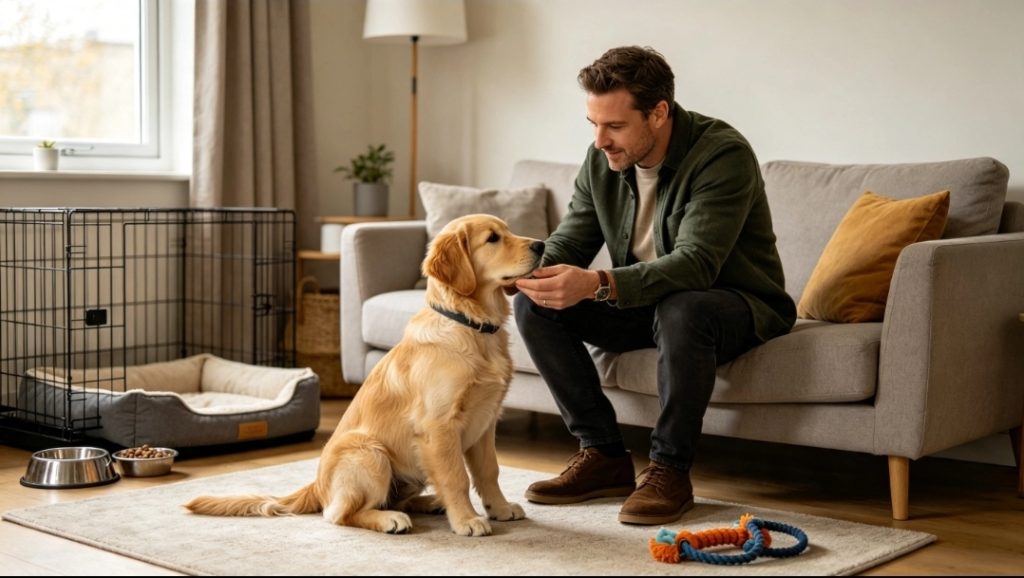
If you’ve recently brought a puppy home, you may have quickly discovered something that surprises many new owners.
Puppies bite.
They bite your hands.
They bite your feet.
They grab your trousers.
They pull at your sleeves.
They attack shoelaces.
They sometimes seem determined to put absolutely everything in their mouth.
For a new puppy owner, this can become frustrating very quickly.
So, how do you stop a puppy biting your hands, feet and clothes?
The answer isn’t simply telling your puppy “no” repeatedly.
Puppies need to learn what they are allowed to bite, what they should leave alone and how to control their behaviour around people.
The earlier you establish appropriate habits, the easier it can become to manage puppy biting as your dog develops.
Why Do Puppies Bite?
Understanding how to stop a puppy biting your hands, feet and clothes starts with understanding why puppies bite in the first place.
Biting and mouthing are normal puppy behaviours.
Puppies use their mouths to explore their environment.
They investigate objects.
They play.
They interact with other dogs.
They learn about their surroundings.
Teething can also increase a puppy’s desire to chew and mouth objects.
Excitement, frustration, tiredness and overstimulation can also contribute to increased biting.
This means puppy biting isn’t necessarily a sign that your puppy is aggressive.
However, that doesn’t mean you should simply allow the behaviour to continue.
Your puppy needs guidance.
Puppy Biting Hands
Hands can be particularly exciting to puppies.
They move.
They make interesting sounds.
They interact with toys.
They deliver food.
They stroke the puppy.
From your puppy’s perspective, hands can be extremely interesting.
If your puppy bites your hand during play, avoid turning your hands into another toy.
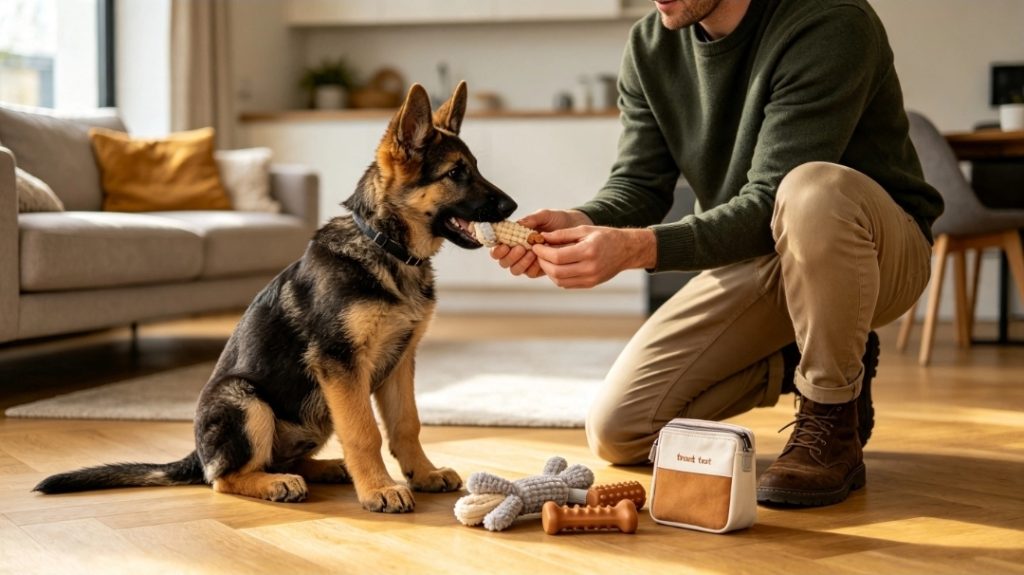
Instead, redirect the puppy towards an appropriate toy.
The objective is to teach:
Human hands are for interaction. Toys are for biting and chewing.
Consistency is important.
If you allow your puppy to bite your hands during play sometimes but become frustrated about it at other times, your puppy receives mixed information.
Puppy Biting Feet
Feet can trigger a puppy’s natural desire to chase.
You walk across the room.
Your puppy follows.
You speed up.
The puppy grabs your trouser leg or ankle.
You move again.
The puppy thinks the game is fantastic.
Your movement can accidentally reinforce the behaviour.
If your puppy repeatedly attacks your feet, stop turning the behaviour into a game.
Remain calm.
Redirect the puppy towards an appropriate toy or another suitable activity.
Reward calm behaviour.
Puppy Biting Clothes
Puppies often grab clothing because it moves.
Trousers, dressing gowns, sleeves and socks can all become exciting targets.
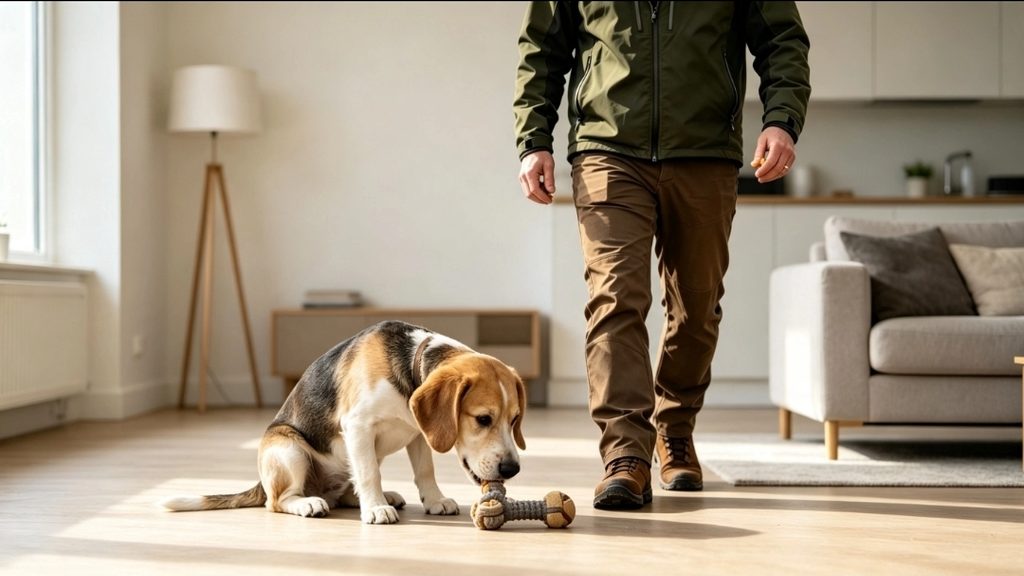
If your puppy grabs your clothes, avoid turning it into a tug-of-war.
Pulling the clothing away can encourage the puppy to pull harder.
Instead, calmly redirect the puppy towards an appropriate toy.
Once the puppy releases the clothing and engages with the toy, reward the appropriate choice.
Your puppy gradually learns that toys are more rewarding targets than clothing.
Don’t Chase Your Puppy
One of the easiest mistakes to make is chasing your puppy when they grab something they shouldn’t have.
Your puppy grabs your sock.
You chase them.
The puppy runs away.
You follow.
Suddenly, you’ve created a brilliant game.
Your puppy may not even understand that you’re trying to retrieve the sock.
They simply know that running away while carrying something gets a reaction.
Instead, remain calm and encourage your puppy to exchange the inappropriate item for something appropriate.
Teach Your Puppy What They Can Bite
Telling a puppy what not to bite is only part of the solution.
You also need to teach them what they can bite.
Have appropriate puppy toys readily available.
When your puppy becomes mouthy, redirect them towards the toy.
When they engage with it, reward them.
This gives the puppy a clear alternative.
Instead of:
“Don’t bite that.”
You’re teaching:
“Bite this instead.”
That distinction can make training much clearer for a young puppy.
Use Toys to Redirect Puppy Biting
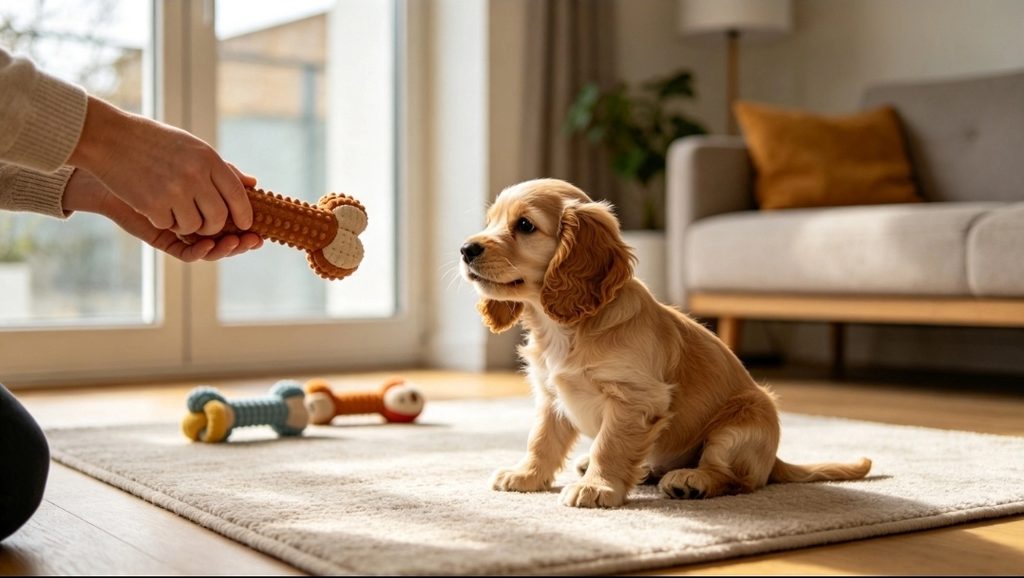
Keep suitable toys available throughout the day.
Different puppies enjoy different types of toys.
Some prefer soft toys.
Others prefer rubber toys.
Some enjoy interactive toys.
Others enjoy appropriate chew items.
The important thing is to use suitable products designed for puppies and supervise your puppy appropriately.
If a toy becomes damaged, remove it and replace it.
Don’t Encourage Rough Hand Play
Rough play involving hands can make puppy biting more difficult to manage.
If you wrestle with your puppy using your hands, allow them to grab your fingers or encourage them to chase your hands, your puppy may learn that human skin is part of the game.
Instead, use appropriate toys for interactive play.
This allows your puppy to enjoy energetic play while keeping a clear distinction between toys and people.
Teach Your Puppy Bite Inhibition
Puppies need to learn how to control the pressure of their mouths.
Puppies naturally learn some bite control through interactions with their mother and littermates.
Once your puppy comes home, you can continue teaching appropriate mouth behaviour through careful handling, play and training.
The objective isn’t simply to stop every instance of mouthing instantly.
Your puppy is still learning.
The goal is to gradually develop better control and appropriate behaviour around people.
A Puppy That Bites May Simply Be Tired
This is something many new puppy owners overlook.
Puppies need a lot of sleep.
An overtired puppy can become extremely excitable.
They may run around the house.
They may grab clothing.
They may bite hands.
They may appear unable to settle.
The owner may assume the puppy needs more exercise.
Sometimes the opposite is true.
Your puppy may need help settling down and getting appropriate rest.

Recognise When Your Puppy Is Overstimulated
Puppies can become overwhelmed by too much activity.
Visitors arrive.
Children are playing.
The television is on.
The puppy has been playing.
Someone is trying to train them.
Then suddenly the puppy starts biting everything.
This can be a sign that the puppy needs a break.
Move them into a calm environment.
Provide an appropriate chew or toy.
Encourage them to settle.
Learning how to manage your puppy’s environment is an important part of preventing excessive biting.
Don’t Punish Your Puppy for Being a Puppy
Frustration is understandable.
Constant puppy biting can be exhausting.
But your puppy doesn’t automatically understand why you’re angry.
Shouting, hitting, intimidating or physically punishing your puppy can create fear and damage the relationship you’re trying to build.
Instead, focus on teaching the behaviour you want.
Redirect.
Reward.
Manage the environment.
Provide appropriate outlets.
Repeat consistently.
Your puppy is learning.
Teach Your Puppy to Settle
A puppy shouldn’t be expected to entertain themselves constantly.
Teaching your puppy to relax is an important life skill.
After play or training, encourage calm behaviour.
Give your puppy an appropriate place to rest.
Reward calmness.
Over time, your puppy can learn that not every moment needs to involve excitement.
This can also help reduce situations where your puppy becomes overstimulated and starts biting.
Puppy Biting During Play
Play is one of the most common situations where puppies bite.
Your puppy becomes excited.
They grab the toy.
They grab your hand.
They jump.
They chase.
Instead of stopping all play, teach your puppy how to play appropriately.
Use toys that create distance between your hands and the puppy’s mouth.
Keep play controlled.
If the puppy becomes excessively excited, pause.
When they calm down, you can resume.
Your puppy begins learning that calm behaviour keeps the interaction going.
What If Your Puppy Bites Hard?
If your puppy bites hard enough to cause injury, take the behaviour seriously.
Don’t turn the situation into a confrontation.
End the interaction calmly and assess what caused the behaviour.
Was the puppy overtired?
Overexcited?
Frustrated?
Was the play too intense?
Were they guarding something?
Understanding the context is important.
If biting is severe, persistent or accompanied by concerning body language such as stiffening, growling, guarding or attempts to cause injury, seek professional advice.
Consistency Is Essential
Everyone in the household needs to follow the same rules.
If one person allows the puppy to bite hands during play while another person becomes angry when the puppy does it, the puppy receives conflicting information.
Establish simple rules.
Hands aren’t toys.
Clothing isn’t a toy.
Feet aren’t toys.
Appropriate toys are for biting and chewing.
Then consistently reinforce those rules.
A Simple Puppy Biting Routine
If you’re learning how to stop a puppy biting your hands, feet and clothes, keep your response consistent.
Step 1: Stay Calm
Don’t turn the biting into an exciting game.
Step 2: Stop the Interaction
If the puppy is becoming excessively mouthy, calmly pause the interaction.
Step 3: Redirect
Offer an appropriate puppy toy.
Step 4: Reward the Correct Choice
When your puppy engages with the toy, provide appropriate praise or another suitable reward.
Step 5: Encourage Calmness
If your puppy remains highly excited, give them an opportunity to settle.
Step 6: Repeat
Your puppy will need many repetitions before the behaviour becomes reliable.
Common Puppy Biting Mistakes
Playing Roughly With Your Hands
This can teach your puppy that hands are appropriate play objects.
Chasing Your Puppy
This can accidentally turn stealing and running away into a game.
Allowing Biting Sometimes
Mixed rules can make it difficult for a puppy to understand what is expected.
Ignoring the Puppy Being Over-Tired
An exhausted puppy can become much more difficult to manage.
Providing Too Little Appropriate Chewing
Puppies naturally need suitable outlets for chewing and mouthing.
Reacting With Anger
Fear and punishment don’t teach the puppy what you want them to do instead.
Expecting Instant Results
Puppy training is a process.
Your puppy needs repetition, consistency and time.
How GPK9 Can Help With Puppy Training
The foundations you establish during puppyhood can influence how your dog behaves as they mature.
This includes communication, engagement, obedience, focus and appropriate behaviour around people.
For owners who want structured guidance during the early stages, a puppy-specific training programme can provide a useful framework.
GPK9 Fundamentals 1 – 6 Weeks to 6 Months
GPK9 Fundamentals 1 – 6 Weeks to 6 Months is the most relevant GPK9 course for puppies in this age range.
The course is designed to help owners establish training foundations during the important early development period.
Puppy biting is only one part of raising a well-trained dog. Building communication, engagement and obedience alongside appropriate puppy management can help establish better habits as your puppy develops.
GPK9 Fundamentals 1 – 6 Weeks to 6 Months
When Will Puppy Biting Stop?
When Will Puppy Biting Stop?
There isn’t a specific age when every puppy suddenly stops biting.
Puppies develop at different rates.
Teething, excitement, play, frustration, environment, training and individual temperament can all influence mouthing behaviour.
What matters is that the behaviour gradually improves as your puppy learns appropriate alternatives and develops better impulse control.
Don’t measure progress by expecting your puppy to stop biting completely overnight.
Look for smaller improvements.
Perhaps your puppy previously attacked your hands every time you played.
Now they choose a toy most of the time.
That’s progress.
Continue building on it.
When Should You Get Professional Help?
Professional help can be useful if you’re struggling to manage your puppy’s biting or you’re unsure whether the behaviour is normal puppy mouthing or something more concerning.
Seek professional guidance if your puppy:
- Regularly causes injuries.
- Bites aggressively rather than through normal play or exploration.
- Displays stiff or threatening body language.
- Guards food or objects.
- Shows significant fear around people.
- Repeatedly targets people despite consistent training.
- Becomes increasingly difficult to manage.
A qualified professional can assess the puppy’s behaviour in context and help you establish an appropriate training plan.
Final Thoughts: How to Stop a Puppy Biting Your Hands, Feet and Clothes
Learning how to stop a puppy biting your hands, feet and clothes takes patience and consistency.
Remember that biting and mouthing are normal parts of puppy development, but your puppy still needs to learn appropriate boundaries.
Don’t use your hands as toys.
Don’t encourage your puppy to chase clothing.
Don’t turn biting into a game.
Provide appropriate toys.
Redirect unwanted behaviour.
Reward good choices.
Teach your puppy to settle.
Make sure everyone in the household follows the same rules.
Most importantly, remember that your puppy is learning.
You’re not simply trying to stop a behaviour.
You’re teaching your puppy what behaviour you want instead.
Hands aren’t toys. Feet aren’t toys. Clothes aren’t toys. Appropriate toys are for chewing and playing.
With consistent training and appropriate management, your puppy can gradually learn better ways to interact with the people around them.
For puppies between 6 weeks and 6 months, you can continue developing those early training foundations with GPK9 Fundamentals 1 – 6 Weeks to 6 Months.