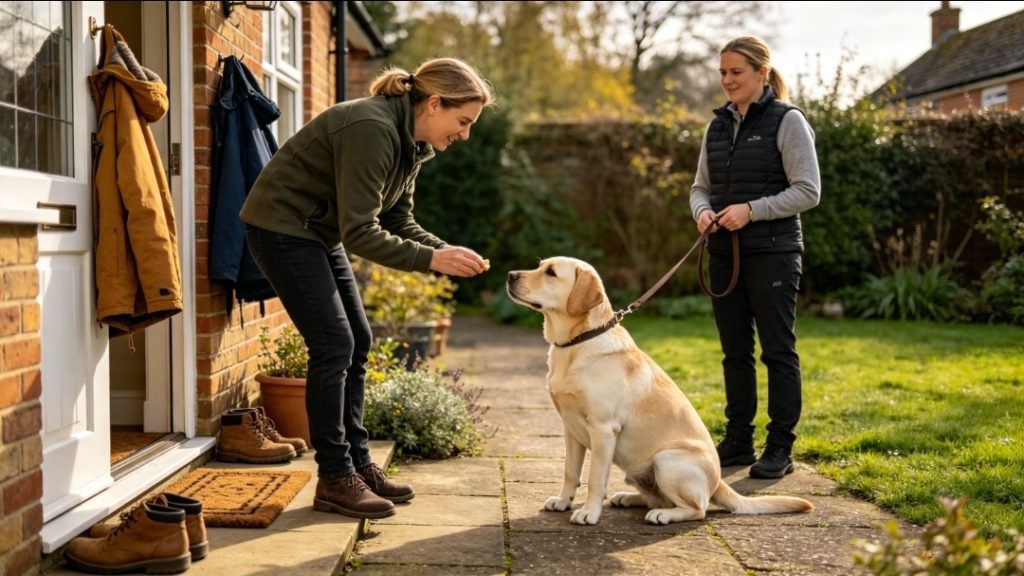
Few things are more frustrating than opening the door to a visitor and having your dog immediately launch themselves at them.
They jump.
They paw.
They may lick people’s faces.
They may become extremely excited.
And sometimes they can knock someone over.
You may find yourself asking:
“How do I stop my dog jumping up at people?”
The good news is that jumping up is a behaviour that can be changed.
But your dog needs to understand what you want them to do instead.
Simply telling your dog “No” doesn’t necessarily teach them an alternative.
The aim is to teach your dog that keeping four paws on the floor, remaining calm and responding to their handler is what gets rewarded.
Why Does My Dog Jump Up at People?
Before learning how to stop your dog jumping up at people, it helps to understand why they do it.
Dogs may jump because they are:
- Excited
- Seeking attention
- Greeting someone
- Trying to reach a person’s face
- Expecting interaction
- Frustrated
- Overstimulated
- Reinforced for jumping in the past
For many dogs, jumping works.
They jump.
Someone touches them.
Someone talks to them.
Someone pushes them away.
Someone laughs.
Even negative attention can still be attention.
From your dog’s perspective, jumping has produced a reaction.
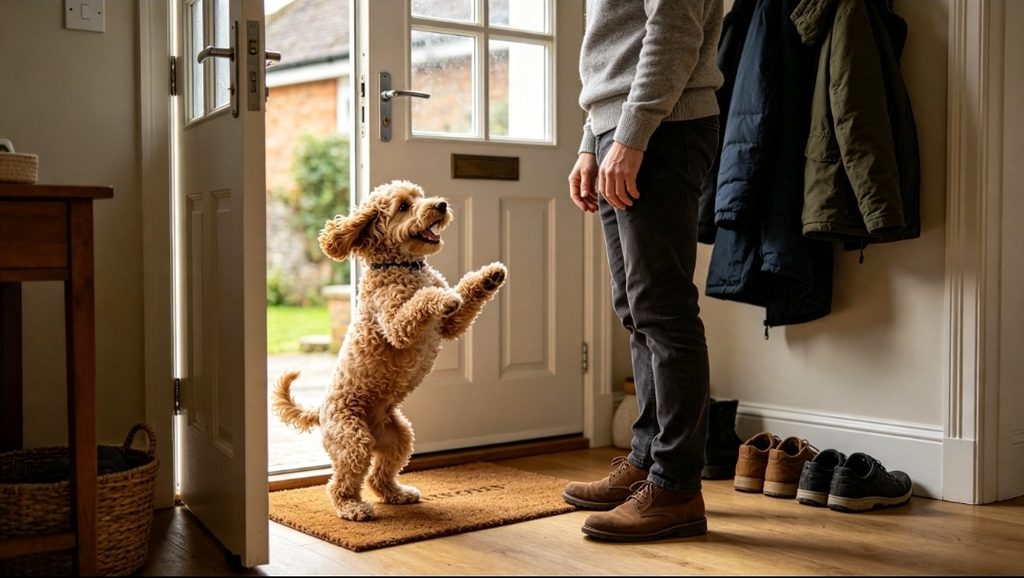
Jumping Up Is Often Rewarded Without Owners Realising
One of the biggest problems with jumping is that people often reinforce it accidentally.
Your dog jumps.
You push them down.
Your dog jumps again.
You tell them to stop.
They jump again.
Eventually you give them a stroke.
Your dog may not understand that the jumping was wrong.
They may simply learn:
“Jumping makes people interact with me.”
If everyone responds differently, training becomes even more difficult.
One person ignores the jumping.
Another pushes the dog away.
Someone else gives them attention.
Someone else allows them to jump because they think it’s cute.
Your dog receives mixed information.
Consistency matters.
Teach Your Dog What to Do Instead
Stopping jumping is only half the training.
Your dog needs an alternative behaviour.
For example:
Four paws on the floor.
Sit.
Stand calmly.
Look at the handler.
Go to a designated place.
You are giving your dog a clear answer to the question:
“What should I do when someone arrives?”
Start Without Visitors
You don’t need to begin by inviting ten people into your house.
Start with basic training when your dog is calm.
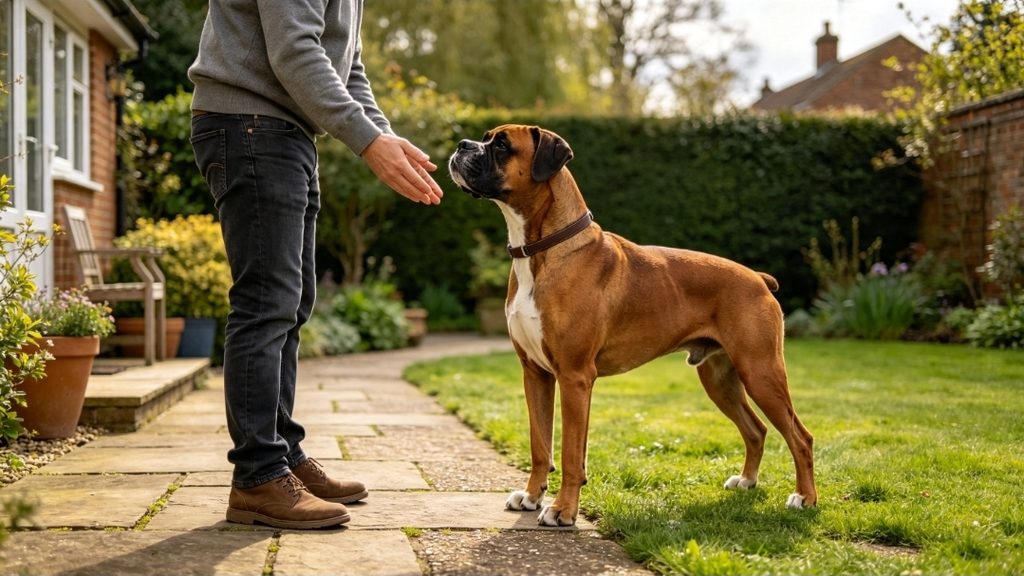
Stand near your dog.
Wait for four paws to remain on the floor.
Reward.
Move around.
Reward calm behaviour.
Ask for a sit.
Reward.
Gradually increase the excitement level.
The objective is to establish the behaviour before introducing difficult distractions.
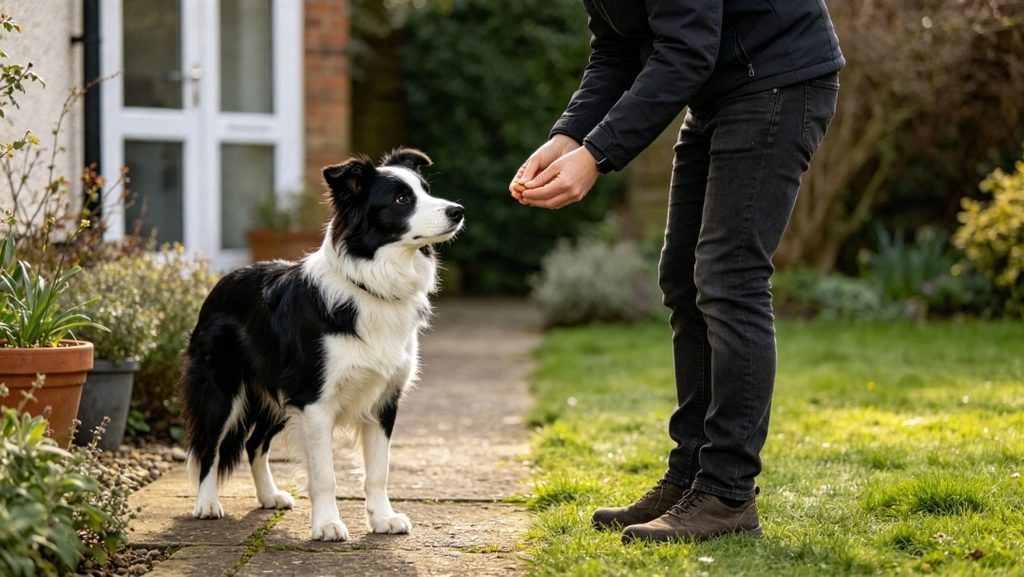
Reward Calm Greetings
Your dog needs to discover that calm behaviour produces attention.
Approach your dog.
If they remain calm, reward them.
If they jump, calmly remove your attention.
When all four paws return to the floor, reward them again.
The timing matters.
Your dog needs to connect the reward with the behaviour you want.
You’re teaching:
Calm behaviour = attention.
Jumping = no access to attention.
Don’t Push Your Dog Down
It can be tempting to push a jumping dog away.
But this can become part of the interaction.
Your dog jumps.
You touch them.
They jump again.
You push them.
They may interpret the physical contact as engagement.
Instead, calmly remove attention where appropriate and reward the moment they return to the correct behaviour.
Teach a Sit for Greetings
A sit can provide your dog with a clear behaviour during greetings.
Practise when there are no distractions.
Ask your dog to sit.
Reward.
Stand up.
Reward if they remain calm.
Move away.
Return.
Reward.
Gradually make the exercise more difficult.
Eventually, you can introduce another person.
The objective isn’t simply to make your dog sit for a few seconds.
You’re teaching them how to control their excitement when someone approaches.
Practise With Different People
Dogs need to generalise behaviour.
Your dog may behave perfectly when greeting you.
Then your friend arrives and the jumping starts again.
That’s because your dog may associate the behaviour with particular people and situations.
Practise with:
- Family members
- Friends
- Neighbours
- People wearing different clothing
- People entering through different doors
- People carrying bags
- People who are excited themselves
Keep the training controlled.
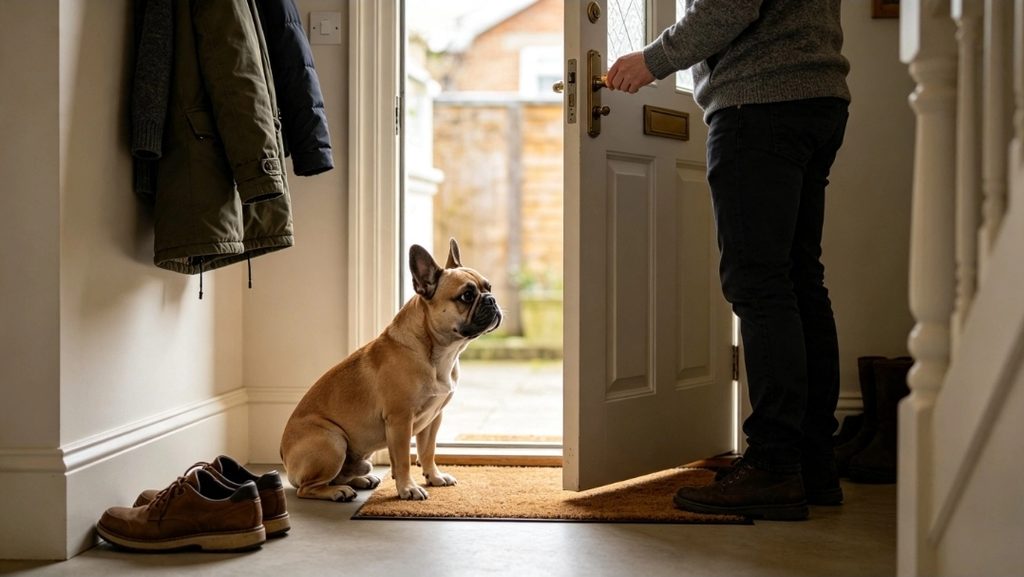
Ask Visitors to Ignore the Dog Initially
If your dog becomes extremely excited when people arrive, ask visitors not to immediately interact with them.
No:
- Excited voices
- Stroking
- Eye contact
- Pushing
- Playing
Wait until your dog becomes calmer.
Then introduce the greeting.
This reduces the excitement surrounding the arrival.
Train Before the Door Opens
Many dogs become excited as soon as they hear the doorbell.
The sound becomes a trigger.
Doorbell.
Dog runs to the door.
Dog jumps.
Visitor enters.
Dog becomes even more excited.
Instead, teach your dog what to do when they hear the doorbell.
You can practise without a real visitor.
Ring the bell.
Wait.
Reward calm behaviour.
Repeat.
Gradually increase the difficulty.
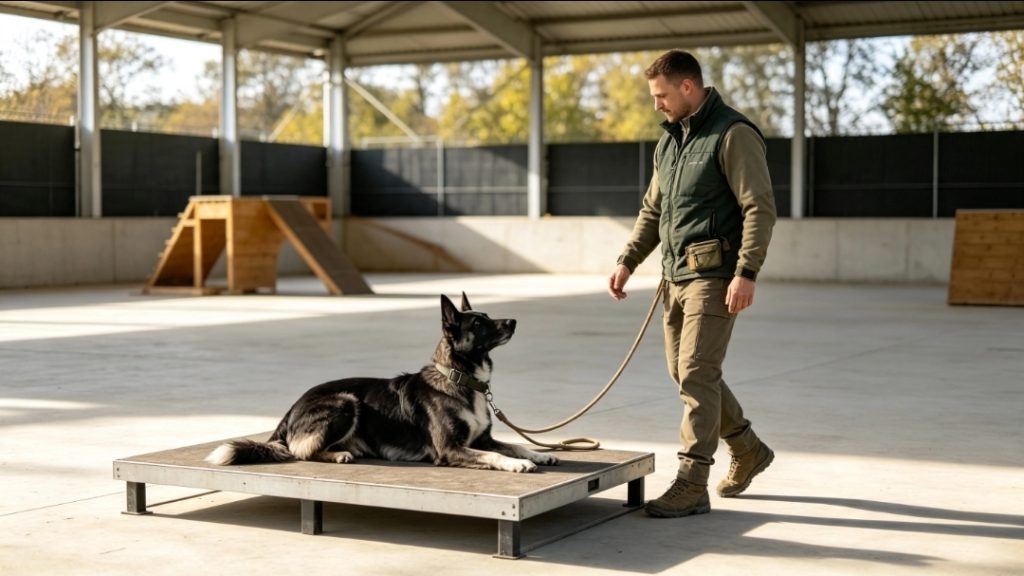
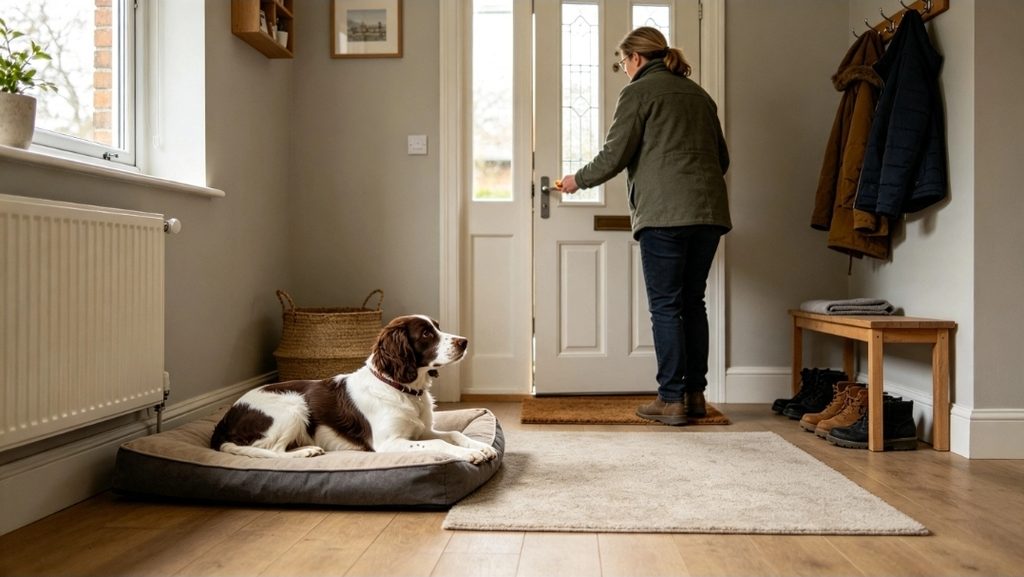
Teach a Place or Station
A designated place can be extremely useful for dogs that become overexcited when visitors arrive.
Your dog learns:
Doorbell → go to place → remain there → reward.
This gives your dog a job.
Instead of racing towards the door and jumping at the visitor, they have a predictable behaviour to perform.
Don’t Only Train When Someone Arrives
If you only practise when visitors arrive, you’re making the exercise unnecessarily difficult.
Build the individual behaviours first.
Teach:
- Sit
- Stay
- Place
- Wait
- Recall
- Focus
- Release
Then combine them.
Dog training works best when you build behaviours progressively.
Children and Jumping Dogs
Jumping can be particularly concerning around children.
A large or enthusiastic dog can easily knock a child over.
Children can also behave unpredictably from the dog’s perspective.
They may run.
They may shout.
They may wave their arms.
They may hug the dog.
This can increase excitement.
Dogs and children should be appropriately supervised, particularly when the dog is still learning calm greeting behaviour.
Teach the dog what behaviour is expected rather than relying on the child to control the situation.
What If My Dog Jumps on People Outside?
The same principles apply.
Your dog sees someone.
They become excited.
They pull towards them.
They jump.
The person gives attention.
The behaviour is reinforced.
Instead, create appropriate distance.
Get your dog’s attention.
Ask for an appropriate behaviour.
Reward calmness.
Don’t allow every person you meet to become a training opportunity without considering whether your dog can actually handle the situation.
Don’t Let Everyone Reward the Jumping
If you’re serious about learning how to stop your dog jumping up at people, everyone needs to understand the rules.
If one person rewards jumping while everyone else discourages it, your dog receives inconsistent information.
Tell visitors:
“Please wait until the dog is calm before giving them attention.”
That simple instruction can make a significant difference.
What If My Dog Jumps Because They’re Excited?
Excitement needs to be managed rather than simply punished.
Lower the intensity.
Increase distance.
Wait for your dog to calm down.
Reward the calmer behaviour.
Then gradually increase the excitement.
If your dog becomes uncontrollable, the exercise is probably too difficult at that moment.
Go back a step.
What If My Dog Jumps on Me?
Don’t assume that because your dog only jumps on you, it isn’t important.
If jumping is allowed with you, your dog may struggle to understand why it isn’t allowed with visitors.
Establish the same rules.
Calm greeting behaviour should be rewarded consistently.
How Long Does It Take to Stop a Dog Jumping?
There isn’t one exact timeframe.
Some dogs improve quickly once everyone becomes consistent.
Others may take longer, particularly if jumping has been reinforced for years.
Your dog’s age, temperament, training history and level of excitement all matter.
Don’t focus on achieving perfection immediately.
Look for progress.
Your dog jumps less often.
They recover faster.
They respond to your cue.
They keep four paws on the floor for longer.
They can remain calm when visitors enter.
These are all signs that training is working.
Consistency Is the Key
If you allow jumping sometimes but discourage it at other times, your dog will struggle to understand the rule.
Everyone needs to follow the same approach.
Four paws on the floor = attention.
Jumping = attention stops.
Calm behaviour = reward.
The more consistent the message, the easier it becomes for your dog to understand.
GPK9 and Building Better Obedience
Learning how to stop your dog jumping up at people isn’t simply about stopping one unwanted behaviour.
It’s about developing impulse control, engagement, obedience and communication.
These skills can then transfer into other areas of everyday life.
A dog that understands how to remain calm around people is developing a much more useful set of life skills than simply learning not to jump.
GPK9 90 Day Transformation
The GPK9 90 Day Transformation is the most relevant GPK9 course for this topic because stopping jumping requires consistent reinforcement and the development of reliable obedience rather than a one-off exercise.
A structured training period gives you the opportunity to establish better habits, reinforce calm behaviour and progressively increase the difficulty around real-world distractions.
The goal isn’t simply to stop your dog jumping for one training session.
It’s to build behaviour that remains reliable when visitors arrive, when you’re out walking and when your dog becomes excited.
A Simple Plan to Stop Your Dog Jumping Up at People
Step 1 — Stop Rewarding Jumping
Don’t give attention when your dog jumps.
Step 2 — Teach Four Paws on the Floor
Reward your dog for remaining grounded.
Step 3 — Teach a Sit
Use a clear alternative behaviour for greetings.
Step 4 — Practise Without Visitors
Build the behaviour before introducing distractions.
Step 5 — Introduce One Person
Keep the first visitor-training sessions controlled.
Step 6 — Ask Visitors to Ignore Jumping
Everyone needs to follow the same rules.
Step 7 — Reward Calm Greetings
Give your dog attention when they demonstrate the behaviour you want.
Step 8 — Practise the Doorbell
Teach your dog what to do when someone arrives.
Step 9 — Increase the Difficulty
Gradually introduce more exciting visitors and environments.
Step 10 — Stay Consistent
Continue reinforcing the behaviour until it becomes a reliable habit.
Final Thoughts: How to Stop Your Dog Jumping Up at People
If you’re wondering how to stop your dog jumping up at people, remember that your dog needs more than a correction.
They need to understand what you want them to do instead.
Teach calm greetings.
Reward four paws on the floor.
Use obedience behaviours such as sit and place.
Practise around controlled distractions.
Ask visitors to follow the same rules.
Don’t allow jumping to become a way of obtaining attention.
And most importantly, be consistent.
Your dog isn’t necessarily jumping because they’re badly behaved.
They may simply have learned that jumping produces attention.
Change the consequence.
Teach the alternative.
Reward the behaviour you want.
With repetition and consistency, your dog can learn that greeting people calmly is far more rewarding than jumping all over them.
Four paws on the floor. Calm behaviour. Clear communication. Consistent training.