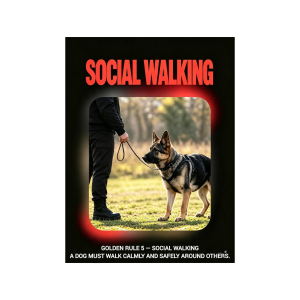
Golden Rule One — Home and Social

£19.99
Golden Rule One — Home & Social
£19.99
Golden Rule One — Home & Social is a focused, practical course designed to help owners understand the essential principles of home management, social behaviour and how to establish clear expectations for their dog within the home and everyday family life.
Training a dog at home is not simply about teaching commands. It involves understanding how dogs learn, establishing appropriate routines, developing consistent communication, managing the environment and encouraging desirable behaviour.
This course covers the key foundations owners need to understand when helping their dog settle into home life, develop appropriate habits and learn how to behave around people and within the household.
What This Course Covers
The course covers the essential questions owners commonly have about home and social training:
How do I establish appropriate behaviour in the home?
How do I help my dog settle into a household routine?
How do I introduce boundaries and consistent expectations?
How do I teach my dog where to rest?
How do I introduce crate training correctly?
How do I help my dog settle calmly?
How do I manage my dog’s behaviour around family members?
How do I encourage appropriate behaviour around visitors?
How do I develop consistency between different household members?
How do I prevent unwanted habits from becoming established?
How do I use food, rewards and motivation effectively?
How do I reinforce desirable behaviour?
How do I manage excitement inside the home?
How do I recognise when my dog is becoming unsettled?
How do I respond when my dog struggles to settle?
How do I manage my dog’s environment to support learning?
How do I introduce freedom gradually?
How do I avoid confusing my dog with inconsistent rules?
How do I establish appropriate everyday behaviour?
How do I build the foundations for a calm and manageable home environment?
Understand Home Management
Successful home training begins with understanding how the environment influences behaviour.
You will learn how routines, access to different areas, resting spaces and consistent expectations can influence your dog’s ability to settle and develop appropriate habits.
The course explains the importance of:
- Observation.
- Consistency.
- Clear communication.
- Appropriate routines.
- Environmental management.
- Suitable resting areas.
- Positive reinforcement.
- Manageable distractions.
- Gradual progression.
Understanding these principles helps owners recognise how their everyday decisions influence their dog’s behaviour and how to create conditions that support successful learning.
Build Clear Communication at Home
Effective home training requires clear and consistent communication between the handler and dog.
You will learn how to develop communication through:
- Consistent expectations.
- Clear verbal cues.
- Appropriate body language.
- Recognition of desirable behaviour.
- Reward timing.
- Repetition and practice.
- Consistency between household members.
The aim is to help owners understand how their actions influence learning and how to establish clearer communication throughout everyday life.
Establish Routines and Boundaries
Dogs benefit from predictable routines and clear expectations.
You will learn how to establish a structured approach to everyday home life by considering:
- Resting and settling.
- Access to household areas.
- Appropriate indoor behaviour.
- Consistent household rules.
- Supervision and management.
- Opportunities to practise desirable behaviour.
- Gradual increases in freedom.
The focus is on creating an environment in which the dog can understand what is expected and develop appropriate habits through consistent guidance.
Understand Crate Training and Settling
A suitable resting space can help owners manage the home environment and provide their dog with an opportunity to rest.
You will learn the importance of introducing a crate positively and helping your dog become comfortable with its resting area.
The course covers the principles of:
- Introducing a suitable resting space.
- Building positive associations.
- Encouraging calm behaviour.
- Establishing consistent routines.
- Recognising when a dog needs rest.
- Avoiding the use of a crate as punishment.
- Adjusting the environment when settling becomes difficult.
The objective is to help owners understand how structured rest and appropriate management can support everyday training.
Develop Appropriate Social Behaviour
Home and social training involves helping dogs learn how to behave appropriately around people and within everyday situations.
You will learn how to encourage desirable behaviour through:
- Consistent guidance.
- Positive reinforcement.
- Appropriate introductions.
- Management of excitement.
- Recognition of the dog’s responses.
- Gradual exposure to manageable situations.
- Adjustment of the environment when necessary.
The aim is to help owners make informed decisions about their dog’s behaviour rather than expecting the dog to understand unfamiliar situations without appropriate guidance.
Understand Rewards and Motivation
Motivation plays an important role in developing appropriate home behaviour.
You will learn how food rewards, toys, play, praise and positive experiences can encourage desirable responses and support learning.
The course covers:
- Understanding what motivates an individual dog.
- Choosing appropriate rewards.
- Delivering rewards effectively.
- Reinforcing desirable behaviour.
- Maintaining engagement.
- Recognising when motivation decreases.
- Adjusting an exercise when necessary.
The objective is to help owners develop a positive training process that encourages their dog to participate and learn.
Understand Your Dog’s Behaviour at Home
Dogs communicate through their behaviour and responses to their surroundings.
You will learn how to observe your dog and recognise when it is:
- Settling comfortably.
- Becoming distracted.
- Becoming overexcited.
- Struggling to relax.
- Responding to environmental changes.
- Finding a situation difficult.
- Needing more structure.
- Ready for gradual progression.
This helps owners make better decisions about their dog’s environment and training instead of assuming every unwanted behaviour is deliberate disobedience.
Learn Why Punishment Can Create Problems
Effective home training involves understanding the difference between teaching a desirable behaviour and reacting to an unwanted one.
You will learn why shouting, frightening a dog or using physical punishment can create confusion and anxiety without clearly teaching the desired alternative.
The course focuses on:
- Teaching appropriate behaviour.
- Reinforcing successful responses.
- Providing clear and consistent guidance.
- Managing the environment.
- Recognising when a dog is struggling.
- Creating opportunities for success.
The aim is to develop understanding and appropriate behaviour through positive reinforcement rather than fear.
Learn How to Progress Home Training
Home training should develop as the dog’s understanding improves.
You will learn how to progress through a structured learning process:
INTRODUCTION → UNDERSTANDING → REPETITION → CONSISTENCY → PROGRESSION → RELIABILITY
Each stage provides a foundation for the next.
If the dog struggles, simplify the situation.
If the dog succeeds consistently, gradually introduce more challenging circumstances.
If behaviour deteriorates, reassess the environment, distractions, motivation and difficulty.
The aim is to develop reliable everyday behaviour through appropriate progression rather than expecting immediate results.
Understand Freedom and Responsibility
The way a dog behaves at home influences how much freedom it can safely and successfully manage.
The course explains the principle:
MORE FREEDOM REQUIRES MORE BEHAVIOURAL RESPONSIBILITY.
As the dog develops appropriate habits and greater reliability, opportunities for freedom can gradually increase.
Where difficulties arise, owners can temporarily simplify the environment, increase supervision and provide more structure while rebuilding successful habits.
Learn How to Respond When Problems Arise
Home training does not always progress as expected.
You will learn how to identify potential difficulties and adjust your approach.
If the dog struggles to settle, review the routine and resting environment.
If unwanted behaviour occurs repeatedly, reassess access, supervision and opportunities for practice.
If distractions are too strong, reduce their intensity.
If motivation decreases, reassess the reward and training conditions.
If progress becomes inconsistent, review the timing, repetition and clarity of your communication.
This encourages owners to identify the cause of a problem and improve the training process rather than repeatedly making the same mistake.
Positive Reinforcement
The course focuses on reinforcing desirable behaviour and helping the dog develop positive associations with home training.
The training process is:
OBSERVE → CUE → RESPONSE → REWARD
Clear communication, suitable rewards and consistent repetition help the dog develop an understanding of what is expected.
As learning develops, owners can gradually introduce more challenging situations while continuing to reinforce successful responses.
A Practical Learning Process
Throughout the course, owners are encouraged to use a simple decision-making process:
OBSERVE → INTERPRET → DECIDE → COMMUNICATE → OBSERVE RESPONSE → REASSESS
This encourages owners to assess what the dog is showing them, make an appropriate decision and evaluate the result.
If the dog succeeds, continue developing the behaviour.
If the dog struggles, simplify the situation.
If the dog becomes overexcited, reduce stimulation and allow time to settle.
If distractions interfere with learning, reduce their intensity.
If progress becomes inconsistent, return to a stage where the dog can succeed.
The objective is to develop a thoughtful, consistent approach to home and social training that can be applied throughout the dog’s life.
Who Is This Course For?
This course is suitable for:
- New dog owners.
- Families introducing a dog into their home.
- Owners who want to establish consistent household routines.
- Owners who want to develop appropriate indoor behaviour.
- Owners who need guidance with crate training and settling.
- Owners who want to improve communication with their dog.
- Owners who want to encourage appropriate social behaviour.
- Owners who want to understand rewards and motivation.
- Owners who want to avoid common training mistakes.
- Owners who want to develop consistent training habits.
- Owners who want to establish the foundations for reliable everyday behaviour.
What You Will Take Away
By completing the course, you will have a clearer understanding of how to:
- Establish appropriate behaviour in the home.
- Develop consistent household routines.
- Build communication with your dog.
- Introduce boundaries and expectations.
- Support crate training and settling.
- Encourage desirable social behaviour.
- Use food, toys and rewards appropriately.
- Recognise and reinforce desirable responses.
- Manage excitement and distractions.
- Recognise when your dog is struggling.
- Avoid common training mistakes.
- Use positive reinforcement effectively.
- Progress training at an appropriate pace.
- Respond constructively when problems arise.
- Develop consistency and reliability over time.
Course Price
Golden Rule One — Home & Social — £19.99
A focused, practical course covering the essential principles of home management and social training, from establishing routines and appropriate boundaries through to developing communication, settling and the foundations for reliable everyday behaviour.
£19.99 one-off purchase.