How to Use a Dog Crate When Visitors Arrive
Why Can Visitors Create Problems for Dogs?
How to Use a Dog Crate When Visitors Arrive starts with understanding why this situation can become difficult for some dogs.
A visitor arriving at the home can immediately change the normal environment.
The doorbell may sound, the front door opens, unfamiliar people enter and household activity suddenly increases.
Some dogs become extremely excited.
Others may bark, jump, rush towards the door, pace around the room or struggle to settle.
Some dogs may become worried or uncomfortable when unfamiliar people enter their home.
The problem is often made more difficult when the owner reacts at the same time as the dog.
The owner may become rushed, frustrated or distracted while trying to answer the door and control the dog.
This can create a situation where both the dog and owner are reacting to the same event.
The positive side is that visitors can become part of a structured training environment when the situation is managed appropriately.
What Happens When the Dog Rushes to the Door?
One of the most common problems is a dog rushing towards the front door as soon as the doorbell sounds.
The dog may bark, jump against the door, run between people’s legs or become highly excited before the visitor has even entered.
This can create a difficult situation for the owner.
The visitor may be standing outside while the owner is trying to manage the dog, open the door and communicate with the person at the same time.
A common mistake is allowing this pattern to happen repeatedly without considering why the dog becomes so excited.
Every arrival can then become another opportunity for the same behaviour to occur.
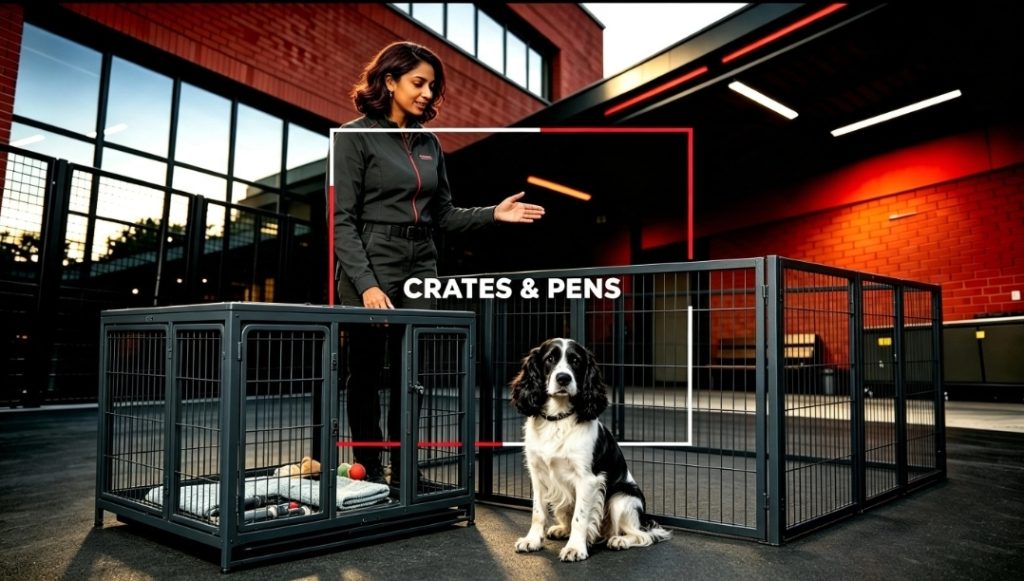
A dog crate can form part of the household structure by providing a defined area away from the immediate doorway.
RECOMMENDED PRODUCTS
Is the Crate Being Used as a Punishment?
Another important problem occurs when owners only use the crate when something has gone wrong.
For example, the dog hears the doorbell, becomes excited and the owner immediately becomes frustrated and sends the dog into the crate.
If this happens repeatedly, the dog may begin to associate the crate with stressful household events.
A crate should not be used as a punishment.
The aim is for the crate to form part of a predictable and positive home environment.
This is particularly important when learning how to use a dog crate when visitors arrive.
The crate should not simply appear when the owner is angry or when the dog has already lost control of the situation.
Why Does Timing Matter When Visitors Arrive?
Timing can create another problem.
Some owners wait until the visitor is already inside before attempting to manage the dog.
By this point, the dog may already be highly excited.
The visitor may be walking through the doorway, talking to the owner and moving around the house while the dog is attempting to interact with them.
Trying to introduce structure after the dog has already become highly aroused can make the situation much harder to manage.
The problem is not necessarily that the dog cannot learn.
The issue may be that the owner has waited until the most difficult part of the situation before attempting to create structure.
RECOMMENDED PRODUCTS

What If the Dog Barks When Someone Arrives?
Barking is another common problem when visitors arrive.
A dog may bark because of excitement, uncertainty, alertness or frustration.
The owner may respond by repeatedly telling the dog to stop.
Sometimes this creates even more noise, particularly when the dog is already highly stimulated.
The owner can then become frustrated because the dog appears not to be listening.
The important point is to recognise what is happening before simply reacting to the barking.
A calm and structured environment can make it easier to observe the dog’s behaviour and determine whether the situation is improving or becoming more difficult.
If the dog’s behaviour becomes concerning, professional assessment may be appropriate.
RECOMMENDED PRODUCTS

What If the Dog Jumps at Visitors?
Another common problem is jumping.
A dog may become excited when the visitor enters and immediately jump up for attention.
The visitor may unintentionally reinforce this by touching, talking to or looking at the dog.
The dog can then learn that visitors arriving at the home are extremely exciting events.
This can become particularly difficult with larger dogs, older visitors or children.
Owners should consider how visitors interact with the dog rather than focusing only on the dog’s behaviour.
A consistent household approach can help reduce confusion.
What If the Dog Cannot Settle While Visitors Are Present?
Some dogs remain active throughout the entire visit.
They may follow the visitor from room to room, repeatedly seek attention, pace around the house or continually attempt to interact.
The owner may spend the entire visit telling the dog to sit, stay or stop.
This can turn a social occasion into continuous training.
The problem may be that the dog has not learned how to manage household activity calmly.
A suitable crate can provide a defined resting environment, but it should be part of a wider approach to home structure rather than the only method used.
RECOMMENDED PRODUCTS
What Happens When Visitors Encourage Excitement?
Visitors can also unintentionally create problems.
A visitor may be enthusiastic about dogs and immediately approach, stroke or excite the dog.
They may encourage jumping or play without realising that this makes the situation more difficult.
Children can also become excited when a dog is excited.
The owner therefore needs to consider the entire environment.
The dog is not the only factor involved.
People, movement, noise and interaction can all affect how manageable the situation becomes.
Should Every Visitor Be Treated the Same?
Another common mistake is expecting every visitor to create the same response.
A familiar family member may produce a completely different reaction from a delivery person, tradesperson or someone the dog has never met.
The dog’s response may also change depending on the time of day, the level of activity in the home and what happened immediately before the visitor arrived.
This is why owners should observe the dog rather than assuming that one successful visitor means every future arrival will be easy.
RECOMMENDED PRODUCTS

What If the Dog Becomes Overexcited?
Overexcitement can quickly become a major problem.
The dog may move rapidly around the room, bark, jump, grab toys, seek attention or repeatedly approach the visitor.
The owner may then increase verbal commands in an attempt to regain control.
If the dog is already highly stimulated, however, repeated commands may not resolve the underlying problem.
The first consideration should be the dog’s state and the environment.
If the dog is becoming increasingly difficult to manage, the situation may need to be made calmer rather than more exciting.
What If the Dog Becomes Nervous Around Visitors?
Not every difficult response is caused by excitement.
Some dogs may become nervous when unfamiliar people enter the home.
They may hide, move away, remain tense, bark from a distance or avoid interaction.
Forcing a nervous dog to approach a visitor can increase the difficulty.
The dog should be given appropriate space and the owner should observe the dog’s behaviour carefully.
If there are concerns about fear, aggression or significant behavioural changes, professional support from a qualified dog training professional or behaviour professional may be appropriate.
RECOMMENDED PRODUCTS

Why Is the Crate Location Important?
The position of the crate can make a significant difference.
Placing it directly beside the front door can expose the dog to every movement and sound associated with visitors.
The dog may become more focused on the entrance rather than settling.
Placing the crate somewhere completely isolated from normal household activity can create a different problem, because the dog may be removed entirely from the household environment.
The appropriate location depends on the individual dog and the home.
The important consideration is whether the location supports calm management.
What Are the Common Mistakes Owners Make?
There are several common mistakes when learning how to use a dog crate when visitors arrive.
One mistake is waiting until the dog is already overexcited.
Another is using the crate as punishment.
Another is allowing visitors to immediately excite the dog.
Another is expecting the dog to behave perfectly despite having no previous experience with visitors.
Another is giving too much freedom around the house while the dog is still struggling to manage household activity.
Another is repeatedly shouting commands while the dog is already highly stimulated.
Another is assuming that every dog will respond to visitors in exactly the same way.
The positive side is that recognising these problems gives the owner an opportunity to change the way the situation is managed.
RECOMMENDED PRODUCTS

How Do the GPK9 Golden Rules Relate to Visitors?
The GPK9 Golden Rules are taught as separate areas of dog training education, with each course focusing on its own training subject.
GPK9 Golden Rule One: Home and Social
GPK9 Golden Rule One: Home and Social relates directly to creating structure within the home and managing the dog’s relationship with the household environment.
GPK9 Golden Rule Two: Obedience
GPK9 Golden Rule Two: Obedience focuses on obedience training, communication, food motivation and luring within structured training.
GPK9 Golden Rule Three: Prey Drive and Play
GPK9 Golden Rule Three: Prey Drive and Play focuses on engagement and play and the problems that can occur when arousal becomes difficult to manage.
GPK9 Golden Rule Four: Toilet Training
GPK9 Golden Rule Four: Toilet Training focuses on structured toilet routines and the problems that can occur when a dog’s routine becomes inconsistent.
GPK9 Golden Rule Five: Social Walking
GPK9 Golden Rule Five: Social Walking focuses on calm, manageable walking and the dog’s ability to remain composed around the outside environment.
Each GPK9 Golden Rule is a separate area of education with its own purpose.
How Can Owners Create a More Structured Visitor Environment?
Learning how to use a dog crate when visitors arrive is not simply about putting a dog into a crate whenever someone comes through the door.
The wider environment matters.
The dog’s previous experience matters.
The visitor’s behaviour matters.
The timing matters.
The owner’s consistency matters.
The dog’s individual response matters.
Problems can occur when all of these factors are overlooked and the crate is expected to solve everything.
A more structured approach allows the owner to recognise what is happening and respond appropriately.
The positive reinforcement approach used within GPK9 education focuses on building desirable behaviour rather than relying on harsh punishment.
RECOMMENDED PRODUCTS
How to Use a Dog Crate When Visitors Arrive
How to Use a Dog Crate When Visitors Arrive is ultimately about recognising the problems that can occur when a dog’s home environment suddenly changes.
The doorbell can trigger excitement.
The visitor entering the home can increase stimulation.
The owner can become distracted.
The dog may bark, jump, rush towards the door or struggle to settle.
A nervous dog may respond differently and need additional consideration.
Using the crate incorrectly can create another problem if it becomes associated with punishment.
The crate can instead form part of a structured home environment when it is introduced positively, used appropriately and considered alongside the dog’s wider training.
Understanding the problem is an important part of improving the situation.
RECOMMENDED COURSE

GPK9 Golden Rule One: Home and Social
Related Articles
What Is a Dog Crate? How Crate Training Works
Why Use a Dog Crate? Understanding Crate Training
When Should You Use a Dog Crate? Practical Crate Training
How to Introduce Your Dog to a Crate Step by Step
How to Use a Dog Crate to Create Structure at Home
How to Use a Dog Crate When the Postman Arrives
How to Use a Dog Crate When Someone Comes to the Door
How to Use a Dog Crate During Busy Household Activity
How to Use a Dog Crate Safely Around Children
How to Use a Dog Crate Around Other Animals
Common Dog Crate Training Mistakes and How to Avoid Them
What to Do When Your Dog Leaves the Training Mat
Dog Crate vs Training Mat vs Playpen: What Is the Difference?
How to Use a Dog Crate, Training Mat and Playpen Together
How Much Freedom Should You Give a Puppy at Home? :::