Prey Drive and Play Drive in Dogs: How They Work Together
Prey Drive and Play Drive in Dogs: How They Work Together is an important subject because these two forms of motivation can appear together during activities involving movement, toys, chasing and interaction. Prey drive can influence a dog’s natural interest in pursuing or interacting with moving objects, while play drive relates to the motivation to participate in play activities. They can overlap, but they are not identical and should not automatically be treated as the same behaviour. Problems can develop when handlers misunderstand the difference, increase toy movement without observing the dog, mistake high arousal for useful engagement or expect every dog to respond in the same way. This can create frustration, poor timing and unclear communication between dog and handler.
RECOMMENDED PRODUCT
Interactive Tug Toy — a suitable interactive toy can provide a controlled way to observe how movement and play influence an individual dog’s engagement.
What Is Prey Drive?
Prey drive describes a dog’s natural motivation toward behaviours associated with noticing, pursuing, chasing, catching or interacting with moving objects.
Different dogs can display different levels of interest.
One dog may immediately notice a moving toy and attempt to chase it.
Another may watch the movement without pursuing.
Another may become interested only when the movement, environment or type of object changes.
Prey drive therefore needs to be considered as part of the individual dog’s behaviour rather than as a fixed response that looks identical in every dog.
What Is Play Drive?
Play drive describes a dog’s natural motivation to participate in play.
Play can include:
- Tugging
- Chasing
- Carrying
- Retrieving
- Investigating toys
- Interacting with a handler
- Repeating a game
- Engaging with movement
A dog can show strong play drive without demonstrating the same level of interest in every type of toy.
Likewise, a dog may show interest in a moving object without necessarily wanting to continue playing with it.
This distinction becomes important when understanding how prey drive and play drive overlap.
How Prey Drive and Play Drive Can Overlap
Movement can activate a dog’s interest in an object.
The dog may notice the object, orient toward it, follow it, chase it and attempt to interact with it.
The activity can then become part of a play interaction between the dog and handler.
This is where prey drive and play drive can appear closely connected.
However, the behaviours should still be observed separately.
A dog pursuing a moving object does not automatically mean that the dog understands the activity as a game.
Likewise, a dog enjoying a game of tug does not mean every part of that interaction should be interpreted as prey behaviour.
The context, body language, motivation and behaviour of the individual dog all matter.
Common Problems When They Are Confused
One of the most common problems is assuming that prey drive and play drive are interchangeable terms.
A handler may see a dog chasing a toy and immediately describe the behaviour as play drive.
Another handler may see the same behaviour and focus entirely on the dog’s pursuit response.
Both observations may describe part of what is happening, but neither necessarily explains the complete interaction.
The problem becomes greater when the handler changes the activity without understanding what the dog is responding to.
This can lead to excessive movement, repeated attempts and unclear expectations.
High Arousal During Prey and Play Activities
Movement-based activities can sometimes produce a rapid increase in arousal.
A dog may begin with controlled attention and then become increasingly excited as the toy moves.
The dog may start jumping, barking, pulling, grabbing or attempting to restart the activity.
High arousal can make it harder for the handler to determine whether the dog is still responding to the activity in a controlled way.
The problem is not simply that the dog is excited.
The important issue is whether the handler recognises the change and understands what is happening.
Low Interest and Limited Engagement
Not every dog will respond strongly to movement or toys.
Some dogs may have relatively low prey drive.
Others may show limited play drive.
Some may respond to food more consistently than toys.
A dog may watch a moving toy without chasing it or interact briefly before losing interest.
This does not automatically mean that the dog lacks motivation or cannot learn.
It means the handler needs to observe what motivates that particular dog rather than assuming every dog will respond to movement and play in the same way.
Frustration Between Dog and Handler
Frustration can occur when the handler expects a stronger response than the dog naturally provides.
The handler may move the toy faster, repeat the activity or introduce more stimulation.
The dog may respond by becoming confused, disengaging or becoming increasingly aroused.
The opposite can also happen.
A dog with strong motivation may become frustrated if the handler continues teasing with the toy without allowing appropriate interaction.
Both situations demonstrate why understanding the relationship between motivation, timing and communication is important.
Timing and Movement
Timing can significantly affect how prey and play behaviours appear.
The handler needs to notice what happens when the toy moves.
Does the dog immediately orient toward it?
Does the dog follow it?
Does the dog chase?
Does the dog interact once it reaches the object?
Does the dog remain engaged?
Does the dog become increasingly aroused?
Does the dog disengage?
These observations provide more useful information than simply deciding that a dog has high or low prey drive.
Misunderstanding and Miscommunication
Prey drive and play drive can be misunderstood when the handler focuses only on the visible action.
A dog chasing a toy may be showing strong interest in movement.
A dog carrying a toy may be showing engagement in play.
A dog refusing to chase a toy may have a different motivational preference.
A dog becoming highly excited may be demonstrating increased arousal rather than improved communication.
The handler needs to consider the entire interaction rather than one behaviour in isolation.
GPK9’S FIVE GOLDEN RULES
The GPK9 Five Golden Rules provide one connected training system for understanding the dog, the handler, the environment and the timing of training.
Prey Drive and Play Drive in Dogs: How They Work Together is particularly connected to Golden Rule Three — Prey Drive / Play, but the wider system is important because play does not happen separately from the dog’s home structure, obedience, routine and social environment.
The framework can be used from a new puppy and family dog through to more experienced dogs and professional dog training environments.
The objective is to understand the individual dog rather than simply increase excitement.
Golden Rule One — Home and Social
A dog needs to understand different levels of freedom and activity within the home.
The GPK9 progression of crate → placemat → playpen provides increasing levels of controlled freedom.
The crate provides safety, reset and toilet support.
The placemat provides calm home freedom.
The playpen provides monitored freedom.
This structure helps create a distinction between calm periods and active periods.
That distinction becomes important when play activities increase the dog’s level of engagement.
The traffic-light system provides further guidance:
Green: progress and monitor.
Amber: observe and review.
Red: return to appropriate structure and stop where necessary.
Golden Rule Two — Obedience
Obedience creates another important form of structure.
The GPK9 approach uses food and luring while focusing on calm behaviour, praise, shaping, movement, timing and hand-delivered food.
This provides a structured training environment that can be distinguished from active play.
A dog should not remain in the same level of arousal throughout every training activity.
The handler needs to understand when the dog is participating in obedience and when it is engaging in play.
Clear separation between activities can help reduce confusion.
Golden Rule Three — Prey Drive and Play
Golden Rule Three is the central rule for understanding how prey drive and play drive can work together.
Play should take place in a quiet, suitable area separate from obedience.
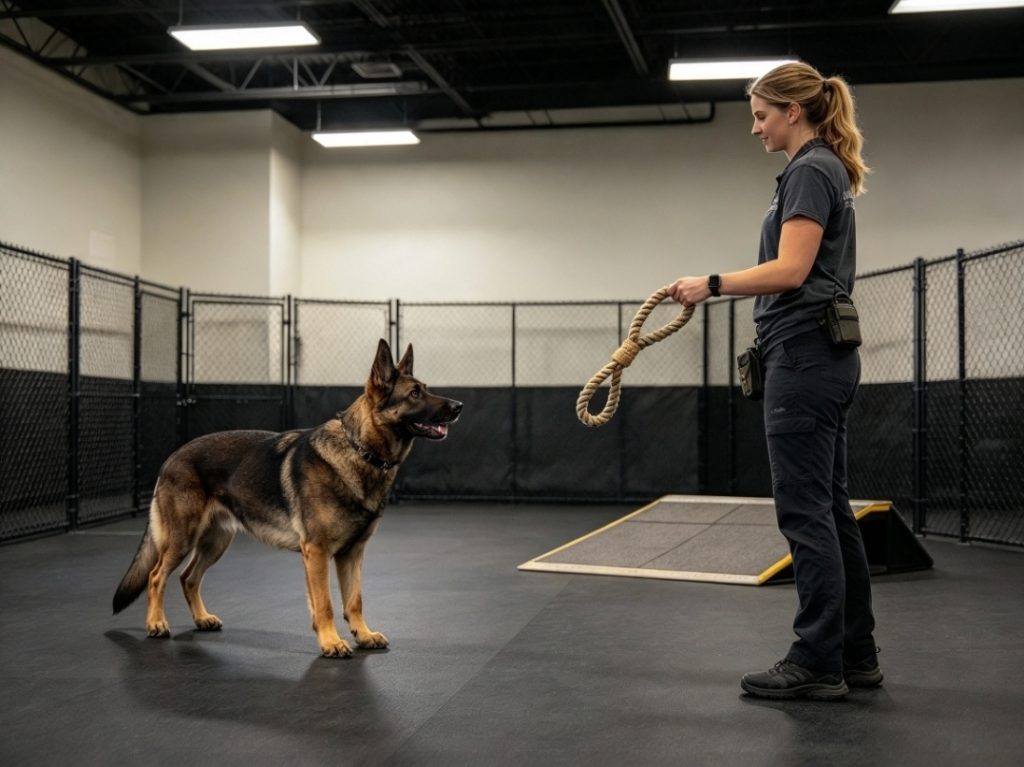
Tug and toy activities can be used to observe how the dog responds to movement and interaction.
The handler should pay attention to:
- Initial interest
- Orientation toward the toy
- Pursuit
- Interaction
- Duration of engagement
- Changes in arousal
- Ability to disengage
- Return to a calmer state
The GPK9 traffic-light structure provides a clear framework.
Green: observe and play.
Amber: observe and reduce arousal.
Red: stop and allow the dog to become calm.
The objective is not simply to create the highest possible level of excitement.
It is to understand what the dog is communicating and maintain appropriate structure throughout the interaction.
Golden Rule Four — Toilet
Toilet training is separate from prey and play behaviour, but it remains part of the wider GPK9 structure.
Using the same place, the same time and a consistent toilet command creates predictable routines.
This is especially important for puppies, where play, rest, feeding and toilet routines can all occur throughout the day.
Keeping these activities structured helps prevent the handler from treating every form of dog behaviour as one continuous activity.
Golden Rule Five — Social Walking / Ignore the World
Social walking introduces a completely different environment in which the dog encounters movement, people, animals and other distractions.
The objective is a calm, relaxed and manageable walk.
The dog is not required to respond to constant commands.
The handler observes the dog’s body language and manages the situation according to the dog’s state.
Green: monitor and continue.
Amber: stop and allow the dog to become calm in a quieter area until Green.
Red: stop the walk immediately.
This is relevant to prey and play because movement in the environment can attract attention.
A dog may notice birds, people, vehicles or other moving objects without the handler wanting that environmental movement to become a play activity.
Understanding the difference between controlled play and environmental movement helps maintain clearer communication.
A suitable training ball can provide another way to observe how an individual dog responds to movement, pursuit, carrying and interaction. It can be incorporated into structured play while the handler observes engagement and arousal.
A training mat can provide a consistent place for the dog to return to between active exercises. This can help create a clearer transition between play and calm behaviour.
Understanding Prey Drive and Play Drive Through the GPK9 System
Prey drive and play drive can work closely together, particularly when movement, toys and interaction are involved.
However, they should not automatically be treated as identical.
Prey drive relates more closely to natural motivation toward pursuit and interaction with moving objects.
Play drive relates to motivation to participate in play.
The two can overlap during activities such as chasing and tugging, but the individual dog’s behaviour needs to be observed in context.
The GPK9 Five Golden Rules provide a wider framework for understanding that behaviour.
Golden Rule One provides home structure.
Golden Rule Two provides structured obedience.
Golden Rule Three provides controlled prey and play activities.
Golden Rule Four maintains toilet structure.
Golden Rule Five develops calm and manageable social walking.
Together, the rules help the handler understand the complete dog rather than focusing only on the intensity of toy interaction.
Final Connection
Prey Drive and Play Drive in Dogs: How They Work Together is about understanding the relationship between movement, pursuit, play, motivation and engagement.
Prey drive and play drive can overlap, but they are not simply two interchangeable terms.
Problems can occur when handlers confuse them, expect every dog to respond identically, increase movement without observing the dog or mistake high arousal for useful engagement.
The GPK9 Five Golden Rules provide a structured approach to understanding these behaviours within the wider training system.
Home and Social provides structure, Obedience creates clearer expectations, Prey Drive and Play provides controlled interaction, Toilet maintains routine, and Social Walking / Ignore the World helps the dog remain calm and manageable around environmental movement.
Understanding how prey drive and play drive work together therefore requires more than watching a dog chase a toy.
It requires the handler to observe the individual dog, recognise motivation, monitor arousal, understand timing and maintain clear communication throughout the training process.