Why Does My Dog Dig?
Why does my dog dig? Dogs dig for several reasons, including natural behaviour, boredom, excess energy, searching, escaping, cooling themselves or simply because they enjoy digging. Digging is not automatically a sign that something is wrong with your dog. The important thing is to understand when, where and why your dog digs so you can decide whether the behaviour needs managing or redirecting.
Digging is a normal behaviour that many dogs find rewarding. RSPCA guidance recognises digging as one of the normal behaviours that owners may find undesirable, while also noting that boredom and a lack of suitable activities can contribute to digging.
RECOMMENDED PRODUCTS

Why Do Dogs Dig?
There is no single reason why dogs dig.
Your dog may dig because they:
- Enjoy the activity
- Have excess physical or mental energy
- Are bored
- Are searching for something
- Are following a scent
- Want to bury or uncover something
- Want to find cooler ground
- Are trying to escape
- Have learned that digging gets attention
- Have a strong natural motivation to dig
The same behaviour can have completely different causes in different dogs.
Is Digging Normal for Dogs?
Yes. Digging can be a normal part of canine behaviour.
Dogs naturally investigate their surroundings using their noses, mouths and paws. Digging can provide physical activity, mental stimulation and an opportunity to perform a behaviour that is naturally rewarding.
The problem is usually where, when and how much the dog digs, rather than the fact that they dig at all.
Why Does My Dog Dig in the Garden?
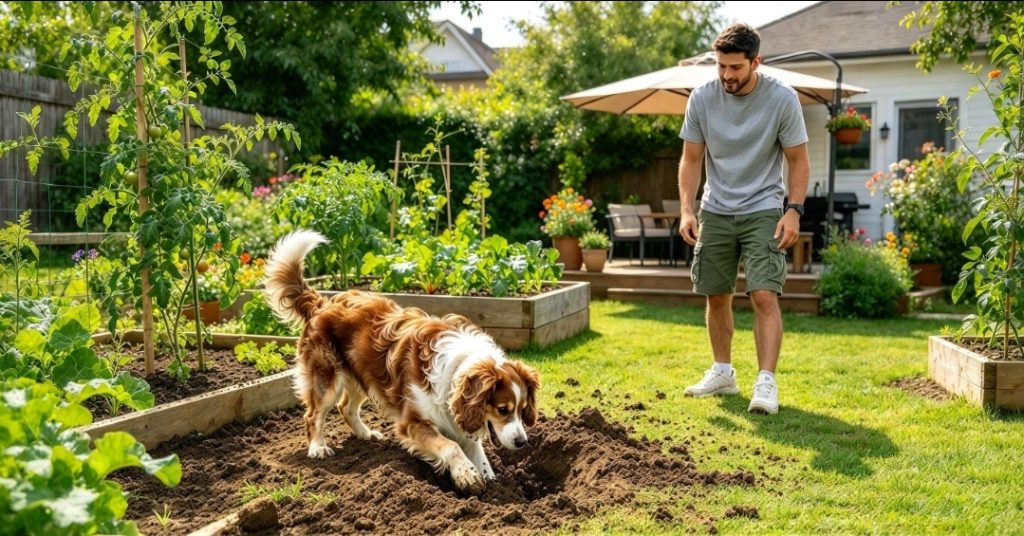
Garden digging can happen because the soil is interesting, smells good, feels rewarding to move or contains something your dog wants to investigate.
Your dog may also simply have discovered that digging is fun.
If your dog spends time outside without enough appropriate activity, digging can become an easy form of entertainment. RSPCA guidance notes that dogs may create their own entertainment, including digging up the garden, when they are bored.
Why Does My Dog Dig Holes?
Digging holes can be rewarding in itself.
Your dog may enjoy moving the soil, following a scent, searching for insects or objects, or creating a place to lie.
If your dog repeatedly digs holes in the same location, look at what makes that area particularly interesting.
The location can provide useful information about the reason for the behaviour.
Why Does My Dog Dig When They Are Bored?
Boredom can contribute to digging.
If your dog has plenty of unused energy and few suitable activities, they may find their own entertainment.
Providing appropriate exercise, play, exploration and mental stimulation can give your dog better outlets for that energy. RSPCA guidance recommends providing dogs with suitable opportunities for exercise, play and stimulation.
However, do not automatically assume boredom is the cause. Some dogs dig even when they receive plenty of exercise because they genuinely enjoy digging.
Why Does My Dog Dig Under the Fence?
Digging under a fence can indicate that your dog is trying to reach something outside or escape from the garden.
Your dog may be attracted by:
- Another animal
- People passing outside
- Interesting smells
- Other dogs
- Food
- Noise or activity
- A desire to explore
Escape digging needs to be taken seriously because a dog that gets through the boundary can run into roads, become lost or encounter other animals.
Prevent access to the area while you work out what is motivating the behaviour.
Why Does My Dog Dig When Left Alone?
If your dog mainly digs when you leave them alone, there may be more than one possible explanation.
They may be bored and looking for something to do, or they may be experiencing separation-related distress.
Look for other signs such as:
- Barking or whining
- Pacing
- Destructive behaviour
- Toileting indoors
- Excessive excitement when you return
- Attempts to escape
- Difficulty settling
Separation-related behaviour can include destructive activity when a dog is left alone, so the wider pattern matters.
RECOMMENDED PRODUCTS
Why Does My Dog Dig at the Ground Before Lying Down?
Some dogs scratch, paw or dig at an area before settling.
This can be a normal part of preparing a comfortable resting place.
If your dog occasionally paws at bedding, grass or another suitable surface before lying down and otherwise behaves normally, it does not necessarily indicate a behavioural problem.
Why Does My Dog Dig at the Carpet or Bed?
Indoor digging can be another form of scratching or nesting behaviour.
Your dog may be trying to make a comfortable resting area, responding to an interesting smell or simply enjoying the movement.
If the behaviour becomes excessive, look at when it happens and whether there are other signs of stress, frustration or boredom.
Why Does My Dog Dig at the Sofa?
If your dog repeatedly scratches or digs at furniture, consider what happens immediately before the behaviour.
They may be trying to settle, seeking attention, feeling restless or looking for something to do.
Preventing access to the furniture and providing an appropriate resting area or activity can help while you identify the cause.
Do not assume that the behaviour is deliberate disobedience.
Why Does My Dog Dig at Their Bed?
Some dogs scratch or paw at their bed before settling.
This can be completely normal.
If the digging is brief and followed by relaxation, there may be no need to stop it.
If your dog cannot settle, repeatedly digs at the bed or appears distressed, look at the wider behaviour rather than treating the digging as an isolated problem.
Why Does My Dog Dig in the Soil?
Soil contains smells and textures that can be highly interesting to dogs.
Your dog may smell insects, roots, buried objects or other animals.
Digging also gives your dog immediate feedback because the soil moves when they use their paws.
That combination can make digging extremely rewarding.
Why Does My Dog Dig in the Same Place?
Repeated digging in one location can indicate that something about that area is particularly rewarding.
Your dog may have found an interesting scent, previously found something there or simply learned that the soil in that location is easy and enjoyable to dig.
Watch what your dog does immediately before and during the behaviour.
This can help you work out what is maintaining it.
Does Breed Affect Digging?
Breed can influence how strongly a dog is motivated to perform particular behaviours, but individual dogs vary considerably.
Some dogs may have particularly strong instincts or preferences that make digging highly rewarding.
However, you should still look at the individual dog’s environment, routine and behaviour rather than assuming the cause based solely on breed.
Should I Let My Dog Dig?
That depends on where and how your dog digs.
If your dog enjoys digging and there is a safe area where it does not cause a problem, allowing appropriate digging can be a practical option.
You could create a designated digging area and teach your dog that digging there is acceptable.
Trying to eliminate a natural behaviour completely is not always necessary when you can safely provide an appropriate outlet for it.
How Can I Tell Why My Dog Is Digging?
Look at the pattern rather than just the digging itself.
Ask:
When does my dog dig?
Is it after being left alone, during play, when they enter the garden or when they see something outside?
Where does my dog dig?
Do they dig in soil, under fences, in flower beds, at their bed or in furniture?
What happens immediately before digging?
Is there another animal nearby? Has your dog been inactive? Have you just left the house?
What happens after digging?
Does your dog find something, settle down, get your attention or continue playing?
These observations can help you identify the reason behind the behaviour.
Should I Stop My Dog Digging?
Not necessarily.
If your dog digs occasionally in an appropriate location and there is no safety or welfare problem, digging may simply be a normal behaviour you can allow.
If your dog is destroying the garden, escaping, injuring themselves or digging because they are distressed, then the behaviour needs to be managed and the underlying cause addressed.
The aim should be to understand the behaviour rather than simply punish the digging.
Should I Punish My Dog for Digging?
No.
Do not shout at, hit or physically punish your dog for digging.
Punishment does not explain what you want your dog to do instead and can create fear or confusion. RSPCA guidance recommends rewarding positive behaviour rather than shouting at or punishing dogs.
Instead, identify the reason for the digging, manage access where necessary and provide an appropriate alternative.
RECOMMENDED PRODUCTS
What If My Dog Suddenly Starts Digging?
A sudden change in behaviour deserves more attention than an established habit.
Look for changes in your dog’s environment, routine, exercise, access to the garden or interactions with other animals.
Also consider whether there are other changes in behaviour.
If your dog’s behaviour changes suddenly or they show signs of stress, fear, illness or injury, speak to your vet. RSPCA guidance recommends seeking veterinary advice when a dog’s behaviour changes or they show regular signs of distress.
When Is Digging a Behaviour Problem?
Digging becomes more concerning when it:
- Causes injury
- Allows your dog to escape
- Damages property extensively
- Happens compulsively
- Occurs alongside severe anxiety
- Happens whenever your dog is left alone
- Is accompanied by other significant behavioural changes
In these situations, focus on the reason behind the digging rather than simply trying to suppress it.
Conclusion
Dogs dig for many different reasons, and digging is often a normal and rewarding behaviour rather than deliberate bad behaviour.
Your dog may be bored, exploring, searching, escaping, cooling down or simply enjoying the activity.
Watch the circumstances surrounding the digging, identify what is motivating it and decide whether you need to manage the behaviour or provide a more appropriate place for your dog to dig.
Understanding why your dog digs is the first step towards deciding what to do about it.
GPK9 — The Five Golden Rules
The GPK9 Five Golden Rules provide the foundation of the GPK9 Professional Training System. They give new dog owners, new dog handlers, experienced handlers and professional dog trainers a clear structure for developing the dog and the handler together.
The GPK9 Five Golden Rules cover five essential areas of development: Home & Social, Obedience, Prey Drive, Toilet and Social Walking. Each area has its own purpose, but they are designed to work together as one complete training system.
The GPK9 approach is based on CATEGORY → STATUS → DRIVE → CONTROL and the handler’s ability to OBSERVE → INTERPRET → DECIDE → COMMUNICATE → OBSERVE RESPONSE → REASSESS. This gives the handler a consistent process for understanding what the dog is doing, why the behaviour is occurring, what level of control is appropriate and how to communicate effectively.
The purpose of the GPK9 Five Golden Rules is not simply to teach a collection of individual exercises. They are designed to develop the dog’s behaviour, motivation, communication, control and reliability while teaching the handler how to make better decisions.
Golden Rule One — Home & Social
Golden Rule One — Home & Social establishes the foundation for everyday life with the dog. It focuses on communication, boundaries, calm behaviour, household routines and appropriate behaviour around people, animals and normal activity.
The purpose of Golden Rule One — Home & Social is to help the handler understand the dog’s behaviour and recognise changes in arousal before they become larger problems. The handler learns to observe, assess and communicate rather than simply reacting after unwanted behaviour has already occurred.
Golden Rule One — Home & Social provides the foundation from which the handler can develop a calmer, more predictable and better-communicating dog.
Golden Rule Two — Obedience
Golden Rule Two — Obedience develops the dog’s ability to understand and respond to the handler’s communication.
The focus of Golden Rule Two — Obedience is not simply teaching commands. It is about developing understanding, reliability, timing, reward, release and control so the dog learns what the handler is communicating.
Through Golden Rule Two — Obedience, the handler learns to progress training appropriately, gradually increasing the dog’s freedom and responsibility as understanding and reliability improve.
Golden Rule Three — Prey Drive
Golden Rule Three — Prey Drive focuses on understanding and developing the dog’s natural motivation to chase, pursue, engage and work with an appropriate toy or prey-based reward.
The purpose of Golden Rule Three — Prey Drive is not simply to increase drive. The handler must learn how to recognise the dog’s level of motivation, select an appropriate reward and use timing, communication and control to channel that motivation productively.
Golden Rule Three — Prey Drive teaches the handler that motivation can become a powerful training tool when it is developed and controlled correctly.
Golden Rule Four — Toilet
Golden Rule Four — Toilet establishes reliable toilet habits through consistency, observation, timing, supervision and appropriate reinforcement.
The handler learns through Golden Rule Four — Toilet to recognise when the dog is likely to need the toilet, provide the correct opportunity and reinforce the desired behaviour.
The objective of Golden Rule Four — Toilet is to establish a predictable routine that helps the dog understand where and when toileting is appropriate while reducing opportunities for mistakes.
Golden Rule Five — Social Walking
Golden Rule Five — Social Walking develops the dog’s ability to walk calmly and appropriately in the real world while remaining connected to the handler.
The focus of Golden Rule Five — Social Walking is the relationship between the handler, the dog, the environment, distractions, distance and available control.
Through Golden Rule Five — Social Walking, the handler learns to observe body language, identify potential triggers, assess distance and recognise changes in drive or arousal before behaviour escalates.
The objective of Golden Rule Five — Social Walking is not simply to make the dog walk beside the handler. It is to develop a dog that can experience the outside world while remaining connected to the handler and capable of responding to clear communication.
How the Five Golden Rules Work Together
The GPK9 Five Golden Rules are designed to work together rather than being treated as five completely separate subjects.
Golden Rule One — Home & Social establishes the foundations for everyday behaviour and communication.
Golden Rule Two — Obedience develops understanding, responsiveness and control.
Golden Rule Three — Prey Drive develops motivation and teaches the handler how to channel natural drive appropriately.
Golden Rule Four — Toilet establishes essential household routine and reliability.
Golden Rule Five — Social Walking takes the communication and control developed through the other areas into the outside environment.
Together, the GPK9 Five Golden Rules help the handler develop a complete understanding of the dog rather than treating individual behaviours as isolated problems.
The overall objective of the GPK9 Five Golden Rules is to train the human, train the dog and build the partnership through clear observation, communication, appropriate control and progressive development.