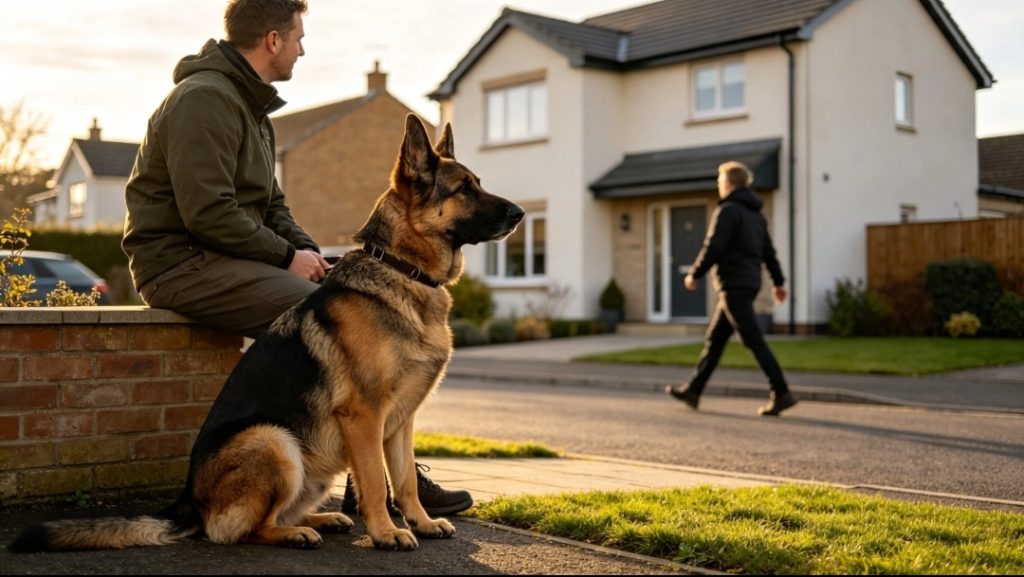
A barking dog can be frustrating.
Whether your dog barks at people walking past the house, reacts to other dogs, goes crazy when the doorbell rings or simply seems to bark at everything, excessive barking can quickly become one of the most difficult behaviours for an owner to manage.
But before you ask how to stop your dog barking, there is an important question you need to answer:
Why is your dog barking in the first place?
Barking is a normal form of canine communication. Dogs bark to alert, communicate, express excitement, respond to something unfamiliar, seek attention and sometimes because they are frightened or frustrated. The reason behind the barking matters because different causes require different training approaches.
The realistic goal is not necessarily to make your dog completely silent.
Instead, the goal is to teach your dog when barking is appropriate, when they should stop and what you want them to do instead.
In this GPK9 guide, we’ll look at 10 proven dog training techniques to help stop excessive barking and build better control and communication between you and your dog.
Why Is My Dog Barking?
Before learning how to stop your dog barking, identify what is causing the behaviour.
Your dog could be barking because:
- Someone is approaching your house.
- A person is walking past the window.
- Another dog is nearby.
- Your dog is excited.
- Your dog is frightened.
- Your dog is frustrated.
- Your dog wants attention.
- Your dog is bored.
- Your dog is reacting to a particular sound.
- Your dog struggles when left alone.
Some dogs will also bark because they have learned that barking produces a result.
For example, if your dog barks at the front door and the visitor eventually leaves, your dog may believe that barking successfully made the person go away.
This is why simply shouting “QUIET!” often doesn’t solve the problem.
Your dog may not understand that you are asking them to stop barking. They may simply interpret your shouting as you joining in with the noise.
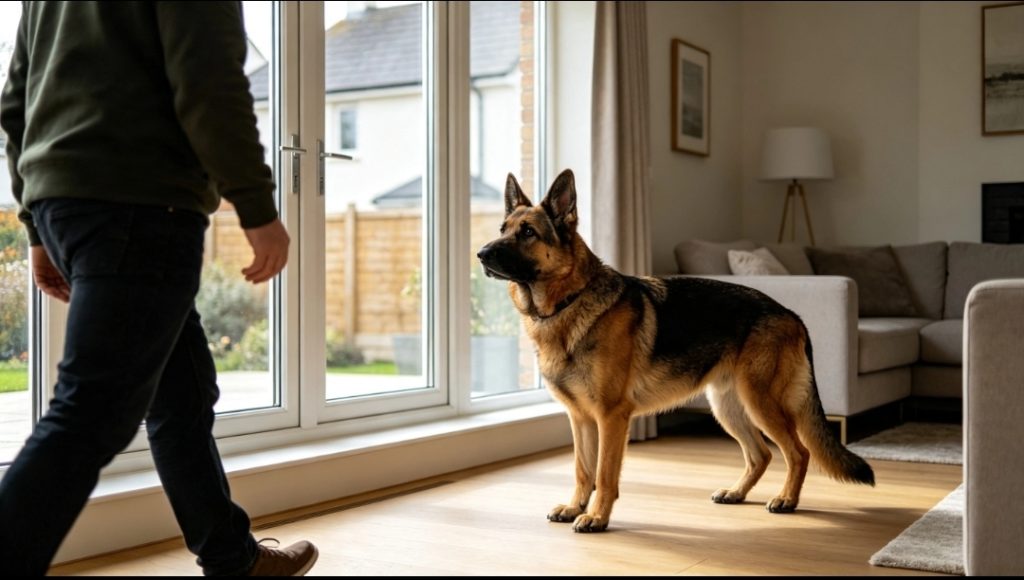
- Identify Your Dog’s Barking Trigger
The first technique for learning how to stop your dog barking is observation.
Before changing the behaviour, identify exactly what causes it.
Keep track of when your dog barks.
Does it happen when:
- Someone walks past the house?
- The doorbell rings?
- Another dog appears?
- You leave the house?
- You prepare their food?
- Someone enters the garden?
- Your dog sees wildlife?
- Your dog becomes excited?
- You are giving attention to another person or animal?
The more accurately you identify the trigger, the easier it becomes to create an effective training plan.
If your dog barks at people passing the window, for example, your training plan will be very different from a dog barking because they become distressed when left alone.
Don’t treat every barking problem as the same problem.
- Stop Your Dog Rehearsing the Barking
One of the most overlooked parts of dog training is management.
Every time your dog repeatedly practises a behaviour, that behaviour can become more established.
Imagine your dog spends hours every day sitting at the window barking at people.
The dog sees someone.
The dog barks.
The person continues walking.
From the dog’s perspective, the barking appears to have worked.
The same thing happens again tomorrow.
And the next day.
Instead of allowing your dog to repeatedly practise the behaviour, manage the environment while you train.
For example, if your dog constantly barks at people through a window, temporarily restrict access to that window or use appropriate visual barriers.
This doesn’t replace training.
It gives you an opportunity to reduce the rehearsal of the unwanted behaviour while teaching an alternative.
- Teach Your Dog an Alternative Behaviour
One of the most effective ways to learn how to stop your dog barking is to stop focusing entirely on the barking.
Instead, teach your dog what you want them to do.
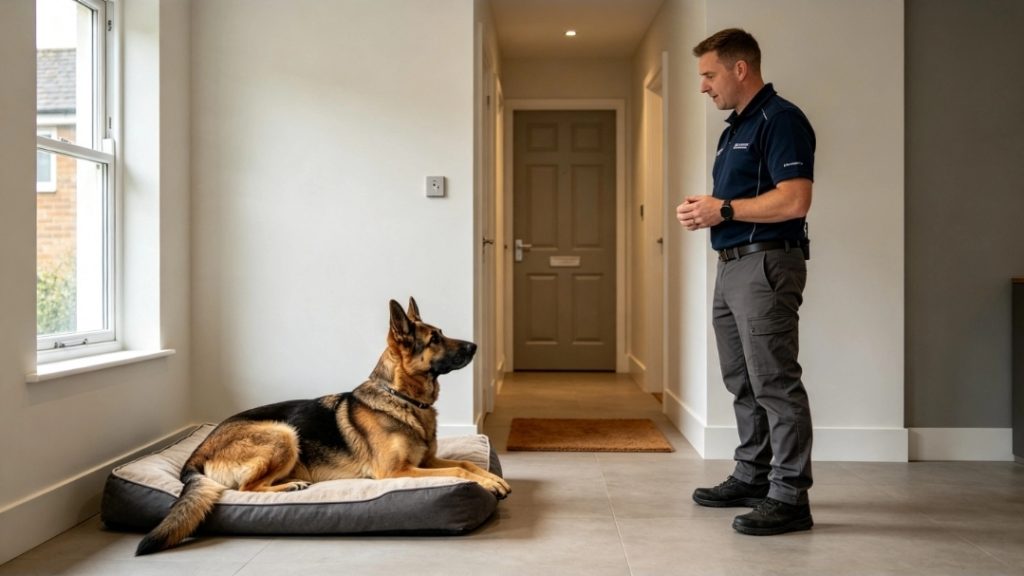
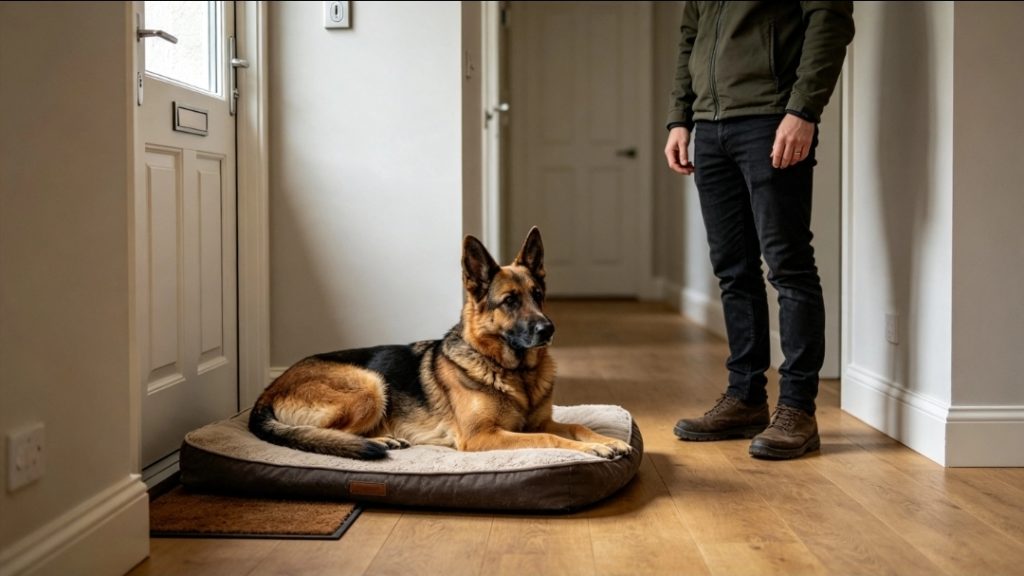
For example, if your dog hears the doorbell and immediately runs to the front door barking, teach them to go to a bed or designated place instead.
Your dog hears the doorbell.
Instead of running to the door:
Doorbell → go to bed → remain calm → reward.
This gives your dog a clear job.
Dogs learn much more effectively when we give them a behaviour they can understand and practise.
PDSA has also highlighted teaching dogs an alternative behaviour, such as going to their bed when the doorbell rings, as a way of creating a calmer routine around visitors.
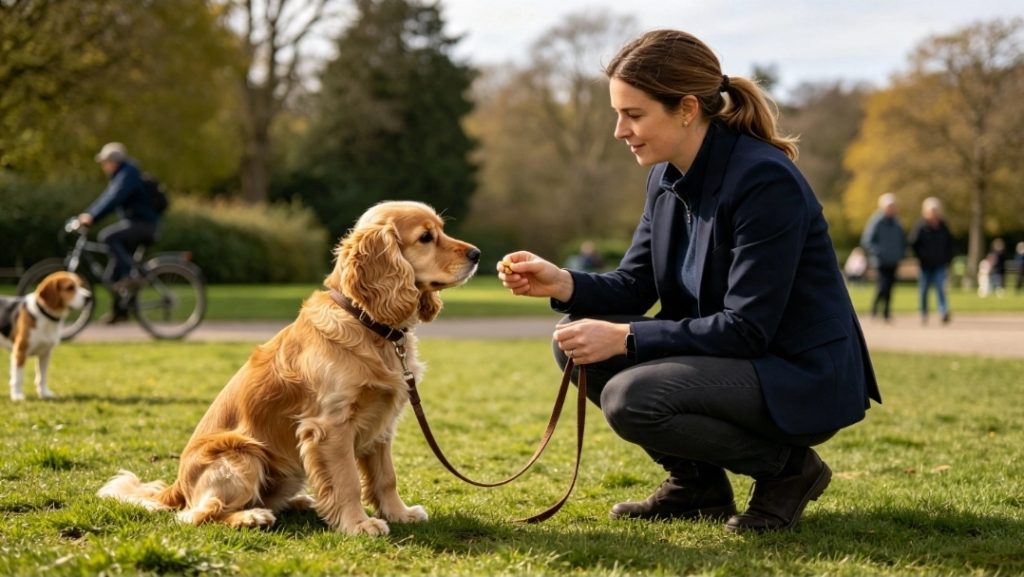
- Reward Calm Behaviour
If you only react when your dog is barking, you may accidentally give your dog attention for the very behaviour you’re trying to reduce.
Instead, actively look for moments when your dog is calm.
Your dog is lying quietly?
Reward them.
Your dog notices someone outside but doesn’t bark?
Reward them.
Your dog hears the doorbell and looks at you instead of rushing to the door?
Reward them.
Your dog returns to their bed and settles?
Reward them.
This is the foundation of reward-based training: reinforce the behaviour you want your dog to repeat. PDSA explains that dogs are more likely to repeat behaviours that are rewarded and recommends clear timing, consistency and short training sessions.
Over time, your dog can learn that calm behaviour is valuable.
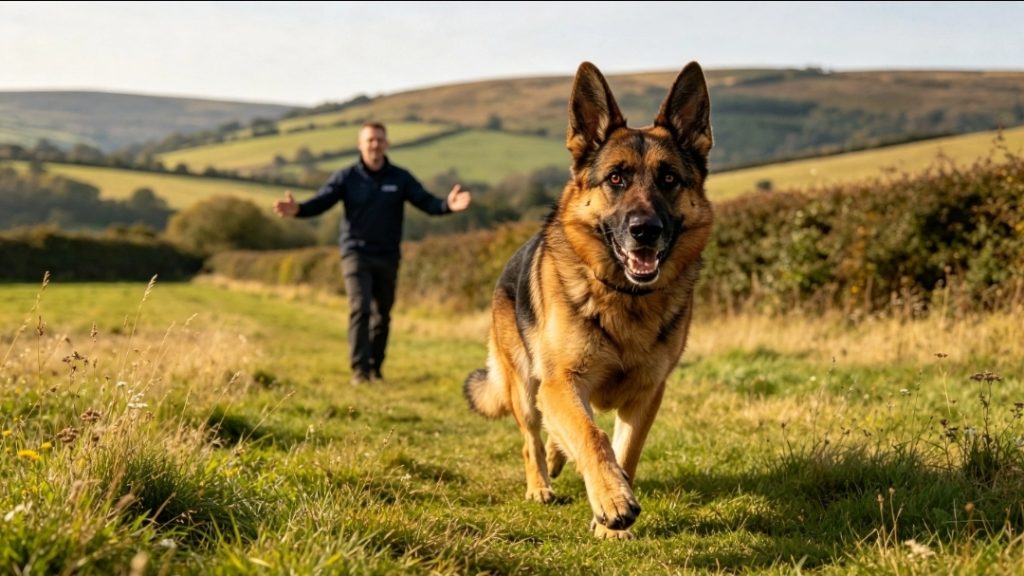
- Teach a Reliable Recall
A good recall is useful far beyond getting your dog to come back at the park.
It can also help interrupt unwanted behaviour.
If your dog is barking in the garden, calling them back to you can give them something else to focus on.
But recall needs to be trained before you expect it to work around distractions.
Start somewhere quiet.
Call your dog.
When they come to you, reward them.
Gradually introduce more distractions as your dog’s response becomes reliable.
The objective is to make returning to you worthwhile.
A strong relationship and reliable communication give you more options when your dog becomes distracted or excited.
- Teach Your Dog to Focus on You
If your dog is completely focused on the thing causing the barking, shouting commands across the room is unlikely to solve the problem.
Instead, teach your dog that paying attention to you is rewarding.
Start in a quiet environment.
Reward your dog for looking at you.
Then gradually introduce distractions.
Eventually, your dog can learn that when something interesting appears, checking in with their handler is a useful behaviour.
This is particularly important for dogs that bark at people, dogs or environmental distractions.
The objective isn’t to force the dog to ignore everything around them.
It is to teach the dog that you are worth listening to even when something interesting is happening.
- Gradually Desensitise Your Dog to the Trigger
Some dogs bark because something makes them uncomfortable or frightened.
In these situations, simply telling the dog to stop barking isn’t enough.
You need to work on the underlying emotional response.
For example, if your dog barks at another dog, you might begin training at a distance where your dog can see the other dog without becoming overwhelmed.
Reward calm behaviour.
Then gradually work towards closer distances over time, always keeping the dog below the point where they lose control.
If the dog starts barking intensely, you have probably moved too quickly or allowed the situation to become too difficult.
Move further away and make the exercise easier.
Desensitisation and counter-conditioning are established behaviour-modification approaches, but they need to be applied appropriately to the individual dog and trigger.
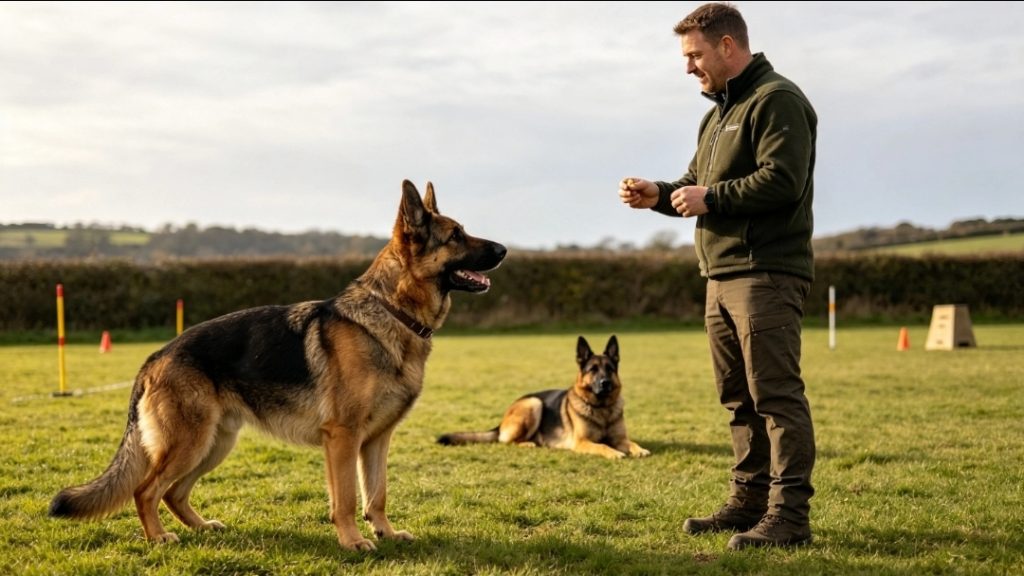
- Don’t Reward Attention-Seeking Barking
Some dogs learn that barking gets their owner’s attention.
The dog barks.
The owner says:
“Stop barking!”
The dog has received attention.
The dog barks again.
The owner gets up.
More attention.
From the dog’s perspective, barking has produced a result.
This doesn’t mean you should simply ignore every barking problem.
If your dog is barking because they are frightened, distressed or reacting to a genuine trigger, the situation needs to be addressed rather than simply ignored.
But where barking is genuinely attention-seeking, avoid accidentally reinforcing it with attention and instead reward your dog when they are calm and quiet.
- Give Your Dog Appropriate Mental and Physical Activity
Barking can sometimes be associated with boredom, frustration or excess energy.
That doesn’t mean the solution is simply to exhaust your dog.
Exercise is important, but so is mental stimulation and structured interaction.
Depending on the individual dog, useful activities can include:
- Obedience training
- Recall training
- Scent games
- Structured play
- Appropriate chewing activities
- Puzzle feeding
- Controlled walks
- Calm settling exercises
- Training games
Training itself can be mentally tiring.
A dog doesn’t necessarily need to spend hours running around to have a productive day.
Teaching your dog to think, focus and respond to you can be just as valuable.
PDSA describes training as a useful way to keep dogs mentally active while strengthening the bond between dog and owner.
- Be Consistent With Your Commands and Rules
The final technique is one of the most important:
Consistency.
If you want to know how to stop your dog barking, everyone in the household needs to follow the same approach.
If one person rewards calm behaviour while another person shouts at the dog, the dog receives mixed messages.
Decide what behaviour you want.
Decide what command you are going to use.
Reward the behaviour you want.
Repeat it consistently.
Keep training sessions short and achievable, and gradually increase the difficulty.
Your dog isn’t going to understand everything after one training session.
Training is a process of repetition.
Why Shouting at Your Dog Usually Doesn’t Stop Barking
When your dog is barking loudly, shouting can feel like the obvious thing to do.
But shouting can increase excitement, provide attention or add stress to an already difficult situation.
Your dog may hear you making noise and interpret that as part of the interaction.
If barking is caused by fear or anxiety, punishment can also make the underlying problem worse.
Reward-based training is recommended by organisations including PDSA and Blue Cross, with an emphasis on teaching desirable behaviour rather than using punishment.
The aim should be to teach your dog what you want them to do.
How to Stop Your Dog Barking at the Door
Doorbell barking is one of the most common problems owners experience.
Your dog hears the bell.
They run to the door.
They bark.
Someone enters.
The excitement increases.
Instead of waiting for the doorbell to trigger the behaviour every time, practise the routine when nothing important is happening.
Teach your dog to go to their bed.
Practise the behaviour.
Reward them for staying there.
Then introduce a very quiet version of the trigger.
You can gradually increase the difficulty as your dog becomes successful.
PDSA’s current guidance similarly recommends practising doorbell sounds, teaching the dog to go to a bed or mat and rewarding calm behaviour.
How to Stop Your Dog Barking at People Walking Past
If your dog sits at the window barking at everyone who walks past, start by managing the environment.
If necessary, prevent your dog from repeatedly watching people through the window.
Then teach an alternative behaviour.
For example:
Person appears → dog looks at handler → dog comes away from window → reward.
You can gradually teach your dog that seeing someone outside doesn’t automatically mean they need to bark.
The same principle can be applied to people passing the garden.
Instead of allowing your dog to spend long periods practising the behaviour, supervise the situation and call your dog back to you when appropriate.
How to Stop Your Dog Barking at Other Dogs
Barking at other dogs can have many causes.
Your dog might be:
- Excited
- Frustrated
- Nervous
- Overstimulated
- Attempting to interact
- Reacting defensively
Don’t assume that every barking dog is aggressive.
Look at the whole picture, including body language, distance, environment and what happens immediately before and after the barking.
If your dog becomes overwhelmed around other dogs, increase distance and work at a level where your dog can remain calm.
If the behaviour is intense or you’re concerned about aggression, professional assessment is recommended.
What If My Dog Barks When Left Alone?
Barking when left alone can be different from barking at people walking past the house.
Some dogs bark or howl because they become distressed when separated from their owners.
This shouldn’t simply be treated as an obedience problem.
If your dog becomes distressed when left alone, seek appropriate professional advice and consider speaking to your vet.
Blue Cross specifically advises owners of dogs that bark excessively when left alone to seek qualified behaviour support where basic advice does not resolve the problem.
When Should You Get Professional Help?
If your dog is barking excessively and you cannot identify the cause, professional help can save you a great deal of frustration.
You should consider professional help if:
- The barking is getting worse.
- Your dog appears frightened.
- Your dog is showing aggressive behaviour.
- Your dog is extremely reactive to people or dogs.
- Your dog becomes distressed when left alone.
- Training isn’t producing progress.
- You are struggling to understand the trigger.
- The behaviour has changed suddenly.
A qualified professional can assess the individual dog and help identify the reason for the behaviour.
If you are concerned about a sudden behavioural change, pain or illness, speak to your veterinary professional.
Build the Foundations Before Expecting Reliable Behaviour
One of the biggest mistakes owners make is trying to fix barking without building the dog’s overall obedience and communication.
A dog that understands how to:
- Focus on its handler
- Recall
- Stay
- Settle
- Follow basic commands
- Walk appropriately
- Disengage from distractions
- Respond to its name
has more tools available when faced with something exciting or distracting.
This is why GPK9 places importance on building strong foundations rather than simply trying to suppress individual behaviours.
GPK9 Fundamentals 2
For owners with dogs beyond the early puppy stage who need to strengthen obedience, focus, communication and general control, GPK9 Fundamentals 2 – 6 Months to 18 Months is the most relevant GPK9 course for this stage of training.
The course sits within the GPK9 dog-training programme and is designed for dogs from 6 months to 18 months, making it particularly relevant for owners whose dogs are moving beyond basic puppy training and need stronger foundations as they mature.
You can find “GPK9 Fundamentals 2 – 6 Months to 18 Months“ within the GPK9 online dog-training courses.
Building stronger obedience and communication can give owners more tools to manage distractions and teach alternative behaviours when barking becomes a problem.
Don’t Expect Your Dog to Stop Barking Completely
One of the most important things to understand when learning how to stop your dog barking is that barking itself is normal.
Dogs communicate.
The goal isn’t necessarily to create a dog that never makes a sound.
Instead, aim for a dog that can:
Notice something → remain under control → respond to the handler → settle when appropriate.
That is a much more realistic and useful goal.
The GPK9 Approach to Dog Training
At GPK9, we believe that good dog training is about creating clear communication between dog and handler.
Rather than simply reacting to unwanted behaviour, owners should understand why the behaviour is happening and teach the dog an appropriate alternative.
Barking is a perfect example.
Instead of constantly shouting:
“Stop barking!”
ask yourself:
What is causing the barking?
What behaviour do I want instead?
How can I teach my dog that behaviour?
Once you start thinking in those terms, dog training becomes much clearer.
Final Thoughts: How to Stop Your Dog Barking
Learning how to stop your dog barking isn’t about finding one magic command.
It is about understanding the reason for the barking, managing the environment, preventing unnecessary rehearsal of the behaviour and teaching your dog what you want them to do instead.
The 10 techniques covered in this guide are:
- Identify your dog’s barking trigger.
- Stop your dog repeatedly rehearsing the behaviour.
- Teach an alternative behaviour.
- Reward calm behaviour.
- Build a reliable recall.
- Teach your dog to focus on you.
- Gradually desensitise your dog to appropriate triggers.
- Avoid rewarding attention-seeking barking.
- Provide appropriate mental and physical activity.
- Be consistent with your training.
Remember that every dog is an individual.
A dog barking because it is excited needs a different approach from a dog barking because it is frightened. A dog barking at people through the window needs a different plan from a dog that becomes distressed when left alone.
Understand the reason.
Teach the alternative.
Reward the behaviour you want.
And stay consistent.
That’s how you build a dog that doesn’t simply stop barking because you’ve told it to — but learns how to respond differently.
For dogs aged 6–18 months that need stronger obedience and training foundations, explore “GPK9 Fundamentals 2 – 6 Months to 18 Months