
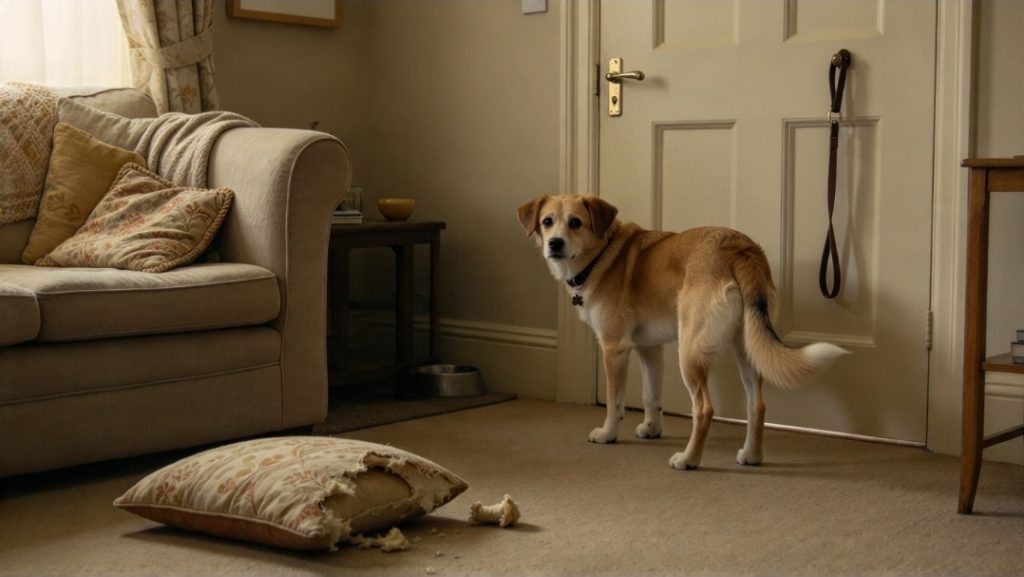
Why Does My Dog Destroy Things When Left Alone?
Why does my dog destroy things when left alone? Your dog may destroy things when left alone because it is experiencing separation-related distress, frustration, boredom, or anxiety, or because it has learned that chewing and destroying objects is rewarding. The first step is to identify what is causing the behaviour and then teach your dog to remain calm and settled when you are away.
RECOMMENDED PRODUCTS

Why Does My Dog Destroy Things When Left Alone?
Destruction when you leave can be a sign that your dog is struggling to cope with being alone.
Your dog may chew furniture, scratch doors, tear up bedding, pull at carpets, empty bins or destroy other objects around the home.
The location and timing of the destruction can provide useful information.
If your dog mainly damages doors, windows or areas around exits, it may be trying to reach you or escape. If it destroys accessible objects throughout the home, boredom, frustration or an established chewing habit may also be involved.
Is My Dog Destroying Things Because of Separation Anxiety?
Destructive behaviour can occur with separation-related distress, particularly when it happens specifically during your absence.
Look for other signs such as:
- Barking or whining after you leave
- Pacing around the home
- Scratching at doors
- Repeated attempts to escape
- Toileting indoors
- Excessive drooling
- Inability to settle
- Following you constantly when you are home
Destruction on its own does not automatically mean your dog has separation anxiety. The complete pattern of behaviour needs to be considered.
Why Does My Dog Only Destroy Things When I Leave?
Your dog may behave differently when you are present because you provide boundaries, interaction and reassurance.
When you leave, those controls disappear and your dog may choose an activity that provides stimulation or helps it cope with the situation.
Chewing can be naturally rewarding for dogs. If destroying an object also reduces frustration or helps your dog respond to stress, the behaviour can become repeated.
This is why simply telling your dog not to destroy things when you return does not solve the underlying problem.
How Do I Stop My Dog Destroying Things When I Leave?
The solution is to manage the environment while gradually teaching your dog to cope with being alone.
Step 1: Prevent Access to Valuable or Dangerous Items
Before leaving, remove objects your dog could damage or swallow.
Keep cables, rubbish, food, household items and anything potentially dangerous out of reach.
This prevents your dog from repeatedly practising destructive behaviour while you work on the underlying problem.
Step 2: Teach Your Dog to Settle Independently
Practise calm independent behaviour while you are still at home.
Encourage your dog to settle in an appropriate area without constantly following you or demanding interaction.
Reward calm behaviour and gradually increase the amount of time your dog can relax independently.
Step 3: Introduce Short Separations
Move into another room for a very short period and return while your dog remains calm.
Gradually increase the duration.
If your dog becomes distressed or starts looking for things to destroy, make the exercise easier.
Step 4: Practise Very Short Departures
Once your dog can cope with short periods of separation inside the home, practise leaving the house.
Start with a duration your dog can manage comfortably.
Return calmly and repeat the exercise before gradually increasing the time.
Step 5: Increase Duration Gradually
Do not move from a few successful minutes to a long absence.
Increase the duration in manageable stages.
If your dog begins showing signs of distress, reduce the duration and rebuild from an easier level.
Should I Exercise My Dog Before Leaving?
Appropriate physical and mental activity can help your dog settle, particularly if it has excess energy.
However, exercise should not be used as the only solution.
A dog experiencing separation-related distress may still panic after being exercised, so the underlying ability to cope with being alone must also be trained.
Should I Give My Dog Something to Chew?
A suitable chew, food-based activity or toy can provide an appropriate alternative to household objects.
Introduce it while your dog is calm and supervise its use appropriately.
If your dog refuses food or toys as soon as you leave, this may indicate that it is too distressed to engage with enrichment.
In that situation, reduce the difficulty of the separation rather than simply providing more toys.
Can a Crate Stop My Dog Destroying Things?
A crate can prevent access to dangerous objects if your dog is already comfortable and relaxed using it.
However, a crate should not be used as a quick fix for separation-related destruction.
If your dog panics when confined, attempts to escape or becomes more distressed, forcing it to remain in the crate can make the situation worse.
The crate should be a safe, familiar resting area rather than a punishment or containment solution for an untrained separation problem.
What If My Dog Destroys the Door?
Destruction around doors or other exit points deserves particular attention.
Scratching, chewing or damaging doors may indicate that your dog is attempting to follow you or escape from the area.
Do not punish the behaviour when you return.
Instead, reduce the duration of separation and work on teaching your dog to remain calm while you gradually increase the distance and time apart.
Should I Punish My Dog for Destroying Things?
No.
Punishing your dog after you return does not teach it what to do differently while you are away.
If the destruction is caused by distress, punishment can also make your dog’s emotional response to separation worse.
Focus on prevention, appropriate alternatives and gradual separation training.
RECOMMENDED PRODUCTS
What If My Dog Destroys Things Even After Exercise and Toys?
If your dog continues destroying things despite appropriate exercise, enrichment and management, look at the behaviour rather than simply adding more activity.
Ask yourself:
- Does the destruction start immediately after you leave?
- Does your dog show other signs of distress?
- Does it mainly occur around doors or windows?
- Can your dog settle when you are at home?
- Will your dog eat or play when you leave?
- Does the behaviour happen only during your absence?
These observations can help identify whether separation is a significant part of the problem.
What Mistakes Should I Avoid?
Avoid giving your dog unrestricted access to the home if it repeatedly destroys dangerous or valuable objects.
Avoid suddenly leaving your dog alone for long periods.
Avoid repeatedly allowing your dog to become distressed during training.
Avoid assuming that destruction is simply bad behaviour.
Avoid relying entirely on exercise, toys or chews when the underlying problem may be separation-related distress.
Avoid punishing your dog when you return.
How Long Does It Take to Stop Destructive Behaviour?
There is no fixed timeframe.
Progress depends on why your dog is destroying things, how severe the behaviour is, how long it has been happening and how consistently you manage and train it.
Start with separation periods your dog can handle and gradually increase the difficulty.
Successful calm repetitions are more important than making the training progress quickly.
When Should I Get Professional Help?
Seek professional help if your dog becomes highly distressed when left, repeatedly attempts to escape, injures itself, damages doors or windows, cannot cope with even very short absences or continues destroying things despite careful training.
A vet should also be considered if the behaviour appears suddenly or changes significantly, particularly if there could be an underlying health or behavioural problem.
Conclusion
Why does my dog destroy things when left alone? Destructive behaviour can be caused by separation-related distress, frustration, boredom, anxiety or an established chewing habit.
Prevent access to dangerous objects, teach your dog to settle independently and gradually build up its ability to cope with being alone.
The goal is not simply to stop your dog destroying your belongings. The goal is to teach your dog how to remain calm, settled and comfortable when you are away.
GPK9 — The Five Golden Rules
The GPK9 Five Golden Rules provide the foundation of the GPK9 Professional Training System. They give new dog owners, new dog handlers, experienced handlers and professional dog trainers a clear structure for developing the dog and the handler together.
The GPK9 Five Golden Rules cover five essential areas of development: Home & Social, Obedience, Prey Drive, Toilet and Social Walking. Each area has its own purpose, but they are designed to work together as one complete training system.
The GPK9 approach is based on CATEGORY → STATUS → DRIVE → CONTROL and the handler’s ability to OBSERVE → INTERPRET → DECIDE → COMMUNICATE → OBSERVE RESPONSE → REASSESS. This gives the handler a consistent process for understanding what the dog is doing, why the behaviour is occurring, what level of control is appropriate and how to communicate effectively.
The purpose of the GPK9 Five Golden Rules is not simply to teach a collection of individual exercises. They are designed to develop the dog’s behaviour, motivation, communication, control and reliability while teaching the handler how to make better decisions.
Golden Rule One — Home & Social
Golden Rule One — Home & Social establishes the foundation for everyday life with the dog. It focuses on communication, boundaries, calm behaviour, household routines and appropriate behaviour around people, animals and normal activity.
The purpose of Golden Rule One — Home & Social is to help the handler understand the dog’s behaviour and recognise changes in arousal before they become larger problems. The handler learns to observe, assess and communicate rather than simply reacting after unwanted behaviour has already occurred.
Golden Rule One — Home & Social provides the foundation from which the handler can develop a calmer, more predictable and better-communicating dog.
Golden Rule Two — Obedience
Golden Rule Two — Obedience develops the dog’s ability to understand and respond to the handler’s communication.
The focus of Golden Rule Two — Obedience is not simply teaching commands. It is about developing understanding, reliability, timing, reward, release and control so the dog learns what the handler is communicating.
Through Golden Rule Two — Obedience, the handler learns to progress training appropriately, gradually increasing the dog’s freedom and responsibility as understanding and reliability improve.
Golden Rule Three — Prey Drive
Golden Rule Three — Prey Drive focuses on understanding and developing the dog’s natural motivation to chase, pursue, engage and work with an appropriate toy or prey-based reward.
The purpose of Golden Rule Three — Prey Drive is not simply to increase drive. The handler must learn how to recognise the dog’s level of motivation, select an appropriate reward and use timing, communication and control to channel that motivation productively.
Golden Rule Three — Prey Drive teaches the handler that motivation can become a powerful training tool when it is developed and controlled correctly.
Golden Rule Four — Toilet
Golden Rule Four — Toilet establishes reliable toilet habits through consistency, observation, timing, supervision and appropriate reinforcement.
The handler learns through Golden Rule Four — Toilet to recognise when the dog is likely to need the toilet, provide the correct opportunity and reinforce the desired behaviour.
The objective of Golden Rule Four — Toilet is to establish a predictable routine that helps the dog understand where and when toileting is appropriate while reducing opportunities for mistakes.
Golden Rule Five — Social Walking
Golden Rule Five — Social Walking develops the dog’s ability to walk calmly and appropriately in the real world while remaining connected to the handler.
The focus of Golden Rule Five — Social Walking is the relationship between the handler, the dog, the environment, distractions, distance and available control.
Through Golden Rule Five — Social Walking, the handler learns to observe body language, identify potential triggers, assess distance and recognise changes in drive or arousal before behaviour escalates.
The objective of Golden Rule Five — Social Walking is not simply to make the dog walk beside the handler. It is to develop a dog that can experience the outside world while remaining connected to the handler and capable of responding to clear communication.
How the Five Golden Rules Work Together
The GPK9 Five Golden Rules are designed to work together rather than being treated as five completely separate subjects.
Golden Rule One — Home & Social establishes the foundations for everyday behaviour and communication.
Golden Rule Two — Obedience develops understanding, responsiveness and control.
Golden Rule Three — Prey Drive develops motivation and teaches the handler how to channel natural drive appropriately.
Golden Rule Four — Toilet establishes essential household routine and reliability.
Golden Rule Five — Social Walking takes the communication and control developed through the other areas into the outside environment.
Together, the GPK9 Five Golden Rules help the handler develop a complete understanding of the dog rather than treating individual behaviours as isolated problems.
The overall objective of the GPK9 Five Golden Rules is to train the human, train the dog and build the partnership through clear observation, communication, appropriate control and progressive development.




