Why Does My Dog Bark and Lunge at Other Dogs?
Why does my dog bark and lunge at other dogs? Dogs may bark and lunge because they are frightened, frustrated, overexcited, overwhelmed or trying to create distance from another dog. The behaviour can become stronger when the dog is restrained on a lead because they may feel unable to move away or reach the other dog. The first priority is to create distance, prevent escalation and identify what is causing the reaction.
What Does Barking and Lunging at Other Dogs Mean?
Barking and lunging do not automatically mean that your dog wants to attack another dog.
Your dog may be trying to:
- Create distance
- Defend itself
- Stop another dog approaching
- Reach another dog
- Express frustration
- Respond to fear
- Release excessive excitement
- Control the interaction
Look at the whole situation rather than judging the behaviour from barking and lunging alone.
Your dog’s body language, the distance from the other dog, the environment and what happened immediately beforehand can provide important information.
Why Does My Dog Bark and Lunge at Other Dogs?
Fear
A fearful dog may bark and lunge because it wants another dog to move away.
The behaviour can make the other dog increase distance, which can accidentally teach your dog that barking and lunging works.
Frustration
Some dogs want to approach another dog but become frustrated when the lead prevents them from doing so.
This can produce intense barking, pulling and lunging.
Overexcitement
A dog may become highly aroused when it sees another dog and struggle to control its behaviour.
Excitement can quickly turn into frantic movement, barking and lunging.
Previous Negative Experiences
A previous frightening or unpleasant interaction can affect how your dog responds to other dogs.
Your dog may react defensively because it expects another negative experience.
Overwhelm
Your dog may cope with one dog at a distance but struggle when the environment contains several dogs, people, noises and other distractions.
The overall level of stimulation can push the dog beyond what it can manage.
How Do I Know If My Dog Is Barking and Lunging Because It Is Scared?
Look for signs that appear before the barking and lunging.
These may include:
- Staring at the other dog
- Becoming stiff or tense
- Trying to move away
- Lowering the body
- Tucking the tail
- Hiding behind you
- Lip licking
- Yawning
- Freezing
- Growling
- Increasing breathing or panting
A dog that wants distance may become more intense when the other dog continues approaching.
Why Is My Dog Worse on the Lead?
A lead limits your dog’s ability to move freely.
A fearful dog may feel unable to escape, while a frustrated dog may be unable to reach the other dog.
This restriction can increase the intensity of the reaction.
The solution is not to repeatedly walk closer to other dogs until your dog stops reacting. Instead, create enough distance for your dog to remain capable of learning.
How Do I Stop My Dog Barking and Lunging at Other Dogs?
The first step is to stop your dog repeatedly rehearsing the behaviour.
Step 1: Create More Distance
Move away from the other dog before your dog reaches the point of barking and lunging.
Crossing the road, changing direction or moving behind a physical barrier can be useful.
Step 2: Find Your Dog’s Starting Distance
Find the distance at which your dog can notice another dog without immediately reacting.
This becomes your starting point for training.
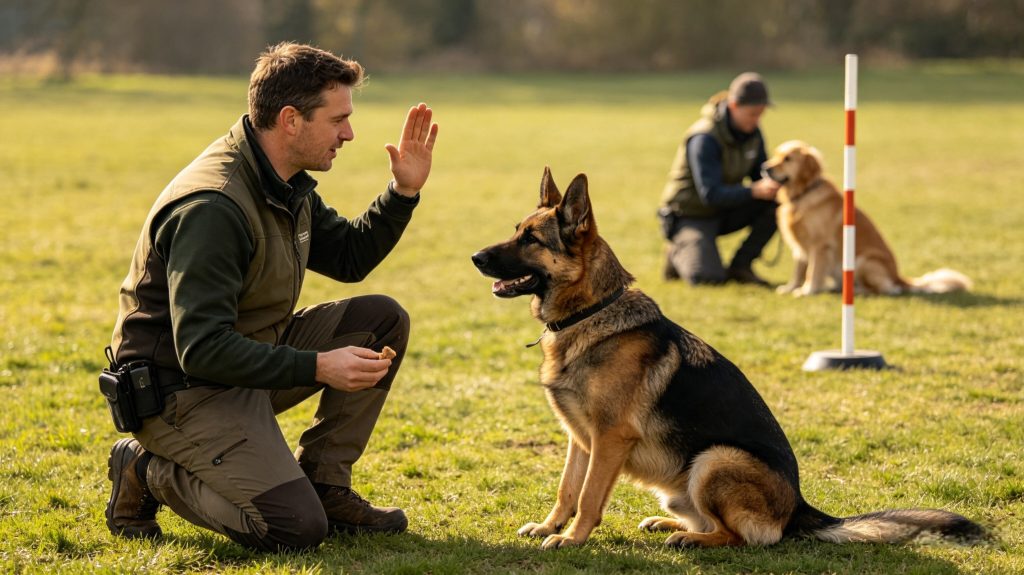
Step 3: Reward Calm Behaviour
When your dog sees another dog and remains calm, reward the behaviour.
Food can be useful if your dog is comfortable enough to eat. Play can also be appropriate when your dog finds it rewarding.
Step 4: Keep Training Short
Do not remain around other dogs for so long that your dog becomes overwhelmed.
Several successful short sessions can be more useful than one long session that ends with repeated reactions.
Step 5: Progress Gradually
When your dog can consistently remain calm, gradually increase the difficulty.
You might reduce the distance slightly or introduce a little more movement or distraction.
Only change one part of the exercise at a time.
What Should I Do If My Dog Starts Barking and Lunging?
Do not continue moving towards the other dog.
Increase distance and reduce the stimulation.
Avoid shouting or repeatedly giving commands while your dog is highly aroused. Once your dog has recovered enough to respond normally, reassess the situation.
If your dog cannot calm down, end the training session and allow proper recovery.
Should I Let My Dog Meet Other Dogs?
Not necessarily.
A dog does not need to greet every dog it sees.
If your dog barks and lunges, forcing close interactions can increase the problem and create a safety risk.
A more useful training goal may be teaching your dog to see another dog, remain calm and continue walking without needing to interact.
Should I Use Treats When Another Dog Is Nearby?
Yes, provided your dog is calm enough to eat and learn.
When your dog notices another dog and remains relaxed, provide an appropriate reward.
The timing matters. Reward calm behaviour before the reaction whenever possible.
If your dog refuses food they normally enjoy, the situation may be too difficult. Increase distance rather than trying to make the food more tempting.
What Equipment Should I Use?
Equipment should help you manage your dog safely while training.
Secure Harness and Lead
A secure harness and lead can help you maintain control and create distance from other dogs.
Short Line
A short line can provide closer management when other dogs are nearby or when you need your dog to remain close.
Long Line
A long line can be useful for controlled training in a suitable open environment.
It should only be used where your dog cannot reach other dogs, people, roads or other hazards.
Muzzle
A muzzle may be appropriate where there is a genuine risk of biting.
It should be introduced gradually and positively. A muzzle is a safety tool, not a way to force a dog into close contact with other dogs.
What If My Dog Is Calm Until Another Dog Gets Close?
Your dog may have a specific reaction distance.
For example, your dog might calmly watch another dog from a large distance but begin staring, stiffening and barking as the other dog approaches.
Do not wait until the dog is already lunging before responding.
Use the early signs to increase distance and keep your dog below the point where the reaction begins.
What If My Dog Barks and Lunges at Every Dog?
Start with management.
Choose quieter walking areas or times where possible and avoid situations where your dog repeatedly reacts.
Find the distance where your dog can notice another dog without immediately becoming reactive.
If the behaviour occurs almost every time your dog sees another dog, professional assessment can help identify the underlying cause and create a suitable training plan.
Can Socialisation Fix Barking and Lunging?
Socialisation does not mean forcing your dog to interact with more dogs.
Good socialisation involves helping a dog experience other dogs and environments in a way it can cope with.
For a reactive dog, this may mean calmly observing other dogs from a safe distance rather than meeting them.
The aim is to build appropriate responses, not simply increase the number of dog-to-dog interactions.
What If My Dog Has Already Fought Another Dog?
Take the situation seriously.
Do not deliberately recreate the interaction to see whether your dog behaves differently.
Prevent further close encounters while you assess what happened.
If your dog has injured another dog, been injured itself or continues to show aggressive behaviour, seek veterinary and professional behaviour support.
Why Has My Dog Suddenly Started Barking and Lunging?
A sudden change in behaviour should not automatically be treated as a training issue.
Pain or illness can affect behaviour, while a recent frightening experience may also change how your dog responds to other dogs.
If the change is sudden or unusual, arrange a veterinary assessment and consider what has changed in your dog’s environment or experiences.
Should I Punish My Dog for Barking and Lunging?
No.
Shouting, hitting or physically confronting your dog can increase fear, stress or frustration.
Punishment may stop the outward behaviour temporarily without addressing why the dog is reacting.
Instead, create distance, identify the trigger and reinforce calm, appropriate behaviour.
When Should I Get Professional Help?
Professional help is recommended if your dog:
- Lunges aggressively at other dogs
- Snaps or attempts to bite
- Has fought or injured another dog
- Is difficult to control
- Reacts unpredictably
- Is becoming increasingly reactive
- Cannot recover after seeing another dog
- Reacts at almost every opportunity
A qualified professional can assess the behaviour and help establish a safe management and training plan.
Conclusion
Dogs bark and lunge at other dogs for different reasons, including fear, frustration, overexcitement and overwhelm.
Do not force your dog closer to other dogs or punish the reaction. Create distance, recognise the early warning signs and reward calm behaviour at a level your dog can manage.
The aim is to help your dog learn that seeing another dog does not require barking and lunging. With appropriate management, gradual training and professional support when necessary, your dog can learn safer and more appropriate responses.