How to Use a Dog Crate Around Other Animals
Featured Image Description
How to Use a Dog Crate Around Other Animals
How to use a dog crate around other animals starts with understanding that a crate is a management tool designed to provide the dog with a secure and structured area.
When a dog lives with cats, rabbits, birds or other household animals, owners need to consider how movement, noise, smell and proximity can affect behaviour.
A common mistake is assuming that animals will automatically become comfortable with each other simply because they share the same home.
The crate can help create controlled separation, but it should not be treated as a substitute for appropriate supervision or gradual introductions.
RECOMMEND PRODUCTS
Why Dog Crate Structure Matters Around Other Animals
Other animals can behave unpredictably from a dog’s perspective.
A cat moving quickly across a room, another dog approaching the crate or a small animal making unfamiliar noises can increase excitement or curiosity.
The owner therefore needs to control the environment rather than simply allowing repeated exposure.
Learning how to use a dog crate around other animals means understanding when the crate can provide a quiet space and when additional separation or professional support is required.
The Crate Should Remain a Safe Space
The dog should be able to settle inside the crate without another animal constantly approaching, staring through the bars or attempting to interact.
The owner should protect this space.
If another animal repeatedly disturbs the dog while it is resting, the crate may stop functioning as the calm area it was intended to provide.
Common Human Mistakes When Other Animals Are Present
Many problems occur because owners move too quickly or assume that calm behaviour means animals are ready for direct interaction.
Allowing Animals to Approach the Crate
An owner may allow a cat, another dog or another household pet to repeatedly approach the crate because the dog appears calm.
However, repeated close interaction can increase arousal or frustration.
The owner should monitor the situation and create appropriate distance when required.
Using the Crate to Force Interaction
Another mistake is placing a dog inside a crate and allowing another animal to remain directly outside it for extended periods.
The crate should provide separation, not force the dog to remain close to something that is causing discomfort or excessive excitement.
Assuming the Crate Makes Interaction Safe
A crate provides physical management, but it does not automatically make every interaction safe.
Owners still need to observe both animals and manage the environment appropriately.
RECOMMENDED PRODUCTS
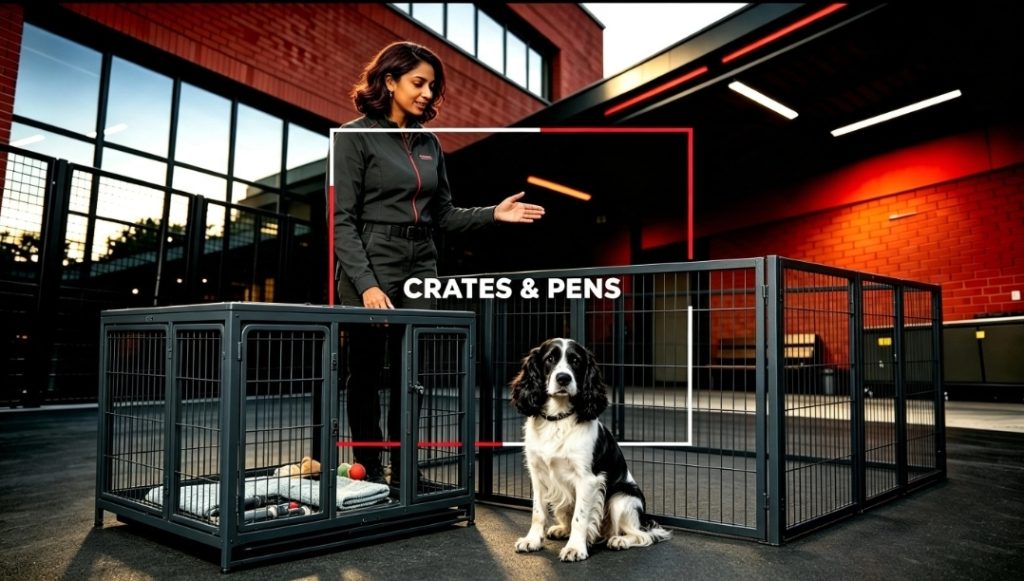
A secure, appropriately sized crate can provide a controlled resting area when a dog needs separation from other household animals.
Introducing a Dog to a Home With Other Animals
Introductions should be controlled rather than rushed.
The owner needs to consider the individual animals involved, their previous experiences and how they respond to movement and proximity.
A calm environment gives the owner more opportunity to observe behaviour accurately.
Start With Management
The dog does not need unrestricted access to every part of the home immediately.
Controlled areas allow the owner to establish structure while observing how the dog responds to other animals.
The crate can form one part of this structure, alongside appropriate physical separation and supervision.
Watch the Dog’s Body Language
Owners should observe changes in posture, attention, movement and arousal.
A dog that becomes increasingly focused on another animal may need more distance or a change in the environment.
The important point is to respond to the behaviour early rather than waiting until the dog becomes highly excited.
How to Use a Dog Crate Around Other Dogs
When multiple dogs live together, the crate can provide each dog with an opportunity to rest separately.
This can be particularly useful during feeding, household activity, training or periods when the dogs need individual downtime.
A common mistake is allowing dogs to remain together constantly because they appear to get along.
Dogs still need opportunities to disengage and rest.
The owner should therefore establish clear periods where each dog can settle independently.
How to Use a Dog Crate Around Cats
Cats move differently from dogs and can quickly change direction, climb furniture or move through areas the dog cannot access.
This movement can trigger curiosity or play behaviour.
The owner should avoid assuming that a dog is safe to interact freely with a cat simply because the dog has been calm while inside the crate.
Controlled exposure and appropriate separation remain important.
How to Use a Dog Crate Around Smaller Animals
Extra caution is required when the household contains rabbits, guinea pigs, birds or other small animals.
Some dogs can have a strong natural interest in small, fast-moving animals.
A crate can provide temporary separation, but owners should not deliberately encourage the dog to stare at or become highly excited by the animal.
The safest approach is controlled management and careful observation.
RECOMMENDED PRODUCTS
Secure containment can help owners create separate areas for dogs and other household animals while maintaining predictable routines.
Managing Excitement Around Other Animals
A dog may become excited when another animal moves nearby.
The owner’s response should focus on managing the dog’s state before the behaviour escalates.
If the dog becomes increasingly focused, vocal, restless or difficult to settle, the environment may need to be changed.
The crate can be used as a quiet resting area when appropriate, rather than as a place where the dog is deliberately exposed to another animal until it becomes overwhelmed.
When the Dog Should Be Separated
There are situations where separation should take priority.
If either animal is showing signs of fear, distress, repeated avoidance, excessive arousal or aggressive behaviour, the owner should increase distance and stop the interaction.
The goal is not to force animals to become friends.
The goal is to create a household environment where animals can be managed safely and calmly.
Where serious behavioural concerns are present, professional assessment from a GPK9 Dog Training Instructor may be appropriate.
RECOMMENDED COURSE

Golden Rule One: Home and Social
Golden Rule One: Home and Social teaches owners how to create structure within the home, establish appropriate boundaries and develop controlled freedom while helping the dog understand where it can rest and settle.
GOLDEN RULE ONE: HOME AND SOCIAL
Home and Social focuses on household structure and controlled freedom. The crate provides a defined area where the dog can rest while the owner manages its access to the wider home and other animals.
GOLDEN RULE TWO: OBEDIENCE
Obedience develops communication through food, luring, praise, shaping and movement. Clear communication helps the owner manage the dog’s behaviour when another animal becomes a distraction.
GOLDEN RULE THREE: PREY DRIVE / PLAY
Prey Drive / Play focuses on appropriate engagement and controlled play. Around other animals, the owner should recognise when natural excitement is increasing and manage the dog’s arousal before play becomes inappropriate.
GOLDEN RULE FOUR: TOILET TRAINING
Toilet Training creates predictable routines around timing and location. A structured routine can make household management easier when multiple animals share the same environment.
GOLDEN RULE FIVE: SOCIAL WALKING / IGNORE THE WORLD
Social Walking / Ignore the World develops calm behaviour around everyday distractions. Learning to remain relaxed around movement and environmental activity can support better management when other animals are present.
Creating Structure for Multiple Animals
How to use a dog crate around other animals is ultimately about responsible household management.
The owner should not rely on the crate alone or assume that physical containment automatically resolves behavioural problems.
Instead, the crate should form part of a wider structure that includes supervision, appropriate separation, controlled exposure and opportunities for the dog to rest.
The humans create the environment in which the animals learn.
When owners recognise problems early, avoid forcing interactions and provide each animal with appropriate space, the home can become more predictable and manageable for everyone.
RECOMMENDED PRODUCTS
Use secure, suitable equipment to provide the dog with a defined resting and management area when living alongside other animals.
Related GPK9 Articles
- Why Use a Dog Crate? Understanding Crate Training
- How to Use a Dog Crate to Create Structure at Home
- How to Use a Dog Crate During Busy Household Activity
- How to Use a Dog Crate Safely Around Children
- Common Dog Crate Training Mistakes and How to Avoid Them
- How to Calm an Overexcited Dog at Home
- How to Teach a Dog to Settle at Home