
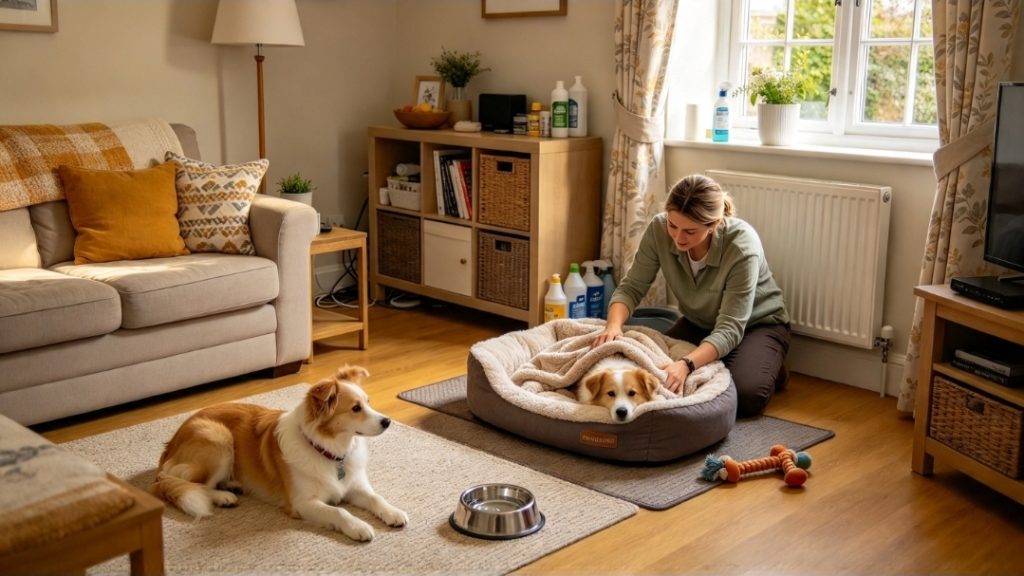
How Do I Create a Better Home Environment for My Dog?
Creating a better home environment for your dog starts with establishing consistent routines, clear household expectations and positive everyday interactions. Dogs need to understand what is expected of them, where they can rest, how to behave around people and how to navigate the activities of family life.
A suitable home environment is not simply about having enough space or providing toys and a comfortable bed. It also involves the way you organise daily life, introduce new experiences, manage boundaries and respond to your dog’s behaviour.
When expectations are consistent and the environment suits your dog’s needs, you can make everyday life more predictable and support learning, settling and appropriate behaviour.
GPK9’s Home & Social approach focuses on these foundations. It helps you consider how the home environment, household routines, social experiences and human interaction contribute to your dog’s everyday behaviour.
Why Is the Home Environment Important for Dogs?
Your dog learns from everyday experiences. The way you manage feeding, resting, play, visitors, household activity and access to different areas can influence the behaviours your dog practises and develops.
For example, if your dog receives attention whenever it jumps up, jumping may become a familiar way of gaining interaction. If you consistently reward your dog for greeting people calmly, you give it an opportunity to learn a more appropriate alternative.
Likewise, a dog that is constantly disturbed while resting may struggle to settle, while a dog that has no clear routine may find it harder to anticipate what happens next.
The aim is to create an environment that makes appropriate behaviour easier to learn and maintain.
This does not mean expecting your dog to behave perfectly at all times. Dogs need time to adjust, practise new skills and learn how to cope with different situations. Puppies, rescue dogs and dogs with previous negative experiences may need additional patience and support.
1. Establish Consistent Household Routines
How Do Routines Help Dogs Adapt to Family Life?
A consistent daily routine helps your dog become familiar with the rhythm of household life. Regular opportunities for feeding, toileting, exercise, training, interaction and rest can make the day easier to manage.
Your routine does not need to follow an exact timetable every minute. The important thing is to provide suitable opportunities throughout the day and avoid unnecessary unpredictability where possible.
Consider establishing a routine that includes:
- Regular feeding times appropriate to your dog’s needs.
- Frequent toilet opportunities, particularly for puppies.
- Suitable exercise, play and mental stimulation.
- Short, manageable training sessions.
- Quiet periods when your dog can rest without disturbance.
- Consistent arrangements for visitors and other household activities.
A routine should reflect your dog’s age, health, temperament and individual needs. A young puppy will generally require more frequent toilet breaks and rest opportunities than a healthy adult dog.
It is also important to balance activity with recovery. Constant interaction, excitement and stimulation can make it difficult for some dogs to settle, particularly when they have not yet learned how to relax around normal household activity.
How Can You Make Household Expectations Clear?
Think about the behaviours you want to encourage in everyday situations. For example, decide where your dog is allowed to rest, how you want it to greet visitors and which areas of the home are accessible.
Make these expectations consistent across the household. If one person encourages a behaviour while another regularly discourages it, your dog may receive conflicting information.
For practical guidance on putting these expectations into place, explore Home Training and House Rules — Establishing Household Rules. This course builds on the Home & Social foundation by focusing on household routines, boundaries, access and the everyday habits that help a dog understand how to live successfully with its family.
2. Create Clear and Consistent Boundaries
What Boundaries Should a Dog Have at Home?
Boundaries help your dog understand which behaviours are appropriate in different parts of the home and during everyday interactions.
They may include where your dog sleeps, whether it is allowed on particular furniture, how it should behave around food, and what happens when family members are eating, working or relaxing.
There is no single set of household rules that suits every family. What matters is choosing reasonable expectations that fit your circumstances and applying them consistently.
For example, if you do not want your dog jumping up at visitors, teach and reward an alternative behaviour, such as keeping four paws on the floor or settling in a designated place. Simply telling the dog not to jump without showing it what to do instead may leave it unsure how to respond.
Consider the following principles:
- Decide which household rules matter most to your family.
- Make those rules clear and consistent.
- Manage access to areas where your dog is not yet reliable.
- Reward the behaviours you want to see repeated.
- Avoid giving your dog opportunities to practise unwanted behaviours unnecessarily.
- Make sure everyone involved in the dog’s care understands the agreed expectations.
Boundaries should be taught through appropriate guidance and management, not through intimidation or harsh punishment.
What If My Dog Keeps Breaking the Rules?
If your dog repeatedly ignores a household expectation, consider whether it has actually learned the behaviour you want.
Ask yourself whether the cue is clear, whether the situation is too distracting, whether the behaviour has been practised enough and whether your dog is receiving attention or another reward for doing the opposite.
You may need to simplify the situation, manage access more effectively or reward the desired behaviour more consistently.
This is where Golden Rule One — Home & Social: Creating a Better Home and Social Environment provides the wider foundation. It focuses on the relationship between home life, routines, boundaries, communication and social experiences, helping you approach household behaviour as part of an overall training system rather than as a collection of unrelated problems.
3. Give Your Dog a Suitable Place to Rest and Settle
Why Is Rest Important in the Home?
Dogs need opportunities to rest without being continually disturbed. A suitable resting area gives your dog somewhere to relax away from busy household activity when it needs a break.
Choose a location that suits your dog and your home. Consider noise levels, foot traffic, temperature, comfort and whether the dog can rest without children, visitors or other pets repeatedly interrupting it.
Teach family members to respect the dog’s resting space. Children should be supervised around dogs and should not be allowed to climb on, disturb or handle a dog that is trying to rest.
Settling is also a skill that can be developed gradually. You can reward your dog for relaxing on a bed or mat, remaining calm while everyday activities take place and returning to rest after play or training.
Do not assume that a dog that is physically tired will automatically know how to settle. Some dogs need help learning how to relax in an appropriate environment.
Can Crate Training Help a Dog Settle?
For some dogs, a properly introduced crate can provide a comfortable place to rest. However, a crate is not essential for every dog, and it should never be used as punishment or as a substitute for suitable exercise, interaction, supervision and toilet opportunities.
If you choose to use one, introduce it gradually and help your dog build a positive association with the space. Give the dog time to become comfortable rather than forcing it to remain inside when it is frightened or distressed.
The aim is to help your dog feel safe and relaxed, not simply to keep it contained.
The Crate Training and Settling — Teaching Your Dog to Settle course develops this subject in greater detail. It explains how appropriate crate introduction and settling routines can support the wider Home & Social approach, while recognising the importance of your dog’s comfort and individual responses.
4. Help Your Dog Develop Positive Social Skills
How Should You Introduce People, Dogs and New Experiences?
Social experiences are an important part of everyday life, but more exposure is not automatically better. Dogs need opportunities to become familiar with suitable people, animals, places, sounds and activities at a pace they can manage.
A positive social experience does not require your dog to greet every person or interact with every dog. Sometimes the best experience is calmly observing something from a comfortable distance.
Pay attention to your dog’s behaviour. Does it approach voluntarily, remain relaxed and continue exploring? Or does it repeatedly move away, hide, become stiff, bark or appear unable to settle?
No single body-language signal should be interpreted in isolation. Consider the overall situation and how your dog behaves before, during and after an interaction.
To support positive social learning:
- Introduce unfamiliar experiences gradually.
- Allow your dog suitable distance from people, dogs and other distractions.
- Avoid forcing greetings or physical contact.
- Reward calm, appropriate behaviour.
- Provide opportunities to retreat from situations that become uncomfortable.
- Adjust the experience when your dog appears overwhelmed.
Puppies benefit from suitable early social experiences, but adult dogs also continue learning throughout life. A rescue dog or a dog with limited previous exposure may need a particularly gradual approach.
If your dog shows persistent fear, severe reactivity or aggression, seek appropriate professional guidance rather than deliberately placing it in difficult situations.
How Does Socialisation Connect With Home Training?
The way a dog behaves around visitors, family members and other animals is closely connected to its everyday environment. Clear household routines can help you manage introductions, while consistent expectations help everyone understand how to support the dog.
However, socialisation is not the same as teaching a dog to tolerate every interaction. It is about helping the dog develop appropriate responses and providing experiences suited to its individual needs.
The Socialisation and Social Skills — Developing Positive Social Skills course expands on this area by exploring experiences with people, dogs, places and environments. It complements Home & Social by helping you consider how to introduce experiences thoughtfully, recognise your dog’s comfort level and build confidence without overwhelming it.
5. Understand How Your Dog Responds to Human Interaction
Why Does the Way You Interact With Your Dog Matter?
Your behaviour is part of your dog’s home environment. The way you approach, touch, praise, play with and communicate with your dog can influence how it experiences everyday life.
People often assume that their dog will enjoy the same interactions every time. In reality, a dog may welcome attention when relaxed but prefer space when tired, uncertain or overstimulated.
For example, a dog approaching you may be seeking contact, play or attention. A dog turning away or moving out of reach may be communicating that it does not want the interaction to continue at that moment.
Observe the whole situation rather than relying on one signal. Consider your dog’s posture, movement, facial expression and willingness to remain involved.
You can support better interactions by:
- Allowing your dog to approach voluntarily when appropriate.
- Recognising when it welcomes attention and when it needs space.
- Avoiding forced cuddling or handling.
- Using rewards that your individual dog finds motivating.
- Keeping play appropriate to the situation.
- Adjusting your behaviour when your dog responds differently than expected.
This does not mean avoiding affection. It means making affection and interaction appropriate for the dog in front of you.
How Does FUSS With Purpose Support Home & Social?
The FUSS With Purpose — Understanding Your Dog’s Responses to Interaction course explores how dogs experience affection, touch, attention, play, food, praise and everyday interaction.
It complements Home & Social by helping you look beyond your own intentions and consider how your dog responds. This is useful when establishing household expectations because the same interaction can affect different dogs in different ways.
For example, if your dog becomes excited whenever someone arrives, simply telling it to calm down may not address what is driving the behaviour. You can instead consider the environment, the way the greeting is managed, the behaviour being encouraged and whether your dog needs a different routine.
FUSS encourages a more considered approach: observe your dog, interpret its response, decide how to proceed, communicate clearly and reassess the outcome.
By applying this understanding to everyday life, you can make better decisions about attention, handling, rewards, play and boundaries.
6. Manage the Environment Before Problems Develop
How Can You Prevent Unwanted Behaviour at Home?
Good home management is not just about responding when something goes wrong. It also involves arranging the environment so your dog has appropriate opportunities to succeed.
If your puppy repeatedly chews shoes, for example, place shoes out of reach and provide suitable alternatives. If your dog becomes overexcited when visitors arrive, plan how to manage the greeting before opening the door.
Environmental management can include:
- Keeping potentially dangerous objects and unsuitable food out of reach.
- Providing suitable toys and activities.
- Using doors, gates or other appropriate barriers when needed.
- Supervising puppies and dogs that are still learning household rules.
- Planning visitor introductions.
- Providing quiet space when the home becomes busy.
- Keeping routines appropriate to the dog’s needs.
Management is not a replacement for training. It reduces opportunities for unwanted behaviour while you teach the dog what to do instead.
If a behaviour continues, look at the circumstances in which it occurs. A dog that barks at the window may be responding to movement outside. A dog that becomes unsettled in the evening may need a change to its activity, rest or routine. The cause should be considered rather than assuming all unwanted behaviour has the same explanation.
7. Make Sure Everyone in the Household Is Consistent
What If Family Members Have Different Rules?
Dogs can find it harder to understand expectations when people respond differently to the same behaviour.
For example, if one person encourages jumping during greetings while another discourages it, your dog receives inconsistent information. Similarly, if the dog is allowed to disturb someone who is resting but expected to remain quiet at other times without clear guidance, the expectation may be difficult to learn.
Agree on a small number of important household rules and make sure everyone understands how to apply them.
Discuss:
- Where the dog is allowed to rest.
- How greetings should be managed.
- Which areas of the home are accessible.
- How food, toys and other resources are managed.
- What the dog should do when the household is busy.
- How family members should respond to unwanted behaviour.
Children should be taught appropriate, supervised interactions with dogs. They should never be expected to manage a dog’s fear, guarding or aggressive behaviour themselves.
Consistency does not mean responding mechanically in every situation. Your dog’s age, health, emotional state and circumstances still matter. It means giving clear guidance while adapting to what the dog needs.
How Do the GPK9 Home & Social Courses Work Together?
Creating a better home environment is not one isolated task. It involves understanding the overall household, teaching clear expectations, supporting rest, introducing suitable social experiences and recognising how your dog responds to people.
The GPK9 courses address different parts of this process:
- Golden Rule One — Home & Social provides the wider foundation for understanding household routines, boundaries, social experiences and everyday expectations.
- Home Training and House Rules develops the practical side of establishing consistent rules, managing access and encouraging appropriate habits throughout family life.
- Crate Training and Settling focuses on helping a dog become comfortable with appropriate resting arrangements and developing settling routines.
- Socialisation and Social Skills explores how to introduce people, dogs, places and experiences while considering the individual dog’s comfort.
- FUSS With Purpose helps you understand how your dog experiences affection, attention, handling, play and other everyday interactions.
These courses complement one another, but you do not need to treat every household challenge as the same problem. Start with the area most relevant to your circumstances, then explore additional guidance where it would help you develop a more complete understanding.
What Should I Do First to Improve My Dog’s Home Environment?
Start by observing an ordinary day in your home. Look at when your dog eats, rests, plays, receives attention, meets visitors and has opportunities to learn.
Ask yourself three questions:
- Are our routines suitable and reasonably consistent? Check whether your dog receives appropriate opportunities for rest, activity, toileting and interaction.
- Are our household expectations clear? Identify any rules that different family members apply inconsistently.
- How does my dog respond to its environment? Notice when it settles comfortably, becomes excited, seeks attention or appears uncomfortable.
Choose one or two practical changes rather than attempting to change everything at once. For example, you might establish a more consistent evening routine, create a quieter resting area or plan calmer greetings with visitors.
Give your dog time to learn, reward appropriate behaviour and review whether the changes are helping. If a problem is severe, persistent or creates a safety concern, seek suitable professional advice.
Conclusion: Build a Home Environment That Helps Your Dog Succeed
Creating a better home environment for your dog involves more than setting rules. It means developing consistent routines, teaching appropriate household behaviour, supporting rest, managing the environment and providing suitable social experiences.
Just as importantly, it means recognising that your dog is an individual. Its age, previous experiences, temperament and responses should all influence how you approach training and everyday interactions.
The GPK9 Home & Social foundation helps bring these elements together. Start with Golden Rule One — Home & Social to understand the wider principles, then explore Home Training and House Rules, Crate Training and Settling, Socialisation and Social Skills and FUSS With Purpose for more focused guidance.
By combining clear expectations with appropriate management and a better understanding of your dog’s responses, you can create a more predictable home environment and give your dog a stronger foundation for everyday family life.




