
Crate Training and Settling
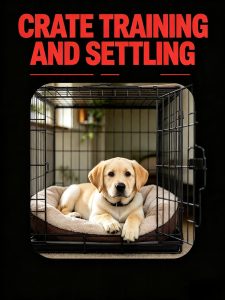
£14.99
Learn how to use a dog crate correctly, safely and responsibly — from the first introduction through to settling, freedom and welfare.
Crate training should never be about simply putting a dog behind a closed door. A properly used crate can provide a safe, comfortable and predictable resting environment, while poor crate management can create unnecessary stress, toileting problems and behavioural difficulties.
This practical course explains how to introduce and use a crate appropriately while considering the individual dog, age, previous experience, environment, toilet needs, comfort, welfare and developing behavioural responsibility.
What You’ll Learn
This course covers:
- How long crate training can realistically take
- How long puppies can appropriately remain in a crate
- How long an adult dog should stay in a crate
- Whether puppies should sleep in a crate
- Crating your puppy at night
- Why puppies cry in the crate
- Why dogs may struggle to settle
- When to leave the crate door open
- When a dog may no longer need regular crating
- When a puppy can begin having more freedom
- Whether crate training can be cruel
- What should and should not be placed inside a crate
- How to choose an appropriate crate size
- Why a crate must allow a dog to stand, turn, stretch and lie naturally
- Why an excessively large crate can create toilet-training difficulties
- How crate size can affect a puppy’s sleeping and toileting behaviour
- Why dogs generally prefer to keep their sleeping area clean
- How previous experiences of sleeping around urine or faeces can affect toilet training
- How cleanliness and appropriate toilet opportunities support welfare
- How to recognise when a crate is supporting the dog rather than simply containing it
- How to increase freedom as behavioural responsibility develops
- How to recognise signs that the dog is comfortable, unsettled or distressed
A Welfare-Focused Approach
The course places particular emphasis on understanding why the crate is being used.
A suitable crate should provide:
SAFETY → COMFORT → REST → APPROPRIATE MANAGEMENT
It should not become:
PUNISHMENT → EXCESSIVE CONFINEMENT → NEGLECTED TOILET NEEDS → DISTRESS
You’ll learn how crate size, bedding, water, location, cleanliness, toilet opportunities and the surrounding household environment all contribute to the dog’s welfare.
Crate Size and Toilet Training
One of the most important areas covered is choosing the appropriate crate size.
Your dog needs enough space to:
- Stand comfortably
- Turn around
- Stretch
- Lie naturally
- Change position
However, simply buying the largest crate possible is not always appropriate for a young puppy.
If there is excessive unused space, a puppy may be able to sleep at one end and toilet at the other. This can make toilet training more difficult.
You’ll learn how to balance welfare, comfort and appropriate environmental management, including how a divider may be useful as a puppy grows.
The course also explains why a puppy that has previously been kept in an environment where it regularly slept around urine or faeces may have developed different toileting habits and why those habits can require patience and careful management to change.
Learn to Read the Dog
The course also teaches you to look beyond whether the dog is simply quiet.
A dog can be silent without necessarily being comfortable.
You’ll learn to observe:
- Body posture
- Restlessness
- Panting
- Scratching
- Attempts to escape
- Settling
- Sleeping
- Willingness to enter
- Toileting behaviour
- Ability to recover
- Signs of discomfort or distress
The aim is to understand what the dog’s behaviour is telling you and adjust the environment accordingly.
Gradual Freedom
The crate should not become a permanent substitute for appropriate freedom.
As the dog develops reliability, freedom can gradually increase.
You’ll learn how to assess whether the dog is ready to:
CRATE → SUPERVISED FREEDOM → GREATER HOUSEHOLD ACCESS → INCREASED INDEPENDENCE
The central principle is:
MORE FREEDOM REQUIRES MORE BEHAVIOURAL RESPONSIBILITY.
Who Is This Course For?
This course is suitable for:
- New puppy owners
- Existing dog owners
- Owners introducing a crate for the first time
- Owners struggling with puppy crate training
- Owners experiencing toileting problems in the crate
- Owners unsure whether their crate is the correct size
- Owners wanting to improve their dog’s settling behaviour
- Anyone wanting to understand responsible crate use and canine welfare
Course Price
£14.99
A focused, affordable course designed to give dog owners a clearer understanding of crate training, settling, crate size, toilet training, welfare and progressive freedom.
The objective is not simply to teach a dog to stay inside a crate.
It is to help the owner understand when, why and how a crate should be used, while keeping the dog’s safety, comfort, welfare and behavioural development at the centre of the process.