How Do I Stop My Dog Reacting to People?
How do I stop my dog reacting to people? Start by identifying why your dog reacts, keeping enough distance for your dog to remain calm, and gradually teaching a more appropriate response using positive reinforcement. Do not force your dog to approach people or punish barking, growling, lunging or other warning behaviour. The aim is to help your dog feel more comfortable and learn that it does not need to react whenever a person is nearby.
RECOMMENDED PRODUCTS

Why Does My Dog React to People?
A dog can react to people for several different reasons.
Your dog may be:
- Frightened or nervous.
- Uncomfortable with close contact.
- Frustrated.
- Overexcited.
- Protecting its space.
- Reacting to a previous negative experience.
- Overwhelmed by unfamiliar people or busy environments.
The same outward behaviour can have different causes, so it is important to observe what happens before the reaction.
What Does a Dog Reacting to People Look Like?
A reaction can include barking, growling, lunging, pulling, staring, freezing, hiding, backing away or attempting to escape.
Some dogs become more obvious as a person gets closer. Others may react as soon as they see someone.
Watch for early signs such as:
- Staring intensely.
- Becoming stiff or tense.
- Stopping or slowing down.
- Pulling towards or away from the person.
- Repeatedly watching the person.
- Becoming unable to respond normally.
Recognising these signs gives you an opportunity to intervene before the reaction becomes intense.
What Should I Do When My Dog Reacts to Someone?
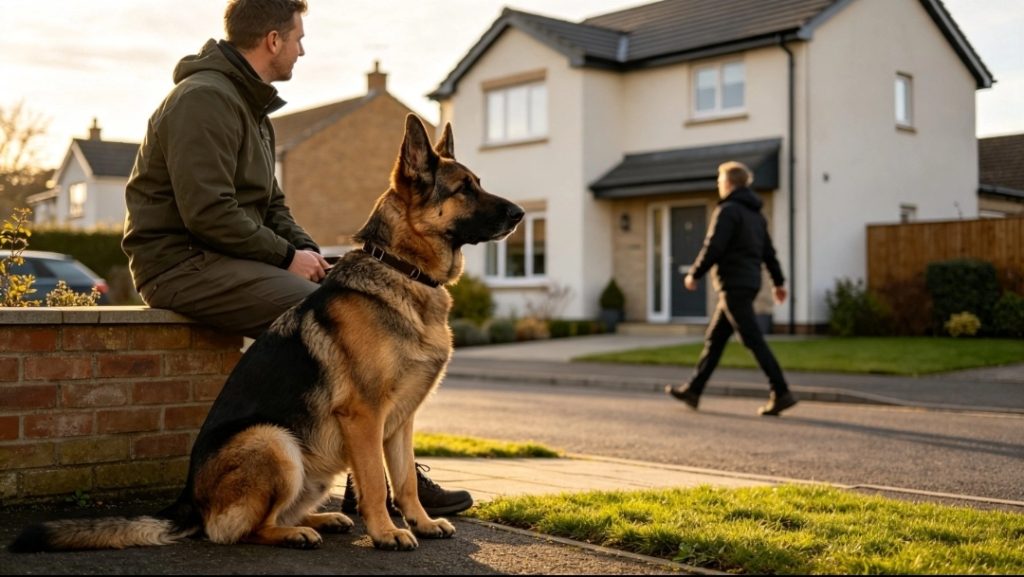
Your first priority is to create distance.
Move your dog away from the person, change direction or use available space to make the situation easier.
Do not force your dog to remain close to someone while it is frightened or highly aroused.
Once your dog is calm enough to think and respond again, reassess the situation.
How Do I Train My Dog to Stop Reacting to People?
Step 1: Identify the type of person or situation that triggers the reaction
Work out whether your dog reacts to:
- Strangers.
- Men.
- Women.
- Children.
- People wearing certain clothing.
- People approaching directly.
- People entering the home.
- People moving quickly.
- People who try to touch your dog.
This information helps you understand what your dog is finding difficult.
Step 2: Find the right training distance
Start far enough away that your dog can see a person without immediately reacting.
If your dog is already barking, lunging, growling or trying to escape, increase the distance.
The correct starting distance is the one where your dog can notice the person while still being able to think and respond.
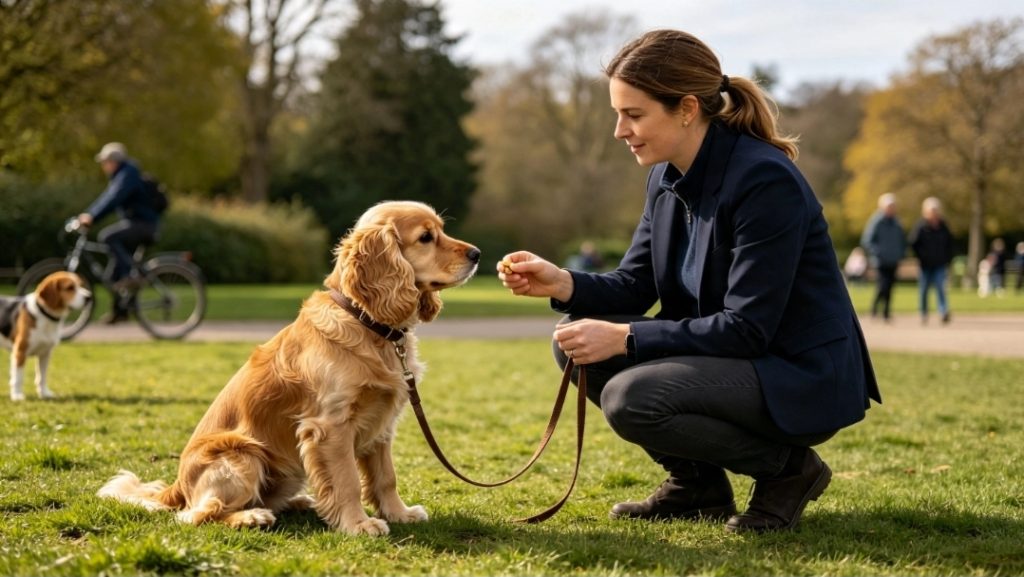
Step 3: Reward calm behaviour
When your dog notices a person and remains calm, reward that behaviour.
You can use food, play or another reward your dog values.
Reward behaviours such as looking at the person without reacting, looking back towards you, remaining relaxed or continuing to walk calmly.
Step 4: Increase difficulty gradually
Once your dog can remain calm around people at the starting distance, gradually make the situation more difficult.
You might reduce the distance, introduce a quieter person first, or eventually practise around more movement and distractions.
Do not make the exercise difficult too quickly.
Should I Let Strangers Touch My Dog?
No, not if your dog is uncomfortable.
Your dog does not need to be touched by every person it meets.
If your dog is nervous or reactive, ask people to give your dog space. Allow your dog to become comfortable with people without forcing physical contact.
A dog that learns it can remain at a safe distance does not need to use a reaction to make people move away.
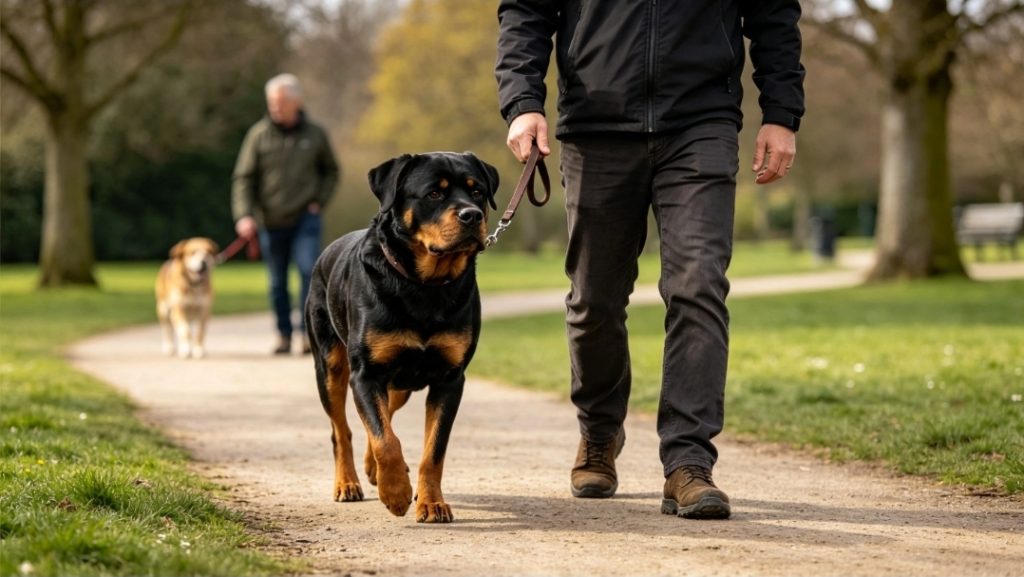
How Do I Stop My Dog Reacting to People on Walks?
Create as much space as necessary.
If someone is approaching, move to the side of the path, cross the road or change direction when appropriate.
Reward your dog for remaining calm and focusing on you.
Do not wait until the person is close enough to trigger a reaction before deciding what to do.
What if someone wants to greet my dog?
You can simply tell them that your dog is training and needs space.
You do not have to allow a greeting just because someone wants to interact with your dog.
Controlled exposure is more useful than repeated forced greetings.
How Do I Stop My Dog Reacting to Visitors?
Visitors can be particularly difficult because they enter your dog’s home and may move around unpredictably.
Before opening the door, make sure you can manage your dog safely.
If necessary, use a crate or secure area to give your dog space while the visitor enters and settles.
Once your dog is calm enough to cope, you can gradually work on controlled exposure to the visitor.
Do not allow a visitor to approach, touch or crowd your dog if the dog is uncomfortable.
What Equipment Can Help?
A suitable harness and lead can provide safe control when training outside.
A short line may be useful when you need closer management.
A longer line may be appropriate in a secure environment once your dog has developed enough control for greater freedom.
At home, a crate can provide a secure recovery area when your dog needs space from visitors or household activity.
Equipment should support training and safety. It should not be used to force your dog into an interaction.
If your dog presents a genuine risk of biting, a properly introduced muzzle may provide an additional safety measure. It should be introduced gradually and positively.
RECOMMENDED PRODUCTS
Can Treats Help My Dog Stay Calm Around People?
Yes, if your dog is calm enough to eat and learn.
Reward your dog when it notices a person without reacting, looks towards you or chooses to remain calm.
If your dog refuses food, becomes highly focused or begins reacting, the situation may be too difficult.
Increase the distance and allow your dog to recover before trying again.
Should I Punish My Dog for Barking or Growling at People?
No.
Barking and growling can be important communication signals.
Punishing these behaviours may increase fear or stress without resolving the reason your dog is reacting. It can also suppress warning behaviour without changing how the dog feels.
Instead, identify the trigger, create distance and reinforce calmer behaviour.
What If My Dog Reacts to Everyone?
If your dog reacts to almost everyone, focus on management first.
Choose quieter environments where possible, avoid unnecessary close interactions and give your dog enough space to remain calm.
Start training with controlled situations rather than exposing your dog repeatedly to large numbers of people.
If your dog is reacting from a very large distance or cannot recover after seeing people, professional help is recommended.
What If My Dog Reacts to Children?
Take particular care around children.
Children can move quickly, make sudden noises and behave unpredictably from a dog’s perspective.
Do not force interaction between a reactive dog and a child.
Create distance and use appropriate management to prevent the dog from becoming overwhelmed.
If there is any realistic risk of a bite, keep the dog and child safely separated and seek professional help.
What If My Dog Tries to Bite Someone?
Treat this as a serious safety issue.
Prevent your dog from reaching people and avoid situations where a bite could occur.
Do not rely on training alone to manage an immediate safety risk.
A properly introduced muzzle may provide additional protection where appropriate, but professional assessment should be sought to address the underlying behaviour.
If your dog has bitten someone, seek help from a suitably qualified behaviour professional and discuss any sudden behavioural change with your vet.
What If My Dog Reacts During Training?
Do not continue increasing the difficulty.
Create distance and allow your dog to recover.
Then consider why the situation became too difficult. The person may have been too close, moving too quickly, approaching directly or the training session may have gone on for too long.
Use the reaction as information and make the next training session easier.
How Long Does It Take to Stop a Dog Reacting to People?
There is no fixed timeframe.
Some dogs improve relatively quickly once the trigger and correct training distance are established. Others require months of consistent management and training.
Progress may appear as:
- Less intense reactions.
- Faster recovery.
- Greater distance tolerance.
- Better attention towards you.
- Less pulling or barking.
- Increased ability to remain calm around people.
Do not judge progress only by whether your dog reacts. Being able to recover and make a better choice is also meaningful progress.
When Should I Get Professional Help?
Seek professional help if your dog:
- Attempts to bite people.
- Has bitten someone.
- Cannot be safely controlled around people.
- Reacts from a very large distance.
- Is becoming increasingly difficult to manage.
- Cannot recover after a reaction.
- Has suddenly developed serious reactions.
A sudden change in behaviour should also be discussed with your vet because pain or an underlying medical problem can contribute to behavioural changes.
Conclusion
To stop your dog reacting to people, understand what triggers the behaviour, create enough distance for your dog to remain calm and reward appropriate responses.
Do not force your dog to interact with people or punish warning behaviours such as growling.
Start with manageable situations, recognise your dog’s early signs of discomfort and gradually increase the difficulty as your dog’s confidence and ability to cope improve.
GPK9 — The Five Golden Rules
The GPK9 Five Golden Rules provide the foundation of the GPK9 Professional Training System. They give new dog owners, new dog handlers, experienced handlers and professional dog trainers a clear structure for developing the dog and the handler together.
The GPK9 Five Golden Rules cover five essential areas of development: Home & Social, Obedience, Prey Drive, Toilet and Social Walking. Each area has its own purpose, but they are designed to work together as one complete training system.
The GPK9 approach is based on CATEGORY → STATUS → DRIVE → CONTROL and the handler’s ability to OBSERVE → INTERPRET → DECIDE → COMMUNICATE → OBSERVE RESPONSE → REASSESS. This gives the handler a consistent process for understanding what the dog is doing, why the behaviour is occurring, what level of control is appropriate and how to communicate effectively.
The purpose of the GPK9 Five Golden Rules is not simply to teach a collection of individual exercises. They are designed to develop the dog’s behaviour, motivation, communication, control and reliability while teaching the handler how to make better decisions.
Golden Rule One — Home & Social
Golden Rule One — Home & Social establishes the foundation for everyday life with the dog. It focuses on communication, boundaries, calm behaviour, household routines and appropriate behaviour around people, animals and normal activity.
The purpose of Golden Rule One — Home & Social is to help the handler understand the dog’s behaviour and recognise changes in arousal before they become larger problems. The handler learns to observe, assess and communicate rather than simply reacting after unwanted behaviour has already occurred.
Golden Rule One — Home & Social provides the foundation from which the handler can develop a calmer, more predictable and better-communicating dog.
Golden Rule Two — Obedience
Golden Rule Two — Obedience develops the dog’s ability to understand and respond to the handler’s communication.
The focus of Golden Rule Two — Obedience is not simply teaching commands. It is about developing understanding, reliability, timing, reward, release and control so the dog learns what the handler is communicating.
Through Golden Rule Two — Obedience, the handler learns to progress training appropriately, gradually increasing the dog’s freedom and responsibility as understanding and reliability improve.
Golden Rule Three — Prey Drive
Golden Rule Three — Prey Drive focuses on understanding and developing the dog’s natural motivation to chase, pursue, engage and work with an appropriate toy or prey-based reward.
The purpose of Golden Rule Three — Prey Drive is not simply to increase drive. The handler must learn how to recognise the dog’s level of motivation, select an appropriate reward and use timing, communication and control to channel that motivation productively.
Golden Rule Three — Prey Drive teaches the handler that motivation can become a powerful training tool when it is developed and controlled correctly.
Golden Rule Four — Toilet
Golden Rule Four — Toilet establishes reliable toilet habits through consistency, observation, timing, supervision and appropriate reinforcement.
The handler learns through Golden Rule Four — Toilet to recognise when the dog is likely to need the toilet, provide the correct opportunity and reinforce the desired behaviour.
The objective of Golden Rule Four — Toilet is to establish a predictable routine that helps the dog understand where and when toileting is appropriate while reducing opportunities for mistakes.
Golden Rule Five — Social Walking
Golden Rule Five — Social Walking develops the dog’s ability to walk calmly and appropriately in the real world while remaining connected to the handler.
The focus of Golden Rule Five — Social Walking is the relationship between the handler, the dog, the environment, distractions, distance and available control.
Through Golden Rule Five — Social Walking, the handler learns to observe body language, identify potential triggers, assess distance and recognise changes in drive or arousal before behaviour escalates.
The objective of Golden Rule Five — Social Walking is not simply to make the dog walk beside the handler. It is to develop a dog that can experience the outside world while remaining connected to the handler and capable of responding to clear communication.
How the Five Golden Rules Work Together
The GPK9 Five Golden Rules are designed to work together rather than being treated as five completely separate subjects.
Golden Rule One — Home & Social establishes the foundations for everyday behaviour and communication.
Golden Rule Two — Obedience develops understanding, responsiveness and control.
Golden Rule Three — Prey Drive develops motivation and teaches the handler how to channel natural drive appropriately.
Golden Rule Four — Toilet establishes essential household routine and reliability.
Golden Rule Five — Social Walking takes the communication and control developed through the other areas into the outside environment.
Together, the GPK9 Five Golden Rules help the handler develop a complete understanding of the dog rather than treating individual behaviours as isolated problems.
The overall objective of the GPK9 Five Golden Rules is to train the human, train the dog and build the partnership through clear observation, communication, appropriate control and progressive development.