How to Deliver Food Rewards Correctly in Dog Training
GPK9 Blog Category
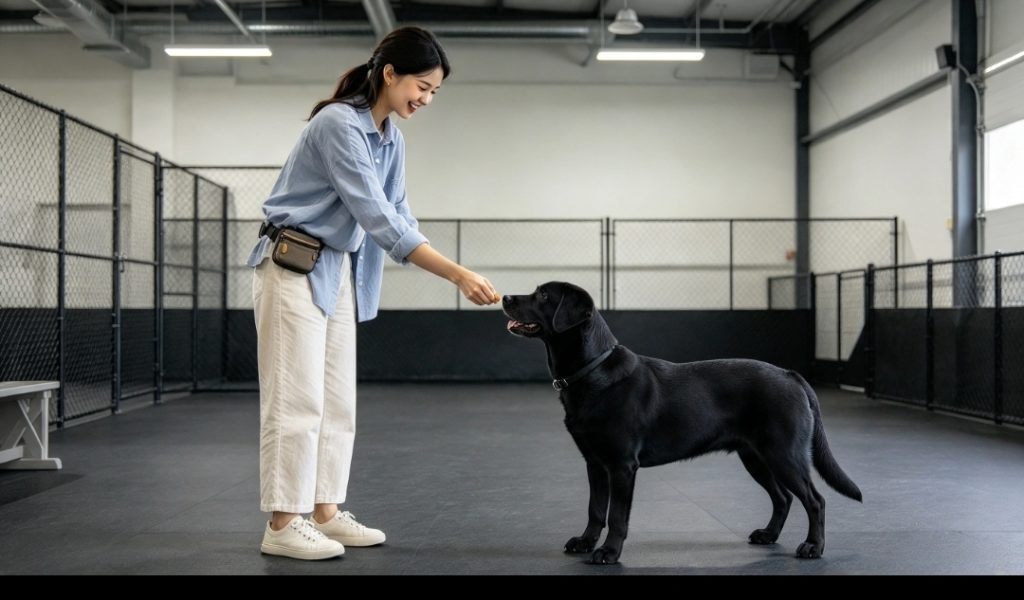
Create a professional, realistic educational dog-training photograph showing a 9-month-old male Labrador Retriever with a short black coat during a structured food-reward exercise. The dog should be standing calmly in front of an adult female handler, with its attention focused on the handler’s hand as a small food reward is being delivered directly and calmly at the dog’s mouth level. The handler should have a relaxed upright posture and use one hand to deliver the reward while keeping the movement controlled and deliberate. Show the dog’s attentive expression, relaxed mouth, focused eyes and balanced four-foot stance. The handler should have a small treat pouch positioned at the waist with additional training rewards available. The setting should be a professional indoor training facility with a dark-grey rubberised floor, neutral walls, black metal fencing and subtle industrial features. Use clean professional lighting and an eye-level camera angle that clearly shows the moment of reward delivery and the relationship between the dog’s mouth, the handler’s hand and the reward. The composition should communicate calm, precise reward delivery rather than excitement or feeding. Professional realistic educational photography, no logos, watermarks, unnecessary text, unrelated people or distracting objects.
How to Deliver Food Rewards Correctly in Dog Training
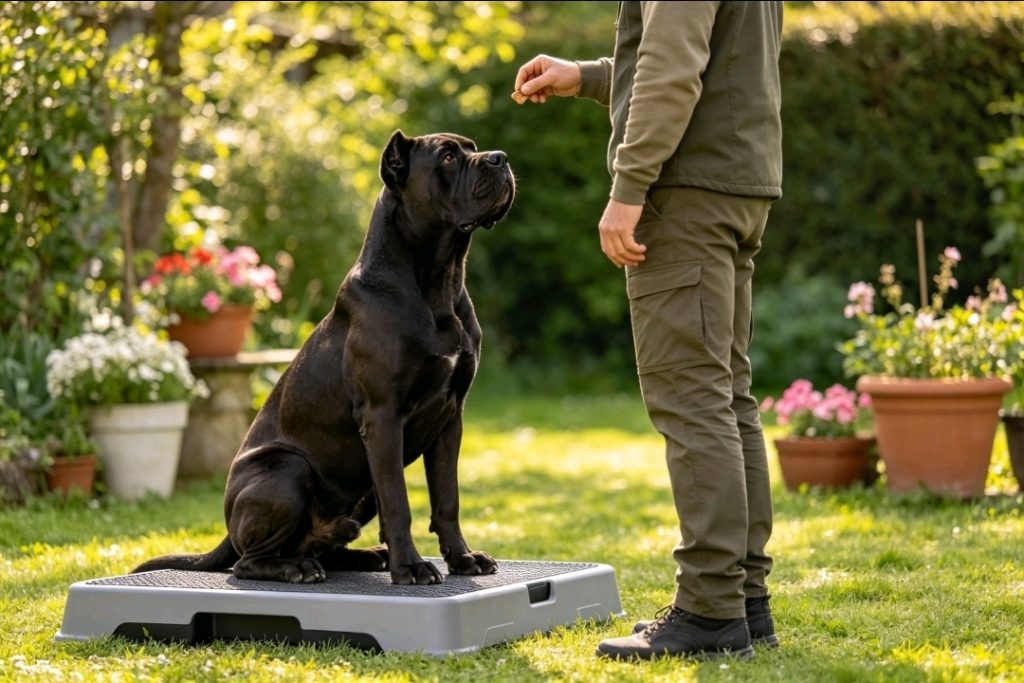
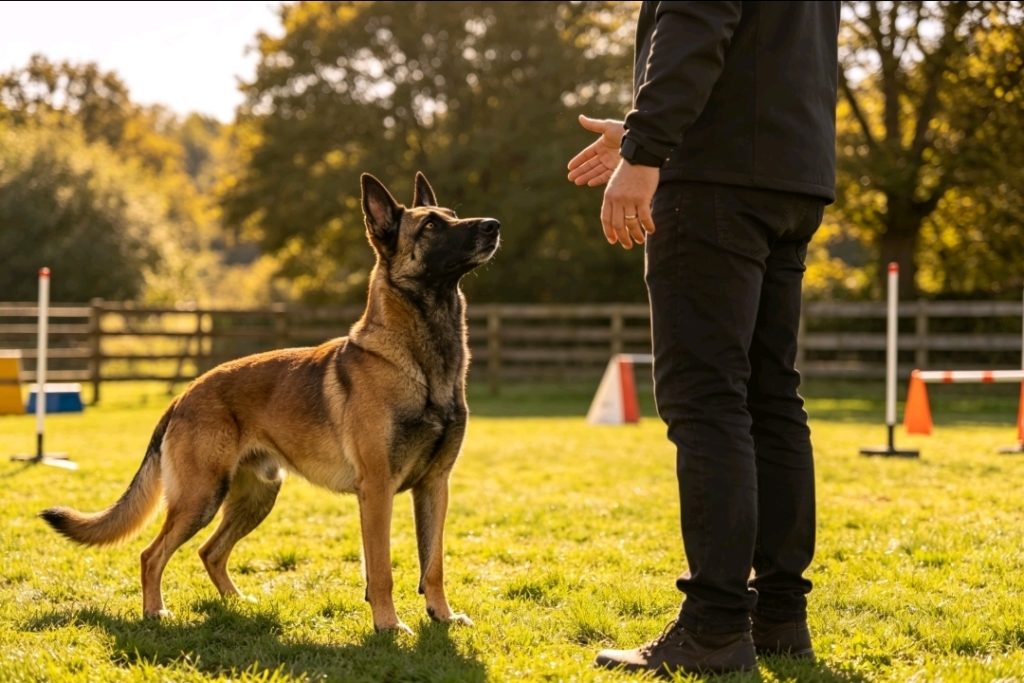
How to Deliver Food Rewards Correctly in Dog Training is important because the way a reward is delivered can influence what the dog learns from an exercise. Food that is delivered too early, too late, from the wrong position or with excessive movement can create confusion and inconsistent behaviour. A dog may begin jumping for food, grabbing at the handler’s hand, moving away from the intended position or expecting food without completing the exercise. The handler may also become inconsistent when trying to reward quickly, particularly when the dog becomes excited. These problems can make it difficult to understand whether the dog is responding to the training exercise or simply reacting to the presence of food.
RECOMMENDED PRODUCTS
Training Treats — Small, suitable training treats can make food delivery more precise and easier to control during structured training exercises.
Common Problems With Food Reward Delivery
One of the most common problems is delivering the reward before the dog has completed the intended behaviour.
If the handler produces the food too early, the dog may focus on obtaining the reward rather than completing the movement. The reward can then become associated with an incomplete response.
Another problem occurs when the handler waits too long.
The dog may perform the correct behaviour and then change position before the reward arrives. If the food is delivered after the dog has moved, the timing may become unclear.
This can make progression difficult because the handler believes the correct behaviour has been rewarded while the dog may associate the reward with a different movement.
Common Issues With Reward Position
Where the food is delivered can also affect the dog’s behaviour.
If the reward is delivered too high, the dog may jump or lift its head excessively. If it is delivered too low, the dog may lower its head or move away from the intended position.
The handler may also reach towards the dog from an awkward direction, causing unnecessary movement.
Consistent reward positioning can therefore be important when the objective is to maintain a particular posture or location.
The dog needs to be able to receive the reward without the delivery itself changing the behaviour that the handler is trying to develop.
Common Mistakes With Food Rewards
A common mistake is repeatedly waving food around before delivering it.
This can create unnecessary excitement and encourage the dog to focus on the handler’s hand rather than the exercise.
Another mistake is allowing the dog to take the reward roughly from the hand. If the dog repeatedly grabs, jumps or pushes towards the food, the reward delivery itself can become part of the unwanted behaviour.
Handlers can also make the mistake of delivering food inconsistently. One repetition may involve a reward directly at the dog’s position, while another may involve the dog moving several steps towards the handler.
This lack of consistency can make the exercise harder to understand.
RECOMMENDED PRODUCTS
Treat Pouch — A treat pouch allows the handler to keep rewards accessible while reducing unnecessary movement and helping maintain more consistent reward delivery.
Frustration During Reward Delivery
Frustration can occur when the dog knows that food is available but cannot predict when or how the reward will be delivered.
If the handler repeatedly delays the reward, the dog may become restless. If the reward is presented too quickly, the dog may become increasingly focused on the handler’s hand.
The handler can also become frustrated when the dog starts jumping, grabbing or moving position whenever food appears.
This may result in faster movements, repeated commands or inconsistent reward delivery.
The problem can then become self-reinforcing, with the dog becoming more excited and the handler becoming less precise.
Timing and Food Rewards
Timing is one of the most important parts of food reward delivery.
The handler needs to recognise the behaviour being reinforced and deliver the reward at an appropriate moment.
If the dog performs the intended behaviour and the reward arrives immediately afterwards, the connection between behaviour and consequence is clearer. If there is a significant delay, the dog may have already changed behaviour.
Timing becomes particularly important during movement-based exercises.
A dog may briefly reach the desired position before stepping away. If the handler waits until after the movement has changed, the reward may no longer correspond clearly with the behaviour that was intended.
Food rewards therefore need to be considered as part of the complete training sequence rather than simply something given after an exercise.
Misunderstanding and Miscommunication
Food rewards can create misunderstanding when the handler focuses only on whether the dog received the food.
Receiving a reward does not necessarily mean that the correct behaviour was reinforced.
The handler needs to consider what the dog was doing at the exact point when the reward was delivered.
For example, if a dog is expected to remain in a particular position but moves before receiving the food, delivering the reward after the movement may create a different association from the one intended.
The dog may also begin watching the handler’s hand rather than responding to the exercise itself.
This can make the handler believe the dog understands the behaviour when the dog is actually anticipating the reward.
GPK9’S FIVE GOLDEN RULES
The GPK9 Five Golden Rules provide a connected structure for understanding food rewards within the wider training process.
Food delivery is particularly relevant to obedience, but reward timing and consistency can also be influenced by home structure, play, routines and environmental distractions.
The Five Golden Rules help the handler consider the complete training situation rather than treating food rewards as an isolated technique.
Golden Rule One — Home and Social
How to Deliver Food Rewards Correctly in Dog Training is connected to the dog’s ability to remain within an appropriate level of structure.
A dog that is constantly moving around the home, unable to settle or given more freedom than it can manage may find it harder to remain focused when rewards are introduced.
The progression of crate → placemat → playpen provides different levels of controlled freedom.
The crate provides safety, reset and toilet support. The placemat introduces calm home freedom, while the playpen provides monitored freedom.
This allows the handler to consider whether the dog’s overall level of structure is appropriate before expecting precise food-reward delivery during training.
Golden Rule Two — Obedience
Golden Rule Two has the strongest connection to food rewards.
Food can be used during structured obedience to reinforce behaviour, support luring and help develop clearer communication between dog and handler.
The GPK9 approach focuses on food being hand-delivered rather than casually feeding while moving around. This helps the handler maintain greater awareness of the dog’s behaviour and the timing of each reward.
Praise, shaping and movement can also form part of the training process.
The important consideration is not simply whether the dog receives food, but what behaviour is being reinforced when the food is delivered.
Golden Rule Three — Prey Drive / Play
Food rewards and play have different roles within the GPK9 system.
Golden Rule Three provides a separate area for working with toys, tugging, movement and engagement.
Keeping play separate from structured food-reward exercises can help the handler understand whether the dog is responding to food-based training or becoming increasingly excited through play.
Where arousal increases, the handler needs to recognise the change rather than continuing to increase activity simply because the dog remains engaged.
Golden Rule Four — Toilet
Golden Rule Four focuses on consistency, timing, location and communication.
Food rewards are not the central method of toilet training within this rule, but the wider principle of predictable timing remains relevant.
The handler needs to recognise patterns in the dog’s routine and provide clear communication about what is expected.
This reinforces the wider GPK9 approach of using structure and consistency throughout the dog’s daily activities.
Golden Rule Five — Social Walking / Ignore the World
Food reward delivery also needs to be considered when the dog is outside the training environment.
Golden Rule Five focuses on a calm, relaxed and manageable walk without constantly placing the dog under command.
Food should not become something the handler has to deliver continuously simply to maintain control in every environment.
The handler needs to understand when food-based training is appropriate and when the priority should be calm movement and environmental management.
This helps prevent rewards from becoming a constant distraction or management tool.
Solution Connection
The problems associated with food reward delivery often involve poor timing, inconsistent position, excessive hand movement, premature rewards, delayed rewards, frustration and misunderstanding.
The GPK9 Five Golden Rules provide a wider structure for addressing these issues.
Problem → Issue → Mistake / Timing / Frustration / Misunderstanding → GPK9 Five Golden Rules → Structured Solution
Golden Rule One provides home and social structure.
Golden Rule Two connects food rewards with structured obedience, luring, shaping, praise and movement.
Golden Rule Three provides an appropriate place for play, engagement and arousal management.
Golden Rule Four reinforces predictable routines and timing.
Golden Rule Five considers how food-based training fits within calm, manageable social walking.
Together, these rules help the handler understand that food delivery is part of a wider training process rather than simply giving the dog a treat after an exercise.
Final Connection
How to Deliver Food Rewards Correctly in Dog Training is about understanding what happens at the moment a reward is delivered.
The timing, position, movement and consistency of food delivery can all influence what the dog learns. Poor delivery can contribute to jumping, grabbing, anticipation, movement away from position, frustration and confusion.
The GPK9 Five Golden Rules provide the wider structure needed to place food rewards into an organised training system.
From crate → placemat → playpen, through structured obedience, play, toilet routines and calm social walking, each area contributes to clearer communication and consistency between dog and handler.
The objective is not simply to give food when the dog does something correctly. The objective is to understand what behaviour is being reinforced, when the reward is delivered and how that reward fits into the wider GPK9 training system.