
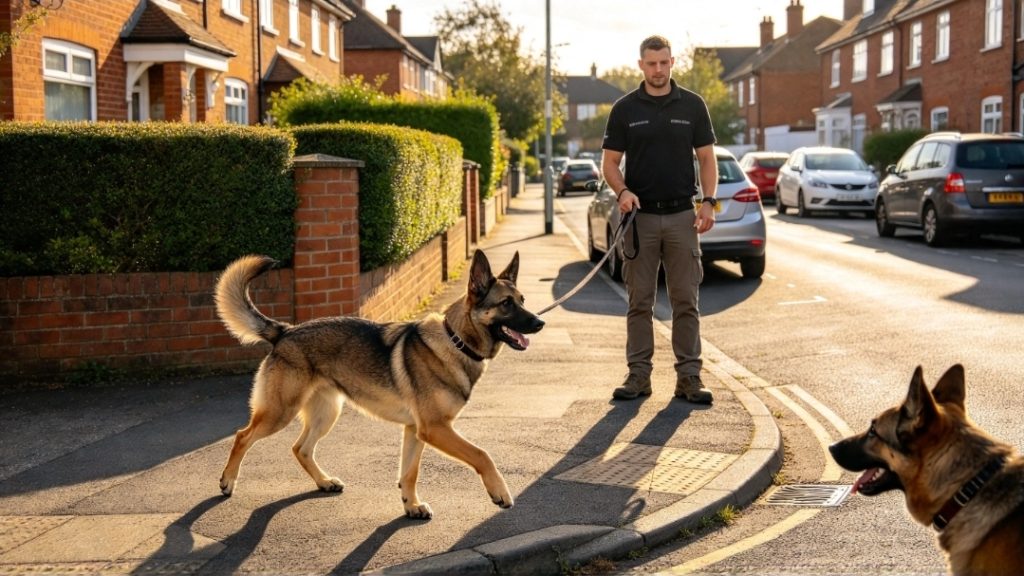
Why Is My Dog Reactive or Aggressive, and What Should I Do?
A dog may become reactive or display aggression because of fear, anxiety, frustration, uncertainty, previous experiences or other factors. The behaviour needs to be understood in context rather than judged by appearance alone. The priority is to keep people and animals safe, recognise what triggers the reaction, manage situations appropriately and seek professional assessment when necessary.
What Is the Difference Between Reactivity and Aggression?
Reactivity describes an intense or exaggerated response to something in the environment. A reactive dog might bark, growl, pull, lunge, freeze, whine or attempt to move away when encountering a particular person, dog, sound or situation.
Aggression describes behaviour that threatens or attempts to harm another individual. It can include snapping, biting and other threatening actions, but the presence of barking or growling alone does not establish that a dog intends to bite.
The terms can overlap, but they are not interchangeable. A dog that lunges at another dog on a lead may be frightened, frustrated, overexcited or responding to a perceived threat. Another dog displaying similar behaviour may have a different motivation.
The appearance of a reaction does not, by itself, explain why it is happening. Understanding the circumstances, the dog’s body language and the events leading up to the behaviour is essential.
Why Is My Dog Reactive or Aggressive?
There is rarely one explanation that applies to every dog. Behaviour can be influenced by several factors, and the same dog may react differently depending on the environment, distance, previous experiences and current emotional state.
Fear and Anxiety
A dog that feels threatened or uncertain may bark, growl, lunge or attempt to escape to increase the distance between themselves and the perceived threat. These responses can develop when a dog feels unable to cope with a situation.
Fear and anxiety can influence how a dog interprets everyday experiences. For example, an unfamiliar dog approaching directly may be manageable at a distance but overwhelming when close.
Understanding these responses is important when deciding how to help. The GPK9 course on Fear, Confidence and Anxiety explores how uncertainty can affect behaviour and learning, including recognising stress signals, adjusting situations and building confidence gradually.
Frustration and Overexcitement
Not every reactive response is driven by fear. Some dogs become frustrated when a lead prevents them from reaching another dog, person or exciting stimulus. Others struggle to manage their arousal when faced with movement, noise or activity.
Barking and lunging can occur in these situations, but the behaviour should not automatically be interpreted as friendliness or hostility. The individual dog’s history, body language and circumstances need to be considered.
Previous Experiences and Learned Responses
A frightening encounter, repeated stressful interactions or an uncomfortable experience can affect how a dog responds to similar situations in the future.
Behaviour can also become established through repetition. If barking and lunging repeatedly result in a perceived threat moving away, the dog may learn that reacting helps create distance. This does not mean the dog is deliberately being difficult; it means the response may have become part of how they cope with that situation.
Pain, Discomfort and Other Changes
Physical discomfort or illness can affect a dog’s tolerance and behaviour. If a normally comfortable dog suddenly becomes reactive or aggressive, or the behaviour changes significantly, arrange a veterinary assessment to investigate possible underlying causes.
Do not assume that a sudden change is simply a training problem.
How Can I Recognise What Triggers My Dog?
A trigger is something that contributes to a dog’s response. It may be a particular person, another dog, an approaching stranger, a sudden sound, physical handling or a specific environment.
Identifying triggers involves observing the whole situation rather than focusing only on the moment the dog barks or lunges.
Look for patterns such as:
- Distance: Does the reaction occur when something approaches closely, or does it begin from farther away?
- Movement: Does your dog react to direct approaches, running, sudden movements or dogs passing by?
- Environment: Is the behaviour more likely in narrow paths, busy streets, entrances or unfamiliar places?
- Lead handling: Does the response change when your dog is on a lead or has less room to move away?
- Early signals: Does your dog become still, stare, turn away, tense their body or attempt to retreat before reacting?
- Recovery: How long does your dog take to settle after the trigger has passed?
Record what happened before, during and after each incident when it is safe to do so. This can help you identify patterns and give a professional a clearer picture of the behaviour.
Do not deliberately expose your dog to a trigger to see how they react. Safety comes first.
Why Is Reading My Dog’s Body Language Important?
Dogs often communicate discomfort before a reaction becomes obvious. Learning to recognise these signals can help you respond earlier and avoid situations escalating.
Possible signs of stress or uncertainty include:
- Turning the head or body away.
- Repeatedly looking towards a trigger and struggling to disengage.
- Becoming tense or unusually still.
- Attempting to move away or hide.
- Lip licking, yawning or panting in a context where these may indicate discomfort.
- Growling, barking, showing teeth or lunging.
No single signal should be interpreted in isolation. For example, panting can be caused by heat or exercise, while a still posture may have several meanings depending on the circumstances.
The GPK9 course Read Your Dog focuses on understanding canine body language and recognising signs of comfort, uncertainty, stress and excitement. Improving your observation skills can help you make safer decisions before a situation becomes difficult.
Never punish a dog simply for communicating discomfort. Growling and other warning signals provide important information. Suppressing a warning without addressing the underlying situation may make it harder to recognise when the dog is struggling.
What Should I Do When My Dog Reacts?
When your dog begins reacting, the immediate goal is not to force obedience or make them confront the trigger. It is to reduce risk and help the situation become manageable.
1. Create Distance
Calmly move away from the trigger where possible. Cross the road, turn around, move behind a suitable barrier or choose a wider route.
Avoid forcing your dog to remain close to something that is causing distress. If the dog is already highly aroused, they may not be able to respond to familiar cues as reliably as they normally would.
2. Prevent Unsafe Contact
Do not allow your dog to approach another dog or person when there is a risk of injury. Avoid close greetings, crowded situations and environments where you cannot maintain safe control.
If you are concerned that your dog may bite, use secure, appropriate management and seek professional guidance. A properly introduced basket muzzle may form part of a safety plan, but it should be introduced gradually and positively. Do not rely on a muzzle as a substitute for distance, supervision or appropriate handling.
3. Avoid Confrontation and Punishment
Shouting, physical corrections, deliberately frightening your dog or forcing them closer to a trigger can increase distress and risk. These approaches do not reliably identify or resolve the reason for the behaviour.
Instead, focus on preventing repeated incidents, recognising early signs and creating opportunities for the dog to feel safer.
4. Allow Time to Recover
After a difficult encounter, give your dog space and reduce further demands. A dog may remain unsettled even after the immediate trigger has disappeared.
Avoid immediately arranging another challenging encounter. Allow recovery and consider whether the next outing should be quieter or more controlled.
5. Seek Professional Assessment
If your dog has bitten, attempted to bite, repeatedly lunges at people or dogs, or behaves unpredictably, seek an individual assessment from a suitably qualified canine behaviour professional with experience in aggression and reactivity. Veterinary advice is also important where pain, illness or a significant behavioural change may be involved.
If there is an immediate risk of injury, prioritise separation and safety rather than attempting training yourself.
How Can Walking Foundations Help?
Walking skills can support safer management, but a dog that reacts should not simply be expected to walk closer to triggers or obey through distress.
A suitable walking plan considers the dog’s current ability, the environment, available space and the handler’s capacity to maintain control. The aim is to make safe decisions before the dog becomes overwhelmed.
The GPK9 Lead Training and Walking Foundations course covers the development of walking skills and clearer communication between dog and handler. These foundations may support everyday handling, but they do not replace a tailored behaviour plan when aggression or serious reactivity is present.
Until appropriate support is in place, choose quieter routes and times, maintain a secure lead and avoid situations where you cannot safely create distance.
What Role Does Dog Communication Play?
Effective communication involves more than giving commands. It also means noticing how your dog responds, recognising when they are uncomfortable and adjusting your actions accordingly.
A dog may be unable to cope with a situation even when the handler is giving familiar cues. In that moment, increasing pressure can make the problem worse. The handler needs to consider the environment, the dog’s response and whether it is appropriate to continue.
The GPK9 K9 Communication course explores canine body language, behavioural signals and clearer communication between dog and handler. These skills can help owners observe more carefully and make better-informed decisions during everyday training.
Communication does not mean assuming you know exactly what your dog is thinking. It means observing the evidence, considering possible explanations and responding in a way that prioritises safety.
Can Reactivity or Aggression Be Improved?
Many dogs can make progress when their individual needs are understood and the training plan is appropriate. However, progress depends on the cause, severity, history and context of the behaviour. There is no single exercise or guaranteed solution that works for every dog.
A suitable plan may include:
- Managing the environment to prevent unsafe encounters.
- Identifying triggers and maintaining an appropriate distance.
- Recognising early signs of stress or rising arousal.
- Gradually building the dog’s ability to cope with manageable situations, without forcing exposure.
- Teaching useful skills in safe settings.
- Reviewing progress and adjusting the plan when needed.
- Seeking veterinary and behavioural support where appropriate.
The goal is not simply to stop barking or lunging. It is to understand what is driving the response, reduce risk and help the dog cope more safely with everyday life.
When Should I Get Professional Help?
Professional assessment is particularly important if your dog has bitten or attempted to bite, has caused injury, reacts towards children or vulnerable people, guards resources in a way that creates risk, or is becoming more unpredictable.
Seek help promptly if you feel unable to control the situation safely. Do not wait for another incident before asking for support.
When arranging an assessment, explain the dog’s history, known triggers, previous incidents, changes in behaviour and the management measures already in place. Avoid recreating an incident for demonstration purposes.
Online education can help owners develop their understanding, but it cannot replace an individual assessment when the safety of people or animals may be at risk.
Understanding Your Dog Is the First Step
Reactivity and aggression should be approached with observation, context and appropriate management rather than assumptions. Recognising triggers, understanding body language, developing safe walking habits and improving communication can all contribute to better-informed decisions.
Safety comes first. Create distance when needed, avoid forcing your dog into stressful encounters and seek professional assessment when behaviour creates a risk.
If you need additional support, contact our online coach.




