
Why Does My Dog Behave Differently in Different Places?
Why does my dog behave differently in different places? Dogs can behave differently in different places because the environment changes the level of distractions, excitement, stress, familiarity and competing rewards around them. A dog that responds perfectly at home may struggle in a garden, on a walk or in a busy public place because the behaviour has not yet become reliable in that environment. Dogs learn at different rates, so training should progress gradually.
RECOMMENDED PRODUCTS
Why Does My Dog Listen at Home but Not Outside?
Your dog may understand the behaviour but not yet be able to perform it around distractions.
At home, there may be very little competing for your dog’s attention. Outside, your dog may encounter:
- Other dogs
- People
- Animals
- New smells
- Traffic
- Movement
- Noise
- Different surfaces
- Unfamiliar surroundings
These additional distractions can make a familiar command much harder.
The RSPCA recommends starting new training in a quiet environment and gradually introducing distractions as the dog becomes more reliable.
Does My Dog Forget Its Training in a New Place?
Usually, no.
Your dog may not have forgotten the behaviour. It may simply not have learned that the same cue applies equally in different environments.
For example, your dog may know “sit” in the kitchen but need additional practice before reliably sitting in the garden or at the park.
A behaviour learned in one location still needs to be generalised to other locations.
Why Is My Dog Better Behaved at Home?
Home is often a familiar and predictable environment.
Your dog knows the surroundings, smells, routines and people. There may also be fewer distractions.
This can make it easier for your dog to concentrate on you and respond to familiar cues.
When you move somewhere new, the environment itself becomes part of the difficulty.
Why Does My Dog Behave Differently in the Garden?
The garden may be more distracting than the house.
Your dog may encounter birds, smells, noises, neighbouring animals or movement outside the boundary.
Start by practising familiar behaviours in a quiet part of the garden.
Reward your dog for responding correctly and gradually introduce more distractions.
If your dog becomes too distracted to respond, return to an easier exercise.
Why Does My Dog Behave Differently on Walks?
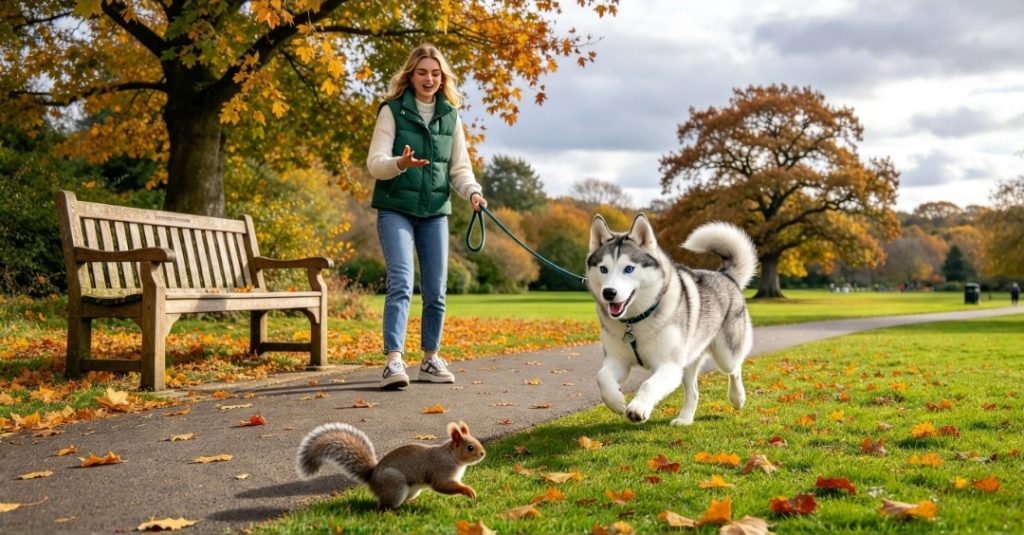
Walks provide far more stimulation than most indoor training environments.
Your dog may become interested in smells, other dogs, people, vehicles, wildlife or moving objects.
This does not necessarily mean your dog is being stubborn.
It means the behaviour may not yet be reliable at that level of distraction.
Practise short training exercises during walks and reward your dog for paying attention to you. Loose-lead training should also be progressed gradually around distractions. (rspca.org.uk)
Why Does My Dog Behave Differently Around Other Dogs?
Other dogs can be highly rewarding or distracting.
Your dog may become excited, frustrated, nervous or fearful when another dog appears.
If your dog can respond to you at home but cannot respond when another dog is nearby, increase the distance and practise at a level where your dog can still focus.
Reward calm attention and gradually reduce the distance only when your dog is coping.
Do not move closer simply because your dog succeeded once.
Why Does My Dog Behave Differently Around People?
People can also change your dog’s behaviour.
Your dog may become excited when it sees people, want to greet them, become nervous around strangers or react to particular types of movement.
Start at a comfortable distance and reward calm behaviour.
Gradually introduce more difficult situations while ensuring your dog can still respond to you.
If your dog is fearful or aggressive around people, professional behavioural advice may be appropriate.
Why Does My Dog Behave Differently in Busy Places?
Busy environments contain several distractions at once.
Your dog may have to process people, dogs, vehicles, sounds, smells and movement simultaneously.
If your dog struggles in a busy location, do not assume it needs more exposure immediately.
Reduce the difficulty first.
Choose a quieter location, increase your distance from distractions and practise behaviours your dog already knows.
Once your dog is successful, gradually increase the level of activity.
How Do I Teach My Dog to Behave the Same Everywhere?
You need to practise the behaviour in different environments.
A useful progression might be:
- Quiet room
- Another room
- Garden
- Quiet outdoor area
- Quiet public location
- More distracting environment
- Busy environment
Do not move through these stages simply because a certain amount of time has passed.
Progress when your dog is consistently successful at the current level.
The RSPCA recommends practising behaviours in different places and gradually increasing difficulty.
RECOMMENDED PRODUCTS
Should I Use Treats in Different Places?
Yes.
Rewards can help your dog understand that the behaviour remains worthwhile even when the environment changes.
The reward should be appropriate for the difficulty of the situation.
A simple food reward may work well in the house but may not be sufficiently motivating when your dog is surrounded by major distractions.
Dogs can also be motivated by play, toys or praise, depending on the individual dog. (rspca.org.uk)
Why Does My Dog Stop Taking Treats Outside?
If your dog normally enjoys food but refuses it in a particular environment, the situation may be too difficult or your dog may be too excited, stressed or distracted to eat.
Do not keep pushing the training.
Increase distance from the distraction or move somewhere quieter.
Once your dog is able to focus again, offer an easier behaviour and reward it.
If your dog cannot take a reward or respond to a familiar cue, the environment may currently be too difficult.
Why Does My Dog Behave Differently With Different People?
Dogs can learn different patterns with different people.
One person may consistently reward calm behaviour while another may accidentally reward jumping, pulling or barking with attention.
Everyone who regularly handles the dog should use consistent cues and responses.
Consistency helps your dog understand which behaviours are expected.
Why Does My Dog Behave Differently at the Dog Trainer?
A dog may perform better during a training session because the environment is structured and the handler is focused on the training.
However, the opposite can also happen if the dog finds the training environment distracting or stressful.
What matters is whether the behaviour transfers into everyday life.
Practise what you have taught your dog in normal situations rather than relying only on formal training sessions.
RECOMMENDED PRODUCTS
Why Does My Dog Behave Differently at the Vet?
The veterinary environment can be particularly difficult because it may involve unfamiliar smells, people, animals, handling and previous experiences.
Do not expect your dog to behave exactly as it does at home.
Instead, gradually build positive experiences around veterinary visits where possible and follow your veterinary practice’s advice.
If your dog is extremely fearful or reactive at the vet, discuss this with your vet before the appointment.
Could My Dog Be Stressed in Certain Places?
Yes.
A change in environment can affect behaviour, particularly if the surroundings are unfamiliar, noisy, crowded or associated with something the dog finds frightening.
Watch for signs such as:
- Avoidance
- Hiding
- Cowering
- Excessive panting
- Lip licking
- Difficulty settling
- Increased barking
- Growling
- Lunging
If your dog is showing signs of stress, make the situation easier rather than forcing it to continue. The RSPCA advises paying attention to changes in behaviour and signs of fear or stress. (rspca.org.uk)
What Should I Do When My Dog Struggles in a New Place?
Go back to an easier stage.
You can:
- Increase distance from distractions
- Move somewhere quieter
- Use a familiar behaviour
- Increase the value of the reward
- Shorten the training session
- Reduce the amount of movement around your dog
- Return home if your dog cannot settle
The aim is not to force your dog to cope.
The aim is to give your dog successful experiences and gradually build reliability.
Should I Train My Dog in Lots of Different Places?
Yes, once your dog has a reasonable understanding of the behaviour.
Practising in different places helps your dog learn that the same cue still has the same meaning when the environment changes.
Introduce new locations gradually rather than taking a newly learned behaviour straight into the most distracting environment possible.
The RSPCA recommends practising behaviours in different places and gradually increasing distractions. (rspca.org.uk)
Does My Dog Need to Be Perfect in Every Location?
No.
The goal is not immediate perfection.
The goal is progressive reliability.
Your dog may perform a behaviour well in one place and need more practice somewhere else.
Judge progress by whether your dog is becoming more consistent as you gradually increase the difficulty.
What Mistakes Should I Avoid?
Avoid assuming that your dog has forgotten its training.
Avoid moving straight from a quiet room to a highly distracting environment.
Avoid repeatedly giving commands your dog cannot currently respond to.
Avoid increasing distractions too quickly.
Avoid punishing your dog for struggling in a difficult environment.
Avoid forcing a frightened or overwhelmed dog to remain in a situation it cannot cope with.
Avoid comparing your dog’s behaviour in one location with another without considering the difference in difficulty.
If your dog struggles, make the environment easier before expecting better behaviour.
When Should I Get Professional Help?
Consider professional help if your dog’s behaviour changes significantly between environments and involves severe fear, anxiety, aggression, lunging, biting or other serious behavioural concerns.
If the behaviour changes suddenly, particularly alongside other unusual behaviour, speak to your vet because health problems can affect behaviour. (rspca.org.uk)
A qualified trainer or behaviour professional can help identify whether the main difficulty is distraction, motivation, fear, overexcitement or another behavioural issue.
Conclusion
Your dog behaves differently in different places because every environment creates a different level of difficulty.
A behaviour that is reliable at home may not yet be reliable around other dogs, people, animals, traffic, smells or noise.
Start with familiar behaviours in easy environments, then gradually practise them in more challenging locations. Reward successful responses, reduce the difficulty when your dog struggles and build reliability one environment at a time.
The goal is not for your dog to behave identically everywhere immediately. The goal is to teach your dog that the same behaviours remain worthwhile wherever you go.
GPK9 — The Five Golden Rules
The GPK9 Five Golden Rules provide the foundation of the GPK9 Professional Training System. They give new dog owners, new dog handlers, experienced handlers and professional dog trainers a clear structure for developing the dog and the handler together.
The GPK9 Five Golden Rules cover five essential areas of development: Home & Social, Obedience, Prey Drive, Toilet and Social Walking. Each area has its own purpose, but they are designed to work together as one complete training system.
The GPK9 approach is based on CATEGORY → STATUS → DRIVE → CONTROL and the handler’s ability to OBSERVE → INTERPRET → DECIDE → COMMUNICATE → OBSERVE RESPONSE → REASSESS. This gives the handler a consistent process for understanding what the dog is doing, why the behaviour is occurring, what level of control is appropriate and how to communicate effectively.
The purpose of the GPK9 Five Golden Rules is not simply to teach a collection of individual exercises. They are designed to develop the dog’s behaviour, motivation, communication, control and reliability while teaching the handler how to make better decisions.
Golden Rule One — Home & Social
Golden Rule One — Home & Social establishes the foundation for everyday life with the dog. It focuses on communication, boundaries, calm behaviour, household routines and appropriate behaviour around people, animals and normal activity.
The purpose of Golden Rule One — Home & Social is to help the handler understand the dog’s behaviour and recognise changes in arousal before they become larger problems. The handler learns to observe, assess and communicate rather than simply reacting after unwanted behaviour has already occurred.
Golden Rule One — Home & Social provides the foundation from which the handler can develop a calmer, more predictable and better-communicating dog.
Golden Rule Two — Obedience
Golden Rule Two — Obedience develops the dog’s ability to understand and respond to the handler’s communication.
The focus of Golden Rule Two — Obedience is not simply teaching commands. It is about developing understanding, reliability, timing, reward, release and control so the dog learns what the handler is communicating.
Through Golden Rule Two — Obedience, the handler learns to progress training appropriately, gradually increasing the dog’s freedom and responsibility as understanding and reliability improve.
Golden Rule Three — Prey Drive
Golden Rule Three — Prey Drive focuses on understanding and developing the dog’s natural motivation to chase, pursue, engage and work with an appropriate toy or prey-based reward.
The purpose of Golden Rule Three — Prey Drive is not simply to increase drive. The handler must learn how to recognise the dog’s level of motivation, select an appropriate reward and use timing, communication and control to channel that motivation productively.
Golden Rule Three — Prey Drive teaches the handler that motivation can become a powerful training tool when it is developed and controlled correctly.
Golden Rule Four — Toilet
Golden Rule Four — Toilet establishes reliable toilet habits through consistency, observation, timing, supervision and appropriate reinforcement.
The handler learns through Golden Rule Four — Toilet to recognise when the dog is likely to need the toilet, provide the correct opportunity and reinforce the desired behaviour.
The objective of Golden Rule Four — Toilet is to establish a predictable routine that helps the dog understand where and when toileting is appropriate while reducing opportunities for mistakes.
Golden Rule Five — Social Walking
Golden Rule Five — Social Walking develops the dog’s ability to walk calmly and appropriately in the real world while remaining connected to the handler.
The focus of Golden Rule Five — Social Walking is the relationship between the handler, the dog, the environment, distractions, distance and available control.
Through Golden Rule Five — Social Walking, the handler learns to observe body language, identify potential triggers, assess distance and recognise changes in drive or arousal before behaviour escalates.
The objective of Golden Rule Five — Social Walking is not simply to make the dog walk beside the handler. It is to develop a dog that can experience the outside world while remaining connected to the handler and capable of responding to clear communication.
How the Five Golden Rules Work Together
The GPK9 Five Golden Rules are designed to work together rather than being treated as five completely separate subjects.
Golden Rule One — Home & Social establishes the foundations for everyday behaviour and communication.
Golden Rule Two — Obedience develops understanding, responsiveness and control.
Golden Rule Three — Prey Drive develops motivation and teaches the handler how to channel natural drive appropriately.
Golden Rule Four — Toilet establishes essential household routine and reliability.
Golden Rule Five — Social Walking takes the communication and control developed through the other areas into the outside environment.
Together, the GPK9 Five Golden Rules help the handler develop a complete understanding of the dog rather than treating individual behaviours as isolated problems.
The overall objective of the GPK9 Five Golden Rules is to train the human, train the dog and build the partnership through clear observation, communication, appropriate control and progressive development.




