Why Does My Dog Become Overexcited?
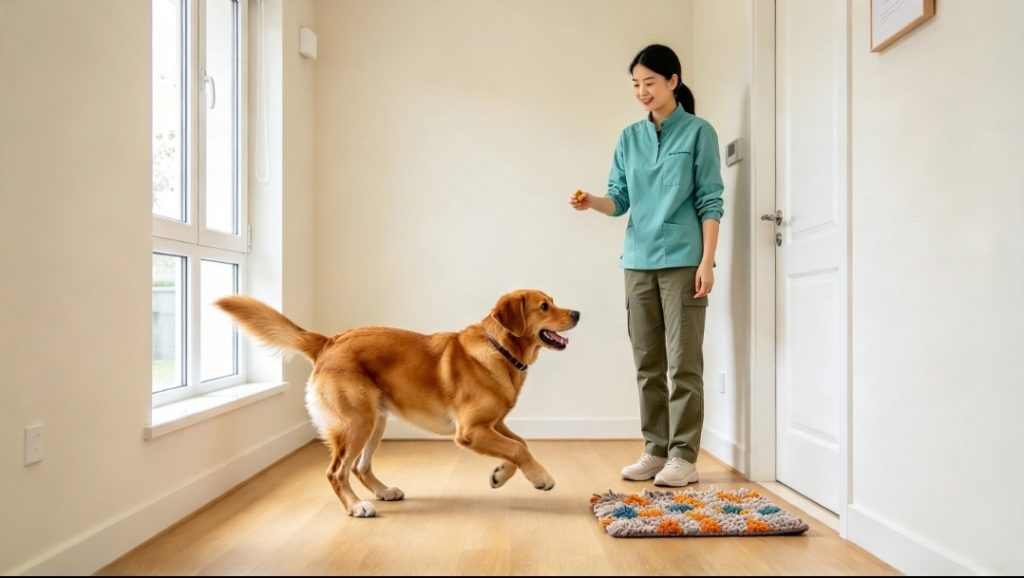
Why does my dog become overexcited? Your dog may become overexcited when something creates a level of excitement that it struggles to control, such as play, visitors, other dogs, walks, food, toys or unfamiliar situations. Overexcitement can make it harder for your dog to listen, settle and respond normally. The aim is not to stop your dog enjoying exciting experiences, but to teach it how to become excited without losing control.
What Does an Overexcited Dog Look Like?
An overexcited dog may show several behaviours at the same time.
You may notice:
- Jumping up.
- Barking or whining.
- Running around.
- Pulling on the lead.
- Spinning or bouncing.
- Grabbing clothing or hands.
- Chasing movement.
- Repeatedly demanding attention.
- Ignoring familiar commands.
- Struggling to remain still.
- Becoming increasingly difficult to calm.
The signs vary between dogs.
Look at the change in your dog’s behaviour and ability to respond, rather than relying on one particular action.
Why Does My Dog Become Overexcited Around People?
People can be highly rewarding or stimulating for dogs.
Your dog may become excited when:
- You return home.
- Someone knocks at the door.
- Visitors enter.
- Someone speaks excitedly.
- People move quickly.
- Your dog expects attention or play.
If jumping, barking or rushing towards people repeatedly results in attention, the behaviour can become established.
Teach your dog that calm behaviour can also lead to attention and interaction.
Why Does My Dog Become Overexcited Around Other Dogs?
Other dogs can trigger excitement because your dog may want to approach, investigate or play.
However, not every highly aroused response means your dog wants to play.
Excitement, frustration, fear and uncertainty can sometimes look similar.
Watch your dog’s whole body and the context.
If your dog becomes tense, fixated, unable to respond or increasingly distressed, create more distance rather than allowing the situation to become more intense.
Why Does My Dog Become Overexcited on Walks?
Walks provide constant stimulation.
Your dog may encounter:
- Other dogs.
- People.
- Animals.
- Traffic.
- New smells.
- Noises.
- Moving objects.
- Different environments.
A dog can become increasingly excited as these experiences accumulate.
If your dog becomes harder to control as the walk continues, reduce the level of stimulation rather than simply demanding more obedience.
Why Does My Dog Become Overexcited During Play?
Play naturally increases excitement.
Running, chasing, tugging and retrieving can all increase arousal.
The problem occurs when your dog becomes so excited that it can no longer control its behaviour.
You may notice harder biting, jumping, grabbing clothing, excessive barking or difficulty stopping.
Build pauses into play and teach your dog that play can start, stop and restart calmly.
Why Does My Dog Become Overexcited When I Pick Up the Lead?
Your dog may have learned that the lead predicts something exciting, such as going for a walk.
If your dog becomes frantic as soon as the lead appears, slow the routine down.
Practise picking up the lead while your dog remains calm.
Reward calm behaviour.
Put the lead down and repeat.
Gradually progress towards attaching the lead and preparing to leave while your dog remains under control.
Why Does My Dog Become Overexcited When Visitors Arrive?
The arrival of visitors can create a sudden increase in stimulation.
Instead of allowing your dog to rush towards the door, practise the routine when there are no visitors.
Teach your dog to remain calm while you approach the door, handle the door and move around the entrance.
Then gradually practise with real arrivals.
If your dog cannot remain calm, increase distance from the visitor and make the situation easier.
Can Lack of Exercise Make a Dog Overexcited?
A lack of appropriate activity can contribute to restlessness and unwanted behaviour.
Dogs need suitable opportunities for physical activity, exploration, play and mental stimulation.
However, more exercise is not always the answer.
Some dogs become more highly aroused when repeatedly given intense activities without learning how to settle afterwards.
Balance activity with opportunities for calm behaviour.
Can Stress Make My Dog Look Overexcited?
Yes.
Not every highly active dog is simply happy or excited.
Stress can also cause increased movement, vocalisation, pacing or difficulty settling.
Look for other signs of discomfort, such as:
- Turning away.
- Avoiding eye contact.
- Lowering the body.
- Tucking the tail.
- Lip licking.
- Yawning.
- Trying to escape.
- Becoming tense.
The RSPCA identifies these types of behaviours as possible signs that a dog is worried or uncomfortable. (rspca.org.uk)
If you think your dog is stressed, reduce the pressure rather than trying to train through it.
How Do I Calm an Overexcited Dog?
First, reduce whatever is causing the excitement.
Depending on the situation, you may need to:
- Stop the exciting activity.
- Increase distance from the trigger.
- Reduce noise or movement.
- Give your dog space.
- Wait for calmer behaviour.
- Reward calm responses.
- Restart at a lower level of intensity if appropriate.
Do not keep increasing stimulation while expecting your dog to become calmer.
Should I Ignore My Overexcited Dog?
Simply ignoring the behaviour is not always enough.
Instead, manage the situation and teach your dog what behaviour you want.
For example, if your dog jumps up for attention, avoid rewarding the jumping while providing opportunities for calm behaviour to receive attention.
The goal is not to ignore your dog.
The goal is to stop reinforcing uncontrolled behaviour and reinforce appropriate behaviour instead.
Should I Punish My Dog for Being Overexcited?
No.
Punishment does not teach your dog how to control its excitement.
Instead, reduce stimulation and reward the calm behaviour you want to see.
Reward-based training helps dogs learn which behaviours are successful and worth repeating. The RSPCA recommends reward-based training rather than shouting at or punishing dogs. (rspca.org.uk)
How Do I Teach My Dog to Control Its Excitement?
Start below the point where your dog loses control.
For example, if your dog becomes extremely excited when seeing another dog, begin at a distance where your dog can still notice the other dog and respond to you.
Reward calm behaviour.
Gradually reduce the distance only when your dog remains capable of responding.
The same principle can be used for visitors, toys, play, walks and other triggers.
Build control before increasing intensity.
How Do I Teach My Dog to Settle After Exciting Activities?
Create a predictable transition from activity to calm behaviour.
For example:
Activity → pause → calm behaviour → reward → rest.
Keep the transition simple.
Do not immediately replace one exciting activity with another.
Your dog needs opportunities to learn that the end of excitement is normal and that settling is rewarding too.
What If My Dog Becomes More Excited When I Try to Calm It?
Your interaction may accidentally add more stimulation.
Talking loudly, repeated touching, excited praise, chasing or repeated commands can sometimes keep the situation going.
Instead, reduce your own movement and communication.
Give your dog space to settle and reward calm behaviour once it appears.
Calm behaviour from the handler can help create a calmer training environment.
What If My Dog Becomes Overexcited and Stops Listening?
Stop increasing the difficulty.
If your dog cannot respond to a familiar cue, the situation may simply be too stimulating.
Do not repeatedly repeat the command.
Instead:
- Reduce the distraction.
- Increase distance.
- Pause the activity.
- Allow your dog to settle.
- Return to an easier behaviour.
- Reward the response.
Then progress again gradually.
What If My Dog Becomes Overexcited Every Day?
Look for patterns.
Write down when the behaviour happens and what occurs immediately beforehand.
You may discover that your dog becomes overexcited:
- Before every walk.
- When visitors arrive.
- During evening play.
- Around other dogs.
- When children are running.
- When particular toys appear.
- After long periods of activity.
Once you identify the trigger, you can manage that situation and train an appropriate response.
How Long Does It Take to Calm an Overexcited Dog?
There is no fixed timeframe.
Some dogs learn to regulate their excitement relatively quickly, while others need consistent practice over a longer period.
Progress should be measured by your dog’s ability to notice exciting situations, remain responsive and recover more quickly.
If your dog repeatedly becomes overwhelmed, make the training easier.
What Mistakes Should I Avoid?
Avoid:
- Punishing your dog for becoming excited.
- Shouting repeatedly.
- Continuing highly stimulating play when your dog has lost control.
- Allowing uncontrolled jumping to become a habit.
- Increasing distractions too quickly.
- Expecting a highly aroused dog to perform difficult commands.
- Using constant intense exercise as the only solution.
- Ignoring signs that excitement may actually be fear or stress.
Instead, reduce stimulation, create opportunities for calm behaviour and gradually build your dog’s ability to cope with excitement.
When Should I Get Professional Help?
Seek professional help if your dog’s overexcitement regularly involves biting, aggression, uncontrollable lunging, dangerous behaviour or an inability to recover.
If your dog has suddenly become much more excitable than usual, or the change is accompanied by other behavioural or physical changes, speak to your vet.
A sudden behaviour change should not automatically be assumed to be a training problem. The RSPCA advises veterinary advice when behaviour changes or there are concerns about illness, pain or injury. (rspca.org.uk)
Conclusion
Dogs become overexcited when the level of stimulation becomes greater than their ability to control their behaviour.
The solution is not to eliminate excitement. It is to teach your dog how to experience exciting situations while remaining responsive and able to settle.
Reduce stimulation when necessary, reward calm behaviour, teach clear starts and stops to exciting activities and gradually increase difficulty as your dog’s ability to cope improves.