How to Start Play With Your Dog Using a Training Toy
How to Start Play With Your Dog Using a Training Toy can be more difficult than simply giving a dog a toy and expecting play to begin. A dog may ignore the toy, move away, become distracted, grab it too quickly, become overly excited or fail to understand what the handler wants. The way a training toy is introduced can influence the dog’s first response, and poor timing or excessive movement can create confusion and frustration. RECOMMENDED PRODUCT: Interactive Tug Toy — a suitable interactive toy can provide a controlled starting point for observing how your dog responds to movement, presentation and interaction.
What Happens When Play Does Not Start Properly?
Starting play may appear simple, but the dog and handler still need to understand what is happening.
Problems can occur when:
- The toy is placed directly in the dog’s face
- The handler moves the toy too quickly
- The dog is expected to interact immediately
- The handler repeatedly waves the toy
- The environment contains too many distractions
- The session continues after the dog loses interest
- Excitement is mistaken for productive engagement
These problems can make the beginning of play unclear.
Instead of developing a useful interaction, the dog may become distracted, frustrated or excessively aroused.
Presenting the Training Toy Incorrectly
One common mistake is presenting the toy too aggressively.
The handler may move it directly toward the dog’s face or repeatedly push it toward the dog’s mouth.
This can make the toy difficult for the dog to understand as an invitation to interact.
The dog may move away, turn its head or become interested in something else.
The handler may then increase movement further, creating a cycle of increasing stimulation without necessarily creating better engagement.
Moving the Toy Too Quickly
Fast movement can attract attention, but it can also produce excessive excitement.
A dog may chase the movement without understanding how to interact with the toy.
The handler may see movement and assume that play has started, even though the dog is simply reacting to the toy moving rapidly.
This can make the interaction difficult to control.
Moving the Toy Too Slowly
The opposite problem can also occur.
If the toy is completely static, a dog with limited interest in that particular toy may not respond.
The handler may assume the dog does not like playing when the presentation itself may not have created enough interest.
The correct level of movement depends on the individual dog and the circumstances.
Expecting the Dog to Grab the Toy Immediately
Not every dog will immediately take a training toy.
A dog may first:
- Look at the toy
- Watch its movement
- Turn its head toward it
- Move closer
- Investigate it
- Follow it
- Briefly touch it
- Attempt to interact
These are different stages of behaviour.
Expecting the dog to immediately grab the toy can cause the handler to miss these smaller signs of developing engagement.
Training Environment Problems
The environment can have a significant effect on the start of a play session.
A busy area may contain other dogs, people, sounds, smells and movement.
The dog may therefore be more interested in the environment than the toy.
This can make it difficult for the handler to determine whether the dog genuinely wants to interact with the training toy.
A quieter environment can make the dog’s initial response easier to observe.
Frustration During the Start of Play
Frustration can develop when the handler and dog are not responding to each other clearly.
The handler may continue moving the toy because the dog has not interacted.
The dog may become more excited without actually engaging.
The handler may then move the toy even more.
This can create increasing arousal while the original objective—starting controlled play—becomes less clear.
Poor Timing
Timing matters from the beginning of the interaction.
The dog may show a very small change in attention when it first notices the toy.
If the handler immediately changes the movement, steps forward or moves the toy away, that response may be missed.
The handler needs to observe what the dog is doing rather than concentrating only on the toy.
High Arousal Is Not the Same as Play
A dog can become excited when a toy is introduced.
The dog may jump, bark, pull or move rapidly.
These behaviours can indicate increased arousal, but they do not automatically mean that the dog understands the play activity.
Effective play training requires the handler to recognise the difference between simple excitement and useful interaction.
GPK9’S FIVE GOLDEN RULES
The GPK9 Five Golden Rules provide one connected training system for understanding the dog, the handler and the environment.
How to Start Play With Your Dog Using a Training Toy is most directly connected to Golden Rule Three — Prey Drive and Play, but the other rules provide important structure around the activity.
The system can be applied from a new puppy or family dog through to more experienced dogs and professional dog-training environments.
The purpose is not simply to make a dog excited about a toy.
It is to develop clearer communication, appropriate engagement and structured interaction.
Golden Rule One — Home and Social
The beginning of play can be affected by how much structure the dog has at home.
A dog that has constant access to toys and unrestricted activity may find it more difficult to understand when a particular toy represents a structured training activity.
The GPK9 progression of crate → placemat → playpen provides different levels of controlled freedom.
The crate provides safety, reset and toilet support.
The placemat provides calm home freedom.
The playpen provides monitored freedom.
This helps establish clear differences between calm periods, monitored activity and structured interaction.
The traffic-light system provides further observation:
Green: progress and monitor.
Amber: observe and review.
Red: return to appropriate structure and stop where necessary.
Golden Rule Two — Obedience
Obedience provides another structured form of interaction between the dog and handler.
GPK9 uses food and luring while paying attention to calm behaviour, praise, shaping, movement, timing and hand-delivered food.
This helps the handler learn to observe the dog and communicate clearly before introducing more active play.
The dog does not need to be constantly stimulated.
Structured obedience and structured play can exist as separate parts of the wider training system.
Golden Rule Three — Prey Drive and Play
Golden Rule Three is the primary connection to starting play with a training toy.
Play should take place in a suitable, quiet area separate from obedience.
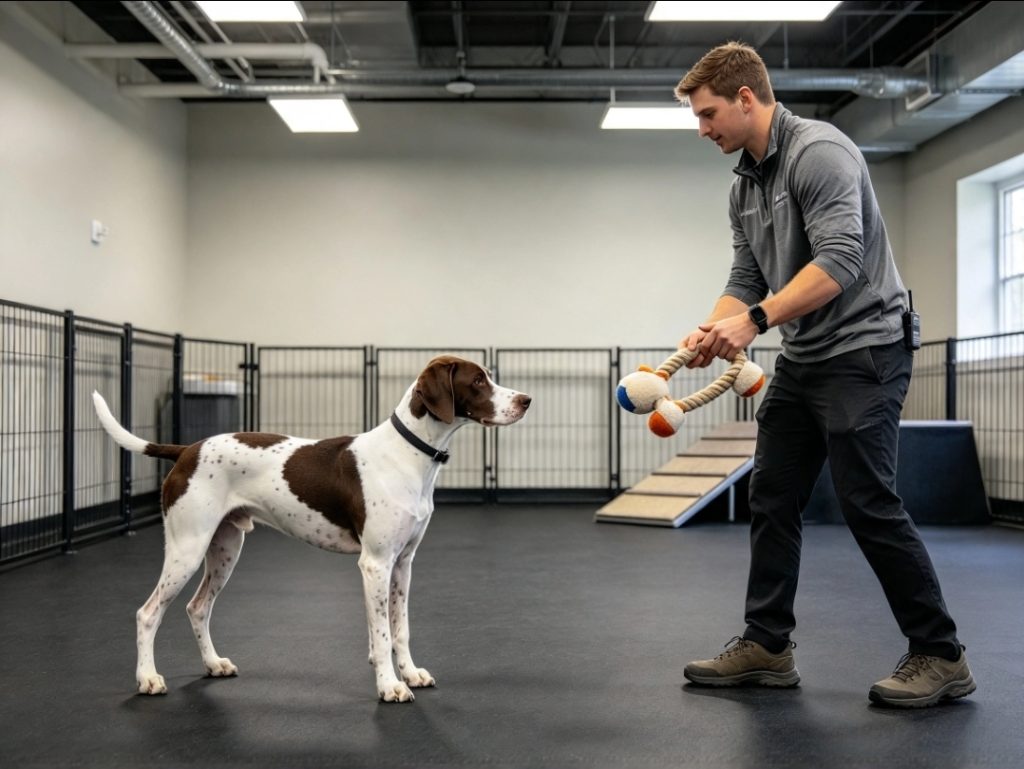
The handler introduces the toy and observes the dog’s response to movement and interaction.
The important observations include:
- Does the dog notice the toy?
- Does the dog orient toward it?
- Does the dog follow its movement?
- Does the dog approach?
- Does the dog attempt interaction?
- Does the dog remain engaged?
- Does arousal increase?
- Can the dog disengage?
- Can the dog return to a calmer state?
The GPK9 traffic-light structure provides a clear framework:
Green: observe and play.
Amber: observe and reduce arousal.
Red: stop and allow the dog to become calm.
Starting play therefore becomes an observation process rather than simply moving a toy around until the dog reacts.
Golden Rule Four — Toilet
Toilet training remains a separate part of the overall system.
Using the same place, the same time and a consistent toilet command provides predictable structure.
This is particularly important for puppies, where play, feeding, rest and toilet routines can all form part of the dog’s daily structure.
Clear routines help prevent different activities from becoming confused.
Golden Rule Five — Social Walking / Ignore the World
Social walking provides another opportunity to observe the dog’s ability to remain calm around environmental movement.
The objective is a calm, relaxed and manageable walk without constant commands.
The traffic-light system provides clear observation:
Green: monitor and continue.
Amber: stop and allow the dog to become calm in a quieter area until Green.
Red: stop the walk immediately.
This is relevant to play because a dog may encounter movement and distractions outside the training environment.
The ability to remain manageable around environmental activity forms part of the wider training system.
RECOMMENDED PRODUCT: Training Ball
A training ball can provide an alternative way to introduce movement-based interaction. Some dogs may show more interest in chasing, following or carrying a ball than interacting with a tug toy, so observing the individual dog’s response remains important.
RECOMMENDED PRODUCT: Training Mat
A training mat can provide a consistent location for transitioning between active play and calm behaviour. This can help the handler create clearer boundaries between periods of interaction and periods of settling.
How to Start Play With a Training Toy
Starting play should be approached as a gradual process of observation and interaction.
Choose a Suitable Environment
Begin in a quiet area with limited distractions.
The purpose is to make the dog’s response easier to observe.
Select One Training Toy
Use one appropriate toy rather than presenting multiple toys simultaneously.
This makes it easier to understand what the dog is responding to.
Allow the Dog to Notice the Toy
Present the toy without immediately forcing it toward the dog.
Watch for the dog’s first signs of interest.
These may be very subtle.
Introduce Controlled Movement
Once the dog notices the toy, introduce appropriate movement.
Avoid automatically increasing speed.
Observe whether the dog becomes more interested, loses interest or becomes excessively excited.
Allow Interaction to Develop
The dog may investigate before interacting.
It may approach, follow, touch or attempt to take the toy.
These stages should be observed rather than rushed.
Monitor the Dog’s Body Language
Look at the whole dog rather than only whether it takes the toy.
Observe:
- Eyes
- Ears
- Head position
- Body position
- Movement
- Distance from the toy
- Interaction
- Changes in arousal
This provides a clearer picture of what is happening.
Recognise When the Dog Disengages
The dog may turn away, stop following, move away or lose interest.
Continuing to increase stimulation at this point may not improve engagement.
Recognising disengagement is part of effective communication.
End With Structure
Play should have a clear ending.
The dog should have an opportunity to move from active interaction back toward a calmer state.
This creates a clearer distinction between play and rest.
Understanding Toy Introduction Through the GPK9 System
Starting play with a training toy is only one part of developing a complete training relationship.
The handler needs to understand the individual dog’s behaviour, motivation, body language and response to different environments.
A dog that does not immediately take a toy is not necessarily demonstrating a lack of ability.
Likewise, a dog that immediately grabs a toy is not necessarily demonstrating better engagement.
The quality of the interaction must be considered.
The GPK9 Five Golden Rules provide a connected structure:
Home and Social establishes controlled freedom and calm structure.
Obedience develops structured interaction and communication.
Prey Drive and Play provides an appropriate area for toy-based interaction.
Toilet establishes predictable routine.
Social Walking / Ignore the World develops calm, manageable behaviour around environmental distractions.
Together, these rules allow the handler to view play as part of the wider training process rather than as an isolated activity.
Final Connection
How to Start Play With Your Dog Using a Training Toy begins with understanding that play does not always start simply because a toy is presented.
The dog may ignore the toy, become distracted, become frustrated, become excessively excited or fail to understand the interaction.
Poor timing, excessive movement and an unsuitable environment can make the beginning of play less clear.
The GPK9 Five Golden Rules provide a structured framework for addressing these challenges.
Home and Social creates structure, Obedience develops communication, Prey Drive and Play provides controlled toy interaction, Toilet maintains routine, and Social Walking / Ignore the World supports calm and manageable behaviour around environmental distractions.
Starting play effectively is therefore not simply about making a toy exciting.
It is about observing the dog, understanding its response, using appropriate movement and timing, recognising engagement and maintaining clear structure throughout the interaction.