How Much Freedom Should You Give a Puppy at Home?
Giving a puppy freedom around the home can become difficult when the amount of access does not match the puppy’s age, development, understanding or ability to manage its surroundings. A young puppy given unrestricted access may quickly begin chewing furniture, picking up household objects, having accidents, jumping on people, chasing movement, becoming overly excited or repeatedly seeking attention. At the same time, restricting a puppy too much without a clear progression can create frustration and make it difficult for the handler to recognise whether the puppy is ready for greater access. The difficulty is often created when freedom is increased based on convenience rather than the puppy’s actual behaviour and ability to manage the environment.
RECOMMENDED PRODUCTS
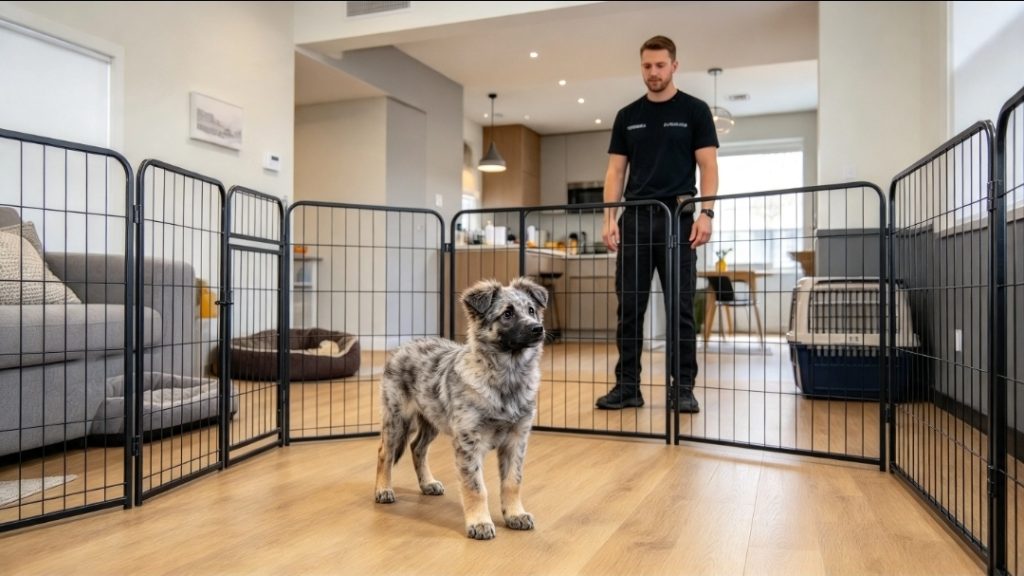
A secure puppy playpen can provide a defined area for monitored freedom while the puppy develops the understanding and behaviour required for greater access to the home.
Common Problems
One of the most common problems is giving a puppy access to too much of the home too quickly. A young puppy may move from room to room without understanding what areas are appropriate, what objects are available to interact with or what behaviour is expected.
This can create a pattern where the puppy repeatedly discovers opportunities to chew, chase, explore, jump, toilet or seek attention. The larger the environment becomes, the more difficult it can be for the handler to monitor everything the puppy is doing.
Another problem is assuming that because a puppy behaves appropriately in one area, it is automatically ready for unrestricted access to the entire home. Different rooms contain different distractions, objects, surfaces, sounds and opportunities for unwanted behaviour.
Common Issues
Inconsistent freedom can create another set of issues. A puppy may be allowed to roam freely at certain times but restricted immediately after displaying unwanted behaviour. If the level of freedom changes without a clear progression, the puppy may experience an inconsistent home environment.
The handler may also struggle to recognise the difference between physical freedom and behavioural readiness. A puppy that can walk around the home without immediately causing a problem may still lack the ability to remain calm, respond appropriately to household activity or make suitable choices without close management.
Common Mistakes
A common mistake is increasing freedom simply because the puppy appears tired or quiet for a short period. A temporary period of calm does not necessarily demonstrate that the puppy is ready for a greater level of freedom.
Another mistake is allowing access to areas containing valuable, dangerous or inappropriate objects before the puppy has developed sufficient understanding. This can lead to chewing, swallowing objects, pulling items down, scratching surfaces or repeatedly investigating areas that should remain controlled.
A further mistake is comparing one puppy with another. Puppies develop at different rates, and behaviour that appears manageable for one puppy may still be difficult for another.
Frustration
Too much freedom can create frustration for the puppy and the handler. The puppy may repeatedly be interrupted because it is moving towards something inappropriate, while the handler may feel that the puppy is constantly creating another problem.
The opposite situation can also create frustration. If the puppy is restricted without a clear progression, it may become increasingly frustrated by the lack of access to the wider home.
This can make it difficult for the handler to identify whether the problem relates to the amount of freedom, the environment, the puppy’s current level of understanding or the consistency of the household routine.
Timing
Timing becomes important when freedom is increased. Giving greater access immediately after a period of calm can sometimes be appropriate, but increasing freedom without observing the puppy’s behaviour over time can lead to premature progression.
Timing can also become inconsistent when freedom is repeatedly removed only after unwanted behaviour has already developed. The handler may then find themselves reacting to problems rather than recognising the earlier signs that the puppy was struggling with the level of access.
Misunderstanding and Miscommunication
A puppy does not automatically understand what freedom within the home means. Access to a room does not explain which objects can be touched, where the puppy should rest, where it should toilet or how it should respond to people moving around the home.
Miscommunication can become more pronounced when different household members have different expectations. One person may allow the puppy onto furniture, into bedrooms or into certain rooms, while another person may restrict the same behaviour.
Without clear and consistent expectations, the puppy can experience mixed information about what freedom actually means.
RECOMMENDED PRODUCTS
Puppy placemat — Dog Beds & Rest
A dedicated placemat can provide a defined location for calm behaviour within the home as the puppy begins progressing beyond more restricted areas.
GPK9’S FIVE GOLDEN RULES
The GPK9 Five Golden Rules provide a connected framework for understanding how much freedom a puppy should have at different stages of development. Freedom is not treated as an isolated decision. It connects to the puppy’s home structure, obedience, play, toilet routine and ability to remain manageable around everyday environments.
The system allows the handler to observe the puppy’s behaviour and consider progression rather than simply increasing freedom because the puppy has reached a particular age.
Golden Rule One — Home and Social
How Much Freedom Should You Give a Puppy at Home? connects directly to Golden Rule One because home structure provides the foundation for progressing freedom.
GPK9 Golden Rule One uses a structured progression from crate to placemat to playpen. The crate provides safety, reset and toilet support. The placemat provides calm home freedom, while the playpen provides monitored freedom.
This progression helps the handler recognise that freedom can be increased gradually rather than given all at once. The puppy’s behaviour provides information about whether progression is appropriate.
The traffic-light system supports this process. Green indicates appropriate progress and monitoring, Amber indicates that behaviour requires observation and review, and Red indicates that the current level of freedom should stop or return to a more controlled stage.
Golden Rule Two — Obedience
Obedience is directly connected to How Much Freedom Should You Give a Puppy at Home? because greater freedom requires clearer communication between the puppy and handler.
Structured obedience provides opportunities to develop engagement, timing, movement and understanding. Food and luring can be used within appropriate exercises while maintaining consistency in the training environment.
As freedom increases, the handler needs to recognise how the puppy responds to different situations rather than assuming that greater physical access automatically means greater behavioural understanding.
Golden Rule Three — Prey Drive and Play
Play can influence how a puppy uses freedom within the home. Increased access can expose the puppy to more opportunities to chase movement, grab objects, interact with toys or become highly excited.
GPK9 Golden Rule Three separates structured play from obedience and focuses on observing the puppy’s level of engagement and arousal.
This is relevant to How Much Freedom Should You Give a Puppy at Home? because increased freedom can expose the puppy to more opportunities for inappropriate play. Understanding the difference between appropriate engagement and increasing arousal helps the handler monitor progression.
Golden Rule Four — Toilet
Toilet training is an important part of deciding how much freedom a puppy should have at home.
A puppy with access to a larger area may have more opportunities to move away from the handler and toilet in an inappropriate location. GPK9 Golden Rule Four establishes consistency through the same place, the same time and a toilet command.
This creates a clearer routine while the puppy’s access to the home develops.
Golden Rule Five — Social Walking and Ignore the World
Although How Much Freedom Should You Give a Puppy at Home? focuses on the home, Golden Rule Five connects with the wider principle of helping a puppy remain calm and manageable around environmental activity.
Greater freedom at home exposes a puppy to more movement, sounds, people and distractions. The ability to remain manageable around these environmental changes forms part of the puppy’s wider development.
GPK9 Golden Rule Five focuses on a calm, relaxed and manageable walk without relying on continuous commands. This complements the wider goal of helping the puppy learn to function appropriately around everyday environments.
Final Connection
How Much Freedom Should You Give a Puppy at Home? is not simply a question of how many rooms a puppy should be allowed to enter. The more important consideration is whether the puppy’s behaviour demonstrates an appropriate level of understanding for the freedom being provided.
Too much freedom too quickly can create unwanted behaviour, confusion, accidents, overstimulation and frustration. Too little progression can also create difficulties when the puppy is not given opportunities to develop greater independence within the home.
The GPK9 Five Golden Rules bring these areas together as one structured training system. Home and social structure provides the foundation, while obedience, play, toilet routines and social walking contribute to the puppy’s wider development.
Freedom can therefore be viewed as a progression rather than a single decision. The puppy’s behaviour, the handler’s consistency, timing, communication and ability to observe what is happening all contribute to determining whether the current level of freedom is appropriate.