HOW IMPORTANT IS PLAY IN DOG TRAINING?
How important is play in dog training? Play can be an extremely valuable part of dog training because it can build motivation, engagement, communication and reinforcement between you and your dog. However, play is not simply about making your dog excited or throwing a toy and allowing them to run around. Used correctly, play can become part of the training process itself, giving your dog another reason to engage with you, respond to your communication and repeat behaviours that you want to develop.
Why is play important in dog training?
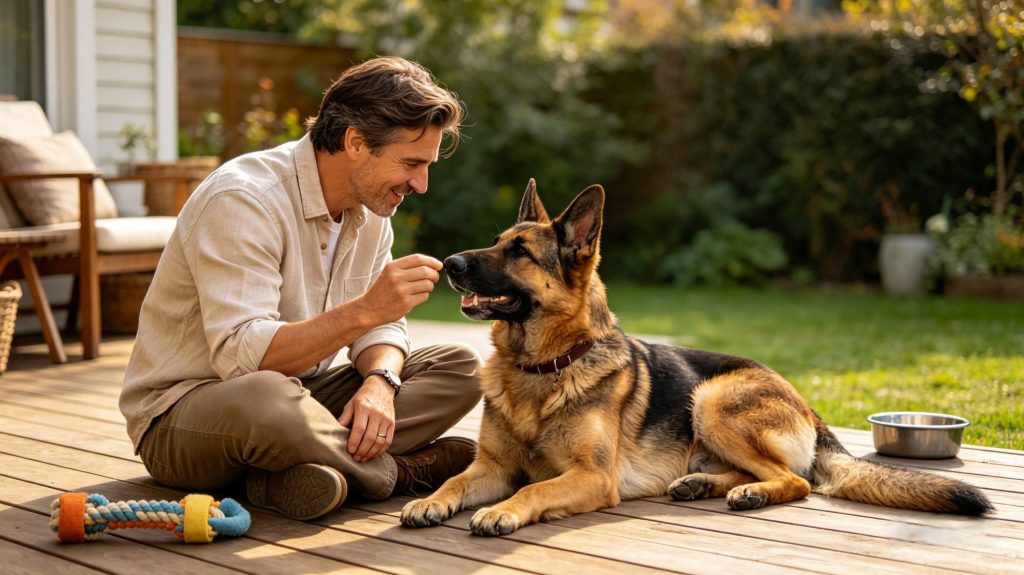
Play can provide a powerful reward for dogs that genuinely enjoy it. Some dogs are highly motivated by toys, movement, chasing, retrieving or tugging, while others are more motivated by food, praise, interaction, freedom or access to their environment.
This means there is no single reward that is automatically best for every dog.
How important is play in dog training therefore depends partly on the individual dog. For one dog, a short game with a favourite toy may produce greater engagement than food. For another, play may have very little value compared with a food reward.
The important point is to understand what motivates your dog and then use that motivation intelligently.
A reward only becomes useful when the dog actually values it.
Can play be used as a training reward?
Yes. Play can be used as reinforcement when access to the game follows a behaviour and makes that behaviour more worthwhile to the dog.
For example:
BEHAVIOUR → MARK → PLAY
Your dog performs the behaviour you have asked for. You identify the correct response and then provide a short play interaction.
The dog begins to understand that responding to you can produce something it enjoys.
This makes play more than entertainment. It becomes part of your communication system.
The same principle applies to food. The reward follows the behaviour rather than becoming the thing the dog must see before deciding what to do.
Play is not the same as engagement
One of the most important distinctions when using play in dog training is the difference between liking a toy and engaging with the handler.
A dog can love a ball but still prefer to run away with it.
A dog can enjoy chasing a toy but have little interest in returning to the handler.
A dog can become excited by tug but struggle to release the toy and return to training.
The toy may have value, but the interaction with the handler may not yet have the same value.
This is why effective play should not simply be about giving your dog access to an object.
The aim is to develop interaction.
HANDLER → OPPORTUNITY → DOG ENGAGES → PLAY → REINFORCEMENT
Engagement is the point at which your dog wants to interact with you and wants access to something you control. That concept is particularly important when toys are being introduced as training rewards.
Does every dog need to play with toys?
No.
This is an important point.
You should never assume that a dog must become highly toy motivated to be successfully trained.
Dogs are individuals.
Some dogs naturally find toys highly rewarding. Others may need time to develop interest in a particular type of play. Some dogs may prefer food, while others may value movement, praise, exploration or environmental access more highly.
The question should not be:
“Why doesn’t my dog love toys?”
The better question is:
“What does my dog find rewarding?”
Once you understand that, you can decide whether play should become part of your dog’s reinforcement system.
Different dogs can also value the same reward differently depending on the environment and the difficulty of the behaviour. A reward that works brilliantly in a quiet room may not have enough value in a distracting outdoor environment.
How can play improve dog training?
Play can make training more engaging and can provide a useful change of activity between repetitions.
For example:
TRAIN → REWARD → PLAY → RESET → TRAIN
A short game can provide motivation without requiring food for every single repetition.
Play can also help develop:
- Engagement
- Responsiveness
- Movement
- Speed
- Handler focus
- Motivation
- Reinforcement
- Interaction
- Confidence
However, speed and excitement should never become the only objective.
A dog performing quickly but inaccurately is not necessarily making better progress than a dog performing calmly and correctly.
The behaviour still matters.
Why is interactive play more useful than simply throwing a toy?
Throwing a ball can certainly be rewarding, but there is a difference between a dog enjoying the environment and a dog learning to engage with its handler.
If every game consists of throwing a toy away from you, your dog may become excellent at chasing the toy without developing the interaction you actually want.
Interactive games can involve the handler more directly.
This might include:
- Tug
- Controlled chasing games
- Retrieving
- Short movement games
- Toy presentation
- Handler-led games
The objective is not to force every dog into tugging.
It is to find a form of play that creates useful interaction for that individual dog.
Structured toy play can also teach the dog that releasing or returning a toy does not automatically mean the fun has ended. This is an important principle in established toy-reward training systems.
Should my dog always have access to their favourite toy?
Not necessarily.
If a particular toy is going to become a valuable training reward, controlled access can help preserve its significance.
That does not mean deliberately frustrating your dog or constantly taking toys away.
It means the handler can control when a particular training game begins and how it is used.
The toy becomes associated with interaction.
The dog learns that the handler is part of the experience.
This can be especially useful when developing toy motivation.
Instead of:
TOY → DOG TAKES IT → DOG LEAVES
you can develop:
TOY → DOG ENGAGES → INTERACTION → PLAY → RESET
The second pattern creates considerably more opportunity for communication.
Does play need rules?
Yes, particularly when you want to use toys as regular training rewards.
A dog should learn that play has a beginning and an end.
The dog can learn to:
- Engage when invited
- Play appropriately
- Release when asked
- Return when required
- Continue interacting with the handler
- Transition back into training
This does not remove the fun from play.
It gives the game structure.
A structured game is easier to use as reinforcement because the handler can control when the reward begins, how it is delivered and when the dog returns to training. Established toy-training approaches place particular emphasis on enthusiasm, releasing the toy and returning to the handler before using tug as an obedience reward.
Can play become too exciting?
Absolutely.
This is where many handlers misunderstand motivation.
More excitement does not automatically mean better training.
A dog can become so aroused during play that they stop listening, stop thinking clearly or struggle to return to the behaviour being trained.
Watch your dog.
If your dog can:
PLAY → RESPOND → RESET → TRAIN
the level of excitement may be useful.
If your dog becomes:
PLAY → FRANTIC → IGNORE → GRAB → RUN → CANNOT RECOVER
the level of arousal has become a problem.
The answer is not automatically to make the game even more exciting.
The answer may be to reduce the intensity, shorten the game, create space or help the dog recover.
How important is recovery after play?
Recovery is an important part of using play effectively.
A dog that can become motivated but cannot calm down afterwards does not yet have complete control over the activity.
The objective is not to eliminate excitement.
The objective is to develop the ability to move between different levels of arousal appropriately.
A useful training cycle is:
MOTIVATE → ENGAGE → PLAY → CONTROL → RECOVER → REASSESS
This is particularly important for dogs with naturally high drive.
The handler should not simply ask:
“How excited can I make my dog?”
Ask:
“Can my dog become excited and still listen?”
That is a much more useful training question.
How does play fit into the GPK9 system?
GPK9 approaches play through:
CATEGORY → STATUS → DRIVE → CONTROL
First, identify what you are actually doing.
Is this training, exercise, play or another activity?
Then observe your dog’s current status.
Is your dog calm, engaged, increasingly aroused or struggling to regulate?
Next consider drive.
What does your dog actually want?
Food?
Toy?
Movement?
Play?
Freedom?
Interaction?
Then consider control.
Can the dog still respond appropriately?
If the answer is yes, play may be an excellent reinforcement tool.
If the answer is no, you need to reassess the level of stimulation.
Play is communication
Play can become another way for the handler and dog to communicate.
Your timing matters.
Your movement matters.
Your voice matters.
Your position matters.
Your decision about when play starts and stops matters.
The dog’s response matters.
This is why GPK9 uses the broader communication process:
OBSERVE → INTERPRET → DECIDE → COMMUNICATE → OBSERVE RESPONSE → REASSESS
You observe what your dog is showing you.
You interpret it.
You decide what the dog needs.
You communicate.
You watch the response.
Then you reassess.
Play therefore becomes part of a two-way communication system rather than simply an activity you impose on the dog.
Can play replace food rewards?
Sometimes.
But it does not have to.
A strong training system does not depend on one reward.
Your dog may find different rewards valuable in different circumstances.
For example:
Food may be ideal for teaching a new behaviour.
Toy play may be ideal for reinforcing fast movement.
Praise may be valuable for maintaining engagement.
Freedom may be powerful after a successful recall.
Sniffing and exploration may be valuable environmental rewards.
This creates a reward hierarchy.
The harder the task or more distracting the environment, the more carefully you need to consider what your dog finds reinforcing.
Can play help build motivation?
Yes, but motivation should be developed rather than forced.
If your dog does not naturally engage with toys, start by finding out what type of interaction they enjoy.
Perhaps they like movement.
Perhaps they like chasing.
Perhaps they prefer carrying.
Perhaps they enjoy gentle interaction.
Perhaps they are more interested in food.
There is no need to turn every dog into a high-drive toy dog.
The goal is to develop useful motivation.
That means motivation that can be connected to appropriate behaviour.
How do you know whether play is helping your training?
Look at what happens after the game.
Ask yourself:
Does my dog return to me?
Does my dog remain engaged?
Can my dog perform the next behaviour?
Can my dog calm down?
Does play improve motivation?
Does play improve responsiveness?
Does play make the training clearer?
If the answer is yes, play is serving a useful purpose.
If your dog becomes increasingly difficult to control, the game may need to be changed.
The dog is giving you the information.
You need to observe it.
Common mistakes when using play in dog training
Making the dog excessively excited
Excitement is not the same as useful motivation.
Assuming every dog should love the same toy
Individual dogs have individual preferences.
Throwing the toy and calling it training
The dog may be enjoying the toy without developing handler engagement.
Never teaching release
A dog that cannot release a toy cannot reliably use that toy as a structured reward.
Playing for too long
Long sessions can reduce concentration and increase arousal.
Making every game extremely intense
Some dogs need controlled interaction rather than increasing stimulation.
Taking the toy away as soon as the dog releases it
If releasing always predicts the end of the game, the dog may become reluctant to release.
Ignoring recovery
The ability to calm after play is part of useful control.
Using play when the dog does not value it
Choose the reward your dog actually wants.
How important is play in dog training for puppies?
Play can be particularly useful with puppies because it can introduce positive interaction with the handler and create opportunities for learning.
However, puppy play should remain appropriate for the puppy’s age, physical development and current arousal.
The objective is not to exhaust the puppy.
It is to create positive engagement.
Short, successful games can be followed by calm behaviour, rest or another simple activity.
The puppy learns that interaction with the handler can be enjoyable while also learning that excitement has an appropriate beginning and end.
How important is play in dog training for adult dogs?
Adult dogs can also benefit greatly from play, but their preferences may be more established.
One dog may love a ball.
Another may prefer tug.
Another may prefer food.
Another may be motivated by freedom and exploration.
The handler’s responsibility is to observe the individual dog rather than trying to force a particular training style.
Your dog’s motivation can also change according to the environment.
A reward that works at home may not be enough in a busy outdoor environment.
This is why GPK9 training is always based on observation, interpretation and appropriate progression.
Play should build the partnership
The ultimate value of play is not the toy itself.
It is what the toy and the game can create between the dog and handler.
When used correctly, play can teach your dog:
Engage with me.
Work with me.
Listen to my communication.
Good behaviour creates reward.
We can become excited and then recover.
The game can start and stop without conflict.
That is where play becomes much more than entertainment.
The GPK9 approach to play
GPK9 does not aim to create the most excited dog possible.
It aims to create a dog that can use motivation appropriately.
The progression is:
OBSERVE
↓
IDENTIFY MOTIVATION
↓
BUILD ENGAGEMENT
↓
INTRODUCE PLAY
↓
STRUCTURE THE GAME
↓
REINFORCE BEHAVIOUR
↓
CONTROL AROUSAL
↓
RECOVER
↓
REASSESS
The objective is not maximum drive.
It is useful drive with control.
GPK9’S FIVE GOLDEN RULES
1. UNDERSTAND WHAT YOUR DOG VALUES
Do not assume every dog is motivated by the same reward.
2. MAKE THE HANDLER PART OF THE GAME
A valuable toy is useful, but engagement with the handler is more important.
3. USE PLAY TO REINFORCE GOOD BEHAVIOUR
Play should have a purpose within training rather than becoming uncontrolled entertainment.
4. CONTROL THE LEVEL OF AROUSAL
Motivation is useful when the dog can still think, listen and respond.
5. BUILD THE ABILITY TO PLAY AND RECOVER
A well-trained dog should be able to engage enthusiastically and then return to an appropriate level of control.
How important is play in dog training? Very important for the dogs that genuinely value it—but play is most powerful when it is used as part of a wider communication and reinforcement system.
You do not need to make every dog obsessed with toys.
You do not need maximum excitement.
You do not need to replace food completely.
You need to understand your dog.
Find what motivates them.
Use that motivation intelligently.
Build engagement.
Create structure.
Reward the behaviour.
Then teach your dog that they can become excited, play, recover and return to you.
Play should build the partnership—not replace the communication.