WILL MY DOG ONLY LISTEN IF I HAVE TREATS?
Will my dog only listen if I have treats? No — your dog does not have to rely on visible treats to listen to you. Treats are an effective way to teach, motivate and reinforce behaviour, but there is an important difference between using food as a reward and teaching your dog that food must be visible before they respond. If your dog only listens when you have a treat in your hand, the problem is usually not that your dog needs treats forever; it is that the reward has become part of the cue. The aim is to teach your dog to listen first, respond correctly, and then receive an appropriate reward.
Why Will My Dog Only Listen If I Have Treats?
When a dog repeatedly sees food before being asked to perform a behaviour, the food can become part of the training signal.
The dog may learn:
See treat → perform behaviour.
Instead, you want the dog to learn:
Hear cue → understand cue → perform behaviour → receive reward.
That difference is extremely important.
There is nothing wrong with having a dog that loves food. In fact, a strong food motivation can be extremely useful during training.
The problem occurs when the dog starts checking your hands, looking for your treat pouch, or refusing to respond until food becomes visible.
If your dog will sit immediately when you hold food but ignores the same cue when your hands are empty, you may need to change the way the reward is being presented.
Will My Dog Only Listen If I Have Treats Because I Am Bribing Them?
Not necessarily, but there is an important distinction between a lure and a reward.
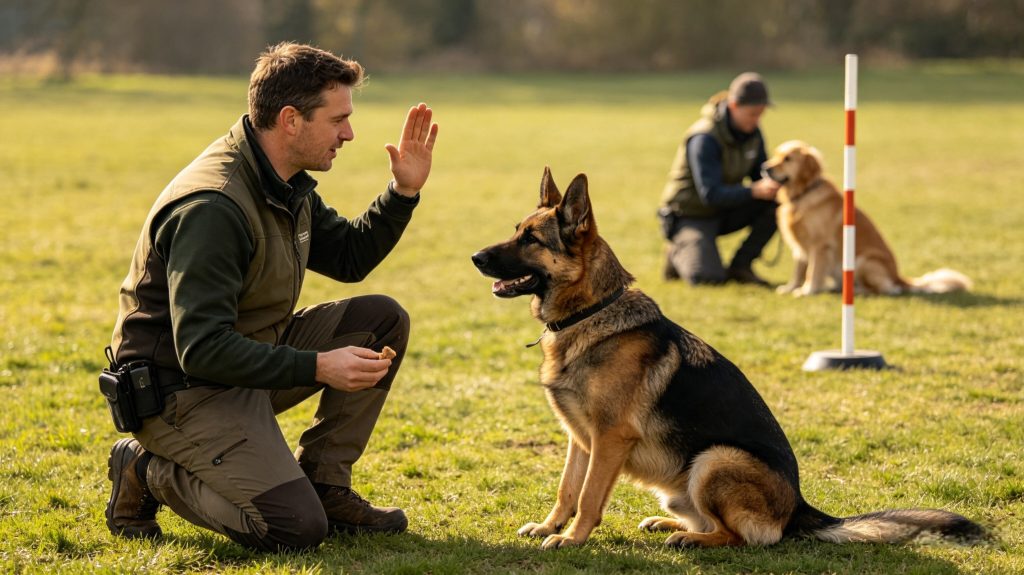
A lure is used to guide a dog into a position or movement.
For example, you may use food to guide your dog into a sit.
That can be useful when teaching a new behaviour.
The problem develops if the dog never progresses beyond following the food.
A reward is different.
The dog performs the behaviour first and the reward follows.
The training sequence becomes:
CUE → BEHAVIOUR → MARK → REWARD
This teaches the dog that the cue has meaning independently of the food.
The food becomes the consequence of responding rather than the instruction to respond.
Will My Dog Only Listen If I Have Treats in My Hand?
If your dog watches your hands before responding, start paying close attention to what your hands are communicating.
For example, you may say:
“Sit.”
Then immediately move a treat towards the dog’s nose.
The dog may not actually be responding to the word “sit.”
The dog may be responding to the movement of your hand and the presence of food.
This does not mean the dog has failed.
It means the behaviour needs to be developed further.
The next stage is to make the food less obvious.
Give the cue.
Allow the dog an opportunity to respond.
If the dog performs correctly:
Mark → reward.
Now the dog begins learning that food can appear after the behaviour.
How Do I Stop My Dog Only Listening When I Show Treats?
The answer is not to suddenly remove all rewards.
Instead, change the position and timing of the reward.
Begin keeping the food out of sight.
Your dog should not know exactly where it is or see it before every response.
Give the cue.
Wait.
If your dog responds:
Mark the correct behaviour.
Then produce the reward.
This creates a new pattern:
Communication first.
Behaviour second.
Reward third.
Repeated correctly, this helps separate the food from the instruction.
Will My Dog Stop Listening If I Stop Showing Treats?
Not if you have built the behaviour correctly.
Your dog can learn that the absence of visible food does not mean the end of training.
In fact, one of the important stages of reward-based training is teaching your dog that the reward does not need to be visible before the behaviour occurs.
For example:
“Sit.”
Your hands are empty.
Your dog sits.
“Yes.”
The food then appears.
The dog learns:
“I did not need to see the food first.”
That is the beginning of independence from the visible reward.
Should I Stop Using Treats Completely?
No.
This is one of the biggest misunderstandings surrounding reward-based training.
The goal is not to eliminate rewards.
The goal is to eliminate dependence on the visible reward.
Treats can remain extremely useful for:
- Teaching new behaviours
- Strengthening existing behaviours
- Training around distractions
- Building motivation
- Reinforcing recall
- Improving precision
- Generalising behaviour
- Rebuilding a behaviour that has weakened
A dog can be highly food motivated without being dependent on seeing food before responding.
Will My Dog Only Listen If I Have Treats Because the Behaviour Has Not Been Generalised?
Sometimes the problem is not treat dependence at all.
Your dog may genuinely understand the behaviour in one environment but not yet understand that the same cue applies everywhere.
For example, your dog may sit reliably in the kitchen.
You then ask for a sit in a busy outdoor environment and your dog struggles.
It is easy to conclude:
“My dog only listens when I have treats.”
But the real issue may be:
“My dog has not yet learned to perform this behaviour in this environment.”
Dogs do not automatically transfer every learned behaviour from one situation to another.
A behaviour developed in a quiet room may need additional training in the garden, on a quiet walk and eventually around increasing levels of distraction.
Will My Dog Only Listen If I Have Treats Outside?
Outdoor training creates a completely different training environment.
Your dog may suddenly have access to:
- Smells
- Movement
- People
- Dogs
- Wildlife
- Vehicles
- Sounds
- Open spaces
- Exploration
- Freedom
The environment itself can be highly rewarding.
If your dog ignores you outside, increasing the value of the food is not always the answer.
You may need to reduce the difficulty.
Increase distance from distractions.
Shorten the training session.
Return to an easier behaviour.
Improve engagement.
Increase reinforcement frequency.
Or simply give your dog more time to learn the behaviour in that environment.
Why Will My Dog Only Listen If I Have Treats When There Are Distractions?
Distractions change the value of everything around the dog.
Your dog may be perfectly capable of responding to a cue but unable to do so reliably when the environment becomes too difficult.
This is why GPK9 uses:
CATEGORY → STATUS → DRIVE → CONTROL
CATEGORY
What are you asking the dog to do?
STATUS
What state is your dog currently in?
DRIVE
What currently has your dog’s attention?
CONTROL
What level of equipment, distance, freedom and environmental management is appropriate?
The answer may not be:
“Find a better treat.”
The answer may be:
“Make the training easier.”
Will My Dog Only Listen If I Have Treats Because I Am Showing the Reward Too Early?
This is one of the most important areas to assess.
If your dog repeatedly sees food before being asked to respond, the food can become a predictor of the behaviour.
Instead, aim for:
CUE → RESPONSE → REWARD
rather than:
REWARD → CUE → RESPONSE
This does not mean food can never be used as a lure.
Luring can be useful when teaching certain new behaviours.
But once your dog begins to understand the movement, start fading the lure.
The sooner the dog learns that the reward can appear after the response, the less likely the dog is to depend upon seeing it first.
How Do I Fade Treats Without Losing My Dog’s Motivation?
Do it gradually.
A useful progression is:
FOOD LURE
↓
EMPTY HAND
↓
HAND SIGNAL
↓
VERBAL CUE
↓
RESPONSE
↓
REWARD
At first, your dog may need considerable help.
As understanding develops, reduce the amount of physical guidance.
Your dog should eventually be able to respond to the cue without seeing food.
But the reward can still appear afterwards.
This is the important distinction:
Fade the lure — not necessarily the reward.
Will My Dog Only Listen If I Have Treats If I Stop Rewarding Too Soon?
Reducing reinforcement too quickly can create another problem.
If a behaviour is still developing and you suddenly remove the reward, the dog may become less reliable.
The dog needs a history of successful responses.
Build the behaviour first.
Strengthen it.
Then gradually vary the reinforcement.
Do not remove rewards simply because you are worried about creating dependence.
The goal is to create reliable behaviour with flexible reinforcement.
What Can I Use Instead of Treats?
Food is only one form of reinforcement.
Depending on your individual dog, other valuable outcomes may include:
- Praise
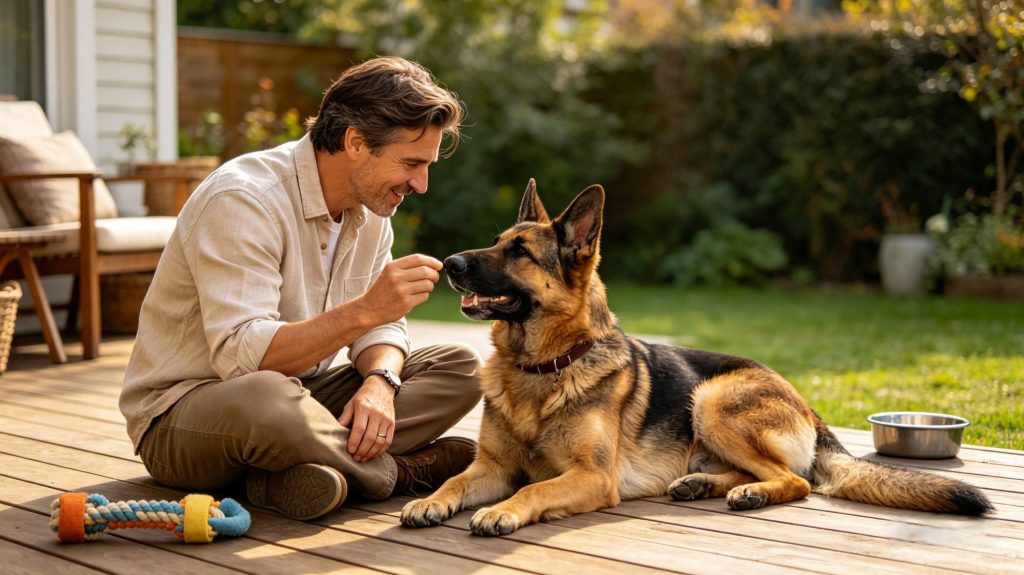
- Play
- Toys
- Interaction
- Sniffing
- Exploration
- Movement
- Freedom
- Access to an area
- Continuing the walk
- Access to a favourite activity
For example:
Loose lead → continue walking.
Recall → return to exploration.
Calm waiting → access.
Good response → play.
Appropriate behaviour → freedom.
This teaches your dog that good behaviour creates opportunities.
Will My Dog Only Listen If I Have Treats During Recall?
Recall deserves particular attention because returning to the handler can compete with almost everything around the dog.
A dog that is exploring may not want to stop.
A dog that is sniffing may not want to leave.
A dog that sees another dog may be highly interested in that interaction.
A dog chasing movement may have an extremely strong competing motivation.
This is why recall should have a strong reinforcement history.
Do not remove rewards simply because you want to prove your dog can recall without food.
Instead, build a history where returning to you consistently produces worthwhile outcomes.
Sometimes that may be food.
Sometimes it may be play.
Sometimes it may be praise.
Sometimes it may be release back to exploration.
The message becomes:
Coming back to my handler does not automatically mean everything enjoyable ends.
Can Freedom Become a Reward?
Yes.
Freedom can become one of the most useful rewards in appropriate situations.
For example:
Recall → marker → release to explore.
The dog returns.
The handler acknowledges the response.
The dog is then given appropriate access to the environment again.
This creates a valuable association:
Responding to my handler can give me more opportunity, not less.
This fits directly into the GPK9 principle:
More freedom requires more behavioural responsibility.
Will My Dog Only Listen If I Have Treats If I Use the Same Reward Every Time?
Not necessarily, but developing a broader reward system can make training more flexible.
You can establish a reward hierarchy.
LOWER VALUE
Calm praise.
Normal food.
Basic interaction.
MEDIUM VALUE
Favourite food.
Play.
Sniffing.
Toy interaction.
HIGHER VALUE
Exceptional food.
Highly valued play.
Preferred activity.
Greater access where appropriate.
The exact hierarchy will differ between dogs and environments.
Something that is highly valuable at home may be less valuable outside.
This is why observation is essential.
How Do I Know If My Dog Is Listening to Me Rather Than the Treat?
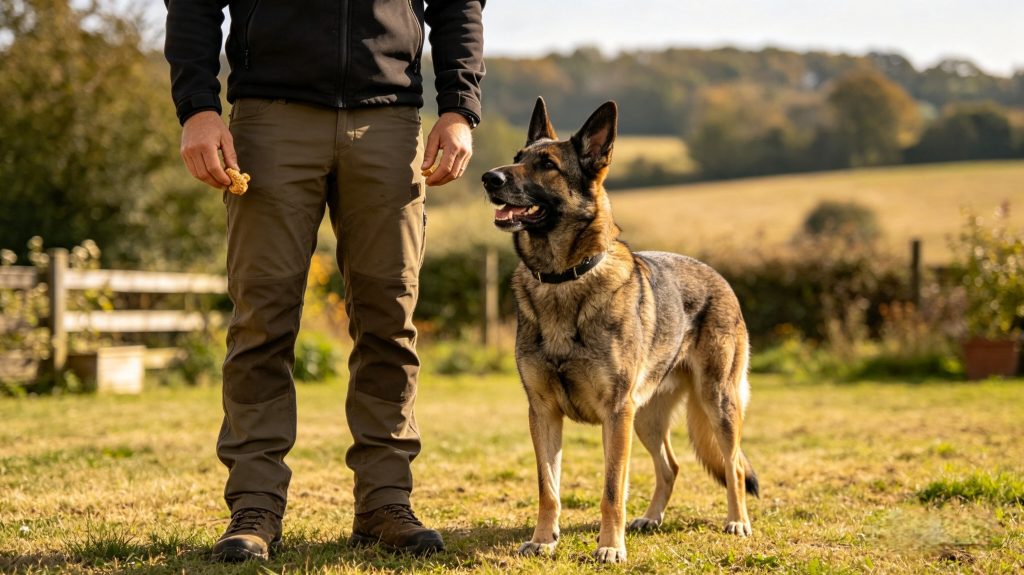
Remove the visible food.
Ask for a behaviour your dog already knows well.
Observe.
Does your dog:
- Respond to the cue?
- Look at you?
- Perform the behaviour?
- Check your hands?
- Search for food?
- Wait for you to produce a treat?
- Ignore the cue completely?
This provides useful information.
If your dog responds before the reward becomes visible, you are developing independence.
If your dog waits for the food to appear, return to easier training and begin separating the cue from the reward.
What If My Dog Looks at My Treat Hand Before Responding?
Do not immediately correct the dog.
Instead, change the training sequence.
Keep the food out of sight.
Give the cue.
Wait for the response.
Then reward.
Over repeated successful repetitions, your dog can learn that the important information comes from the handler’s communication rather than from the appearance of food.
The goal is:
Look to the handler.
Listen to the cue.
Respond.
Receive the outcome.
Will My Dog Only Listen If I Have Treats Because I Am Asking for Too Much?
This is another possibility.
If the dog can perform a behaviour in an easy environment but struggles when you increase:
- Distance
- Duration
- Distraction
- Difficulty
- Environmental pressure
then the problem may not be reward dependence.
The training criteria may simply have increased too quickly.
GPK9 encourages the handler to observe before deciding.
Use:
OBSERVE → INTERPRET → DECIDE → COMMUNICATE → OBSERVE RESPONSE → REASSESS
If the dog struggles, reassess the situation rather than automatically producing a higher-value reward.
How Do I Build a Dog That Listens Without Seeing Food?
Start with behaviour your dog already understands.
Keep the reward hidden.
Give the cue.
Allow the dog to respond.
Mark the correct response.
Deliver the reward.
Then gradually introduce different forms of reinforcement.
For example:
Cue → response → food
Then:
Cue → response → praise
Then:
Cue → response → play
Then:
Cue → response → access
Then vary them appropriately.
The dog learns that the reward system exists, but the reward does not have to be visible before the response.
Will My Dog Only Listen If I Have Treats If I Never Train Without Them?
If every training session follows exactly the same pattern, your dog may become accustomed to that pattern.
Training should therefore develop progressively.
Begin with appropriate reinforcement.
Then change the environment.
Change the reward.
Change the reinforcement frequency.
Change the level of distraction.
Change the duration.
Change the distance.
This develops a dog that can respond under different circumstances.
GPK9 — OBSERVE → INTERPRET → DECIDE → COMMUNICATE → OBSERVE RESPONSE → REASSESS
When your dog does not respond without visible food, use the GPK9 communication process.
OBSERVE
What exactly is the dog doing?
INTERPRET
Is the dog dependent on the visible reward, or is the environment too difficult?
DECIDE
What needs to change?
COMMUNICATE
Give the cue clearly.
OBSERVE RESPONSE
Did the dog respond?
REASSESS
Was the difficulty appropriate?
Was the reward appropriate?
Was the timing correct?
Should the behaviour be simplified?
This turns the situation into a training decision rather than a battle of wills.
Common Mistakes When a Dog Only Listens for Treats
Showing the treat before every cue
This can make the reward part of the instruction.
Removing all rewards
This can reduce motivation unnecessarily.
Increasing food value every time the dog struggles
The environment may actually be too difficult.
Training only in one location
The dog may not yet understand the behaviour in other environments.
Rewarding too late
Poor timing can make communication unclear.
Asking for too much
The dog may be overwhelmed by the difficulty.
Repeating the cue
Repeated cues can weaken the clarity of communication.
Using only food
The dog should learn that many appropriate outcomes can follow good behaviour.
Expecting instant reliability
Training is a progression, not a switch.
GPK9 — The Progression From Treat Dependence to Independence
The process can be simplified into ten stages:
1. TEACH
Use food when it helps establish the behaviour.
2. UNDERSTAND
Make sure the dog begins to understand what is being asked.
3. FADE THE LURE
Remove food from the visible guiding hand.
4. HIDE THE REWARD
Keep the reward available but out of sight.
5. CUE FIRST
Give the cue before the reward appears.
6. REINFORCE
Mark and reward the correct response.
7. VARY
Use different rewards and different reinforcement frequencies.
8. GENERALISE
Train in different environments.
9. MAINTAIN
Continue reinforcing appropriate behaviour.
10. BUILD INDEPENDENCE
Teach the dog to respond because the communication has meaning, not because food is visible.
Will My Dog Only Listen If I Have Treats Forever?
No.
But your dog should not be expected to work completely without reinforcement simply because the behaviour has been learned.
Training is not about reaching a point where rewards disappear forever.
It is about developing a dog that understands the communication and can work with increasingly varied forms of reinforcement.
Food can become less visible.
Food can become less frequent.
Other rewards can become more important.
Environmental rewards can become part of the system.
The dog can become more independent.
But appropriate behaviour should continue to have worthwhile consequences.
GPK9 — More Freedom Requires More Behavioural Responsibility
The ultimate objective is not simply:
“My dog will obey without treats.”
The objective is:
“My dog understands what I am communicating and can make appropriate choices without needing to see a reward first.”
As reliability develops, greater freedom may become possible.
Reliable recall can create greater freedom.
Good walking can create more exploration.
Calm behaviour can create greater access.
Good communication can create more opportunity.
The dog learns:
GOOD CHOICES → GOOD OUTCOMES → GREATER RESPONSIBILITY → GREATER FREEDOM
That is far more valuable than simply removing treats.
So, Will My Dog Only Listen If I Have Treats?
No — provided you teach the dog to separate the cue from the reward.
Use food to teach.
Use food to motivate.
Use food to reinforce.
But gradually teach your dog that the reward does not need to be visible before the response.
Your dog should learn:
LISTEN → UNDERSTAND → RESPOND → RECEIVE OUTCOME
The outcome might be food.
It might be play.
It might be praise.
It might be access.
It might be sniffing.
It might be freedom.
The important point is that your communication comes first.