
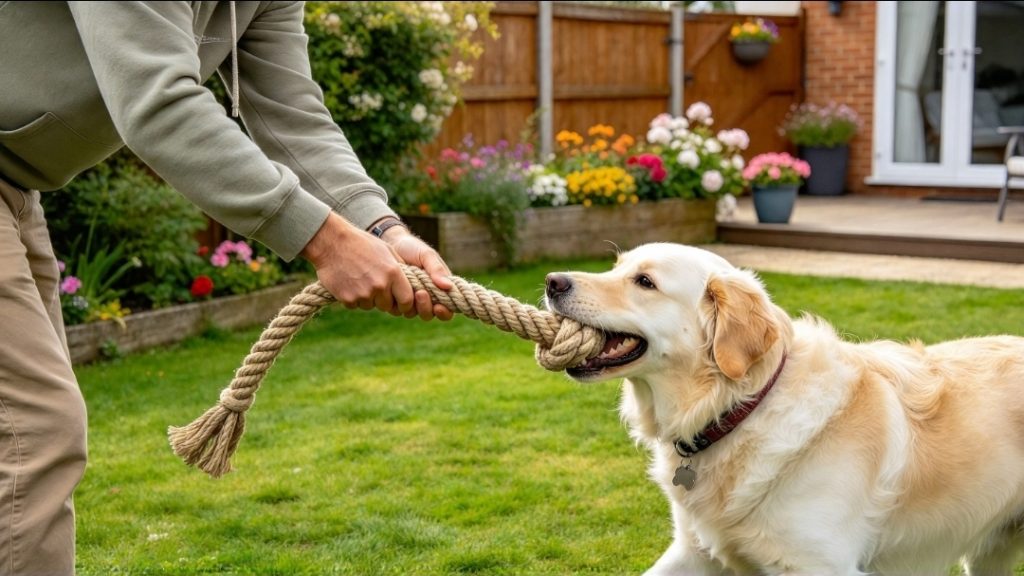
How Do I Teach My Dog to Play Tug?
How do I teach my dog to play tug? Start by introducing a suitable tug toy in a calm environment and encourage your dog to take interest in it. Once your dog takes hold, use gentle movement and resistance to make the game enjoyable. Keep sessions short and teach your dog when to start, stop and release the toy.
RECOMMENDED PRODUCTS

Why Doesn’t My Dog Want to Play Tug?
Some dogs naturally enjoy tug, while others need time to understand the game.
Your dog may not engage because the toy is unfamiliar, the movement is too fast, the environment is distracting, or your dog simply prefers another type of play.
Do not force your dog to take the toy. The aim is to build interest gradually.
What Toy Should I Use for Tug?
Use a strong, appropriate tug toy that is suitable for your dog’s size and chewing behaviour.
A tug toy should give you enough distance from your dog’s mouth to play safely without encouraging your dog to grab your hands.
Avoid damaged toys that could break apart or be swallowed.
Always supervise tug play and replace a toy if it becomes damaged.
How Do I Introduce the Tug Toy?
Start somewhere quiet where your dog is comfortable.
Hold the toy calmly and allow your dog to investigate it. You can move it gently across the floor to encourage interest.
When your dog looks at, approaches or touches the toy, continue the interaction.
If your dog takes hold, allow them to experience the reward of successfully engaging with the toy.
Do not immediately pull hard.
How Do I Get My Dog to Take the Toy?
Make the toy interesting without overwhelming your dog.
Move it gently away from your dog rather than repeatedly pushing it into their face. When your dog follows the movement or attempts to grab it, allow them to catch it.
Once your dog takes hold, keep the resistance light.
The goal at this stage is to teach:
Take the toy → hold the toy → play with the toy.
How Do I Start Tugging With My Dog?
Once your dog is holding the toy, apply gentle resistance.
Move the toy backwards and slightly from side to side rather than pulling sharply upwards.
Allow your dog to pull against you.
Keep the game short and give your dog opportunities to succeed.
If your dog lets go, simply pause and offer the toy again rather than chasing them or forcing it back into their mouth.
Should I Let My Dog Win at Tug?
You do not need to worry about always winning or always losing.
The important part is that your dog enjoys the interaction and learns that releasing the toy does not automatically end the game.
Allow your dog to take possession of the toy at times and continue the interaction when appropriate.
The objective is controlled engagement, not determining who wins.
How Do I Teach My Dog to Release the Tug Toy?
Teaching a release cue is an important part of tug training.
Stop moving the toy and wait for your dog to loosen their grip. When they release it, mark the behaviour and reward them by restarting the game.
You can introduce a consistent word such as “drop” or “release”.
Practise when your dog is calm enough to respond.
Your dog should learn that releasing the toy can make another game of tug available.
Should I Use Food to Teach the Release?
Food can be useful if your dog struggles to release the toy.
Present the food after the release and then, where appropriate, return to the tug game.
However, do not make food necessary every time.
As your dog becomes reliable, practise releasing the toy and restarting the game without needing to show food first.
This helps the release cue become a trained behaviour rather than a trade that only works when food is visible.
How Do I Teach My Dog When Tug Starts?
You can also teach a clear start routine.
Keep the tug toy still until your dog is ready to engage. Give a consistent cue such as “take it”, then begin moving the toy.
This creates a clear distinction between the toy being available and the game actually starting.
Over time, your dog learns to wait for permission rather than grabbing the toy whenever they see it.
How Do I Stop My Dog Grabbing the Toy Before I Say?
Keep the toy out of reach and still.
If your dog attempts to grab it before the start cue, do not turn it into a game. Wait for your dog to settle and then give the cue when appropriate.
Reward the correct response by starting the game.
This teaches your dog that self-control makes play available.
How Long Should Tug Sessions Last?
Keep early sessions short.
A few successful interactions can be more useful than continuing until your dog becomes tired or excessively excited.
End the game while your dog is still able to respond to you.
As your dog becomes more experienced, you can gradually increase the duration while maintaining control.
RECOMMENDED PRODUCTS
What If My Dog Gets Too Excited During Tug?
Tug can increase arousal quickly.
If your dog becomes too excited to respond, stop increasing the intensity. Pause the game and allow your dog to settle.
You can make the game shorter, use slower movements or practise the release more frequently.
The aim is not to make your dog as excited as possible. The aim is to build engagement with control.
What If My Dog Bites My Hands During Tug?
Keep your hands away from the dog’s mouth and use a tug toy with enough length to create a safe distance.
If your dog repeatedly targets your hands instead of the toy, calmly stop the game and redirect them to the appropriate toy.
Do not deliberately encourage your dog to grab hands, sleeves or clothing as part of the game.
If biting is frequent, intense or difficult to control, stop the exercise and seek professional assessment.
Can Tug Help With Dog Training?
Yes. Once your dog understands tug, it can become a valuable reward.
Ask for a behaviour, wait for the correct response, mark it and then use tug as the reward.
For example:
Cue → behaviour → mark → tug → release → reset.
Tug can reinforce behaviours such as attention, recall, waiting and obedience.
The toy should come after the behaviour, rather than being used to constantly lure your dog into position.
How Do I Progress Tug Training?
Once your dog can engage, release and restart the game reliably, gradually introduce more difficulty.
You can increase:
- Duration of play
- Distance from distractions
- The amount of control required before play
- The complexity of the behaviour before the reward
- The number of repetitions
Change one factor at a time so your dog can continue succeeding.
If your dog becomes too excited or stops responding, reduce the difficulty and rebuild control.
When Should I Stop Tug Training?
Stop the session if your dog becomes unable to respond, appears uncomfortable, becomes excessively aroused or repeatedly targets people rather than the toy.
You should also stop if the toy becomes damaged.
Tug should remain a safe, controlled and enjoyable activity, not something that creates conflict between you and your dog.
Conclusion
Teaching your dog to play tug starts with making the toy enjoyable and gradually teaching your dog how the game works.
Build interest, allow your dog to take the toy, use gentle resistance, teach a reliable release and establish clear start and end points.
Once your dog understands the game, tug can become an effective training reward while also teaching an important skill: your dog can become excited about play and still respond to you.
The GPK9 Five Golden Rules provide the foundation of the GPK9 Professional Training System. They give new dog owners, new dog handlers, experienced handlers and professional dog trainers a clear structure for developing the dog and the handler together.
The GPK9 Five Golden Rules cover five essential areas of development: Home & Social, Obedience, Prey Drive, Toilet and Social Walking. Each area has its own purpose, but they are designed to work together as one complete training system.
The GPK9 approach is based on CATEGORY → STATUS → DRIVE → CONTROL and the handler’s ability to OBSERVE → INTERPRET → DECIDE → COMMUNICATE → OBSERVE RESPONSE → REASSESS. This gives the handler a consistent process for understanding what the dog is doing, why the behaviour is occurring, what level of control is appropriate and how to communicate effectively.
The purpose of the GPK9 Five Golden Rules is not simply to teach a collection of individual exercises. They are designed to develop the dog’s behaviour, motivation, communication, control and reliability while teaching the handler how to make better decisions.
Golden Rule One — Home & Social
Golden Rule One — Home & Social establishes the foundation for everyday life with the dog. It focuses on communication, boundaries, calm behaviour, household routines and appropriate behaviour around people, animals and normal activity.
The purpose of Golden Rule One — Home & Social is to help the handler understand the dog’s behaviour and recognise changes in arousal before they become larger problems. The handler learns to observe, assess and communicate rather than simply reacting after unwanted behaviour has already occurred.
Golden Rule One — Home & Social provides the foundation from which the handler can develop a calmer, more predictable and better-communicating dog.
Golden Rule Two — Obedience
Golden Rule Two — Obedience develops the dog’s ability to understand and respond to the handler’s communication.
The focus of Golden Rule Two — Obedience is not simply teaching commands. It is about developing understanding, reliability, timing, reward, release and control so the dog learns what the handler is communicating.
Through Golden Rule Two — Obedience, the handler learns to progress training appropriately, gradually increasing the dog’s freedom and responsibility as understanding and reliability improve.
Golden Rule Three — Prey Drive
Golden Rule Three — Prey Drive focuses on understanding and developing the dog’s natural motivation to chase, pursue, engage and work with an appropriate toy or prey-based reward.
The purpose of Golden Rule Three — Prey Drive is not simply to increase drive. The handler must learn how to recognise the dog’s level of motivation, select an appropriate reward and use timing, communication and control to channel that motivation productively.
Golden Rule Three — Prey Drive teaches the handler that motivation can become a powerful training tool when it is developed and controlled correctly.
Golden Rule Four — Toilet
Golden Rule Four — Toilet establishes reliable toilet habits through consistency, observation, timing, supervision and appropriate reinforcement.
The handler learns through Golden Rule Four — Toilet to recognise when the dog is likely to need the toilet, provide the correct opportunity and reinforce the desired behaviour.
The objective of Golden Rule Four — Toilet is to establish a predictable routine that helps the dog understand where and when toileting is appropriate while reducing opportunities for mistakes.
Golden Rule Five — Social Walking
Golden Rule Five — Social Walking develops the dog’s ability to walk calmly and appropriately in the real world while remaining connected to the handler.
The focus of Golden Rule Five — Social Walking is the relationship between the handler, the dog, the environment, distractions, distance and available control.
Through Golden Rule Five — Social Walking, the handler learns to observe body language, identify potential triggers, assess distance and recognise changes in drive or arousal before behaviour escalates.
The objective of Golden Rule Five — Social Walking is not simply to make the dog walk beside the handler. It is to develop a dog that can experience the outside world while remaining connected to the handler and capable of responding to clear communication.
How the Five Golden Rules Work Together
The GPK9 Five Golden Rules are designed to work together rather than being treated as five completely separate subjects.
Golden Rule One — Home & Social establishes the foundations for everyday behaviour and communication.
Golden Rule Two — Obedience develops understanding, responsiveness and control.
Golden Rule Three — Prey Drive develops motivation and teaches the handler how to channel natural drive appropriately.
Golden Rule Four — Toilet establishes essential household routine and reliability.
Golden Rule Five — Social Walking takes the communication and control developed through the other areas into the outside environment.
Together, the GPK9 Five Golden Rules help the handler develop a complete understanding of the dog rather than treating individual behaviours as isolated problems.
The overall objective of the GPK9 Five Golden Rules is to train the human, train the dog and build the partnership through clear observation, communication, appropriate control and progressive development.




