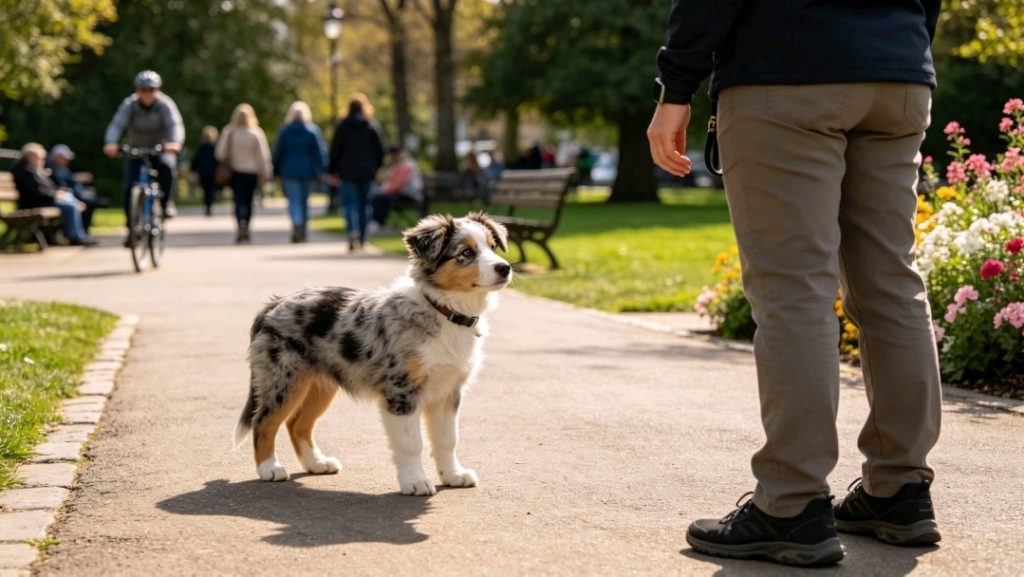
How Do I Teach My Puppy to Come When Called?
How do I teach my puppy to come when called? Start by teaching your puppy that coming to you is one of the most rewarding things they can do. Begin in a quiet, controlled environment, use a clear recall cue, reward every successful response and gradually increase distance and distractions as your puppy becomes more reliable. Do not expect a puppy to come away from something highly exciting before they have learned the behaviour in easier situations.
Recall is one of the most important behaviours a puppy can learn because it can help you manage your dog safely as they become more independent.
The goal is not simply to teach your puppy to respond to the word “come”.
The goal is to build a strong habit:
Hear the recall → turn towards the handler → move towards the handler → reach the handler → receive something worthwhile.
With repetition, the puppy begins to understand that responding to the recall cue is a valuable choice.
RECOMMENDED PRODUCTS

Why Is Recall So Important?
A puppy naturally becomes more interested in the world as they grow.
There are:
- smells to investigate;
- people to watch;
- other dogs;
- wildlife;
- movement;
- interesting objects;
- new environments;
- places to explore.
When the puppy is standing beside you in the house, coming when called may be easy.
When the same puppy is outdoors and discovers something much more interesting, the situation changes.
This is why recall needs to be trained progressively.
The puppy must learn that returning to the handler remains worthwhile even when the environment becomes increasingly interesting.
What Does Good Recall Actually Mean?
Good recall is more than simply turning the head when the owner says the puppy’s name.
A useful recall response involves the puppy:
- noticing the handler;
- responding to the recall cue;
- turning away from the current activity;
- moving towards the handler;
- continuing until they reach the handler;
- remaining engaged long enough to receive the reward.
The final behaviour should be reliable enough to use in appropriate real-life situations.
That reliability is developed gradually.
Start With Your Puppy’s Name
Before expecting a puppy to respond reliably to a recall cue, teach the puppy that their name is important.
Say the puppy’s name in a calm, positive way.
When the puppy looks towards you:
reward the response.
The puppy begins to learn:
My name means I should pay attention to my handler.
This gives you an important foundation for recall.
You are not demanding a complete return yet.
You are developing the puppy’s ability to notice you.
Choose a Clear Recall Cue
Choose one simple recall word.
For example:
- “Come”
- “Here”
You can also establish a consistent whistle or another clear signal.
The important thing is consistency.
If several people live with the puppy, everyone should understand which cue is being used.
Avoid constantly changing the recall word.
The puppy needs to learn that a particular sound has a particular meaning.
Make the Recall Cue Valuable
The recall cue should predict something worthwhile.
When the puppy responds correctly, something good should happen.
Depending on the individual puppy, this could be:
- food;
- praise;
- a favourite toy;
- play;
- attention;
- access to another enjoyable activity.
Different puppies value different things.
The important question is:
What does my puppy actually value?
If you know what motivates your puppy, you can use that motivation to make returning to you worthwhile.
RECOMMENDED PRODUCTS
Begin Somewhere Easy
Do not start recall training in the most distracting environment you can find.
Begin somewhere your puppy can concentrate.
Suitable starting environments may include:
- a quiet room;
- another controlled area of the home;
- a secure garden;
- another safe enclosed space.
The puppy should have a realistic opportunity to succeed.
If the environment is already full of distractions, you are making the exercise unnecessarily difficult.
Keep the First Recalls Simple
Stand close to your puppy.
Get their attention.
Use their name if necessary.
Give the recall cue.
Move away slightly or make yourself inviting.
When the puppy comes towards you:
reward immediately.
The first objective is not distance.
The first objective is to create a strong association between:
Recall cue → return to handler → reward.
Use Your Body Language
Your body language can help make returning to you attractive.
When calling your puppy:
- face them;
- use an encouraging voice;
- open your body towards them;
- move backwards where appropriate;
- make yourself interesting;
- avoid appearing threatening or frustrated.
A puppy is much more likely to want to move towards an inviting handler than towards someone who appears angry.
Recall should become a behaviour the puppy enjoys performing.
Reward Every Successful Recall at the Beginning
When teaching a new recall, reward successful responses consistently.
The puppy needs plenty of reinforcement while learning what the cue means.
If the puppy comes towards you:
make coming to you worthwhile.
The reward does not need to be enormous every time.
It needs to be appropriate to the difficulty of the recall.
An easy recall in the house may require a relatively simple reward.
A difficult recall away from an interesting distraction may require something significantly more valuable.
RECOMMENDED PRODUCTS
Match the Reward to the Difficulty
Not every recall is equally difficult.
Consider the difference between:
Puppy recalls from two metres away in the living room.
and:
Puppy recalls away from an exciting smell outdoors.
The second behaviour is much more difficult.
The reward should reflect the difficulty where appropriate.
This gives the puppy a reason to continue responding when the environment becomes more challenging.
Never Assume the Puppy Understands the Cue Everywhere
A puppy that responds perfectly in the kitchen has not necessarily learned recall in the garden.
A puppy that responds in the garden has not necessarily learned recall in a park.
A puppy that responds in a quiet park may not respond around other dogs.
Each environmental change can make the behaviour more difficult.
Therefore, recall needs to be generalised gradually.
The puppy learns that the recall cue has the same meaning wherever they are.
Increase Distance Gradually
Once your puppy consistently returns from a short distance, increase the distance slightly.
Do not immediately move from:
two metres → twenty metres.
Build the behaviour gradually.
For example:
short distance → slightly longer distance → greater distance
The exact distances are less important than the principle.
Increase the challenge only when the puppy is demonstrating that they can manage the current level.
Introduce Distractions Gradually
Distance is only one part of recall difficulty.
Distractions also matter.
Your puppy may need to learn recall around:
- household activity;
- toys;
- movement;
- garden distractions;
- smells;
- people;
- other dogs;
- increasingly interesting outdoor environments.
Do not introduce several major difficulties at once.
If you increase distance, distractions and environmental complexity simultaneously, it becomes much harder to understand what your puppy has actually learned.
Use One Change at a Time
If your puppy is succeeding consistently, introduce one manageable progression.
For example:
Same environment + slightly greater distance
or:
Same distance + slightly greater distraction
This makes the learning process clearer.
If the puppy struggles, you know which part of the exercise may have become too difficult.
Do Not Call Your Puppy When You Know They Will Ignore You
This is an important part of recall training.
If your puppy is highly focused on something and you already know they are unlikely to respond, repeatedly shouting the recall cue may teach the puppy that the word can be ignored.
Instead, manage the situation.
Reduce the distance.
Use appropriate equipment.
Move away from the distraction.
Wait for an easier opportunity.
Then practise the recall at a level where your puppy has a realistic chance of succeeding.
Do Not Keep Repeating the Recall Cue
Avoid turning:
“Come!”
into:
“Come, come, come, come, COME!”
The puppy can learn that the first cue does not really matter because another one will follow.
Give the puppy an opportunity to respond.
If they do not respond, investigate why.
Perhaps:
- the distraction is too strong;
- the distance is too great;
- the puppy is too excited;
- the puppy does not understand the cue in that environment;
- the reward is not sufficiently motivating;
- the training has progressed too quickly.
The answer may be to make the exercise easier.
What If My Puppy Does Not Come?
Remain calm.
Do not turn the recall failure into a frightening experience.
If you become angry when your puppy eventually returns, the puppy may begin to associate returning to you with something unpleasant.
Instead, consider what caused the failure.
Ask:
Was the exercise too difficult?
Then change the training setup.
You may need to:
- reduce distance;
- reduce distractions;
- use a better reward;
- return to a quieter environment;
- use a long line for management;
- rebuild the behaviour gradually.
A failed recall should provide information.
Always Make Coming Back Worthwhile
Even if the puppy takes longer than expected to return, avoid making the return unpleasant.
When the puppy eventually reaches you, remain positive.
The puppy needs to understand:
Coming back to my handler is always a good choice.
This becomes particularly important in real-life situations where the puppy has become distracted.
You want the puppy to continue believing that returning to you is worthwhile.
Do Not Only Call Your Puppy When Something Fun Is Ending
If every recall means:
- the walk is over;
- play has finished;
- the puppy must leave an interesting area;
- the puppy is going home;
- something enjoyable is being removed;
the puppy may begin to predict that coming back means losing freedom.
Instead, practise recalls during enjoyable activities and then allow the puppy to return to what they were doing when appropriate.
For example:
Recall → reward → release back to exploration.
This can help prevent the puppy from learning that recall always means the end of fun.
Build a Strong Recall Through Everyday Life
Recall does not need to be practised only as a formal exercise.
You can reinforce it during normal daily activities.
Call your puppy from:
- one room to another;
- a short distance in the garden;
- one side of a secure area;
- an easy distraction;
- a calm outdoor environment.
Reward successful responses.
This creates repeated opportunities for the puppy to practise returning to you.
Make Yourself Interesting
Your puppy should have a reason to want to return.
You can make yourself interesting by:
- moving away;
- using an enthusiastic voice;
- offering a reward;
- playing appropriately;
- changing direction;
- engaging with the puppy when they reach you.
The objective is not to constantly perform for the puppy.
It is to make returning to the handler a rewarding and worthwhile behaviour.
Teach Your Puppy That Returning Does Not Always Mean Being Restrained
A puppy may become reluctant to return if every recall ends with being grabbed, restrained or taken away from something interesting.
Practise calm handling after successful recalls.
Reward the puppy.
Then, where appropriate, allow them to return to an enjoyable activity.
This helps create a more flexible recall response.
Use a Long Line While Reliability Develops
A puppy should not be given complete freedom simply because they have successfully recalled several times in a controlled environment.
A long line can provide additional management while recall is being developed.
It allows the puppy to experience greater movement while the handler maintains an appropriate level of control.
The puppy can therefore practise recall without being given the opportunity to run into an unsafe situation.
The long line should support training rather than replace it.
Never Use the Long Line to Drag the Puppy Back
The objective is to encourage the puppy to make the decision to return.
If the puppy does not respond, use the line appropriately to prevent them from running away rather than forcibly dragging them towards you.
The puppy should learn:
I hear the cue and choose to return.
The handler is providing management while that behaviour develops.
Increase Freedom Gradually
Freedom should develop alongside reliability.
A puppy that recalls consistently in controlled environments may eventually be ready for greater freedom.
However, freedom should be increased gradually.
Consider:
- how reliable the recall is;
- how distracting the environment is;
- how far away the puppy is;
- what other animals are present;
- whether there are roads or other hazards;
- how quickly the puppy responds;
- whether the puppy can disengage from interesting distractions.
MORE FREEDOM REQUIRES MORE BEHAVIOURAL RESPONSIBILITY.
Do Not Confuse One Successful Recall With Reliability
A puppy coming back once does not mean the recall is fully trained.
Look for repeated success.
You want the puppy to demonstrate that they can respond:
- from different distances;
- in different locations;
- around different distractions;
- at different levels of excitement;
- with increasing independence.
Reliability is developed through repetition and gradual progression.
Recall Around Other Dogs
Other dogs can be one of the most difficult distractions for a young puppy.
Do not immediately expect your puppy to leave an exciting interaction and return perfectly.
Begin at a distance where your puppy can still pay attention to you.
Reward attention.
Practise simple recalls.
Gradually reduce the difficulty as your puppy becomes more reliable.
If your puppy becomes too focused on the other dog to respond, increase distance and make the exercise easier.
RECOMMENDED PRODUCTS
Recall Around Wildlife and Moving Objects
Moving animals and other fast-moving distractions can be extremely rewarding to a puppy.
This is one reason why recall should be developed before allowing unrestricted freedom in environments where chasing could occur.
If your puppy has a strong interest in movement, train at an appropriate distance.
Reward the puppy for:
- noticing the distraction without immediately chasing;
- looking back towards you;
- responding to their name;
- returning when called.
Do not wait until the puppy is already running after something before trying to establish the behaviour.
What If My Puppy Runs Away From Me?
Do not turn the situation into a chase if you can safely avoid it.
Chasing can become a game.
Instead, use the appropriate management available to you and encourage the puppy to return.
Once the puppy is back, do not punish them for returning.
Then consider what allowed the situation to happen.
Perhaps the puppy had too much freedom too soon.
Perhaps the environment was too distracting.
Perhaps the recall had not been sufficiently developed at that level.
The solution is usually to improve the training and management, not simply become louder.
Observe Your Puppy’s Response
Recall training requires continuous observation.
Watch:
- whether your puppy notices the cue;
- whether they turn towards you;
- how quickly they respond;
- whether they hesitate;
- what distractions affect them;
- what rewards motivate them;
- how their response changes with distance;
- how their response changes with excitement.
These observations tell you when the exercise is becoming too difficult.
Use the Puppy’s Response to Decide the Next Step
If your puppy responds quickly and consistently:
continue and progress gradually.
If your puppy hesitates:
assess the difficulty.
If your puppy ignores the recall:
reduce the challenge rather than repeatedly shouting.
If the puppy becomes highly distracted:
increase distance from the distraction and allow them to regain focus.
If the puppy cannot respond reliably:
return to an easier stage.
The puppy’s response provides the information needed to decide what happens next.
A Simple Recall Training Exercise
Begin in a quiet, secure environment.
Have an appropriate reward available.
Allow your puppy to move a short distance away.
Get their attention.
Use their name if necessary.
Give your recall cue.
Move away from the puppy slightly and make yourself inviting.
When the puppy comes towards you:
reward immediately.
Repeat several successful recalls.
Then stop before the puppy becomes bored or frustrated.
As the puppy becomes reliable, gradually introduce:
- more distance;
- different rooms;
- the garden;
- controlled outdoor environments;
- manageable distractions;
- greater freedom.
Always progress at the puppy’s level.
The Complete Recall Process
1. Teach attention
Help your puppy learn to respond to their name.
2. Introduce the recall cue
Use one clear, consistent word or signal.
3. Make returning rewarding
Give the puppy something they genuinely value.
4. Start somewhere easy
Begin in a quiet, controlled environment.
5. Reward successful responses
Make every early success worthwhile.
6. Increase distance
Gradually ask the puppy to return from further away.
7. Introduce distractions
Change the environment slowly.
8. Use appropriate management
Use a long line or other suitable control where necessary.
9. Observe reliability
Look for consistent responses rather than isolated successes.
10. Increase freedom gradually
Allow greater independence as behavioural responsibility develops.
11. Reassess when the puppy struggles
Reduce difficulty rather than simply repeating the cue.
What Makes a Good Recall?
A good recall is built from several behaviours working together.
Your puppy should learn to:
- notice you;
- respond to their name;
- recognise the recall cue;
- turn away from distractions;
- move towards you;
- reach you;
- remain engaged;
- accept the reward;
- return again when called.
The behaviour should become increasingly reliable through repetition.
The Most Important Recall Rule
Never make coming back to you a bad decision.
Your puppy should learn:
When I hear my recall cue, coming back to my handler is worthwhile.
That does not mean allowing the puppy unlimited freedom.
It means building the behaviour carefully enough that the puppy develops confidence in returning to you.
When the environment becomes harder, your training needs to become more progressive, not more forceful.
The Central Principle
Teaching a puppy to come when called is not about shouting louder or chasing after them.
It is about building a strong behavioural habit.
Start where your puppy can succeed.
Teach attention.
Use a clear recall cue.
Reward the return.
Make yourself worth coming back to.
Practise frequently in manageable situations.
Increase distance gradually.
Introduce distractions progressively.
Use appropriate management while reliability develops.
Never assume that success in one environment automatically means success everywhere.
Most importantly, observe your puppy and let their response determine the next stage of training.
The process is simple:
OBSERVE → INTERPRET → DECIDE → COMMUNICATE → OBSERVE RESPONSE → REASSESS
When your puppy succeeds, reinforce the behaviour and gradually develop it.
When your puppy struggles, reduce the difficulty.
When the environment becomes too distracting, create more distance.
When reliability improves, gradually increase freedom.
The ultimate aim is to develop a puppy that does not simply know the word “come”, but has learned that returning to their handler is one of the most rewarding choices they can make.
Golden Rule Four — Toilet
Golden Rule Four — Toilet establishes reliable toilet habits through consistency, observation, timing, supervision and appropriate reinforcement.
The handler learns through Golden Rule Four — Toilet to recognise when the dog is likely to need the toilet, provide the correct opportunity and reinforce the desired behaviour.
The objective of Golden Rule Four — Toilet is to establish a predictable routine that helps the dog understand where and when toileting is appropriate while reducing opportunities for mistakes.
Golden Rule Five — Social Walking
Golden Rule Five — Social Walking develops the dog’s ability to walk calmly and appropriately in the real world while remaining connected to the handler.
The focus of Golden Rule Five — Social Walking is the relationship between the handler, the dog, the environment, distractions, distance and available control.
Through Golden Rule Five — Social Walking, the handler learns to observe body language, identify potential triggers, assess distance and recognise changes in drive or arousal before behaviour escalates.
The objective of Golden Rule Five — Social Walking is not simply to make the dog walk beside the handler. It is to develop a dog that can experience the outside world while remaining connected to the handler and capable of responding to clear communication.
How the Five Golden Rules Work Together
The GPK9 Five Golden Rules are designed to work together rather than being treated as five completely separate subjects.
Golden Rule One — Home & Social establishes the foundations for everyday behaviour and communication.
Golden Rule Two — Obedience develops understanding, responsiveness and control.
Golden Rule Three — Prey Drive develops motivation and teaches the handler how to channel natural drive appropriately.
Golden Rule Four — Toilet establishes essential household routine and reliability.
Golden Rule Five — Social Walking takes the communication and control developed through the other areas into the outside environment.
Together, the GPK9 Five Golden Rules help the handler develop a complete understanding of the dog rather than treating individual behaviours as isolated problems.
The overall objective of the GPK9 Five Golden Rules is to train the human, train the dog and build the partnership through clear observation, communication, appropriate control and progressive development.