How Do I Teach My Puppy to Be Left Alone?
How do I teach my puppy to be left alone? The best way is to teach your puppy gradually that spending time without you is safe, predictable and rewarding. Start with very short periods of separation, build your puppy’s ability to remain calm, and increase the time away only when your puppy is comfortable. Being left alone should be taught as a skill rather than something a puppy is simply expected to cope with.
RECOMMENDED PRODUC

Why puppies need to learn to be alone
Puppies naturally depend heavily on their carers, particularly when they first arrive in a new home. Everything around them may be unfamiliar, including the people, sounds, smells, routines and physical environment.
Learning to spend time alone is therefore an important part of becoming an independent dog.
The aim is not to make your puppy ignore you or become detached from you. The aim is to teach your puppy that:
- you can leave and return;
- being alone is temporary;
- calm behaviour can continue when you are not present;
- the environment remains safe;
- there is no need to become distressed simply because you have moved away.
A puppy that learns this gradually can develop greater confidence in situations where the owner is not immediately available.
Independence should be taught gradually
One of the most important principles when teaching a puppy to be alone is gradual progression.
Do not begin by leaving a puppy alone for a long period simply because you know you will eventually need to do so.
Instead, begin with a level of separation your puppy can comfortably manage.
For example, the progression may look like:
- remaining on a bed while you are nearby;
- you moving a short distance away;
- you briefly leaving the room;
- you returning before the puppy becomes unsettled;
- leaving the room for slightly longer;
- briefly moving beyond the puppy’s view;
- approaching an exit;
- briefly leaving through the door;
- returning calmly;
- gradually increasing the time away.
The exact progression will vary between puppies. The important point is that the puppy’s response determines when you move forward.
Start while you are still at home
Teaching independence does not have to begin with you leaving the house.
In fact, it can be much easier to begin while you are still nearby.
Your puppy can learn that being separate from you does not automatically mean something has gone wrong.
You might:
- move into another part of the room;
- sit further away;
- briefly step behind a door;
- spend time in another room;
- allow your puppy to remain in its resting area while you carry out normal household activities.
If your puppy remains relaxed, return normally and continue with everyday life.
This teaches an important lesson:
Distance from the owner does not always require a response from the puppy.
Create a calm resting area
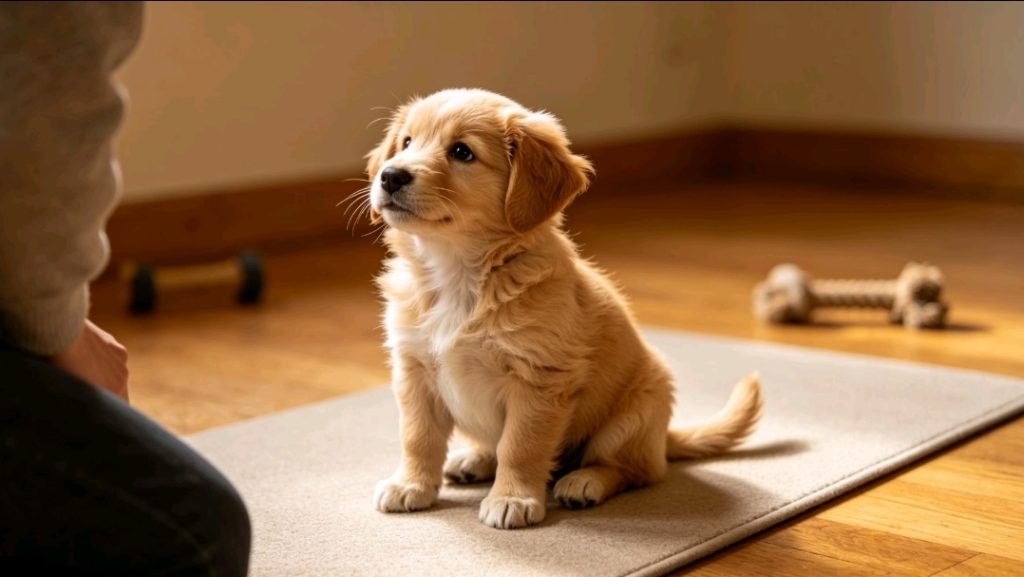
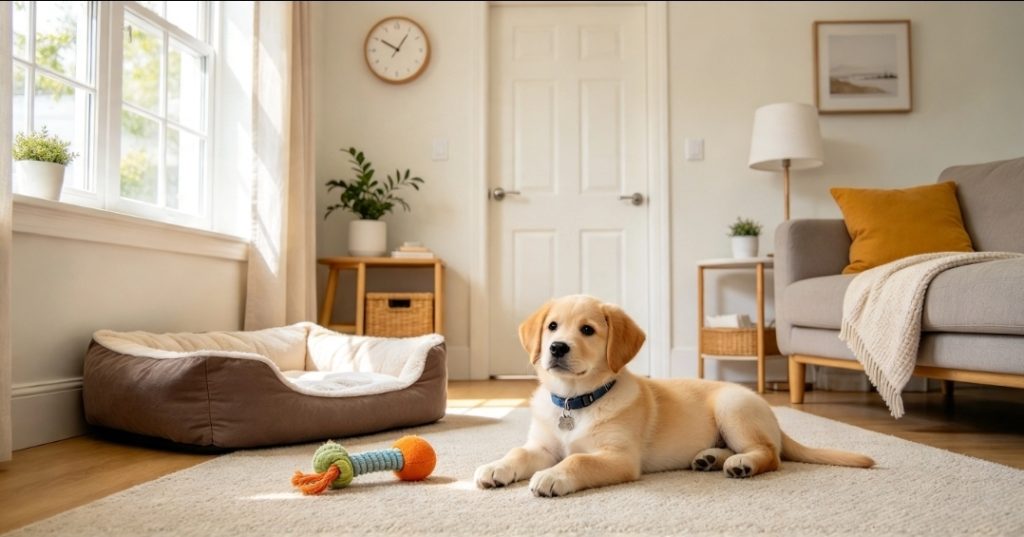
Your puppy should have an appropriate place where it can relax.
This might be:
- a comfortable bed;
- a defined resting area;
- a crate that the puppy has already learned to use positively;
- a suitably managed area of the home;
- a puppy-safe section of a room.
The purpose is to provide somewhere predictable and comfortable rather than somewhere associated with punishment.
A puppy should be able to associate its resting area with calm behaviour, sleep, relaxation and appropriate activities.
If a crate is used, it should be introduced positively and the puppy should already be comfortable spending time inside it. The crate should never become a punishment area.
Teach calmness before increasing separation
Before expecting a puppy to remain alone, look at whether the puppy can settle when you are present.
A puppy that cannot relax while you are nearby may struggle even more when you leave.
Look for behaviours such as:
- lying down;
- relaxing its body;
- calmly chewing an appropriate item;
- resting;
- quietly observing the environment;
- choosing to remain in its resting area;
- recovering quickly after normal household activity.
Reinforce these calm behaviours appropriately.
You are teaching the puppy that calm independence has value.
Reward relaxed behaviour
Positive reinforcement can help a puppy understand which behaviour you want to see repeated.
If your puppy remains calm while you move away, that behaviour can be reinforced.
The reinforcement might involve:
- food;
- an appropriate chew;
- a suitable food-filled enrichment activity;
- calm interaction;
- access to something the puppy values.
The reward should support relaxation rather than create additional excitement.
If giving a reward causes your puppy to become highly excited and immediately follow you around, the reward strategy may need to be adjusted.
The objective is not simply to make the puppy excited about receiving something.
The objective is to develop calm, independent behaviour.
Make separation predictable
Puppies learn through repetition and predictable experiences.
If every departure becomes a major event, the puppy may begin to pay close attention to the owner’s preparation for leaving.
Instead, aim for calm and ordinary departures.
Avoid turning leaving into a dramatic interaction involving excessive excitement, repeated reassurance or prolonged goodbyes.
The same principle applies when you return.
Come back calmly and allow your puppy to settle before giving attention.
This helps teach the puppy that departures and returns are normal parts of everyday life.
RECOMMENDED PRODUCTS
Do not suddenly increase the time
A common mistake is progressing because the puppy has managed one successful attempt.
For example, if a puppy remains calm for five minutes, that does not automatically mean it is ready for thirty minutes.
One successful attempt provides information, but reliability needs to develop through repetition.
Progress gradually.
You might increase:
- distance;
- time;
- physical separation;
- the puppy’s independence within the home;
but avoid making everything harder simultaneously.
If the puppy succeeds consistently, make a small progression.
If the puppy struggles, make the exercise easier again.
Watch what happens when you leave
You cannot always tell how a puppy feels simply by looking at its behaviour when you are standing beside it.
Some signs of difficulty may only appear once the owner has left.
Where appropriate, observing the puppy remotely can provide useful information about what happens after departure.
Look for:
- barking;
- whining;
- pacing;
- repeated movement;
- attempts to escape;
- scratching at doors;
- destructive behaviour;
- toileting indoors;
- inability to settle;
- persistent searching for the owner;
- sudden changes from relaxed behaviour to distress.
Not every bark, movement or accident automatically means separation anxiety. The context matters.
The important question is:
What happens to my puppy when I am no longer there?
Learn to recognise the difference between normal protest and distress
A puppy may occasionally make a noise because something has changed.
However, persistent or escalating signs of distress should not simply be ignored.
A puppy that is becoming increasingly agitated, repeatedly vocalising, attempting to escape or unable to settle may be communicating that the current level of separation is too difficult.
This is where observation becomes important.
Instead of automatically continuing because the training plan says to increase the time, look at the puppy’s actual response.
If the puppy is struggling:
- reduce the separation;
- shorten the duration;
- return to an easier stage;
- allow the puppy to settle;
- reassess before trying again.
The goal is to build confidence rather than repeatedly expose the puppy to a level it cannot manage.
Never use a “cry it out” approach
A puppy should not simply be left to become increasingly distressed in the belief that it will eventually learn to cope.
Repeated experiences of intense distress can make being alone more frightening rather than teaching the puppy that separation is safe.
If your puppy is becoming distressed, the correct response is to reassess the training level and determine what has made the exercise too difficult.
The training should be progressed at a level the puppy can reasonably manage.
Do not punish your puppy for what happens while you are away
If you return home to find:
- chewing;
- toileting;
- barking;
- damaged bedding;
- disturbed belongings;
do not punish your puppy.
The behaviour may have occurred because the puppy was distressed, frustrated, bored, unable to control its toileting or simply given too much freedom.
Punishing the puppy after you return does not teach the puppy what happened several minutes or hours earlier.
Instead, it can make your return home another source of anxiety.
Clean up calmly and consider what the behaviour is telling you about the current level of training and management.
Give your puppy an appropriate environment
Before leaving your puppy alone, consider the environment carefully.
The puppy should have access to:
- a comfortable resting area;
- appropriate temperature;
- water where appropriate;
- a safe area free from hazards;
- appropriate toilet arrangements according to age and development;
- suitable enrichment;
- only items that are genuinely safe for unsupervised use.
Remove objects that could be chewed, swallowed, pulled down or otherwise create a hazard.
Management is particularly important with puppies because they naturally investigate their surroundings.
Use enrichment appropriately
An appropriate activity can help occupy a puppy while it is alone.
Depending on the individual puppy, this may include:
- a suitable chew;
- a safe food-based enrichment activity;
- an appropriate food toy;
- a suitable puzzle activity.
However, enrichment should not be used to hide a separation problem.
If the puppy immediately abandons an activity it normally enjoys once you leave, this can be useful information.
A puppy that is too worried to engage with something normally rewarding may be finding the separation too difficult.
Do not rely on exhaustion
Exercise can help a puppy settle, but exhausting a puppy should not be the foundation of teaching independence.
A puppy still needs to learn how to relax without constant activity.
The objective is to develop the ability to:
- rest;
- settle;
- occupy itself appropriately;
- tolerate short periods without interaction;
- recover from normal household changes;
- remain comfortable when the owner is elsewhere.
Physical exercise and mental activity should support the puppy’s overall routine rather than being used simply to make the puppy too tired to react.
RECOMMENDED PRODUCTS
Toilet needs must be considered
Young puppies have developing bladder and bowel control.
This means the amount of time a puppy can comfortably remain alone will be affected by its age and individual development.
Before leaving a puppy, consider whether it has:
- recently been given an opportunity to toilet;
- had an appropriate amount of activity;
- had access to water;
- had an opportunity to settle;
- been left for an appropriate period.
A puppy should not be expected to remain alone for a period it is physically unable to manage.
Alone time should fit the individual puppy
There is no single amount of time that every puppy can be expected to tolerate.
Age, previous experience, temperament, health, routine and training history can all influence how a puppy copes.
The important principle is not:
“How long should every puppy be left?”
It is:
“How long can my puppy remain comfortable and settled?”
Routine periods of absence should be appropriate to the individual dog. Young puppies generally need much shorter periods than mature dogs, and prolonged absences should be avoided.
Build independence into everyday life
You do not need to make every training session a formal exercise.
Independence can be developed naturally throughout the day.
For example:
- allow your puppy to rest while you work;
- move between rooms without your puppy following every time;
- reward your puppy for settling independently;
- provide appropriate activities away from you;
- give your puppy opportunities to sleep without constant interaction;
- allow calm separation while you complete normal household tasks.
These everyday experiences help the puppy understand that being apart from you is a normal part of life.
Do not encourage constant dependence
It is easy to unintentionally teach a puppy that every movement by the owner requires a response.
If the puppy follows you everywhere, demands attention whenever you sit down and becomes unsettled whenever you move away, look at the pattern rather than simply responding to every demand.
Provide opportunities for the puppy to:
- settle independently;
- occupy itself;
- rest;
- remain in another appropriate area;
- experience short periods without direct interaction.
Independence is developed through repeated successful experiences.
Gradually introduce real departures
Once your puppy can remain calm when you move around the home, begin introducing the next stage.
This can involve:
- Moving away while remaining visible.
- Moving out of sight briefly.
- Leaving the room.
- Returning calmly.
- Approaching the exit without leaving.
- Briefly stepping outside.
- Returning before the puppy becomes distressed.
- Gradually increasing the duration when the puppy remains comfortable.
- Varying the duration once the puppy has developed reliable confidence.
Do not assume that because your puppy can remain alone in one room, it is automatically ready to cope with a long absence from the house.
Each progression needs to be assessed separately.
Change one difficulty at a time
Training becomes easier to understand when only one major variable changes at a time.
For example, avoid simultaneously:
- increasing the duration;
- changing the room;
- introducing visitors;
- adding loud household activity;
- changing the puppy’s routine;
- increasing freedom.
If the puppy struggles, you then have no clear idea which change caused the difficulty.
Instead, make one manageable change and observe the response.
Freedom should develop alongside responsibility
A puppy that is learning to remain alone does not necessarily need unrestricted access to the entire house.
Freedom should reflect what the puppy can currently manage safely.
A controlled area can reduce opportunities for:
- chewing dangerous objects;
- accessing electrical cables;
- damaging household items;
- toileting in unsuitable areas;
- getting into unsafe spaces.
As reliability develops, freedom can gradually increase.
More freedom requires more behavioural responsibility.
What if my puppy follows me everywhere?
Following is common in young puppies, particularly when they are developing their relationship with their new owner.
Rather than constantly correcting the puppy, create opportunities for independent behaviour.
For example:
- encourage your puppy to settle on its bed;
- reward calm behaviour while you remain elsewhere;
- move briefly into another room;
- return before the puppy becomes distressed;
- repeat the experience;
- gradually increase the distance and duration.
The objective is to teach the puppy that remaining where it is can also produce a successful outcome.
RECOMMENDED PRODUCTS
What if my puppy cries when I leave?
Do not automatically assume that the answer is to leave for longer.
First ask:
- How long had the puppy already been alone?
- Was the progression too fast?
- Was the puppy tired or overstimulated?
- Did the puppy need the toilet?
- Was the environment suitable?
- Was the puppy already unsettled before you left?
- Did something unusual happen?
- Is the puppy showing signs of genuine distress?
If the puppy is struggling, return to a level it can manage and rebuild gradually.
What if my puppy becomes destructive?
Destruction can have several possible causes.
A puppy may chew because:
- it is exploring;
- it is teething;
- it is bored;
- it has too much freedom;
- it has access to inappropriate objects;
- it is frustrated;
- it is distressed when alone.
Look at the circumstances surrounding the behaviour.
If destruction happens specifically when the puppy is left alone and is accompanied by barking, pacing, escape attempts or other signs of distress, separation-related difficulty should be considered.
What if my puppy toilets when left alone?
Accidents should be treated as information.
Consider:
- the puppy’s age;
- when it last toileted;
- how long it was alone;
- whether the puppy had been sleeping;
- whether the routine changed;
- whether the accident happens only when alone.
If accidents repeatedly occur specifically during separation, particularly alongside other signs of distress, further assessment may be appropriate.
Sudden or unexplained changes in toileting behaviour can also have medical causes and should be discussed with a veterinary professional where appropriate.
Do not rush the progression
One of the most important skills for the owner is recognising when not to progress.
If your puppy is:
- relaxed;
- settled;
- comfortable;
- engaging normally;
- recovering easily;
the current stage may be appropriate.
If your puppy is:
- increasingly vocal;
- pacing;
- scratching;
- attempting to escape;
- unable to settle;
- showing repeated distress;
the current stage may be too difficult.
The answer is not necessarily more repetition.
Sometimes the best training decision is to make the exercise easier.
A simple training progression
A practical progression might look like this:
Stage 1 — Calm while you are present
Teach your puppy to settle in its resting area while you remain nearby.
Stage 2 — Small movements
Move around the room while your puppy remains settled.
Stage 3 — Short distance
Move further away and return.
Stage 4 — Brief absence
Leave the room for a very short period.
Stage 5 — Increase gradually
Extend the absence only when the puppy remains comfortable.
Stage 6 — Doorway separation
Move through a doorway and return calmly.
Stage 7 — Brief departure
Step outside for a short period and return.
Stage 8 — Build reliability
Gradually increase the duration while continuing to monitor the puppy’s response.
Stage 9 — Maintain independence
Continue giving your puppy regular opportunities to rest and remain comfortable without constant human interaction.
The owner should observe, not simply measure time
A clock can tell you how long your puppy has been alone.
It cannot tell you how your puppy feels about it.
Two puppies may both remain alone for ten minutes while having completely different experiences.
One may sleep peacefully.
Another may spend the entire ten minutes pacing and vocalising.
The second puppy has not successfully learned to be alone simply because ten minutes have passed.
The quality of the experience matters.
The training process
A useful approach is:
OBSERVE → INTERPRET → DECIDE → COMMUNICATE → OBSERVE RESPONSE → REASSESS
Observe
Look at what your puppy is actually doing.
Interpret
Consider what the behaviour may be telling you.
Decide
Choose whether to continue, simplify or change the exercise.
Communicate
Use appropriate timing, environment, reinforcement and management to guide the puppy.
Observe response
Watch what happens next.
Reassess
Decide whether your puppy is ready for another successful repetition or whether the difficulty needs to be reduced.
This prevents the owner from following a rigid timetable when the puppy is clearly communicating that the current stage is too difficult.
When should you seek additional help?
If your puppy shows persistent or significant distress when left alone, do not simply continue increasing the duration and hope the problem disappears.
Signs that additional assessment may be appropriate include:
- persistent barking or howling;
- repeated escape attempts;
- severe pacing;
- destructive behaviour associated with being alone;
- repeated indoor toileting specifically during separation;
- inability to settle;
- intense distress before or immediately after departure;
- behaviour that is becoming progressively worse.
Separation-related problems can be complex, and veterinary or qualified behavioural support may be appropriate when a puppy is showing significant distress.
Teaching a puppy to be alone is a gradual process
Teaching your puppy to be left alone is not about forcing independence.
It is about giving the puppy repeated experiences of being apart from you while remaining comfortable.
Start small.
Create a safe and appropriate environment.
Teach calm behaviour.
Reward appropriate independence.
Increase distance and duration gradually.
Observe the puppy rather than relying purely on a timetable.
If the puppy succeeds, develop the behaviour.
If the puppy struggles, reduce the difficulty and reassess.
Never punish behaviour that occurs because your puppy is distressed when left alone.
The goal is to help your puppy learn that being alone is a normal, temporary and manageable part of everyday life.
Observe → interpret → decide → communicate → observe response → reassess.
GPK9 — The Five Golden Rules
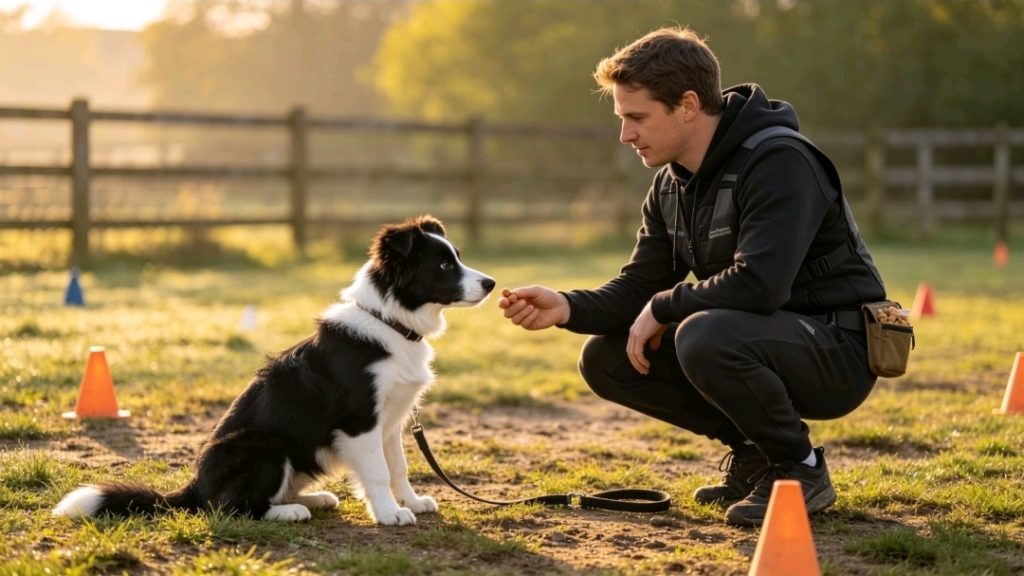
The GPK9 Five Golden Rules provide the foundation of the GPK9 Professional Training System. They give new dog owners, new dog handlers, experienced handlers and professional dog trainers a clear structure for developing the dog and the handler together.
The GPK9 Five Golden Rules cover five essential areas of development: Home & Social, Obedience, Prey Drive, Toilet and Social Walking. Each area has its own purpose, but they are designed to work together as one complete training system.
The GPK9 approach is based on CATEGORY → STATUS → DRIVE → CONTROL and the handler’s ability to OBSERVE → INTERPRET → DECIDE → COMMUNICATE → OBSERVE RESPONSE → REASSESS. This gives the handler a consistent process for understanding what the dog is doing, why the behaviour is occurring, what level of control is appropriate and how to communicate effectively.
The purpose of the GPK9 Five Golden Rules is not simply to teach a collection of individual exercises. They are designed to develop the dog’s behaviour, motivation, communication, control and reliability while teaching the handler how to make better decisions.
Golden Rule One — Home & Social
Golden Rule One — Home & Social establishes the foundation for everyday life with the dog. It focuses on communication, boundaries, calm behaviour, household routines and appropriate behaviour around people, animals and normal activity.
The purpose of Golden Rule One — Home & Social is to help the handler understand the dog’s behaviour and recognise changes in arousal before they become larger problems. The handler learns to observe, assess and communicate rather than simply reacting after unwanted behaviour has already occurred.
Golden Rule One — Home & Social provides the foundation from which the handler can develop a calmer, more predictable and better-communicating dog.
Golden Rule Two — Obedience
Golden Rule Two — Obedience develops the dog’s ability to understand and respond to the handler’s communication.
The focus of Golden Rule Two — Obedience is not simply teaching commands. It is about developing understanding, reliability, timing, reward, release and control so the dog learns what the handler is communicating.
Through Golden Rule Two — Obedience, the handler learns to progress training appropriately, gradually increasing the dog’s freedom and responsibility as understanding and reliability improve.
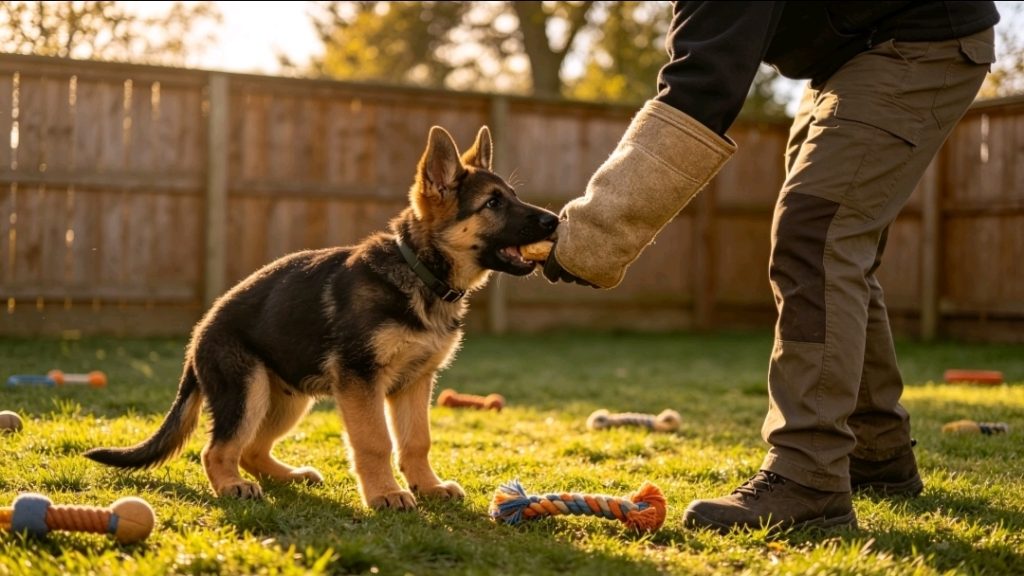
Golden Rule Three — Prey Drive
Golden Rule Three — Prey Drive focuses on understanding and developing the dog’s natural motivation to chase, pursue, engage and work with an appropriate toy or prey-based reward.
The purpose of Golden Rule Three — Prey Drive is not simply to increase drive. The handler must learn how to recognise the dog’s level of motivation, select an appropriate reward and use timing, communication and control to channel that motivation productively.
Golden Rule Three — Prey Drive teaches the handler that motivation can become a powerful training tool when it is developed and controlled correctly.
Golden Rule Four — Toilet
Golden Rule Four — Toilet establishes reliable toilet habits through consistency, observation, timing, supervision and appropriate reinforcement.
The handler learns through Golden Rule Four — Toilet to recognise when the dog is likely to need the toilet, provide the correct opportunity and reinforce the desired behaviour.
The objective of Golden Rule Four — Toilet is to establish a predictable routine that helps the dog understand where and when toileting is appropriate while reducing opportunities for mistakes.
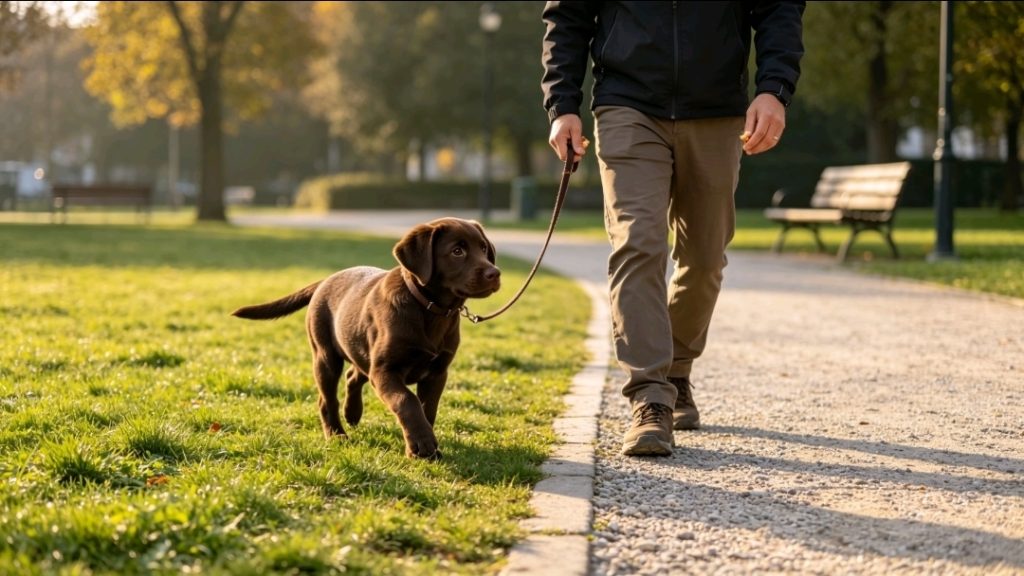
Golden Rule Five — Social Walking
Golden Rule Five — Social Walking develops the dog’s ability to walk calmly and appropriately in the real world while remaining connected to the handler.
The focus of Golden Rule Five — Social Walking is the relationship between the handler, the dog, the environment, distractions, distance and available control.
Through Golden Rule Five — Social Walking, the handler learns to observe body language, identify potential triggers, assess distance and recognise changes in drive or arousal before behaviour escalates.
The objective of Golden Rule Five — Social Walking is not simply to make the dog walk beside the handler. It is to develop a dog that can experience the outside world while remaining connected to the handler and capable of responding to clear communication.
How the Five Golden Rules Work Together
The GPK9 Five Golden Rules are designed to work together rather than being treated as five completely separate subjects.
Golden Rule One — Home & Social establishes the foundations for everyday behaviour and communication.
Golden Rule Two — Obedience develops understanding, responsiveness and control.
Golden Rule Three — Prey Drive develops motivation and teaches the handler how to channel natural drive appropriately.
Golden Rule Four — Toilet establishes essential household routine and reliability.
Golden Rule Five — Social Walking takes the communication and control developed through the other areas into the outside environment.
Together, the GPK9 Five Golden Rules help the handler develop a complete understanding of the dog rather than treating individual behaviours as isolated problems.
The overall objective of the GPK9 Five Golden Rules is to train the human, train the dog and build the partnership through clear observation, communication, appropriate control and progressive development.