How do I teach my dog to stay in one place?
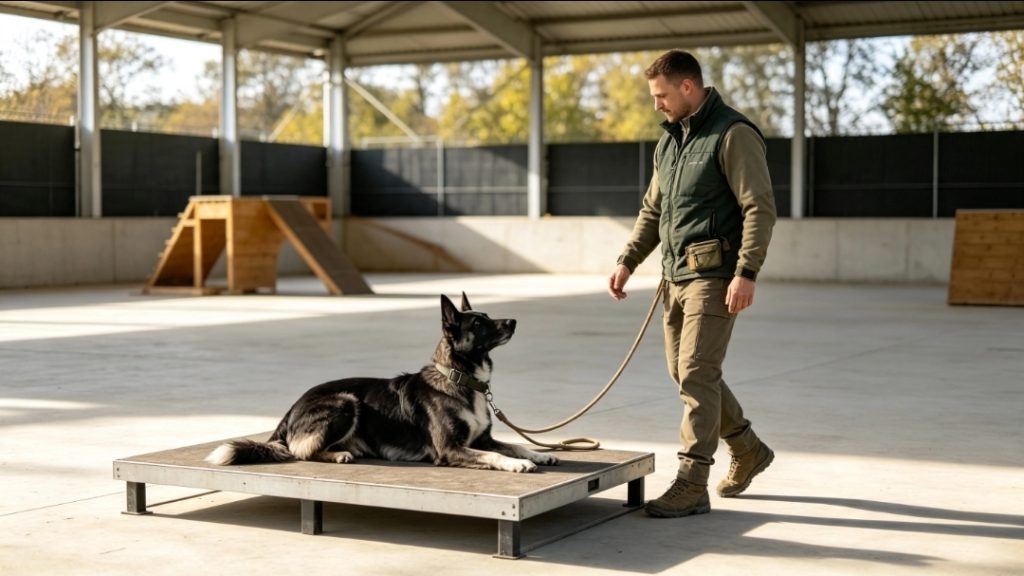
Teaching your dog to stay in one place is about developing clear understanding, calmness, duration and control. Your dog needs to learn that remaining in the required position until released is the behaviour being reinforced. Start with a simple environment, use appropriate motivation, keep the initial duration short and gradually introduce distance and distractions as your dog demonstrates reliable understanding.
RECOMMENDED PRODUCTS

What does “stay in one place” mean?
Staying in one place means your dog remains within the criteria you have established rather than immediately following you, moving towards a distraction or leaving the area.
Depending on the exercise, this can involve:
- Remaining in a sit.
- Remaining in a down.
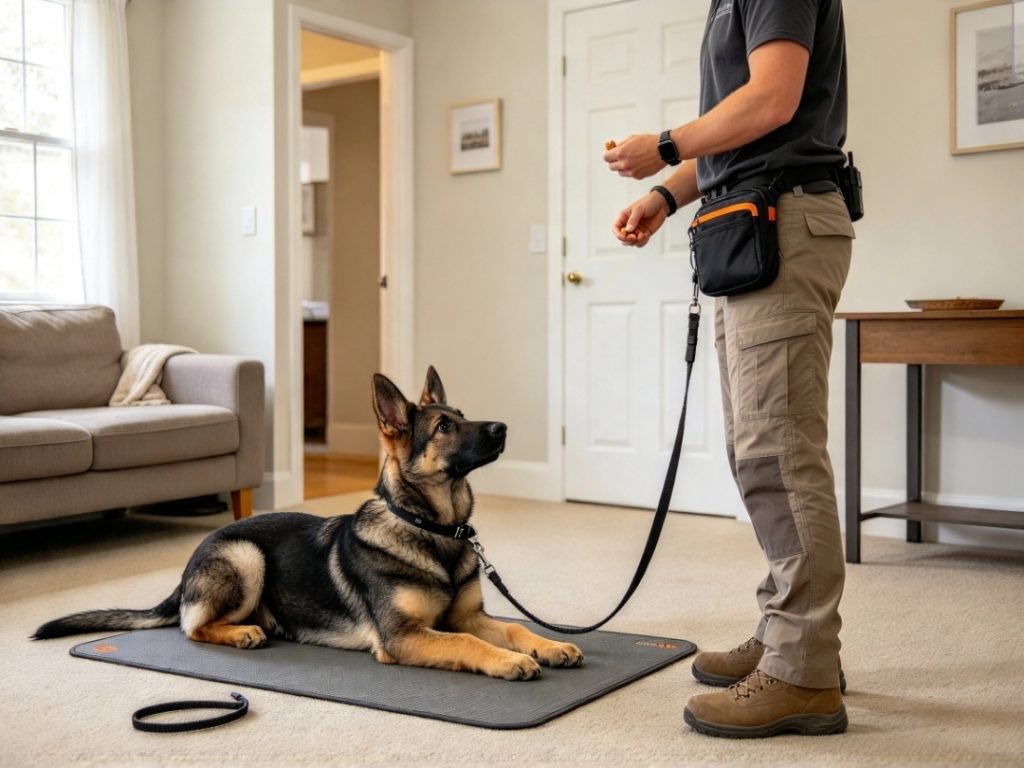
- Remaining on a placemat.
- Remaining in one defined area.
- Remaining still while you move.
- Remaining while food is present.
- Remaining while household activity continues.
- Waiting until you release your dog.
The important point is that your dog needs to understand what “stay” means within the exercise.
It should not simply mean physically preventing the dog from moving.
Why does my dog leave its position?
A dog may leave its position because:
- The duration is too long.
- You moved too far away.
- The environment is distracting.
- Food or toys create too much excitement.
- The dog has not understood the criteria.
- The dog anticipates the reward.
- The exercise has progressed too quickly.
- The dog is struggling to settle.
- The dog is highly aroused.
- The dog is not sufficiently engaged.
- The dog has learned that leaving sometimes produces access to something it wants.
Before changing your approach, observe what is happening.
Look at:
- Body posture.
- Facial expression.
- Ears.
- Tail.
- Movement.
- Orientation.
- Attention.
- Engagement.
- Arousal.
- Ability to settle.
- Responsiveness.
- Recovery.
- Environmental awareness.
- Social behaviour.
- Changes in behaviour.
- Previously learned criteria.
Start in a quiet environment
Begin somewhere your dog can concentrate.
A quiet area of the home can be useful because there are fewer competing distractions.
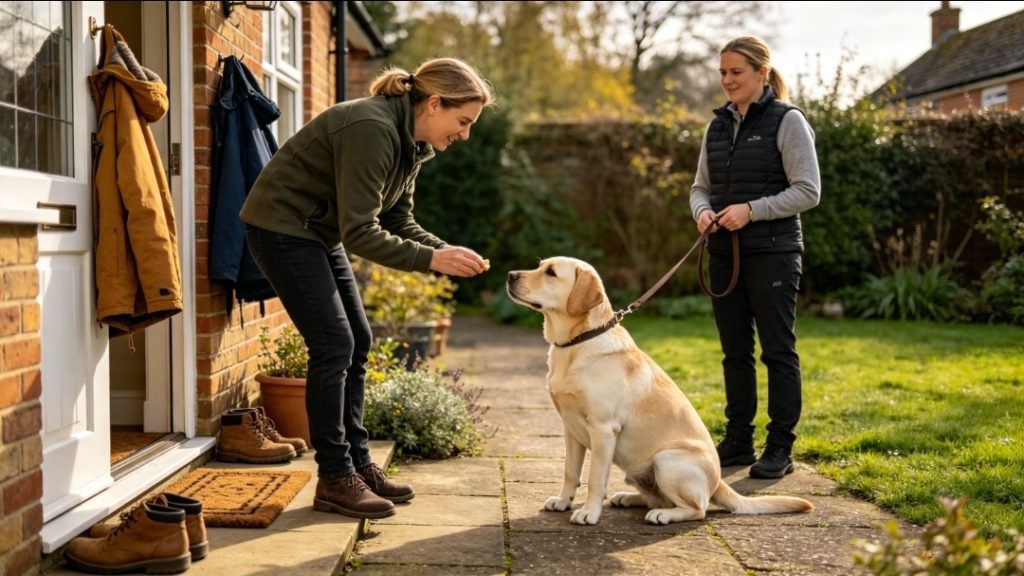
Ask your dog for the position you want and establish a very short stay.
For example:
- Ask your dog to sit or lie down.
- Give the stay cue.
- Remain close to your dog.
- Wait briefly.
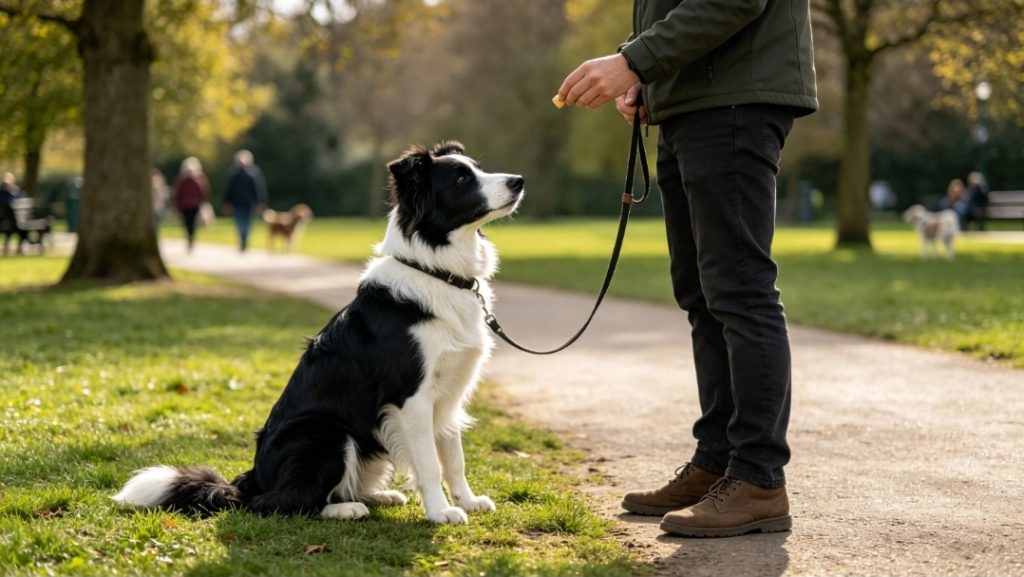
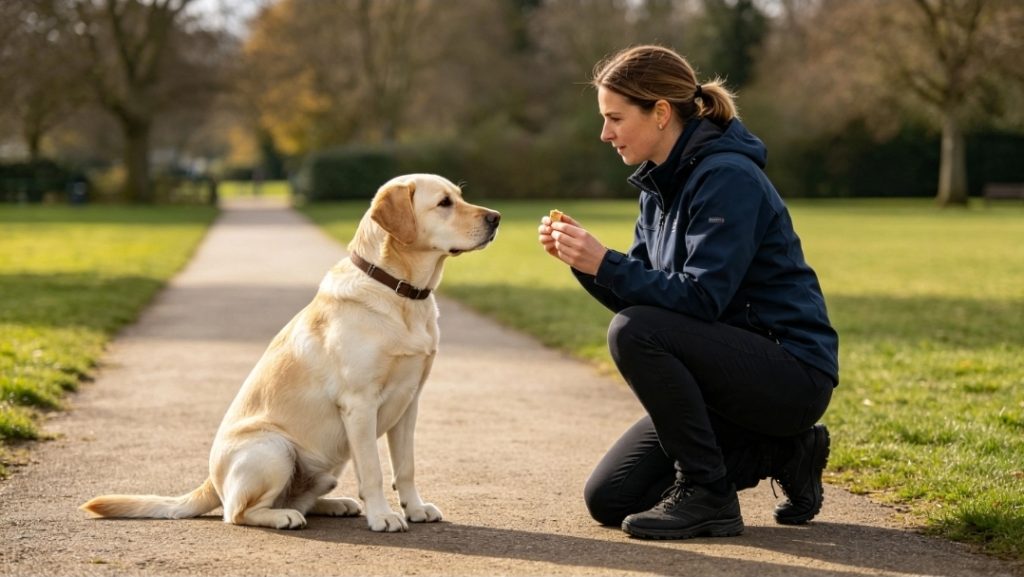
- Reward the dog for remaining in position.
- Release the dog.
- Repeat.
- Gradually increase the difficulty.
The first objective is understanding.
Do not immediately test how long your dog can stay.
Use food to reinforce the correct behaviour
Food can provide clear motivation during obedience training.
The basic learning sequence can be:
STAY → REMAIN IN POSITION → REWARD
Reward the behaviour you want to maintain.
Your timing matters.
If the dog repeatedly moves and then receives the reward, the criteria may become unclear.
Food drive should also be considered.
A dog with low food drive may require different reward value and environmental considerations.
A dog with high food drive may become more excited when food appears.
The aim is to use food to reinforce calm, controlled behaviour rather than create unnecessary arousal.
Build duration gradually
Duration is one of the most important parts of teaching a dog to stay in one place.
Start with a period your dog can successfully achieve.
Then gradually increase it.
For example:
- Very short stay.
- Reward.
- Repeat.
- Slightly longer stay.
- Reward.
- Repeat.
- Gradually increase duration.
- Reassess.
If your dog repeatedly breaks position, the exercise may have become too difficult.
Reduce the duration and rebuild successful repetitions.
There is no benefit in repeatedly asking for a duration your dog cannot currently achieve.
Teach the release
Your dog also needs to understand when the stay has finished.
This creates a clear difference between:
STAY → REMAIN
and:
RELEASE → CONTINUE
The release should be consistent.
Your dog should not have to guess whether the exercise has ended.
A clear release helps prevent the dog from learning that simply waiting a certain amount of time means it can leave.
Increase distance gradually
Once your dog can stay successfully while you remain close, begin introducing small amounts of distance.
Start with:
- One small step away.
- Return.
- Reward.
- Release.
Then gradually progress.
You may eventually be able to:
- Take several steps away.
- Walk around the dog.
- Move across the room.
- Leave the immediate area.
However, each increase in distance changes the difficulty.
A dog that can stay while you are beside it does not automatically understand that it should stay when you walk away.
Don’t increase duration and distance together too quickly
Duration and distance are separate challenges.
If your dog is learning both at the same time, keep the changes small.
For example, if you increase distance, you may temporarily keep the duration short.
Once the dog understands the new distance, you can gradually increase duration again.
This gives your dog a better opportunity to succeed.
Introduce distractions gradually
Distractions can include:
- Food.
- Toys.
- People moving around.
- Doors opening.
- Household activity.
- Other dogs.
- Outdoor sounds.
- Movement.
- New locations.
- Social activity.
Do not introduce the most difficult distraction immediately.
Build gradually.
Observe your dog’s response after each change.
If your dog remains calm and responsive, continue.
If your dog becomes highly distracted or unable to maintain the required behaviour, reduce the difficulty.
What should I do if my dog gets up?
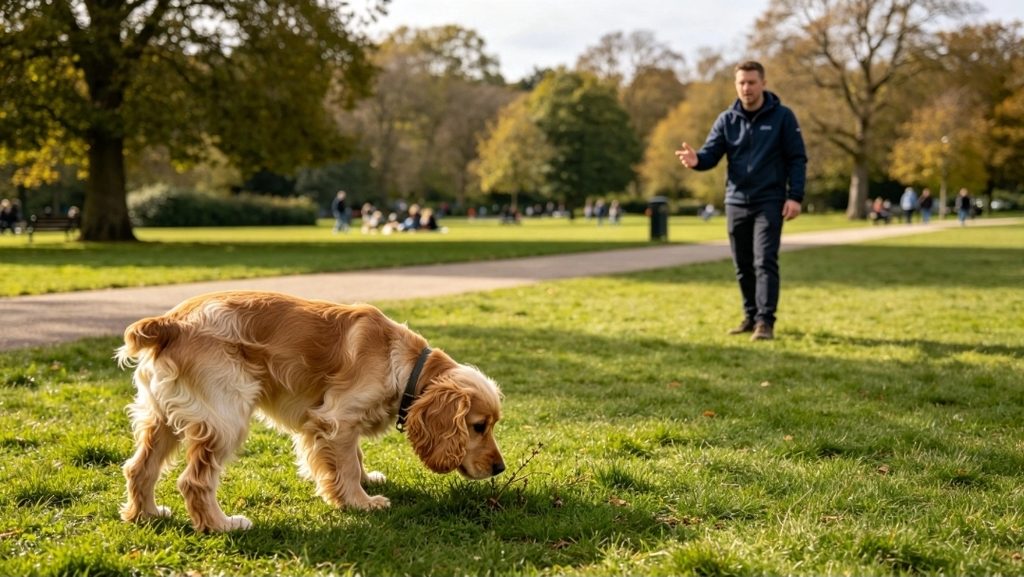
If your dog leaves its position, do not simply repeat the same cue louder.
Observe what happened.
Ask:
- Was the duration too long?
- Was the distance too great?
- Was there a new distraction?
- Did the dog become excited?
- Did the dog lose engagement?
- Was the criteria clear?
- Did I progress too quickly?
Then adjust the exercise.
The GPK9 decision process is:
OBSERVE → INTERPRET → DECIDE → ACT → REASSESS
The mistake provides information about the current level of difficulty.
GPK9 STATUS RESPONSE SYSTEM
GREEN — OBSERVE → CONTINUE → PROGRESS
Green means the dog is in a suitable state for the exercise.
Your dog may be:
- Calm.
- Engaged.
- Responsive.
- Able to settle.
- Maintaining the required position.
The response is:
OBSERVE → CONTINUE → PROGRESS
Continue the exercise and progress gradually when appropriate.
AMBER — OBSERVE → ASSESS → REMOVE FROM DISTRACTION → CALM → REASSESS
Amber means the dog is beginning to struggle.
The response is:
OBSERVE → ASSESS → REMOVE FROM DISTRACTION → CALM → REASSESS
You may need to:
- Reduce duration.
- Reduce distance.
- Remove a distraction.
- Return to a simpler exercise.
- Allow the dog to calm.
- Reassess.
If calmness returns:
GREEN → CALM → CONTINUE → PROGRESS
If you cannot reduce the difficulty and the dog cannot calm:
RED → CANNOT REDUCE → CANNOT CALM → RETURN TO CRATE
RED — STOP WHAT YOU ARE DOING
If your dog cannot respond appropriately, stop the exercise.
Use:
STOP WHAT YOU ARE DOING → OBSERVE → ASSESS → REMOVE FROM DISTRACTION → CALM → REASSESS
If calmness and responsiveness return, reset and return to the relevant training area.
If the situation cannot be reduced and the dog cannot calm:
RETURN TO CRATE
The crate provides a conditioned safe space for rest, routine and resetting.
Use the appropriate level of control
For obedience work, control should match the dog’s current status and environment.
GREEN
Appropriate options may include:
- Short line.
- Harness.
- Long line.
- Free roam.
AMBER
Appropriate options may include:
- Short line.
- Muzzle where appropriate.
RED
Appropriate options may include:
- Short line.
- Muzzle where appropriate.
Equipment provides management and control.
It does not replace teaching.
The dog still needs to understand the required behaviour.
RECOMMENDED PRODUCTS
Use a placemat when appropriate
Staying in one place can overlap with the HOME & SOCIAL area of the GPK9 system, particularly when the objective is settling and controlled freedom within the home.
The core pathway is:
CRATE → PLACEMAT → PLAYPEN
The placemat can provide a defined area for:
- Stationing.
- Duration.
- Settling.
- Calmness.
- Controlled freedom.
The pathway is not necessarily linear.
A dog may need to step back to an earlier level of control if its behaviour deteriorates.
The GPK9 principle is:
MORE FREEDOM REQUIRES MORE BEHAVIOURAL RESPONSIBILITY.
Don’t rely on physical restraint
A dog that stays only because it is physically prevented from moving has not necessarily learned the behaviour.
Appropriate management can help keep the situation safe and controlled, but the long-term objective is understanding.
Your dog should learn:
- What position is required.
- What the stay means.
- What behaviour is rewarded.
- How long the current criteria lasts.
- When the exercise ends.
- How to respond when distractions appear.
Practise in different locations
Once your dog understands the exercise in a quiet environment, gradually practise in different places.
You may eventually work:
- In another room.
- In the garden.
- Outside the home.
- During structured walks.
- Around controlled distractions.
- In new environments.
Reduce the difficulty when changing location.
A behaviour that is reliable at home may need to be rebuilt gradually somewhere unfamiliar.
How often should I practise?
Short, successful sessions are generally more useful than repeatedly continuing after the dog begins struggling.
A session can include:
- Several short repetitions.
- Appropriate rewards.
- Small changes in difficulty.
- Calm releases.
- Reassessment.
Finish while the dog can still respond appropriately.
The objective is progressive learning, not exhausting the dog.
How do I know when my dog is ready to progress?
Look at the dog’s behaviour rather than simply counting repetitions.
Useful indicators include:
- Calmness.
- Attention.
- Engagement.
- Responsiveness.
- Ability to maintain position.
- Recovery after distractions.
- Understanding of the criteria.
- Consistency.
If the dog is consistently successful, progress gradually.
If the dog repeatedly fails, reduce the difficulty.
Build the behaviour into everyday life
Once the basic exercise is understood, appropriate opportunities can be created during normal routines.
For example, your dog can practise remaining in one place while:
- You prepare food.
- You move around the room.
- A door opens.
- Someone walks past.
- You sit down.
- You move to another part of the room.
- Household activity continues.
These situations should be introduced according to the dog’s current ability.
Everyday practice should reinforce the same clear criteria rather than creating unpredictable expectations.
RECOMMENDED COURSES
GOLDEN RULE 1 — HOME AND SOCIAL
This course focuses on the home and social environment, boundaries, controlled freedom, settling, calmness and the CRATE → PLACEMAT → PLAYPEN pathway.
It is particularly relevant when staying in one place is being developed as part of settling and controlled freedom within the home.
GOLDEN RULE 2 — OBEDIENCE
This is the most directly relevant Golden Rule for teaching a structured stay.
It focuses on structured obedience, food motivation, engagement, control, suitable equipment and environments, and progression.
Teaching your dog to remain in one place requires these elements to work together.
GOLDEN RULE 3 — PLAY DRIVE AND PLAY
This course focuses on prey drive, play, toy motivation, controlled play, handler control, calming, resetting and progression.
It can become relevant when movement or toys make it difficult for your dog to remain in position.
GOLDEN RULE 4 — TOILET
This course focuses on toilet routine, location, commands, management, control and progression.
Although staying in one place is not primarily a toilet-training exercise, the wider GPK9 framework uses appropriate control and progression across different areas.
GOLDEN RULE 5 — SOCIAL WALKING
This course focuses on calm social walking, IGNORE THE WORLD, environmental awareness, distractions, control, calmness and structured walking.
It can become relevant when your dog needs to remain controlled around environmental movement and distractions.
GPK9’S FIVE GOLDEN RULES
GPK9’S FIVE GOLDEN RULES. The GPK9 PROFESSIONAL TRAINING SYSTEM is divided into five accessible areas, with each area dealing with a particular part of dog training while all five areas work together as one connected framework. An individual course can provide specific help with a particular training need, but no single course represents the entire system. The five areas are HOME AND SOCIAL, OBEDIENCE, PLAY DRIVE AND PLAY, TOILET, and SOCIAL WALKING — IGNORE THE WORLD. Understanding the complete system gives first-time owners and professional trainers a broader understanding of how different parts of training connect, while the bite-sized structure allows progressive learning. Teaching your dog to stay in one place may strongly relate to OBEDIENCE, because it involves clear criteria, food motivation, engagement, control, responsiveness and progression, while HOME AND SOCIAL can also support stationing, settling and controlled freedom through the placemat. The wider GPK9 system determines how the subject is understood, how the dog’s current situation is considered, how the appropriate response is identified, what control or management is selected, how calmness and reassessment are handled, and when the dog should continue, progress or reset. Understanding all five Golden Rules provides the complete GPK9 framework while allowing the specific subject of teaching your dog to stay in one place to be understood within the wider connections between obedience, calmness, control, motivation, environment, reassessment and progression.