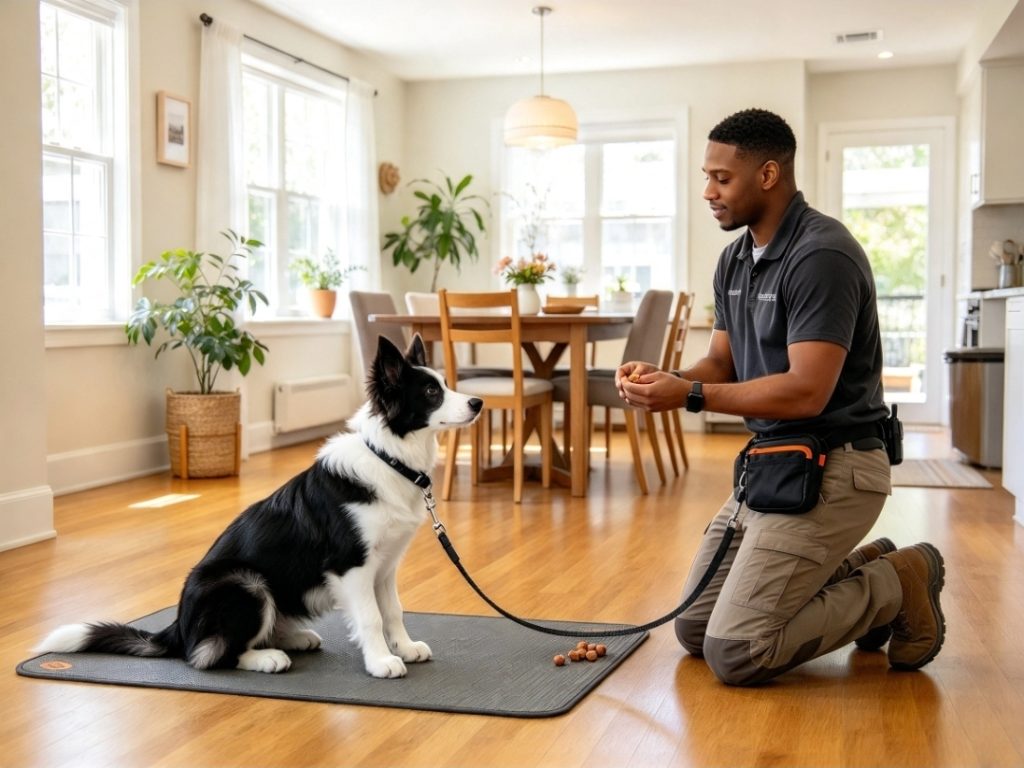
How do I teach my dog patience?
What does patience mean for a dog?
Teaching your dog patience is about helping your dog learn to remain calm, wait appropriately and control its response when something it wants is available. Patience is not simply making your dog wait for longer and longer periods. It involves understanding your dog’s current state, setting achievable criteria, rewarding appropriate behaviour and gradually increasing difficulty as your dog becomes more capable.
RECOMMENDED PRODUCTS

For a dog, patience can involve remaining calm rather than immediately reacting to something it wants.
This might include:
- Waiting for food.
- Waiting for a toy.
- Waiting before going through a doorway.
- Remaining calmly on a placemat.
- Waiting for a release.
- Remaining settled while you move around.
- Ignoring an unnecessary distraction.
- Waiting for attention without demanding it.
- Remaining responsive when something exciting is nearby.
The objective is not to suppress normal behaviour.
The objective is to teach your dog that calm, controlled behaviour produces predictable outcomes.
Why does my dog struggle with patience?
Dogs can struggle with patience for many reasons.
Your dog may:
- Become excited when food appears.
- Become highly motivated by toys.
- Anticipate what is going to happen.
- Move towards something it wants.
- Struggle to remain still.
- Become distracted by movement.
- Have difficulty settling.
- Have not learned the criteria clearly.
- Be asked to wait for too long.
- Be exposed to too much distraction.
- Have progressed faster than its current ability allows.
- Have learned that demanding behaviour sometimes produces attention or access to something desirable.
The first step is therefore to observe the dog rather than immediately correcting the behaviour.
Look at:
- Body posture.
- Facial expression.
- Ears.
- Tail.
- Movement.
- Orientation.
- Attention.
- Engagement.
- Arousal.
- Ability to settle.
- Responsiveness.
- Recovery.
- Environmental awareness.
- Social behaviour.
- Changes in behaviour.
- Previously learned criteria.
Start with simple situations
Patience should be developed gradually.
Start in an environment where your dog can concentrate and where distractions are limited.
For example, you might ask your dog to remain calmly on a placemat while you hold a food reward.
Do not immediately expect a long period of stillness.
Instead:
- Ask for the appropriate behaviour.
- Wait briefly.
- Observe your dog.
- Reward calm, appropriate behaviour.
- Release or continue as appropriate.
- Repeat.
- Gradually increase the difficulty.
This gives your dog a clear learning process.
The dog learns that remaining calm and responding appropriately produces reinforcement.
Use food to develop patience
Food can be a useful motivator when teaching patience.
The reward should reinforce the behaviour you want.
For example:
CALM BEHAVIOUR → WAIT → REWARD
However, food can affect different dogs in different ways.
A dog with low food drive may show little interest in the reward.
A dog with high food drive may become extremely excited as soon as food appears.
Therefore, food should not simply be presented repeatedly without observing the dog’s response.
Consider:
- The value of the food.
- The dog’s current food drive.
- The timing of the reward.
- The distance from the food.
- The level of excitement.
- Whether the dog can remain responsive.
- Whether the exercise is too difficult.
If food is causing excessive arousal, reduce the difficulty and allow the dog to return to a more suitable state.
Teach patience through short periods of success
One of the easiest mistakes to make is asking for too much too soon.
If your dog can remain calm for five seconds, repeatedly demanding thirty seconds may create unnecessary failure.
Instead, build successful repetitions.
For example:
- Very short period.
- Reward.
- Repeat.
- Slightly longer period.
- Reward.
- Repeat.
- Gradually increase the duration.
- Reassess.
The exact duration is less important than whether your dog is demonstrating the behaviour successfully.
Patience develops through repeated successful experiences.
Don’t increase everything at once
There are several ways to make a patience exercise more difficult.
You can increase:
- Duration.
- Distance.
- Distraction.
- Movement.
- Environmental activity.
- Food availability.
- Toy availability.
- Social activity.
- Location.
Avoid increasing several difficult elements simultaneously.
For example, a dog that can wait calmly for ten seconds in a quiet room may not be ready to wait for ten seconds while you walk away, another person enters the room and a toy is moving nearby.
Change one element at a time where possible.
Teach your dog to wait for things it wants
Patience becomes particularly useful when your dog is excited about something.
This might include:
- Food.
- Toys.
- Going outside.
- Greeting someone.
- Playing.
- Getting out of the car.
- Starting a walk.
- Accessing another area of the home.
The principle is to reinforce appropriate calm behaviour rather than automatically giving access while the dog is rushing, jumping or demanding.
Observe the dog’s behaviour.
If the dog can remain calm and responsive, continue.
If the dog becomes too excited, reduce the situation and allow the dog to calm before reassessing.
Use the placemat to build calmness
Within the GPK9 HOME & SOCIAL structure, the placemat provides a useful station for developing settling and duration.
The progression is:
CRATE → PLACEMAT → PLAYPEN
The pathway is not necessarily completely linear. A dog may need to move back to an earlier level of control depending on its behaviour.
The placemat can help your dog learn:
- Stationing.
- Duration.
- Settling.
- Remaining in one location.
- Calm observation.
- Controlled freedom.
The principle is:
MORE FREEDOM REQUIRES MORE BEHAVIOURAL RESPONSIBILITY.
As your dog demonstrates greater behavioural responsibility, appropriate freedom can gradually increase.
Don’t confuse patience with inactivity
Patience does not mean that your dog should simply remain motionless all day.
A balanced dog needs appropriate opportunities for:
- Training.
- Play.
- Exploration.
- Social interaction.
- Rest.
- Movement.
- Enrichment.
The purpose of patience training is to improve your dog’s ability to regulate its behaviour when calm control is required.
A dog can be active and playful at the appropriate time while also learning to settle when required.
What if my dog becomes demanding?
Demanding behaviour can make patience more difficult.
Your dog may:
- Bark for attention.
- Paw at you.
- Jump up.
- Push into you.
- Bring toys repeatedly.
- Rush towards food.
- Attempt to take food.
- Become frustrated when access is delayed.
Rather than focusing only on stopping the behaviour, observe what is happening immediately before it occurs.
Consider:
- What does the dog want?
- How excited is the dog?
- Is the reward too valuable?
- Is the exercise too difficult?
- Has the dog been given clear criteria?
- Is the dog still able to respond?
- Is the environment creating too much stimulation?
Then decide what the dog currently needs.
RECOMMENDED PRODUCTS
GPK9 STATUS RESPONSE SYSTEM
The GPK9 status system helps determine how to respond to your dog’s current behaviour.
GREEN — OBSERVE → CONTINUE → PROGRESS
Green indicates that the dog is in a suitable state.
Your dog may be:
- Calm.
- Engaged.
- Responsive.
- Able to settle.
- Maintaining the required behaviour.
The response is:
OBSERVE → CONTINUE → PROGRESS
If your dog is demonstrating patience successfully, continue the exercise and gradually progress when appropriate.
AMBER — OBSERVE → ASSESS → REMOVE FROM DISTRACTION → CALM → REASSESS
Amber indicates that your dog is struggling.
The response is:
OBSERVE → ASSESS → REMOVE FROM DISTRACTION → CALM → REASSESS
You may need to:
- Reduce the duration.
- Reduce distance.
- Remove a distraction.
- Reduce food or toy excitement.
- Return to a simpler exercise.
- Allow your dog to calm.
- Reassess before continuing.
If calmness returns:
GREEN → CALM → CONTINUE → PROGRESS
If the situation cannot be reduced and your dog cannot calm:
RED → CANNOT REDUCE → CANNOT CALM → RETURN TO CRATE
RED — STOP WHAT YOU ARE DOING
Red means the current exercise should stop.
The response is:
STOP WHAT YOU ARE DOING → OBSERVE → ASSESS → REMOVE FROM DISTRACTION → CALM → REASSESS
If your dog returns to an appropriate state, you can reset and return to the relevant training area.
If the situation cannot be reduced and the dog cannot calm:
RETURN TO CRATE
The crate can act as a conditioned safe space for rest, routine and resetting.
Use the right level of control
Control should be appropriate to the dog’s current status.
For relevant obedience work:
GREEN
Depending on the dog and environment:
- Short line.
- Harness.
- Long line.
- Free roam.
AMBER
Depending on the situation:
- Short line.
- Muzzle where appropriate.
RED
Depending on the situation:
- Short line.
- Muzzle where appropriate.
Equipment is not the same as training.
The equipment provides appropriate management and control while the dog develops the required behaviour.
Build patience around distractions
Once your dog can remain calm in a quiet environment, introduce distractions gradually.
Start with small changes.
For example:
- You move around the room.
- You walk a short distance away.
- A door opens.
- Someone walks past.
- Food is visible.
- A toy is present.
- Another person enters the room.
- You change location.
Observe your dog after every change.
If your dog remains calm and responsive, you can continue.
If your dog becomes distracted or over-aroused, reduce the difficulty.
This is not about seeing how much stimulation your dog can tolerate.
It is about teaching the dog to respond appropriately to gradually increasing challenges.
Teach patience through consistency
Clear criteria make learning easier.
Your dog should be able to understand:
- What behaviour is expected.
- What the reward is for.
- How long the behaviour is required.
- When the exercise finishes.
- When access to the reward is available.
- What happens when the dog struggles.
Inconsistent criteria can make patience difficult to understand.
For example, if jumping sometimes produces attention and sometimes does not, the dog may continue trying different behaviours.
Clear and consistent reinforcement helps your dog understand which behaviour is successful.
What should I do when my dog fails?
Failure provides information.
Instead of simply repeating the same exercise, observe what happened.
Ask:
- Was the exercise too difficult?
- Was the duration too long?
- Was the distraction too strong?
- Was the dog too excited?
- Was the reward too valuable?
- Was the environment inappropriate?
- Did the dog understand the criteria?
- Did I progress too quickly?
Then adjust the exercise.
The GPK9 decision process is:
OBSERVE → INTERPRET → DECIDE → ACT → REASSESS
This means the response is based on what the dog is actually demonstrating.
Practise patience throughout everyday life
Patience does not need to exist only during formal training.
You can reinforce appropriate calm behaviour during normal routines.
Examples include:
- Waiting for food.
- Waiting before leaving the house.
- Waiting before entering the garden.
- Waiting before getting out of the car.
- Waiting for a toy.
- Waiting for attention.
- Remaining calmly on a placemat.
- Settling while household activity continues.
Everyday opportunities can help your dog understand that calm behaviour is useful in different situations.
RECOMMENDED PRODUCTS
Gradually increase freedom
As your dog’s patience and behavioural responsibility improve, freedom can be increased appropriately.
The GPK9 HOME & SOCIAL pathway is:
CRATE → PLACEMAT → PLAYPEN
The purpose is not simply to give the dog more physical space.
Greater freedom requires greater behavioural responsibility.
If your dog cannot manage the current level of freedom appropriately, step back.
This might mean returning to:
- The placemat.
- The playpen.
- The crate.
The appropriate level depends on the dog’s current behaviour.
When should I progress?
Progress when your dog is consistently showing the behaviour you want.
Look for:
- Calmness.
- Engagement.
- Responsiveness.
- Ability to settle.
- Appropriate attention.
- Recovery after distractions.
- Consistent responses.
- Ability to maintain the criteria.
Do not progress simply because a certain amount of time has passed.
Progress because your dog has demonstrated that it is ready for the next level.
RECOMMENDED COURSES
GOLDEN RULE 1 — HOME AND SOCIAL
This course focuses on home and social behaviour, boundaries, controlled freedom, settling, calmness and the progression through CRATE → PLACEMAT → PLAYPEN.
It is relevant when patience needs to be developed through calmness and controlled freedom within the home.
GOLDEN RULE 2 — OBEDIENCE
This course focuses on structured obedience, food motivation, engagement, control, suitable equipment and environments, and progression.
It is directly relevant to developing patience through clear criteria, food motivation, controlled responses and gradual progression.
GOLDEN RULE 3 — PLAY DRIVE AND PLAY
This course focuses on prey drive, play, toy motivation, controlled play, handler control, calming, resetting and progression.
It can be particularly relevant when excitement around toys or movement makes patience difficult.
GOLDEN RULE 4 — TOILET
This course focuses on toilet routine, location, commands, management, control and progression.
Although patience is not primarily a toilet-training subject, the wider GPK9 system uses appropriate control, routine and progression across different areas.
GOLDEN RULE 5 — SOCIAL WALKING
This course focuses on calm social walking, IGNORE THE WORLD, environmental awareness, distractions, control, calmness and structured walking.
It becomes relevant when your dog needs to remain calm and patient around environmental activity and distractions.
GPK9’S FIVE GOLDEN RULES
GPK9’S FIVE GOLDEN RULES. The GPK9 PROFESSIONAL TRAINING SYSTEM is divided into five accessible areas, with each area dealing with a particular part of dog training while all five areas work together as one connected framework. An individual course can provide specific help with a particular training need, but no single course represents the entire system. The five areas are HOME AND SOCIAL, OBEDIENCE, PLAY DRIVE AND PLAY, TOILET, and SOCIAL WALKING — IGNORE THE WORLD. Understanding the complete system gives first-time owners and professional trainers a broader understanding of how different parts of dog training connect, while the bite-sized structure allows progressive learning. Teaching your dog patience may strongly relate to OBEDIENCE because it involves food motivation, clear criteria, control, responsiveness and progression, while HOME AND SOCIAL can support calmness, settling and controlled freedom. However, these areas remain part of the wider GPK9 system. The complete system determines how the subject is understood, how the dog’s current situation is considered, how the appropriate response is identified, what level of control or management is selected, how calmness and reassessment are handled, and when the dog should continue, progress or reset. Understanding all five Golden Rules provides the complete GPK9 framework while allowing the specific subject of teaching your dog patience to be understood within the wider connections between training, behaviour, motivation, control, calmness, reassessment and progression.