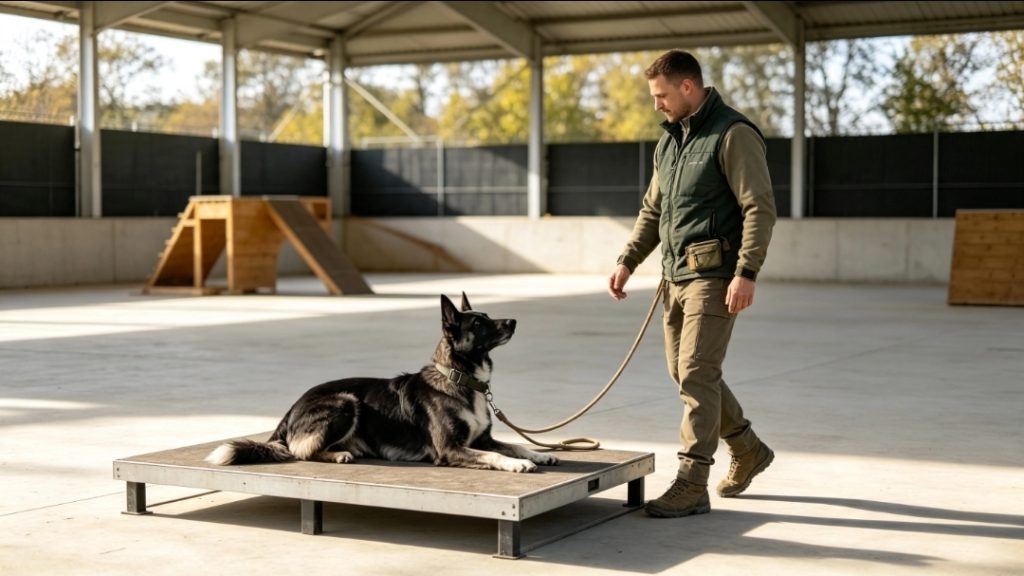
How do I teach my dog to wait?
Teaching your dog to wait is about developing calm control and helping your dog understand that remaining still and attentive can be rewarding. A reliable wait should not be rushed by immediately increasing distance, duration and distractions at the same time. Instead, observe your dog, establish suitable criteria, use appropriate control, reward the behaviour you want and gradually progress when your dog can succeed.
RECOMMENDED PRODUCTS

What does “wait” mean for a dog?
A wait asks your dog to pause rather than immediately moving towards something it wants.
The important part is that your dog needs to understand what behaviour is expected before you begin making the exercise difficult.
A useful wait can involve:
- Remaining in position for a short period.
- Waiting for food.
- Waiting before going through a doorway.
- Waiting while you move a short distance away.
- Waiting before being released to continue.
- Waiting while something interesting is happening nearby.
- Maintaining attention while the handler controls the next step.
- Remaining calm rather than rushing towards the reward.
The objective is not simply to make your dog sit still.
The objective is to develop understanding, control and calmness so your dog can respond appropriately when asked to wait.
Why does my dog struggle to wait?
Dogs can struggle with waiting for several reasons.
Your dog may:
- Become excited when food appears.
- Move towards a toy.
- Struggle to remain still.
- Anticipate the reward.
- Become distracted by movement.
- Have difficulty maintaining attention.
- Have not yet learned the criteria clearly.
- Be asked to wait for too long.
- Be asked to wait while too far away from the handler.
- Become over-aroused by the environment.
- Be progressing faster than its current ability allows.
This is why GPK9 training starts with observation rather than simply repeating a command.
Before progressing, observe your dog’s body language, attention, engagement, arousal, responsiveness and ability to remain calm.
Start with a simple wait
Begin in a quiet, familiar environment where your dog can concentrate.
Ask your dog for an appropriate position and introduce the wait.
Keep the first exercise simple.
For example:
- Ask your dog to sit or remain in the position you are working with.
- Give the wait cue.
- Pause for a very short period.
- Reward your dog for remaining in the correct position.
- Release your dog when the exercise is finished.
- Repeat.
- Gradually increase the difficulty only when your dog is consistently successful.
The reward should reinforce the behaviour you want.
Food can be particularly useful because it provides clear motivation and allows you to reinforce small successful stages of the exercise.
Teach the behaviour before increasing the difficulty
One of the most common mistakes when teaching a wait is progressing too quickly.
A dog that can wait for two seconds while the handler stands directly in front of it does not automatically understand how to wait for thirty seconds while the handler walks across a room.
There are different elements of difficulty:
- Duration.
- Distance.
- Distraction.
- Handler movement.
- Environmental activity.
- Food or toy availability.
- Other people.
- Other dogs.
- Changes in location.
Build these gradually.
If your dog succeeds consistently, you can carefully increase one element.
If your dog begins struggling, reduce the difficulty rather than simply repeating the cue louder or more frequently.
RECOMMENDED PRODUCTS
Use food to build understanding
Food can help your dog understand that remaining calm and waiting produces a predictable outcome.
The process should be clear and consistent.
Your dog learns:
WAIT → REMAIN CALM → MAINTAIN THE CRITERIA → REWARD
Avoid allowing your dog to repeatedly break position and then immediately receive the reward.
The reward should reinforce the behaviour you want to maintain.
Food should also be used appropriately for your dog’s current level of food motivation.
A dog with low food drive may need the environment, reward value, timing and exercise difficulty considered carefully.
A dog with high food drive may become more excited when food is presented.
The same reward can therefore produce different responses in different dogs.
Build duration gradually
Duration is one of the main components of a reliable wait.
Do not assume that because your dog can wait briefly, it is ready for a long wait.
Progress gradually.
For example:
- Very short wait.
- Successful repetition.
- Slightly longer wait.
- Successful repetition.
- Gradual increase in duration.
- Reassess your dog’s behaviour.
- Continue progressing when appropriate.
Your dog should be given opportunities to succeed.
If the duration becomes too difficult and your dog repeatedly breaks the wait, reduce it again.
The goal is not to test how long your dog can tolerate the exercise.
The goal is to build reliable understanding and control.
Gradually increase your distance
Once your dog understands the wait at close range, you can begin introducing small amounts of distance.
Start with a very small movement.
For example:
- Take one step away.
- Return.
- Reward.
- Repeat.
- Take two steps away.
- Return.
- Reward.
- Gradually increase the distance.
Do not immediately walk out of the room.
Distance changes the difficulty because your dog has less direct contact with you and may begin to anticipate what happens next.
Your dog needs to learn that the wait remains in place even when you move.
Add distractions carefully
A wait can become much harder when distractions are introduced.
Distractions might include:
- Food being placed nearby.
- Toys moving.
- People walking past.
- Doors opening.
- Household activity.
- Another dog moving nearby.
- Outdoor activity.
- New environments.
- Noise.
- Movement around the dog.
Introduce distractions gradually.
If the distraction causes your dog to become highly aroused or unable to maintain the exercise, the correct response is not simply to keep increasing pressure.
Observe what has changed.
Then assess whether your dog is still in a suitable training state.
What should I do if my dog breaks the wait?
If your dog breaks the wait, avoid turning the exercise into a confrontation.
Observe what happened.
Ask yourself:
- Was the duration too long?
- Did I increase distance too quickly?
- Was the distraction too difficult?
- Was my dog becoming over-excited?
- Was my dog still engaged?
- Was the criteria clear?
- Was the environment appropriate?
- Did I progress too quickly?
Then reduce the difficulty and try again.
The GPK9 decision process is:
OBSERVE → INTERPRET → DECIDE → ACT → REASSESS
This prevents you from treating every mistake in exactly the same way.
How GPK9 uses status when teaching a wait
The dog’s current status helps determine what happens next.
GREEN — OBSERVE → CONTINUE → PROGRESS
If your dog is calm, engaged, responsive and successfully maintaining the wait:
- Observe.
- Continue.
- Reinforce the correct behaviour.
- Progress gradually when appropriate.
Progress could mean a small increase in duration, distance or distraction.
AMBER — OBSERVE → ASSESS → REMOVE FROM DISTRACTION → CALM → REASSESS
If your dog begins struggling:
- Observe what has changed.
- Assess the situation.
- Remove the dog from the distraction where necessary.
- Allow the dog to calm.
- Reassess.
If your dog returns to a suitable state:
GREEN → CALM → CONTINUE → PROGRESS
If you cannot reduce the difficulty or your dog cannot calm appropriately:
RED → CANNOT REDUCE → CANNOT CALM → RETURN TO CRATE
RED — STOP WHAT YOU ARE DOING
If the dog becomes unable to respond appropriately:
- Stop what you are doing.
- Observe.
- Assess.
- Remove the dog from the distraction.
- Allow the dog to calm.
- Reassess.
If calmness and responsiveness return, you can return to the appropriate level of training.
If the situation cannot be reduced and the dog cannot calm:
RETURN TO CRATE
The crate can provide a conditioned safe space for rest, routine and resetting.
Choose the right level of control
Control should match the dog’s current status.
For obedience work, GPK9 uses different levels of control depending on the situation.
GREEN
Depending on the individual dog and environment, appropriate control may include:
- Short line.
- Harness.
- Long line.
- Free roam.
AMBER
Appropriate control may include:
- Short line.
- Muzzle where appropriate.
RED
Appropriate control may include:
- Short line.
- Muzzle where appropriate.
The equipment itself does not teach the wait.
It provides appropriate management while the dog learns.
Control should be selected according to the dog’s current behaviour, environment and level of responsiveness.
Don’t confuse waiting with simply holding your dog in position
A reliable wait should develop understanding rather than depend entirely on physical restriction.
Your dog needs to learn that the correct response is to remain calm and wait for the next instruction or release.
This means the exercise should be built around:
- Clear criteria.
- Appropriate motivation.
- Consistent timing.
- Suitable control.
- Gradual progression.
- Observation.
- Reassessment.
The objective is controlled behaviour that the dog understands.
Use the same criteria consistently
Dogs learn more effectively when the criteria are clear.
If one repetition allows your dog to move after two seconds and the next repetition expects thirty seconds, the exercise can become confusing.
Be consistent about:
- What position is required.
- What the wait cue means.
- What behaviour earns the reward.
- When the exercise ends.
- How difficulty is increased.
- When the dog is released.
Consistency helps your dog understand what produces reinforcement.
RECOMMENDED PRODUCTS
Practise in different environments
Once your dog can wait successfully in a quiet environment, gradually generalise the behaviour.
You may eventually practise:
- In another room.
- In the garden.
- Outside the house.
- During calm walks.
- Around controlled distractions.
- In different locations.
- Around appropriate environmental activity.
However, a behaviour learned in one environment does not automatically become reliable everywhere.
Each new environment may require you to reduce the difficulty and build the behaviour again.
How long should I practise waiting?
Short, successful training sessions are usually more useful than repeatedly pushing your dog until it becomes frustrated or over-aroused.
A practical approach is to:
- Start with a short exercise.
- Reward successful behaviour.
- Repeat.
- Gradually progress.
- Stop while your dog is still able to work appropriately.
- Return to the exercise later.
The GPK9 system focuses on observing the dog’s current state rather than following an arbitrary progression regardless of the dog’s response.
What if my dog becomes too excited around food?
Food is useful, but food can also increase arousal in some dogs.
If your dog becomes so focused on the food that it cannot wait, observe the response.
You may need to:
- Reduce the value of the reward temporarily.
- Reduce the difficulty.
- Slow down the exercise.
- Improve clarity.
- Reward calmer behaviour.
- Allow your dog to settle.
- Reassess before progressing.
The relevant drive is FOOD DRIVE.
The GPK9 system considers whether food motivation is currently helping the exercise or making the dog more difficult to control.
When should I progress my dog’s wait?
Progress when your dog is consistently demonstrating the behaviour you are asking for.
Look at:
- Calmness.
- Attention.
- Engagement.
- Responsiveness.
- Ability to maintain position.
- Recovery after distractions.
- Understanding of the criteria.
- Consistency across repetitions.
Progression should be based on the dog’s demonstrated behaviour rather than simply reaching a particular number of repetitions or days of training.
What should I do after a successful wait?
When your dog has successfully completed the exercise, the next step should be clear.
You may:
- Reward the behaviour.
- Release your dog.
- Move into another exercise.
- Gradually increase the difficulty.
- End the session.
The release is important because the dog needs to understand when the waiting exercise has finished.
This creates a clearer distinction between:
WAIT → REMAIN
and:
RELEASE → CONTINUE