How do I teach my dog to relax at home?
How do I teach my dog to relax at home is not simply about telling your dog to lie down or expecting them to become calm on their own. Relaxation develops when the dog understands what is expected, the environment is managed appropriately, freedom is introduced at the correct level and the dog is given opportunities to settle successfully. The starting point is to observe your dog’s behaviour, understand their current status, consider their motivation and choose an appropriate level of control before deciding what to do next.
RECOMMENDED PRODUCTS

Why does my dog struggle to relax at home?
Some dogs find it difficult to switch off because the home environment contains constant opportunities for movement, interaction, play, attention and exploration.
A dog may become unsettled when:
- They have too much freedom too quickly.
- They have not learned how to settle in the home.
- The environment contains too many distractions.
- They are highly motivated by movement, toys or food.
- They are repeatedly encouraged to interact when they should be resting.
- Their routine is inconsistent.
- They are given more freedom than their current behaviour can support.
- They have difficulty recovering after excitement.
- They are unable to remain engaged with a calm activity.
- They have not yet learned the difference between active periods and rest periods.
The answer is not always to give the dog more exercise or more freedom.
Sometimes the dog needs less freedom, fewer distractions and clearer environmental management so that they can learn what calm behaviour looks like.
What does a relaxed dog look like?
Before teaching relaxation, you need to know what you are looking for.
The GPK9 decision process begins with:
OBSERVE → INTERPRET → DECIDE → ACT → REASSESS
Observation should come before intervention.
Look at the whole dog rather than focusing on one individual behaviour.
Observe your dog’s body language
Consider:
- Body posture.
- Facial expression.
- Ears.
- Tail.
- Movement.
- Orientation.
- Attention.
- Engagement.
- Arousal.
- Ability to settle.
- Responsiveness.
- Recovery.
- Environmental awareness.
- Social behaviour.
- Changes in behaviour.
- Previously learned criteria.
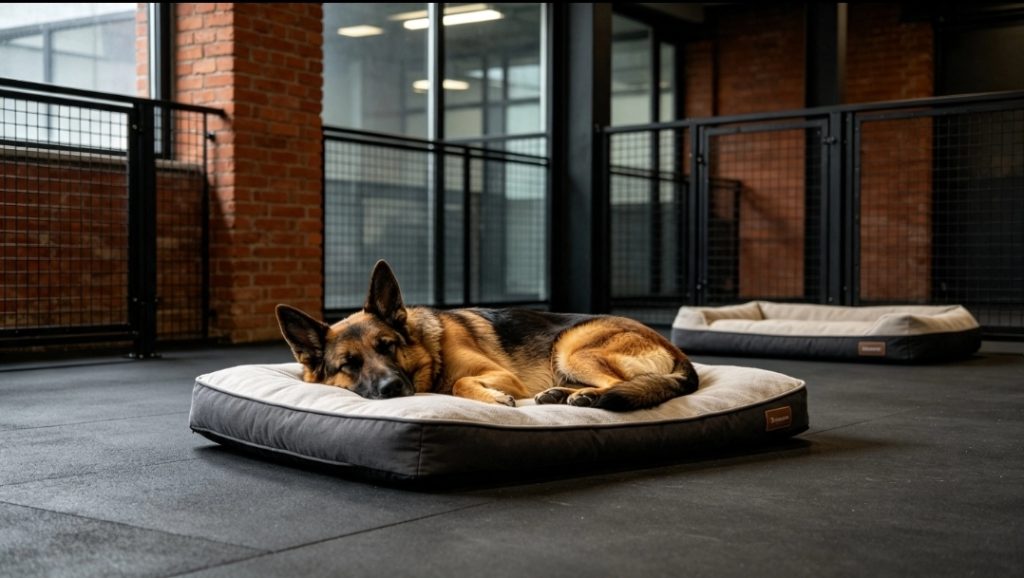
A dog that is genuinely becoming comfortable may show slower movement, a looser body, reduced environmental scanning, an ability to remain in one place and an improved ability to respond appropriately.
Relaxation does not necessarily mean that the dog immediately falls asleep.
A dog may be relaxed while remaining aware of what is happening around them.
The important question is whether the dog can remain appropriately calm and recover from normal household activity.
Start with the right level of freedom
One of the most important principles for teaching calm behaviour at home is:
MORE FREEDOM REQUIRES MORE BEHAVIOURAL RESPONSIBILITY.
Giving a dog unrestricted access to the entire house does not automatically teach them how to relax.
If a dog is repeatedly getting up, following people, searching for activity, grabbing objects, demanding interaction or becoming overexcited, unrestricted freedom may simply give them more opportunities to practise those behaviours.
Instead, freedom should match the dog’s current ability to behave appropriately.
This is where the GPK9 HOME & SOCIAL pathway becomes relevant:
CRATE → PLACEMAT → PLAYPEN
This is not necessarily a one-way progression.
A dog can move backwards when required.
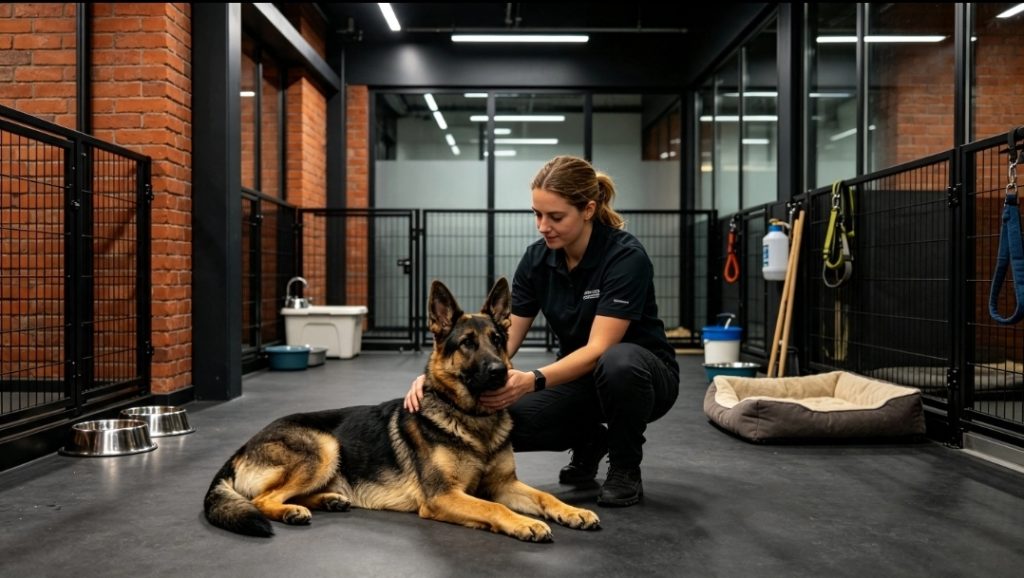
Use the crate as a safe rest and reset area
The crate should provide a conditioned safe space for:
- Rest.
- Routine.
- Recovery.
- Resetting.
- Appropriate management.
The crate should not be used as a punishment.
It provides a predictable area where the dog can reduce environmental activity and settle when too much freedom would make successful behaviour difficult.
For example, if your dog has become highly excited after household activity and cannot settle, returning to an appropriate rest area may help reduce the situation.
The objective is not to keep the dog in the crate permanently.
The objective is to provide an appropriate level of control while the dog develops the ability to settle.
Teach settling on a placemat
Once your dog can settle appropriately, a placemat can provide a clear location for calm behaviour.
The placemat can help develop:
- Stationing.
- Duration.
- Settling.
- Calmness.
- Environmental awareness.
- Appropriate engagement.
- Controlled freedom.
The dog learns that being in the home does not always mean moving around, playing or seeking interaction.
The placemat becomes a predictable location where calm behaviour can be developed.
Keep the environment appropriate to your dog’s current ability.
If your dog cannot settle because the environment is too distracting, the answer may not be to keep repeating the exercise.
Instead:
OBSERVE → ASSESS → REDUCE THE DISTRACTION → CALM → REASSESS
Then determine whether the dog is ready to continue.
Progress towards controlled freedom with a playpen
A playpen can provide an intermediate level of freedom.
It gives the dog more space while maintaining a clear physical boundary.
This can be particularly useful when the dog is not yet ready for unrestricted access to the home.
The playpen allows you to practise calm behaviour while still maintaining management.
The progression may therefore look like:
CRATE → PLACEMAT → PLAYPEN
But the dog does not have to move through these stages permanently or in exactly the same order.
If behaviour deteriorates, return to an earlier level of control.
This is not failure.
It is appropriate management.
How do I know whether my dog is ready for more freedom?
Look at behaviour rather than simply the amount of time your dog has spent in training.
Ask:
- Can my dog settle in the current environment?
- Can my dog remain calm when normal household activity occurs?
- Can my dog respond appropriately?
- Can my dog disengage from unnecessary distractions?
- Can my dog recover after becoming excited?
- Can my dog remain appropriately engaged?
- Can my dog continue calm behaviour without constant intervention?
- Has my dog consistently demonstrated the behaviour I am asking for?
If the answer is yes, progression may be appropriate.
If the answer is no, increase management rather than increasing freedom.
Use the traffic-light response
The GPK9 status response system helps determine what to do when your dog is either coping well or struggling.
GREEN — OBSERVE → CONTINUE → PROGRESS
Green means the dog is in a suitable state to continue.
For relaxation at home, this may mean:
- Your dog is settled.
- Their body language is appropriate.
- They can remain in position.
- They are aware of the environment without becoming over-aroused.
- They can respond appropriately.
- They can recover from minor household activity.
Continue the appropriate activity.
If the dog remains successful, progression can occur gradually.
AMBER — OBSERVE → ASSESS → REMOVE FROM DISTRACTION → CALM → REASSESS
Amber means your dog is beginning to struggle.
You might notice:
- Increasing movement.
- Difficulty settling.
- Increased environmental attention.
- Rising arousal.
- Reduced responsiveness.
- Repeated attempts to leave the settling area.
- Increased interest in household activity.
- Difficulty recovering.
Do not simply continue increasing pressure.
Instead:
OBSERVE → ASSESS → REMOVE FROM DISTRACTION → CALM → REASSESS
If the dog returns to an appropriate calm state:
GREEN → CALM → CONTINUE → PROGRESS
If the dog cannot reduce their arousal or cannot calm appropriately, more management is required.
RED — STOP AND RESET
Red means the current situation needs to stop.
The response is:
STOP WHAT YOU ARE DOING → OBSERVE → ASSESS → REMOVE FROM DISTRACTION → CALM → REASSESS
If the dog returns to a suitable calm state:
GREEN → CALM → CONTINUE → PROGRESS
If the dog cannot reduce or calm:
RED → CANNOT REDUCE → CANNOT CALM → RETURN TO CRATE
Then:
RESET → HOME & SOCIAL → GREEN → OBSERVE → CONTINUE
The important point is that the response is based on the dog’s current state rather than simply continuing because an exercise was planned.
RECOMMENDED PRODUCTS
What role does food motivation play?
Food motivation can be relevant when teaching calm behaviour, particularly when establishing appropriate engagement and reinforcing suitable behaviour.
Consider whether your dog has:
- Low Food Drive.
- High Food Drive.
A highly food-motivated dog may become more excited if food is introduced incorrectly.
The objective is therefore not simply to give food continuously.
Food should support the behaviour you are developing.
If the dog is becoming more aroused rather than calmer, observe what is happening and reassess the approach.
The relevant question is:
Is the motivation helping the dog achieve the behaviour required in the current environment?
What if my dog becomes excited by toys?
Some dogs become highly motivated by toys and movement.
This relates to:
- Prey drive.
- Toy motivation.
- Movement.
- Controlled play.
- Handler control.
- Calming.
- Recovery.
If your dog becomes excited by a toy when they should be settling, introducing more play may increase the problem.
Play and relaxation have different purposes.
If your dog needs calmness, the immediate objective is to reduce unnecessary arousal rather than create more excitement.
Observe the dog, consider their prey drive and determine whether the environment and activity are appropriate.
Should I ignore my dog when they cannot settle?
Ignoring your dog is not a complete training strategy.
First determine why the dog is struggling.
The GPK9 approach is:
OBSERVE → INTERPRET → DECIDE → ACT → REASSESS
Ask what has changed.
Has the dog been given too much freedom?
Is there a distraction?
Has arousal increased?
Is the dog seeking interaction?
Is the environment too stimulating?
Is the dog unable to recover?
Once the situation has been understood, choose the appropriate level of management.
The goal is not simply to ignore behaviour.
The goal is to create the conditions in which appropriate behaviour can be learned and repeated.
Create a predictable home routine
Dogs benefit from predictable patterns.
A suitable home routine can provide clear differences between:
- Training.
- Play.
- Interaction.
- Toilet opportunities.
- Walking.
- Rest.
- Calm household time.
A predictable routine helps the dog understand that activity does not continue indefinitely.
There should be opportunities for the dog to become active and opportunities for the dog to settle.
Keep the environment appropriate
Environmental management is an important part of teaching relaxation.
Consider:
- Noise.
- Movement.
- Visitors.
- Children.
- Other animals.
- Toys.
- Access to furniture.
- Access to different rooms.
- Household activity.
- Time of day.
- Previous exercise or stimulation.
If the dog repeatedly becomes over-aroused in a particular environment, change the environment before simply repeating the same training.
A successful training environment should allow the dog to demonstrate the behaviour you are trying to develop.
What if my dog gets up from the placemat?
Getting up does not automatically mean the training has failed.
Observe what happened.
Ask:
- What attracted the dog?
- Was there a distraction?
- Was the duration too long?
- Was the dog becoming over-aroused?
- Was the environment too difficult?
- Was the dog ready for more freedom?
- Was the dog able to recover?
Then decide what needs to change.
You may need to:
- Reduce the duration.
- Reduce distractions.
- Return to a simpler environment.
- Increase management.
- Allow the dog to calm.
- Return to the crate.
- Reintroduce the placemat.
- Reassess before progressing.
The correct response depends on the dog’s status.
Do not rush progression
Progression should be earned through behaviour.
A dog that can settle for a short period in a quiet environment may not be ready to settle for the same duration when:
- Visitors arrive.
- Children are moving around.
- Food is being prepared.
- Another dog enters the room.
- Toys are available.
- The household becomes noisy.
Progression should therefore be gradual.
Change one factor at a time where possible.
Observe the response.
If the dog remains calm, continue.
If the dog struggles, reduce the difficulty.
When should I return my dog to the crate?
Returning to the crate can be appropriate when the dog cannot reduce arousal or calm sufficiently to continue.
The GPK9 system identifies:
GREEN → PLACEMAT
AMBER → PLAYPEN
RED → CRATE
The crate therefore becomes part of the management and reset process.
A return to the crate is not necessarily a step backwards in training.
It can be the correct response when the current level of freedom is greater than the dog’s ability to behave appropriately.
After the reset:
RESET → HOME & SOCIAL → GREEN → OBSERVE → CONTINUE
The next attempt should begin from a level at which the dog can succeed.
How do I know when my dog is genuinely relaxing?
Look for consistent behaviour rather than one isolated moment.
Your dog should increasingly be able to:
- Settle in an appropriate location.
- Remain calm while normal activity occurs.
- Reduce unnecessary movement.
- Respond appropriately.
- Recover after distractions.
- Remain aware without becoming over-aroused.
- Accept appropriate boundaries.
- Move between activity and rest.
- Continue calm behaviour for gradually longer periods.
- Demonstrate appropriate behaviour with increasing levels of freedom.
The goal is not to make the dog completely unaware of their surroundings.
The goal is to help the dog develop appropriate calmness and behavioural responsibility within the home.
Common mistakes when teaching a dog to relax
Giving too much freedom too soon
Freedom should match behavioural responsibility.
If your dog cannot cope with unrestricted access, reduce the environment and rebuild the behaviour.
Making every interaction exciting
Dogs need to learn that being around people does not always mean playing, receiving attention or moving around.
Calm household time is an important part of the dog’s routine.
Increasing difficulty too quickly
Do not assume that success in one environment means the dog is ready for a more difficult environment.
Progress gradually.
Continuing when the dog is struggling
If the dog is showing signs of increasing arousal or reduced responsiveness, observe and reassess rather than automatically continuing.
Using the crate as punishment
The crate should remain a safe and predictable area for rest, routine and resetting.
Ignoring the environment
The environment can determine whether a dog succeeds.
Manage distractions rather than expecting the dog to cope with everything immediately.
A practical relaxation routine
A simple routine can follow the GPK9 decision process.
Step 1 — Observe
Look at your dog’s:
- Body posture.
- Facial expression.
- Ears.
- Tail.
- Movement.
- Attention.
- Engagement.
- Arousal.
- Ability to settle.
- Responsiveness.
- Recovery.
Step 2 — Interpret
Consider:
- Current status.
- Food motivation.
- Prey or toy motivation.
- Environment.
- Distractions.
- Existing level of control.
- Ability to remain calm.
Step 3 — Decide
Determine whether the dog should:
- Continue.
- Settle.
- Have reduced distractions.
- Have more management.
- Return to an earlier stage.
- Calm.
- Reset.
Step 4 — Act
Apply the appropriate:
- Training.
- Motivation.
- Control.
- Management.
- Environment.
- Equipment.
- Calmness process.
Step 5 — Reassess
Look at the dog again.
Ask:
- Has the dog returned to calm?
- Can the dog engage appropriately?
- Can the dog respond appropriately?
- Can the dog continue?
- Can the dog progress?
If yes, continue appropriately.
If not, reduce the situation and reset.
RECOMMENDED PRODUCTS
The key principle: calmness comes before freedom
Teaching a dog to relax at home is not about forcing calmness.
It is about creating the right conditions for calm behaviour to develop.
The dog needs an environment that matches their current ability.
The level of freedom should match their behavioural responsibility.
The difficulty should increase gradually.
When the dog struggles, reduce the situation.
When the dog becomes calm again, reassess.
When the dog consistently demonstrates appropriate behaviour, progression can occur.
This creates a structured process rather than simply hoping that the dog will eventually learn to switch off.
When should I seek professional help?
If your dog’s behaviour is difficult to understand, is changing significantly, involves persistent inability to calm, or creates a situation that you cannot safely manage, professional assessment may be appropriate.
A training article cannot diagnose the underlying cause of a dog’s behaviour.
The important principle is to recognise when your current level of understanding or control is not enough.
If the dog cannot reduce or calm appropriately, stop the activity, reduce the situation and use an appropriate reset before deciding what should happen next.
Conclusion
Teaching your dog to relax at home starts with understanding the dog’s current state rather than simply asking for a behaviour.
Observe the dog.
Interpret what you are seeing.
Consider status, motivation, environment and control.
Decide what the dog can reasonably manage.
Act using the appropriate level of training and management.
Allow the dog to calm when required.
Then reassess.
A dog that can settle appropriately can gradually develop greater behavioural responsibility and greater freedom.
The process may move between the crate, placemat and playpen depending on the dog’s current ability. Progression is not always linear, and returning to an earlier level of control can be the correct decision when the dog is struggling.
The aim is to build a dog that can remain appropriately calm within the home while understanding that different situations require different levels of freedom, control and responsibility.