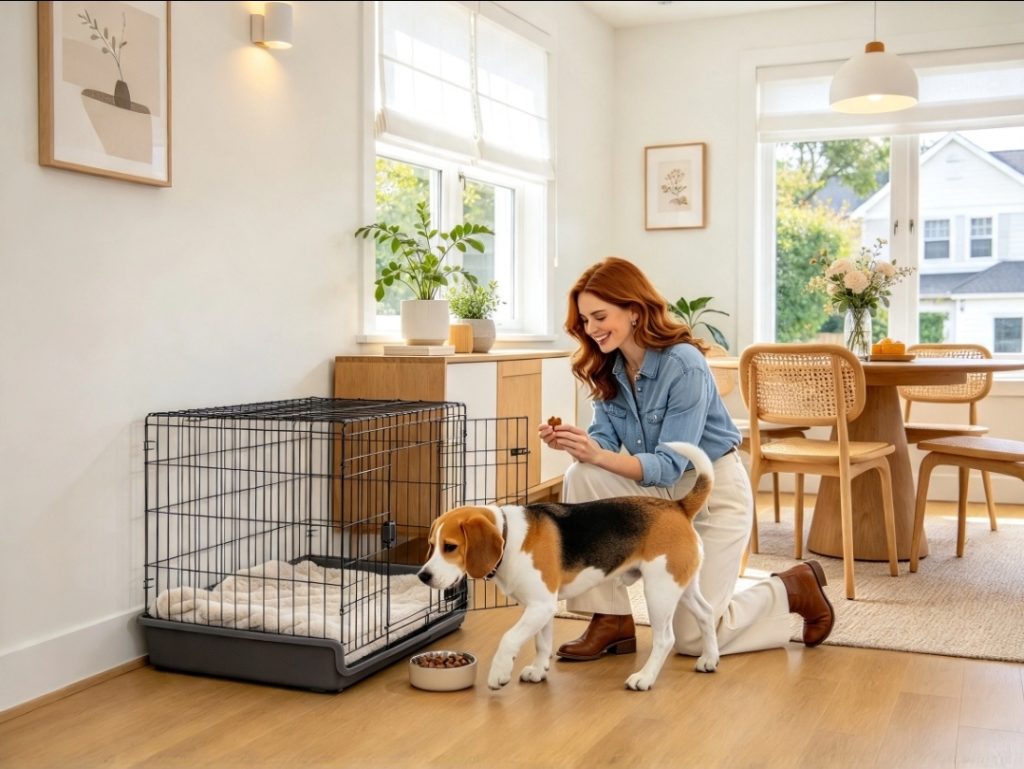
When can I stop using a crate?
Knowing when you can stop using a crate is not simply about your dog’s age. A dog may be physically mature enough to have more freedom but still need the structure of a crate for rest, routine, management or resetting. The more important question is whether your dog can behave appropriately when the crate is no longer being used to provide that level of control.
RECOMMENDED PRODUCTS — Crates and Pens
The crate should not be viewed as something that has to disappear as quickly as possible. Within the GPK9 PROFESSIONAL TRAINING SYSTEM, the crate is part of the HOME & SOCIAL area and provides a conditioned safe space for rest, routine and resetting. Moving away from regular crate use is therefore a progression in behavioural responsibility rather than simply removing a piece of equipment.
Why there is no fixed age to stop using a crate
There is no universal age at which every dog should stop using a crate.
Two dogs of exactly the same age can have very different levels of reliability. One may calmly settle when given freedom around the home, while another may become overexcited, chew furniture, disturb other animals, have toilet accidents or struggle to settle.
The important question is not:
“Is my dog old enough to stop using the crate?”
A more useful question is:
“Can my dog handle the additional freedom responsibly?”
This is central to the GPK9 principle:
MORE FREEDOM REQUIRES MORE BEHAVIOURAL RESPONSIBILITY.
What should your dog be able to do before getting more freedom?
Before reducing your reliance on the crate, observe your dog’s behaviour during normal periods of freedom.
Look at whether your dog can:
- Settle calmly.
- Relax without constant interaction.
- Remain in an appropriate area.
- Avoid destructive behaviour.
- Follow the established household routine.
- Manage normal household activity.
- Respond appropriately when redirected.
- Recover after excitement.
- Remain calm when you are not actively engaging with the dog.
- Maintain appropriate toilet behaviour.
- Return to calm behaviour after distractions.
These observations are more useful than age alone.
A dog that can consistently demonstrate these behaviours may be ready to begin testing greater freedom.
Use the GPK9 decision process
The GPK9 PROFESSIONAL TRAINING SYSTEM uses:
OBSERVE → INTERPRET → DECIDE → ACT → REASSESS
When deciding whether your dog is ready for less crate use, start by observing rather than assuming.
Observe
Watch your dog’s:
- Body posture.
- Facial expression.
- Ears.
- Tail.
- Movement.
- Attention.
- Engagement.
- Arousal.
- Ability to settle.
- Responsiveness.
- Recovery.
- Environmental awareness.
- Behaviour when left without direct supervision.
The objective is to identify what your dog actually does when given freedom.
Interpret
Consider whether the behaviour indicates that your dog can manage the additional freedom.
A calm dog that settles independently and responds appropriately may be demonstrating that greater freedom is suitable.
A dog that becomes highly aroused, destructive, unsettled or unable to respond may require a lower level of freedom.
Decide
Based on what you have observed, decide whether to:
- Continue with the current level of freedom.
- Increase freedom gradually.
- Maintain the existing crate routine.
- Reduce freedom.
- Return to the crate for a reset.
- Reassess the training environment.
Act and reassess
Give your dog an appropriate opportunity to demonstrate the behaviour you are looking for.
Then observe again.
If your dog remains calm and appropriate, you have useful information that the current level of freedom may be suitable.
If the dog struggles, do not simply continue because you have decided that crate use should have finished.
Reduce the situation and reassess.
The crate, placemat and playpen can work together
The GPK9 HOME & SOCIAL pathway is:
CRATE → PLACEMAT → PLAYPEN
This is not necessarily a permanent linear progression.
A dog can move forward and return to an earlier stage when required.
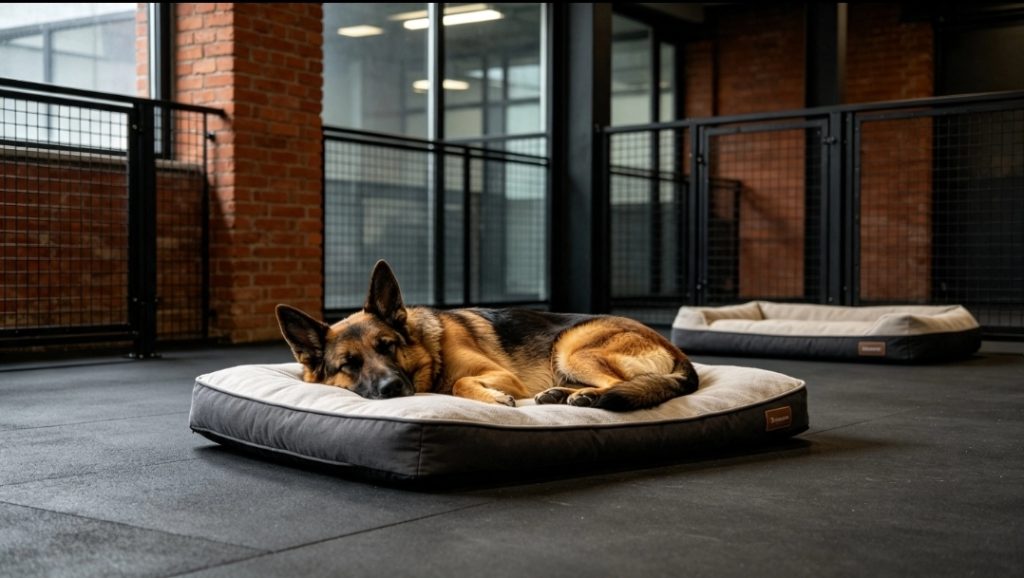
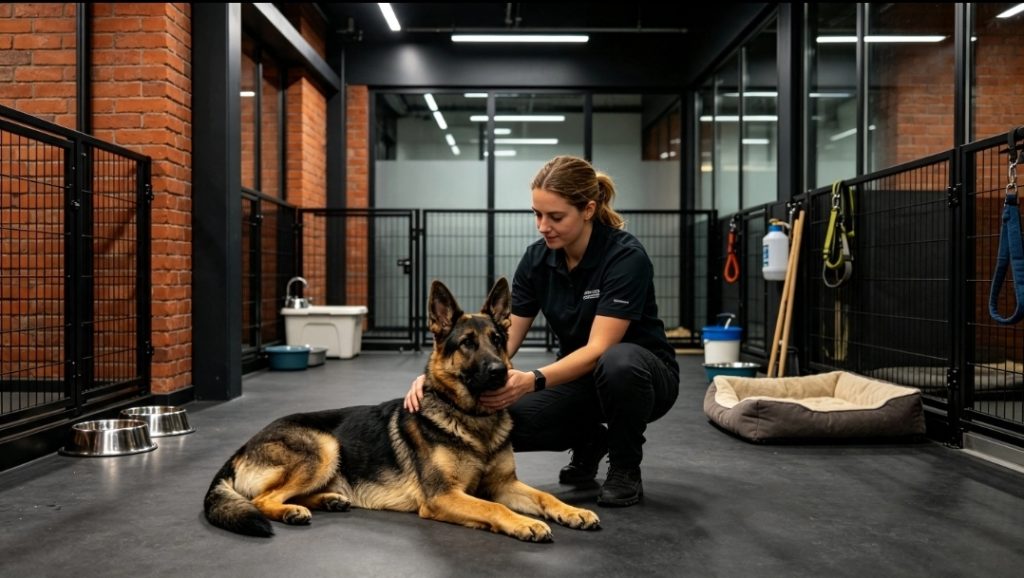
The crate provides a controlled environment for rest, routine and resetting.
The placemat can provide stationing, duration and settling.
The playpen can provide controlled freedom within a boundary.
This creates opportunities to gradually increase responsibility rather than suddenly giving a dog unrestricted access to the entire home.
How to reduce crate use gradually
If your dog is demonstrating suitable behaviour, start by increasing freedom in manageable stages.
For example, instead of immediately leaving the crate permanently open throughout the entire house, you might allow your dog access to one safe area while maintaining the crate as an available resting space.
Observe what happens.
If your dog remains calm, settles and behaves appropriately, you can continue to provide opportunities for greater freedom.
If the dog becomes unsettled or overexcited, reduce the level of freedom and allow the dog to return to a calmer environment.
The purpose is not to test how much freedom the dog can survive.
The purpose is to establish how much freedom the dog can responsibly manage.
Should the crate door stay open?
For some dogs, leaving the crate door open can be an appropriate part of progression.
The crate remains available as a familiar resting area while the dog gains access to a larger environment.
This can be particularly useful because removing the crate completely is not necessary simply because your dog is capable of spending more time outside it.
A dog can continue to choose or be directed toward its established resting area while gradually becoming more independent.
The key consideration is the dog’s behaviour, not whether the crate is physically present.
What if my dog becomes destructive?
Destructive behaviour is important information.
Rather than simply concluding that the dog has “grown out of” crate use, return to the decision process.
OBSERVE → INTERPRET → DECIDE → ACT → REASSESS
Consider:
- When does the behaviour occur?
- What was happening immediately beforehand?
- Was the dog tired or highly aroused?
- Was the dog left with too much freedom?
- Was the environment appropriately managed?
- Could the dog settle?
- Has the level of freedom increased too quickly?
If the dog cannot manage the current level of freedom, reduce it.
The crate can provide a safe and familiar reset environment while the relevant HOME & SOCIAL training is reviewed.
What if my dog becomes overexcited?
Freedom is not only about preventing destructive behaviour.
A dog may also struggle because increased space creates too much opportunity for movement, exploration or interaction.
If your dog becomes highly aroused, observe the behaviour before deciding what to do next.
An AMBER situation means:
OBSERVE → ASSESS → REMOVE FROM DISTRACTION → CALM → REASSESS
If the dog returns to a calm state, you can continue appropriately.
If the dog cannot reduce or calm, the GPK9 system moves toward a RED response, where the activity stops and the dog is returned to an appropriate level of control.
For a HOME & SOCIAL situation, that may mean returning to the crate for a reset.
When should you continue using the crate?
There is nothing wrong with continuing to use a crate when it remains useful.
A crate can continue providing:
- Rest.
- Routine.
- Controlled management.
- A familiar safe space.
- A place to reset.
- Support during periods of increased excitement.
- A controlled environment when greater freedom is inappropriate.
Stopping crate use should therefore not be treated as a milestone that has to happen at a particular age.
The objective is appropriate behaviour and appropriate freedom.
When should you reduce freedom again?
If your dog’s behaviour deteriorates after increasing freedom, take that information seriously.
For example, if your dog previously settled successfully in one room but begins:
- Chewing furniture.
- Becoming excessively excited.
- Failing to settle.
- Ignoring established boundaries.
- Having toilet accidents.
- Becoming difficult to manage.
then the current level of freedom may be too high.
Return to an appropriate level of control.
This is not necessarily failure.
It is part of progression.
The GPK9 pathway allows the dog to move back to an earlier stage when required.
The traffic-light approach to crate progression
For HOME & SOCIAL situations, the GPK9 status system provides a practical way to interpret what you see.
GREEN
OBSERVE → CONTINUE → PROGRESS
Your dog is calm and behaving appropriately.
Continue the appropriate level of freedom and progress gradually when suitable.
AMBER
OBSERVE → ASSESS → REMOVE FROM DISTRACTION → CALM → REASSESS
Your dog is beginning to struggle.
Reduce the situation, remove unnecessary distractions and allow the dog to calm before reassessing.
RED
STOP → OBSERVE → ASSESS → REMOVE FROM DISTRACTION → CALM → REASSESS
The current situation needs to stop.
If the dog cannot reduce or calm:
RED → CANNOT REDUCE → CANNOT CALM → RETURN TO CRATE
Then:
RESET → HOME & SOCIAL → GREEN → OBSERVE → CONTINUE
This creates a structured way to respond instead of making the decision based on frustration or assumption.
RECOMMENDED COURSES
The GPK9 PROFESSIONAL TRAINING SYSTEM contains five connected training areas. For this subject, GOLDEN RULE 1 — HOME AND SOCIAL is the directly relevant course because it covers crate use, controlled freedom, settling, boundaries, calmness, resetting and progression.
1. GOLDEN RULE 1 — HOME AND SOCIAL
This is the primary course relevant to deciding when a dog can move from greater reliance on the crate toward increased freedom.
It covers:
- Crate.
- Placemat.
- Playpen.
- Boundaries.
- Controlled freedom.
- Settling.
- Calmness.
- Resetting.
- Progression.
The remaining Golden Rules form the wider GPK9 system:
2. GOLDEN RULE 2 — OBEDIENCE
Provides the wider framework for structured obedience, engagement, food motivation, control, suitable equipment and progression.
3. GOLDEN RULE 3 — PLAY DRIVE AND PLAY
Covers prey drive, play, toy motivation, controlled play, handler control, calming, resetting and progression.
4. GOLDEN RULE 4 — TOILET
Covers toilet routine, consistent toilet location, toilet command, management, control and progression.
5. GOLDEN RULE 5 — SOCIAL WALKING
Covers calm social walking, IGNORE THE WORLD, environmental awareness, distractions, control and calmness.
For the specific question of when to stop using a crate, the strongest connection is GOLDEN RULE 1 — HOME AND SOCIAL, because the decision concerns freedom, boundaries, settling, environmental management and the appropriate level of control.
A simple test for increasing freedom
Before increasing your dog’s freedom, ask yourself:
Can my dog remain calm?
Can my dog settle without constant intervention?
Can my dog behave appropriately in the environment?
Can my dog respond appropriately when redirected?
Can my dog recover after excitement or distraction?
Can my dog manage the current level of freedom consistently?
If the answer is yes, you have useful evidence that progression may be appropriate.
If the answer is no, reduce the situation rather than simply removing the crate and hoping the behaviour improves.
The crate does not have to disappear
One of the most important points is that stopping regular crate use does not necessarily mean removing the crate from your dog’s life.
The crate can remain available as part of the dog’s environment.
A dog that has learned to associate the crate with rest and routine can continue to benefit from having that familiar space available.
The objective is not to eliminate the crate.
The objective is to develop a dog that can appropriately manage increasing freedom.
What if I am unsure whether my dog is ready?
If you cannot confidently assess your dog’s behaviour, continue observing rather than rushing the progression.
Look for patterns rather than relying on one successful period.
One calm evening does not necessarily demonstrate that unrestricted freedom is appropriate.
Likewise, one difficult period does not necessarily mean that the dog can never have greater freedom.
Use the GPK9 process repeatedly:
OBSERVE → INTERPRET → DECIDE → ACT → REASSESS
Progression should be based on the dog’s demonstrated behaviour.
Final thoughts
The question “When can I stop using a crate?” is therefore better understood as a question about behavioural responsibility and controlled freedom. Age can be part of the wider picture, but it should not be the only factor used to make the decision. Observe your dog, consider its current status, assess the environment and increase freedom gradually. If the dog remains calm and appropriate, continue and progress. If the dog struggles, reduce the situation, allow calmness and reassess. If necessary, return to the crate and reset before trying again.
GPK9’S FIVE GOLDEN RULES
GPK9’S FIVE GOLDEN RULES. The GPK9 PROFESSIONAL TRAINING SYSTEM is divided into five accessible areas, with each area dealing with a particular part of dog training while remaining connected to the wider framework. An individual course can provide specific help for a particular training requirement, but no single course represents the entire system. The five areas work together as one connected framework, allowing information to be learned progressively in a bite-sized structure that can be understood and applied by first-time dog owners and professional trainers. The question of when to stop using a crate relates particularly strongly to HOME & SOCIAL because it involves controlled freedom, settling, boundaries, management, resetting and progression, but HOME & SOCIAL remains part of the wider system. Understanding all five areas provides the complete GPK9 framework and helps the reader understand not only when greater freedom may be appropriate, but also how the dog’s status, drive, control, environment, behaviour, calmness, reassessment and progression fit together when addressing the specific training requirement.