How do I teach my dog to settle in the house?
Teaching a dog to settle in the house means helping the dog learn how to remain calm and comfortable while normal household life continues around it. Settling is not simply making a dog lie down; it involves observing the dog’s current state, providing an appropriate environment, establishing a clear resting location and gradually building the dog’s ability to remain calm.
RECOMMENDED PRODUCTS
What does it mean for a dog to settle?
A settled dog should be able to relax without constantly looking for something to do.
The dog may lie down, remain quietly on its resting area, observe what is happening around it and then return its attention to resting.
Settling is different from simply stopping movement for a few seconds.
Look at the dog’s:
- Body posture.
- Facial expression.
- Ears.
- Tail.
- Movement.
- Attention.
- Engagement.
- Arousal.
- Responsiveness.
- Ability to settle.
- Recovery from distractions.
- Environmental awareness.
A dog that is physically still but remains highly aroused may not yet be genuinely settled.
Why won’t my dog settle in the house?
There can be several reasons why a dog struggles to settle.
The environment may be too stimulating.
The dog may have too much freedom.
The dog may not understand where it should settle.
The dog may have learned that movement, attention or interaction is more rewarding than remaining calm.
The dog may also be struggling because the level of activity has increased faster than its ability to manage it.
Rather than immediately assuming that the dog is being disobedient, observe what is happening.
The GPK9 decision process is:
OBSERVE → INTERPRET → DECIDE → ACT → REASSESS
This allows the dog’s current behaviour to determine the next step.
Give your dog a clear place to settle
A dog can find it easier to understand settling when it has a consistent location.
A placemat can provide a clear boundary for stationing, duration and settling.
The objective is not simply to put the dog onto the placemat.
The dog needs to learn that remaining there calmly is an appropriate behaviour.
Start in a quiet part of the house and keep the initial sessions manageable.
When the dog settles appropriately, reinforce the behaviour using suitable positive reinforcement.
How do I teach my dog to use a placemat?
Begin when your dog is already relatively calm.
Place the placemat in an appropriate location.
Encourage the dog onto it using food motivation where appropriate.
When the dog is on the placemat, allow it to settle.
Reinforce calm behaviour.
Initially, the dog may only remain there for a short period.
That is fine.
The objective is to build duration gradually rather than immediately expecting a long period of calmness.
As the dog becomes more reliable, normal household activity can gradually be introduced.
Should I reward my dog for being calm?
Yes, calm behaviour can be reinforced.
If your dog chooses to lie down, remains quietly on its resting area or settles while you move around the house, those behaviours can be reinforced.
Food can be useful where the dog has suitable food motivation.
The important point is to reinforce the behaviour you want to develop.
Over time, the objective is for the dog to become increasingly capable of settling without requiring constant intervention.
What should I do if my dog gets up?
Getting up does not automatically mean the training has failed.
Observe what happens.
If the dog gets up, looks around and then returns to its resting area, that may be part of normal behaviour.
If the dog repeatedly gets up, searches for stimulation, jumps onto furniture or begins demanding attention, reassess the situation.
Ask:
- Is the environment too stimulating?
- Is the dog too excited?
- Is the session too long?
- Is the dog ready for this level of freedom?
- Does the dog need a calmer environment?
- Has the dog understood the settling behaviour?
Use the dog’s response to determine the next step.
How much freedom should my dog have?
One of the key GPK9 Home & Social principles is:
MORE FREEDOM REQUIRES MORE BEHAVIOURAL RESPONSIBILITY.
A dog that cannot settle with limited freedom may struggle even more when given unrestricted access to the entire house.
Freedom should therefore be increased according to demonstrated behaviour.
The GPK9 Home & Social pathway is:
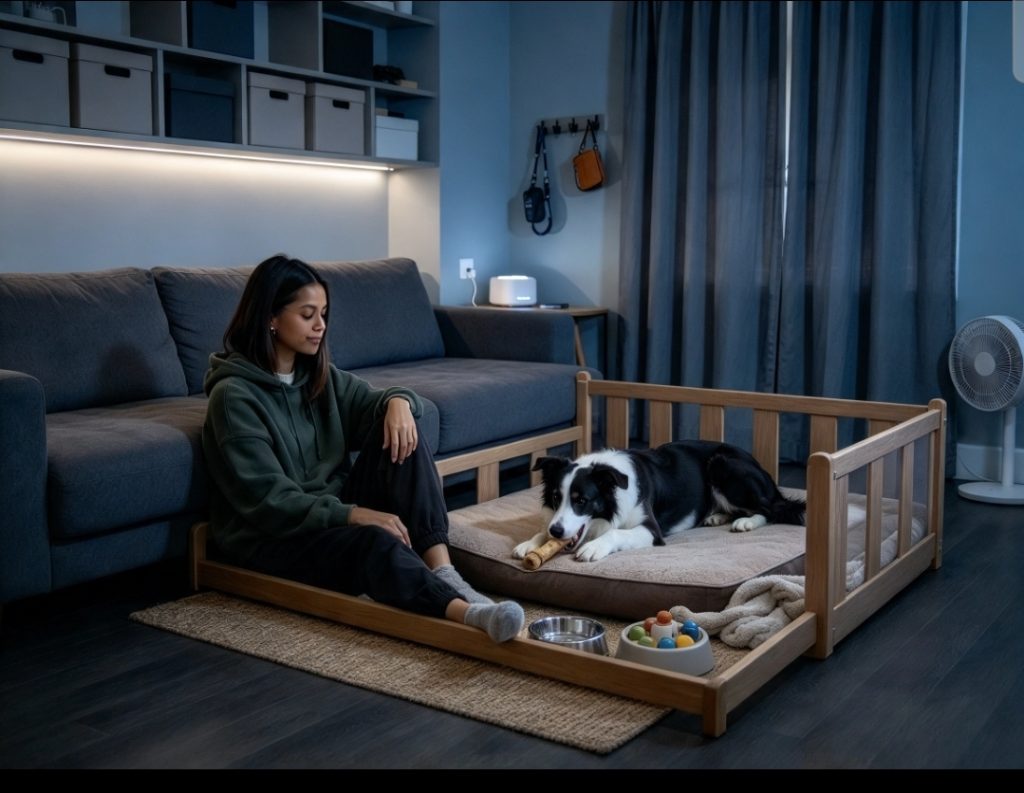
CRATE → PLACEMAT → PLAYPEN
This pathway is not necessarily linear.
A dog can return to an earlier stage when required.
The crate provides a conditioned safe space for rest, routine and resetting.
The placemat provides stationing, duration and settling.
The playpen provides controlled freedom within a boundary.
RECOMMENDED PRODUCTS
Should I use a crate to teach settling?
A crate can support settling when it has already been established as a safe and appropriate space.
Within the GPK9 system, the crate is not simply a place to put a dog when it has done something wrong.
It is a conditioned safe space for:
- Rest.
- Routine.
- Resetting.
- Controlled management.
If your dog cannot reduce its arousal or settle appropriately, returning to an established crate routine can provide an opportunity to reset.
Once the dog is calm, reassess before progressing.
What if my dog is too excited to settle?
If your dog is highly excited, repeatedly moving around or unable to respond appropriately, continuing to demand settling may not be productive.
First observe the situation.
Then assess what is causing the difficulty.
If appropriate, remove the dog from the distraction and allow it to calm.
The GPK9 AMBER response is:
OBSERVE → ASSESS → REMOVE FROM DISTRACTION → CALM → REASSESS
If the dog returns to a calm state:
GREEN → CALM → CONTINUE → PROGRESS
If the dog cannot reduce or calm:
RED → CANNOT REDUCE → CANNOT CALM → RETURN TO CRATE
The objective is to reduce the situation rather than continue increasing pressure.
How do I settle my dog when visitors arrive?
Visitors can make settling considerably more difficult.
The dog may become excited by movement, voices, attention and changes in the environment.
Do not assume that the dog is ready for unrestricted interaction simply because visitors have arrived.
Manage the environment according to the dog’s current state.
If the dog remains calm and responsive, it may be possible to continue.
If the dog becomes increasingly excited, reduce the stimulation and allow it to calm before reassessing.
The same decision process applies:
OBSERVE → INTERPRET → DECIDE → ACT → REASSESS
How do I settle my dog when the family is active?
Normal household activity should eventually become part of the dog’s ability to settle.
However, introduce distractions progressively.
Start with calm activity.
Once the dog can remain settled, gradually introduce more movement and normal household activity.
If the dog loses its ability to settle, the difficulty may have increased too quickly.
Reduce the distraction and return to a level the dog can manage.
Progress should follow successful behaviour.
What if my dog follows me around the house?
Following you does not automatically mean that your dog is unable to settle.
Consider whether the dog can remain independently in an appropriate resting location.
If the dog immediately gets up whenever you move, this can become an opportunity to work on duration and calmness.
Start with very small movements.
Move a short distance away.
Return before the dog becomes overly excited.
Reinforce appropriate settling.
Gradually increase the movement and distance as the dog demonstrates that it can manage it.
How long should my dog stay settled?
There is no single duration that every dog should achieve at the same stage.
The appropriate duration depends on:
- Age.
- Training history.
- Current status.
- Environment.
- Distractions.
- Arousal.
- Responsiveness.
- Previous learning.
- Ability to recover.
Begin with a duration the dog can successfully manage.
Then build gradually.
The objective is not to test how long the dog can be forced to remain still.
The objective is to develop reliable calm behaviour.
RECOMMENDED PRODUCTS
What if my dog keeps demanding attention?
If the dog repeatedly approaches, paws, vocalises or attempts to initiate interaction, observe what happens before automatically responding.
Consider whether attention has previously reinforced the behaviour.
If the dog is calm enough to continue, reinforce appropriate independent settling instead.
If the dog becomes increasingly aroused, reduce the situation and allow it to calm.
The response should be based on the dog’s current status rather than simply ignoring every behaviour automatically.
How do I know whether my dog is actually calm?
Look at the whole dog.
Consider:
- Relaxed body posture.
- Natural movement.
- Neutral or relaxed facial expression.
- Appropriate ear position.
- Relaxed tail.
- Reduced unnecessary movement.
- Ability to remain in position.
- Appropriate environmental awareness.
- Responsiveness.
- Ability to recover from normal distractions.
The dog should be able to settle without remaining constantly focused on the next event.
A simple home settling routine
Step 1 — Choose the resting location
Use an appropriate placemat or dog bed in a calm part of the house.
Step 2 — Reduce unnecessary distractions
Start somewhere where the dog can succeed.
Step 3 — Encourage the dog onto the resting area
Use suitable positive reinforcement and food motivation where appropriate.
Step 4 — Reinforce calm behaviour
Reward appropriate settling rather than repeatedly demanding movement or interaction.
Step 5 — Introduce small distractions
Move around the room calmly while the dog remains settled.
Step 6 — Observe the response
Watch the dog’s body language, arousal, attention and ability to remain calm.
Step 7 — Reassess
If the dog remains calm, continue and gradually progress.
If the dog struggles, reduce the difficulty.
Step 8 — Increase freedom gradually
Give the dog more freedom only when it demonstrates that it can manage it appropriately.
Common mistakes when teaching a dog to settle
Expecting too much too soon
A dog that has never learned to settle cannot be expected to remain calm for a long period immediately.
Increasing distractions too quickly
Progressive exposure to normal household activity is more manageable than suddenly introducing a highly stimulating environment.
Giving too much freedom
If the dog cannot settle with controlled freedom, unrestricted access may make the problem harder.
Only practising when the dog is already overexcited
Settling is easier to teach when the dog is capable of learning.
Repeating commands continuously
Constant verbal direction can become another source of stimulation.
Ignoring the dog’s actual state
A dog that cannot calm may need the environment reduced rather than more repetition.
What should I do if my dog cannot calm down?
The GPK9 status response provides a structured way to respond.
GREEN
OBSERVE → CONTINUE → PROGRESS
The dog is in a suitable state.
Continue the appropriate activity and progress when the dog is ready.
AMBER
OBSERVE → ASSESS → REMOVE FROM DISTRACTION → CALM → REASSESS
The dog is struggling.
Reduce the situation and allow the dog to calm.
RED
STOP WHAT YOU ARE DOING → OBSERVE → ASSESS → REMOVE FROM DISTRACTION → CALM → REASSESS
If the dog still cannot reduce or calm:
RED → CANNOT REDUCE → CANNOT CALM → RETURN TO CRATE
Then:
RESET → HOME & SOCIAL → GREEN → OBSERVE → CONTINUE
This keeps the response focused on the dog’s current state.
When should I increase my dog’s freedom?
Increase freedom when the dog demonstrates that it can manage the current level.
For example, a dog may begin with:
CRATE
Then progress to:
PLACEMAT
Then:
PLAYPEN
Then, where appropriate, greater freedom within the home.
The progression is based on behavioural responsibility.
If the dog begins struggling, return to a level it can manage.
Progression is not about moving forward continuously.
It is about finding the appropriate level of freedom for the individual dog.
How do I know my dog is ready to progress?
Your dog may be ready for greater freedom when it can:
- Settle on its resting area.
- Remain calm while you move around.
- Respond appropriately when distractions appear.
- Recover from normal household activity.
- Remain settled without constant intervention.
- Demonstrate appropriate behaviour consistently.
- Manage increasing levels of freedom.
If the dog cannot do these things reliably, remain at the current stage and continue building the behaviour.
The key to teaching a dog to settle in the house
Teaching a dog to settle is about developing calm behaviour rather than simply preventing movement.
Provide a clear resting location.
Start in an environment the dog can manage.
Reinforce appropriate calmness.
Introduce normal household activity gradually.
Observe the dog’s response.
If the dog remains calm, continue and progress.
If the dog struggles, reduce the distraction and allow the dog to calm.
If the dog cannot reduce or calm, return to an appropriate level of control and reset before trying again.
The aim is for the dog to learn that calm behaviour is part of normal household life.