Professional Dog Training in Cardiff: Your Ultimate Guide
Professional dog training in Cardiff can help owners build better communication, improve obedience, manage unwanted behaviours and develop a stronger relationship with their dogs. Whether you are bringing home a new puppy, working through adolescent behaviour or improving your adult dog’s training, the right approach starts with understanding how dogs learn and how handlers can guide behaviour consistently.
GPK9 provides professional dog training education and online support for dog owners and handlers in Cardiff, South Wales and beyond. Its approach focuses on understanding canine behaviour, developing handler skills and building reliable training through clear communication, motivation and structured progression.
Why Is Professional Dog Training Important?
Every dog is different. Age, temperament, previous experiences, motivation and environment can all influence how a dog responds to training.
Some owners need help establishing puppy foundations, while others may be dealing with lead pulling, unreliable recall, excessive excitement, poor focus or difficulties around other dogs.
Without a clear training plan, owners may try different techniques without understanding why a particular behaviour is happening. This can create inconsistency and make progress harder to measure.
Professional dog training helps owners identify the problem, understand the dog’s needs and develop a practical approach that can be applied consistently in everyday situations.
The objective is not simply to teach a dog commands. It is to help the handler understand how to communicate, recognise behaviour and guide the dog towards more reliable responses.
What Can Dog Training Help With?
Professional dog training can support a wide range of everyday skills and behavioural needs.
Puppy Training and Early Development
Puppy training helps establish the foundations for life at home and in the wider environment.
Important areas include toilet training, appropriate socialisation, settling, engagement, early obedience and developing positive routines. Introducing these skills gradually can help owners build consistency from the beginning.
Dog Obedience Training
Obedience training develops communication between the dog and handler.
Training can include attention, recall, lead manners, position, movement and responding to clear instructions. The aim is to develop behaviours that are useful in everyday life rather than relying on performance in a single familiar location.
Behaviour and Everyday Training
Unwanted behaviour can have different causes. Barking, jumping, chewing, fear, reactivity and difficulty settling may be influenced by the environment, previous learning, motivation or emotional state.
Understanding the reason behind a behaviour is an important first step towards choosing an appropriate response.
Training should focus on practical management, suitable alternatives and gradual development rather than expecting a dog to change immediately.
Lead Walking and Social Skills
Walking calmly around people, dogs and everyday distractions requires more than attaching a lead.
Dogs need opportunities to develop confidence, learn appropriate walking habits and respond to their handlers in different environments.
Progressive training can help owners recognise when a situation is manageable and when additional distance, supervision or support is needed.
Advanced and Working-Dog Training
Some handlers want to progress beyond everyday obedience into advanced handling and working-dog education.
This requires suitable foundations, consistent communication, responsible management and an understanding of the dog’s individual capabilities.
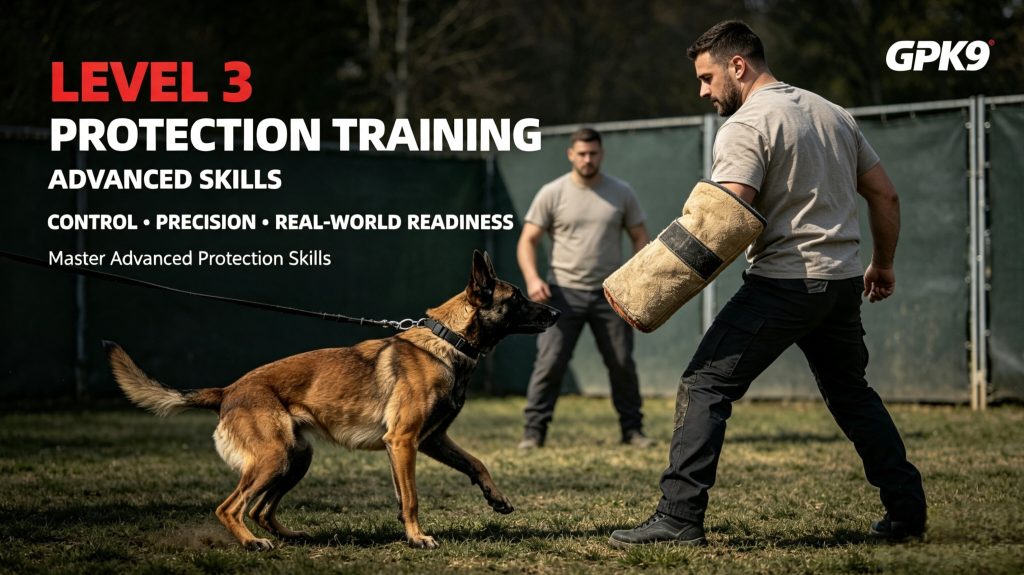
Advanced protection-dog training requires particular attention to control, stability, discrimination, safety and professional guidance. It is not simply a matter of encouraging a dog to chase or bite.
The GPK9 Approach to Professional Dog Training
GPK9 is built around the principle that effective training requires an educated handler as well as a learning dog.
Rather than focusing only on individual commands, GPK9 encourages owners and handlers to understand canine communication, motivation, behaviour and learning.
This approach helps the handler consider what is happening, why the dog may be responding in a particular way and what adjustment could improve the situation.
The key areas include:
- Communication: developing clear, consistent signals between dog and handler.
- Motivation: using appropriate rewards and activities to encourage engagement.
- Obedience: building attention, responsiveness and practical control.
- Behaviour: recognising the circumstances that influence a dog’s actions.
- Progression: increasing difficulty gradually as the dog demonstrates understanding.
- Consistency: applying suitable training principles across everyday situations.
GPK9 provides structured online training and educational support designed to help owners and handlers continue developing their knowledge and practical skills.
How to Choose the Right Dog Training Programme
The most suitable programme depends on your dog’s age, current ability and the skills you want to develop.
1. Identify Your Main Training Goal
Start by identifying the most important issue. You may want to establish puppy foundations, improve recall, develop obedience, improve lead walking or better understand a behavioural difficulty.
A clear objective makes it easier to choose relevant training rather than attempting to change everything at once.
2. Consider Your Dog’s Current Ability
A young puppy will have different needs from an adolescent dog or an experienced adult dog.
Training should reflect the dog’s current understanding, confidence and ability to concentrate. If an exercise becomes too difficult, return to a simpler stage before progressing again.
3. Choose a Structured Approach
Look for training that explains both what to do and why it matters.
Clear instructions, practical examples and a logical progression can help you understand how to apply the training outside a lesson.
4. Practise Consistently
Short, focused sessions can help build useful habits without placing unnecessary demands on the dog.
Consistency matters more than repeatedly practising an exercise without considering whether the dog understands it.
5. Recognise When Professional Assessment Is Needed
Some behavioural difficulties require individual assessment, particularly where fear, aggression, severe reactivity or unpredictable behaviour creates a safety concern.
Online education can help develop general knowledge, but it should not replace an appropriate professional assessment when one is needed.
Can You Learn Dog Training Online in Cardiff?
Yes. Online dog training education can provide a flexible way to learn training principles and practise skills with your dog at home and in suitable everyday environments.
GPK9 offers online training and educational resources covering puppy development, obedience, behaviour, socialisation and more advanced areas of canine handling.
Online learning allows owners to revisit instructions, practise at their own pace and build a consistent routine around their dog’s needs.
However, online training is not suitable for every situation. Dogs displaying aggression, serious fear or unpredictable behaviour may require individual professional guidance before training is continued.
The best approach is to choose a learning method that matches your dog’s needs, your experience and the level of support required.
Why Training the Handler Matters
A dog’s behaviour is influenced by more than the instruction being given. The handler’s timing, movement, consistency, reward delivery and response to the environment can all affect the outcome.
For example, a dog that responds reliably at home may struggle in a busy public area. Rather than assuming the dog is deliberately ignoring an instruction, the handler should consider whether the environment has become too challenging.
The handler may need to reduce distractions, adjust the distance, simplify the exercise or rebuild the behaviour in a more manageable setting.
Understanding these factors helps owners make informed decisions instead of repeatedly changing methods whenever progress slows.
At GPK9, the emphasis is on developing the handler’s understanding so that training decisions become clearer, more consistent and better suited to the individual dog.
Professional Dog Training in Cardiff and South Wales
GPK9 supports dog owners and handlers in Cardiff, South Wales and beyond through structured canine education and online training.
Whether you are starting with a puppy, improving everyday obedience, addressing training challenges or developing advanced handling knowledge, the aim is to provide a clear foundation for continued progress.
GPK9’s training resources cover a range of needs, from early development and everyday behaviour to specialist canine communication and working-dog education.
To explore the available programmes, visit the GPK9 website or view the Professional Dog Training Cardiff page.
If you need help deciding which programme may suit your dog, GPK9’s contact page provides details for enquiries and support.
Frequently Asked Questions About Dog Training in Cardiff
How do I start training my dog?
Begin by identifying your main goal and establishing a consistent routine. Start with manageable exercises, use appropriate rewards and gradually increase difficulty as your dog develops understanding.
Is professional dog training suitable for puppies?
Yes. Puppy training can help establish toilet habits, settling, socialisation, engagement and early obedience. Training should be adapted to the puppy’s age, confidence and development.
Can dog training improve recall and obedience?
Structured training can help develop recall, attention and obedience. Results depend on the individual dog, the training approach, consistency and the environments in which the skills are practised.
Can online dog training help with behavioural problems?
Online education can help owners understand common behaviour and learn general training principles. More serious concerns, including aggression, significant fear or unpredictable behaviour, may require individual professional assessment.
How long does dog training take?
There is no single timescale for every dog. Progress depends on the behaviour being taught, the dog’s previous experience, the difficulty of the environment and the consistency of practice. Reliable skills develop through gradual progression rather than a guaranteed number of sessions.
Start Your Dog Training Journey With GPK9
Professional dog training is about more than teaching commands. It is about understanding behaviour, improving communication and helping the handler make better decisions throughout everyday life.
From puppy foundations and obedience to behavioural education and advanced handling, GPK9 provides structured learning to help owners and handlers develop their knowledge and continue progressing with their dogs.
Train the handler. Train the dog. Build the partnership.
Explore GPK9’s professional dog training resources to identify a suitable starting point for you and your dog.