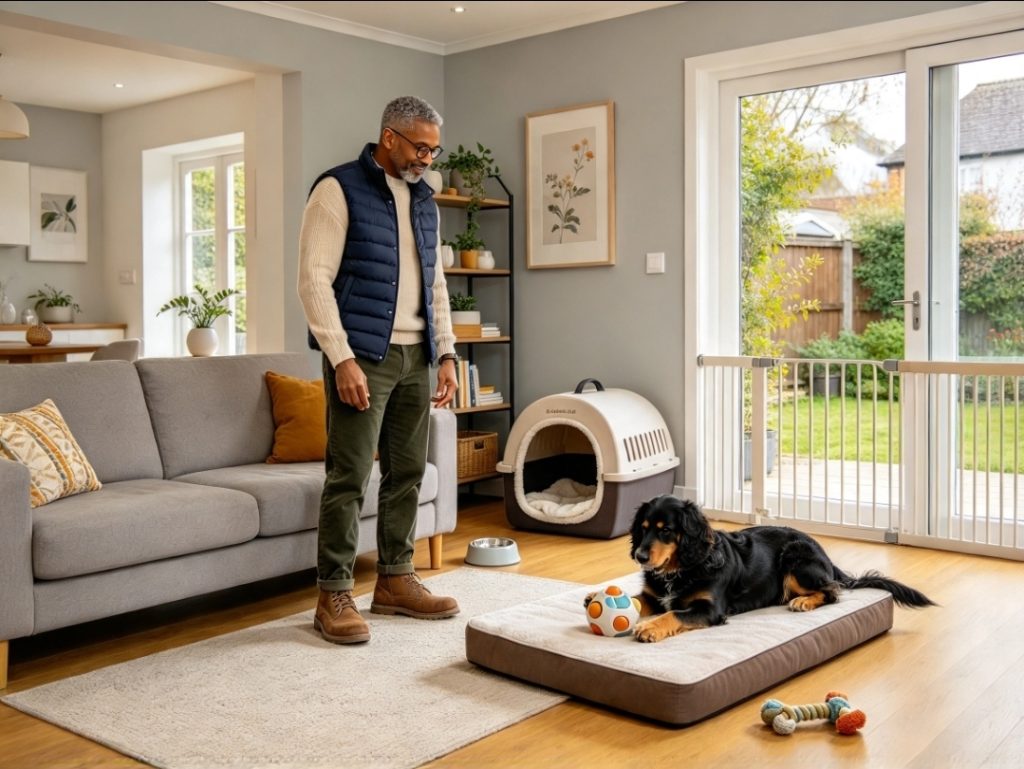
How do I stop my dog constantly following me?
How do I stop my dog constantly following me? If your dog follows you from room to room, gets up whenever you move, waits outside doors or seems unable to remain settled unless you are nearby, the first step is not simply to stop the dog from following. You need to understand why the dog is following, what happens when you move away, how much freedom the dog currently has and whether the dog can settle independently. The GPK9 PROFESSIONAL TRAINING SYSTEM approaches this through observation, status, drive, control, environmental management and reassessment.
RECOMMENDED PRODUCTS

Why does my dog constantly follow me?
Following a person around the home can happen for several different reasons.
Your dog may have learned that following you results in:
- Attention.
- Interaction.
- Food.
- Play.
- Access to another room.
- Access to interesting activity.
- Opportunities to investigate.
- Social contact.
- Something exciting happening.
Some dogs may simply have developed a habit of remaining close to their owner.
The important point is that following behaviour needs to be understood within the current situation.
Instead of immediately asking, “How do I stop my dog following me?”, start with:
What is my dog doing, what is happening around them and what happens when I move away?
Start with observation
The GPK9 decision process begins:
OBSERVE → INTERPRET → DECIDE → ACT → REASSESS
Before changing the behaviour, observe what happens when you move around the home.
Look at:
- Body posture.
- Facial expression.
- Ears.
- Tail.
- Movement.
- Orientation.
- Attention.
- Engagement.
- Arousal.
- Ability to settle.
- Responsiveness.
- Recovery.
- Environmental awareness.
- Social behaviour.
- Changes in behaviour.
- Learned criteria.
You are trying to determine whether your dog is simply choosing to follow you or whether they are becoming increasingly unsettled whenever you move away.
Is your dog following you calmly or becoming unsettled?
This distinction matters.
A dog that calmly gets up and walks into another room may simply be choosing to remain near you.
A dog that becomes increasingly agitated whenever you move may require a different level of management and assessment.
Observe what happens when you:
- Stand up.
- Walk across the room.
- Move into another room.
- Sit down again.
- Close an internal door.
- Begin preparing food.
- Pick up a toy.
- Put on your coat.
- Move towards the front door.
Look at the dog’s response.
Does the dog:
- Remain settled?
- Watch you and then relax?
- Get up immediately?
- Follow closely?
- Become increasingly excited?
- Vocalise?
- Scratch at a door?
- Lose the ability to settle?
- Remain unable to calm?
The behaviour you observe helps determine the appropriate response.
The GPK9 structure: CATEGORY → STATUS → DRIVE → CONTROL
Constant following primarily sits within the HOME & SOCIAL category because the behaviour occurs within the home environment and involves social behaviour, boundaries, settling and controlled freedom.
The next step is to consider the dog’s current status.
GREEN
The dog is able to remain calm and respond appropriately.
The dog may notice that you have moved but does not become significantly unsettled.
AMBER
The dog is beginning to struggle.
They may immediately get up, repeatedly follow you or find it difficult to settle again.
RED
The dog cannot reduce their arousal or cannot calm appropriately.
The situation needs to stop and be reduced before continuing.
The correct response therefore depends on what you observe rather than simply applying the same exercise to every dog.
Teach your dog that you can move without them
One important part of changing constant following is teaching your dog that your movement around the home does not automatically mean they need to get up.
This starts with very small situations.
For example, if your dog is settled appropriately on a placemat, you may stand up and move a short distance.
Observe the dog.
If they remain settled:
GREEN → OBSERVE → CONTINUE → PROGRESS
If the dog immediately gets up and follows:
OBSERVE → ASSESS
Then consider why they followed.
Was the movement too difficult?
Was the duration too long?
Was the dog already becoming aroused?
Was there another distraction?
Was the dog given too much freedom?
The answer determines what you should change.
Use a placemat to develop independent settling
The placemat is particularly useful because it gives the dog a clear location for remaining settled.
It can develop:
- Stationing.
- Duration.
- Settling.
- Calmness.
- Environmental awareness.
- Appropriate independence.
- Controlled behaviour while the owner moves around.
The objective is not to force the dog to remain completely still regardless of what is happening.
The objective is to teach the dog that they can remain appropriately settled while normal household movement occurs.
Start with a level the dog can manage.
Then gradually increase the challenge.
For example:
Dog settles → owner stands → dog remains calm → owner sits down.
Then:
Dog settles → owner takes a few steps → dog remains calm → owner returns.
Then:
Dog settles → owner moves further away → dog remains calm → owner returns.
Later:
Dog settles → owner moves into another part of the home → dog remains appropriately calm.
Progress should be based on the dog’s behaviour.
RECOMMENDED PRODUCTS
Do not keep increasing the distance if your dog is struggling
If your dog gets up immediately every time you move, repeatedly increasing the distance may simply rehearse the following behaviour.
Instead, reduce the difficulty.
You may need to:
- Take smaller steps.
- Reduce the duration.
- Reduce environmental distractions.
- Return to a closer distance.
- Use a more controlled environment.
- Allow the dog to calm.
- Re-establish settling.
- Reassess.
The aim is to create successful repetitions.
What if my dog gets up and follows me?
Do not automatically treat every instance of following as a failure.
Observe what happens.
If your dog gets up, follows you and remains calm, determine whether the current level of freedom is simply greater than the behaviour you are trying to establish.
If your objective is independent settling, calmly return to the appropriate training structure.
Avoid turning the situation into a chase, game or repeated confrontation.
The dog needs to learn that following you is not necessary simply because you have moved.
Reduce the reward for constantly following
Consider what happens after your dog follows you.
If following you regularly results in:
- Attention.
- Petting.
- Play.
- Food.
- Excitement.
- Access to something interesting.
then the behaviour may become more valuable to the dog.
This does not mean that you should ignore your dog indiscriminately.
Instead, make sure that attention and interaction are provided appropriately rather than allowing constant following to become the route to everything the dog wants.
Reward and motivation should support the behaviour you are trying to develop.
What role does food motivation play?
Food motivation can be relevant when developing engagement and settling.
The GPK9 system considers:
- Low Food Drive.
- High Food Drive.
If your dog has a high food drive, food can help support appropriate behaviour.
However, food should not automatically be used every time the dog follows you.
The objective is to develop the behaviour rather than create a situation where the dog only remains settled because they are continuously expecting food.
Observe the dog’s behaviour and use motivation appropriately.
What if my dog has high prey drive?
Some dogs are highly motivated by movement.
If your dog has high prey drive, your movement around the home may itself be interesting.
Walking away can become a trigger for the dog to follow.
In this situation, consider the dog’s:
- Movement sensitivity.
- Prey drive.
- Toy motivation.
- Arousal.
- Ability to calm.
- Existing level of control.
If following becomes a game, avoid turning your movement around the home into an exciting interaction.
The PLAY DRIVE AND PLAY area of the GPK9 system may provide supporting understanding where prey drive and movement contribute to the behaviour, but the primary category for constant following around the home remains HOME & SOCIAL.
Build independence through controlled freedom
The GPK9 HOME & SOCIAL pathway is:
CRATE → PLACEMAT → PLAYPEN
This pathway is not necessarily linear.
A dog can return to an earlier stage when required.
The purpose is to provide an appropriate level of control while developing behavioural responsibility.
CRATE
The crate provides a conditioned safe space for:
- Rest.
- Routine.
- Recovery.
- Resetting.
PLACEMAT
The placemat provides a location for:
- Stationing.
- Duration.
- Settling.
- Calmness.
PLAYPEN
The playpen provides:
- More space.
- Controlled freedom.
- A clear boundary.
- An opportunity to practise appropriate behaviour with increased freedom.
The central principle is:
MORE FREEDOM REQUIRES MORE BEHAVIOURAL RESPONSIBILITY.
Give your dog appropriate freedom rather than unlimited freedom
If your dog follows you constantly throughout the house, unrestricted access may be allowing the behaviour to continue repeatedly.
Controlled freedom gives you an opportunity to teach your dog that they do not have to follow every movement you make.
For example, your dog may be able to remain calmly within a playpen while you move around the room.
Later, the dog may be able to remain on a placemat while you move around the room.
Eventually, the dog may be able to choose to remain settled while you move around the home.
This progression should happen gradually.
Use the traffic-light system
GREEN — OBSERVE → CONTINUE → PROGRESS
Your dog remains calm while you move.
They may look at you but do not need to follow.
Continue the exercise.
When the behaviour is consistent, gradually progress.
AMBER — OBSERVE → ASSESS → REMOVE FROM DISTRACTION → CALM → REASSESS
Your dog starts struggling.
They may repeatedly get up, become increasingly attentive to your movements or lose their ability to settle.
Observe what changed.
Assess the situation.
Reduce the distraction or level of freedom.
Allow the dog to calm.
Then reassess.
If the dog returns to calm:
GREEN → CALM → CONTINUE → PROGRESS
RED — STOP → OBSERVE → ASSESS → REMOVE → CALM → REASSESS
If the dog cannot reduce their arousal or cannot calm appropriately:
RED → CANNOT REDUCE → CANNOT CALM → RETURN TO CRATE
Then:
RESET → HOME & SOCIAL → GREEN → OBSERVE → CONTINUE
The reset allows you to return to a level at which the dog can succeed.
Do not make your departures dramatic
If you are constantly trying to stop your dog following you by making your movements exciting, the dog may become even more interested in what you are doing.
Keep normal household movement calm and predictable.
Stand up.
Move.
Return.
Sit down.
Repeat at an appropriate level.
The dog gradually learns that your movement is part of normal household life rather than an event that requires immediate action.
Practise when your dog is already calm
Training is generally easier when the dog is already in an appropriate state.
If your dog has just finished an exciting activity and is highly aroused, asking them to remain settled while you repeatedly move around the home may be unnecessarily difficult.
First allow the dog to return to a suitable calm state.
Then practise.
This follows the GPK9 principle:
STATUS → DRIVE → CONTROL
The same exercise can produce different results depending on the dog’s current state.
What if my dog follows me to the bathroom, kitchen and bedroom?
This is a useful opportunity to assess the behaviour across different environments.
Do not automatically assume that the dog needs exactly the same response in every room.
The kitchen may contain food.
The hallway may contain movement.
The bedroom may be quieter.
The front door may predict walking.
Each environment can have different distractions and learned associations.
Observe where the following behaviour is strongest.
Then determine whether the environment itself is contributing to the behaviour.
Teach your dog that staying put can be rewarding
Calm behaviour should have value.
When your dog remains appropriately settled while you move, you can reinforce that behaviour in a suitable way.
The reinforcement should not create additional excitement.
The objective is:
CALM BEHAVIOUR → APPROPRIATE REINFORCEMENT → CONTINUE CALMNESS
If reinforcement causes the dog to immediately get up and follow you again, reassess how and when you are providing it.
The desired behaviour is calm independence, not repeated movement towards the owner.
What if my dog follows me because they want attention?
Consider whether attention has become part of the following pattern.
For example:
Owner stands → dog follows → owner talks to dog → dog receives attention.
If this happens repeatedly, the dog may learn that following is an effective way to start interaction.
Instead, create clear opportunities for interaction and clear opportunities for calm independent behaviour.
Your dog should learn that being near you does not always require active engagement.
What if my dog follows me everywhere but settles when I sit down?
This can indicate that your dog’s difficulty is particularly related to movement.
Observe what happens when you stand.
If the dog immediately gets up, start with very small movements rather than attempting to walk around the entire house.
For example:
Stand → pause → dog remains settled → sit.
Then:
Stand → one step → pause → return.
Then:
Stand → several steps → pause → return.
Progress only when the dog can remain appropriately calm.
When should I use the playpen?
The playpen can be useful when your dog needs more freedom than the crate provides but is not ready for unrestricted access to the home.
It creates a physical boundary while allowing the dog to move within a controlled area.
This can help teach:
- Calmness.
- Appropriate independence.
- Environmental awareness.
- Controlled freedom.
- Behavioural responsibility.
If your dog cannot cope with the amount of freedom available in the playpen, reduce the difficulty and return to an earlier stage.
When should I return to the crate?
If your dog becomes increasingly aroused and cannot settle, the crate can provide an appropriate reset.
The response is:
RED → CANNOT REDUCE → CANNOT CALM → RETURN TO CRATE
Allow the dog to recover.
Then:
RESET → HOME & SOCIAL → GREEN → OBSERVE → CONTINUE
The objective is not simply to put the dog in the crate whenever they follow you.
The crate is used as part of a broader management and reset system when the dog cannot appropriately reduce or calm.
A simple progression for reducing constant following
Stage 1 — Calm on the placemat
Teach the dog to settle appropriately while you remain nearby.
Stage 2 — Small movements
Stand up and move a short distance.
Stage 3 — Increase movement
Walk further away while the dog remains settled.
Stage 4 — Move around the room
Carry out normal household movements.
Stage 5 — Increase environmental difficulty
Introduce normal household distractions gradually.
Stage 6 — Increase freedom
Move from a more controlled environment towards greater freedom when behaviour supports it.
Stage 7 — Practise throughout the home
The dog gradually learns that your movement around the house does not automatically require them to follow.
At every stage:
OBSERVE → INTERPRET → DECIDE → ACT → REASSESS
Common mistakes
Giving the dog unlimited access
More freedom does not automatically create more independence.
Making following into a game
Repeatedly moving away, calling the dog back and interacting can accidentally increase excitement around your movement.
Increasing distance too quickly
If your dog cannot remain settled when you walk five steps away, walking into another room is probably too difficult at that stage.
Repeatedly correcting the dog
Constant correction does not teach the dog what they should do instead.
Teach an alternative behaviour such as appropriate settling.
Ignoring the dog’s status
A highly aroused dog may not be able to perform the same behaviour as a calm dog.
Failing to manage the environment
If every room contains something exciting, following may remain highly rewarding.
Confusing independence with isolation
The goal is not to make the dog avoid you.
The goal is to teach the dog that they can remain appropriately settled without constantly following your movement.
RECOMMENDED PRODUCTS
How do I know the training is working?
Look for changes in behaviour.
Your dog may begin to:
- Notice when you stand without immediately following.
- Remain on their placemat while you move.
- Watch you from a distance without becoming unsettled.
- Remain calm when you leave the room briefly.
- Return to settling after normal household movement.
- Become less dependent on your physical movement.
- Demonstrate greater behavioural responsibility.
- Accept gradually increasing levels of freedom.
- Recover more quickly when distractions occur.
Progress is not simply measured by whether the dog follows you once or twice.
Look for a consistent change in their ability to settle and remain appropriately independent.
When should I seek professional support?
If your dog’s following behaviour is accompanied by significant distress, persistent inability to settle, destructive behaviour, vocalisation, inability to recover or other concerning changes in behaviour, professional assessment may be appropriate.
The GPK9 system is designed to help you observe and structure training, but a training article is not a diagnostic assessment.
If you cannot understand what is causing the behaviour or cannot safely manage the situation, seek appropriate professional support.