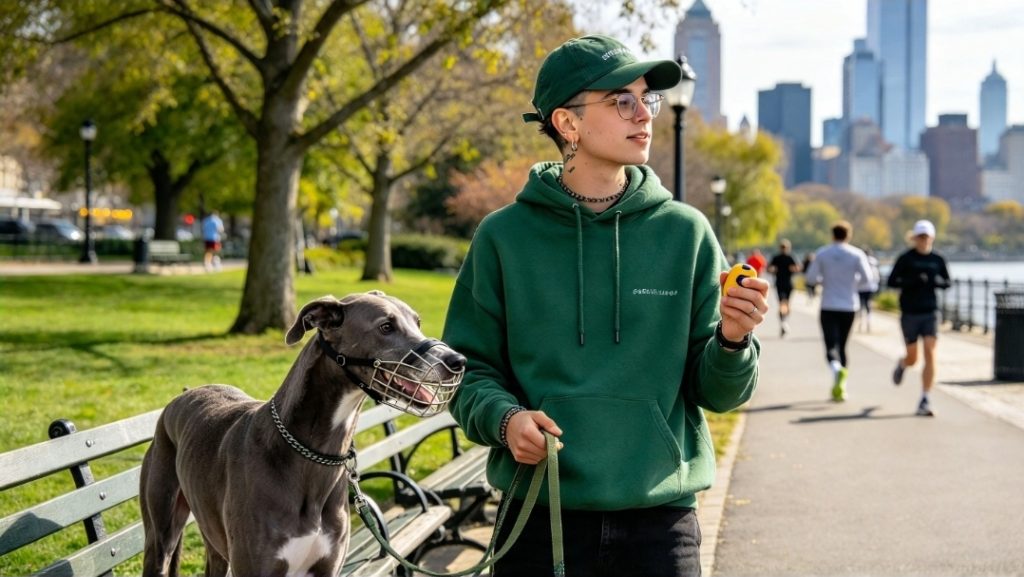
How Do I Train a Reactive Dog With High Food Drive, High Prey Drive and Resource Aggression?
How do I train a reactive dog with high food drive, high prey drive and resource aggression? This combination can be particularly difficult because the dog may have two extremely powerful motivators while also guarding one or both of them. Food may be highly valuable, toys may be highly valuable, and either resource may become associated with possession, conflict or aggression. Training therefore needs to consider reactivity, motivation, arousal, reinforcement, resource guarding and safety before deciding how rewards should be used.
RECOMMENDED PRODUCTS — TRAINING TREATS
What Is a Reactive Dog?
A reactive dog is a dog that responds excessively or intensely to a particular person, dog, animal, object, sound, movement or other trigger.
A reactive response can include barking, lunging, pulling, staring, freezing, growling, rushing towards a trigger or becoming extremely difficult to redirect.
Reactivity does not automatically mean aggression. A dog may react because of fear, frustration, excitement, high arousal, previous experiences or a combination of factors.
The starting point is to observe what happens before, during and after the reaction. Distance from the trigger, the environment, the dog’s current level of arousal and the dog’s individual motivation can all affect the behaviour.
When a dog also has high food drive, high prey drive and resource aggression, understanding the motivation behind the behaviour becomes particularly important.
What Does High Food Drive Mean?
High food drive describes a strong motivation towards food.
A dog with high food drive may show considerable interest in food, work enthusiastically for it and be willing to perform behaviours to obtain it.
This can make food a powerful reinforcer during training.
However, high food drive does not automatically mean that food can be used safely in every situation.
A dog can be highly motivated by food while also becoming possessive, defensive or aggressive when food is present.
This distinction is important because motivation and resource safety are two different things.
What Does High Prey Drive Mean?
High prey drive describes a strong motivation towards behaviours associated with pursuing, chasing, catching, grabbing or interacting with prey-like movement and objects.
A dog with high prey drive may become extremely interested in toys, tugging, chasing games or fast-moving objects.
This can provide another powerful source of reinforcement.
However, high prey drive can also produce high arousal.
A toy that is highly motivating may become much more than a simple training reward if the dog places a very high value on possessing it.
If the dog also displays resource aggression, the toy itself may become something the dog is prepared to guard.
Why Can This Dog Have Two Extremely Powerful Motivators?
A dog with high food drive and high prey drive may have two highly effective sources of motivation.
Food may produce a strong response.
Toys, movement, chasing or interactive play may also produce a strong response.
This can provide the handler with more potential reinforcement options than a dog with only one strong motivator.
However, having more motivation does not automatically make the dog easier to train.
The handler still needs to understand which reward is appropriate for the situation, how strongly the dog responds to it and whether the reward can be delivered and removed safely.
The most powerful motivator is not automatically the best training tool.
Can Food, Toys or Both Become Guarded Resources?
Yes.
A dog can guard food, toys or other resources that it considers valuable.
Resource guarding can involve becoming tense, freezing, staring, moving away with the resource, growling, snapping, lunging or biting when another individual approaches or attempts to interfere.
Some dogs may guard food but not toys.
Others may guard toys but not food.
Some dogs may guard both.
The important point is that high motivation does not automatically equal aggression. A dog can have high food drive without food aggression and high prey drive without toy aggression.
Resource aggression is a separate behavioural concern that requires appropriate assessment.
Why Doesn’t Having More Motivation Necessarily Make the Dog Easier to Train?
It may appear that a dog with high food drive and high prey drive should be easier to train because the handler has access to two powerful rewards.
However, the situation can become more complicated when those rewards are extremely important to the dog.
A highly valuable reward can increase motivation, but it can also increase arousal, frustration or possessive behaviour.
If the dog becomes aggressive when another person approaches the resource, the handler cannot simply assume that increasing the value of the reward will improve training.
The handler needs to consider what happens before the reward is delivered, while the dog has access to it and when the interaction with the resource ends.
The objective is not simply to make the dog want the reward more.
The objective is to use motivation in a way that supports safe and reliable behaviour.
Why Is Selecting Reinforcement Difficult When the Strongest Rewards May Create Conflict?
This is one of the most difficult parts of this combination.
The strongest food may also be the food the dog guards.
The most exciting toy may also be the toy the dog guards.
Using both may create even greater arousal or competition around resources.
This means the handler cannot simply follow the standard advice to use the dog’s favourite food or favourite toy without first considering the dog’s behaviour around that resource.
The correct reinforcement depends on the individual dog, the training environment, the trigger, the dog’s current arousal and whether the resource can be used safely.
A less powerful reward that can be delivered and controlled safely may sometimes be more appropriate than a highly powerful reward that creates conflict.
How Should Management Be Used?
Management should reduce opportunities for the dog to rehearse reactive behaviour and unsafe resource-related behaviour while an appropriate training strategy is being developed.
This means controlling the environment and carefully managing access to situations that are likely to produce an unsafe reaction.
Food, toys and other valuable resources should be managed according to the individual dog’s behaviour.
The handler should avoid creating unnecessary situations in which the dog feels it needs to defend a resource.
Management is not the same as solving the behaviour.
It creates safer conditions in which appropriate training can take place.
Why Is Distance Important When Training a Reactive Dog?
Distance can change how intensely a dog responds to a trigger.
A dog that reacts strongly when another dog, person or other trigger is close may be capable of observing the same trigger from a greater distance without reaching the same level of arousal.
This gives the handler more opportunity to observe what is happening, interpret the dog’s behaviour and make an appropriate decision before the dog loses control.
The objective is not to repeatedly expose the dog to a trigger until it reacts.
The objective is to work at a distance where the dog can still process information and respond.
If arousal continues to increase, the handler should reassess the situation rather than simply offering a more exciting reward.
How Should Reinforcement Be Controlled?
Reinforcement needs to be carefully controlled when food and toys are both highly valuable.
The handler needs to understand what behaviour is being reinforced, when reinforcement is delivered, how the dog responds to it and what happens when the reinforcement ends.
The dog should not be placed into unnecessary competition with the handler over food or toys.
The objective is not to repeatedly prove that the handler can take valuable resources away.
Instead, training should focus on predictable communication, appropriate behaviour and safe reinforcement procedures.
If a particular reward creates excessive arousal or resource conflict, another reinforcement option or different training arrangement may need to be considered.
The strongest possible reward is not always the correct reward.
The correct reinforcement is the one that can be used effectively without unnecessarily increasing risk or conflict.
What If Both Food and Toys Are Highly Valuable?
Having both food and toys available can provide flexibility, but it does not remove the need for careful decision-making.
One resource may be more appropriate in one situation and another resource may be more appropriate elsewhere.
For example, a reward that produces excessive arousal may not be suitable when the dog is already close to its threshold.
Similarly, a resource that the dog guards should not simply be introduced because it happens to be highly motivating.
The handler needs to consider motivation and safety together.
The question is not simply, “What does my dog value most?”
It is also, “What can I use safely and effectively in this situation?”
What Should I Do If My Dog Is Aggressive Around Food or Toys?
Resource aggression should not be treated as a simple obedience problem.
If the dog growls, snaps, lunges or bites when someone approaches food, toys or another valuable resource, the behaviour presents a genuine safety concern.
The handler should not deliberately provoke the dog by repeatedly taking resources away, reaching towards them or testing how much the dog will tolerate.
Professional behavioural support is appropriate when aggression is present.
A suitably qualified professional can assess the behaviour, identify the circumstances in which it occurs and help develop a management and training strategy that prioritises safety.
Where there is a history of biting or serious aggression, professional assessment is particularly important.
Can Food or Toys Still Be Used During Training?
Possibly, but this depends on the individual dog and the specific circumstances.
High food drive does not automatically mean food should be used everywhere.
High prey drive does not automatically mean toys should be used everywhere.
Resource aggression means that the safety of each reinforcement option needs to be considered before it is introduced or increased in value.
Where food or toys can be used safely, they may remain valuable parts of the training strategy.
Where a particular resource creates conflict, the strategy needs to be adapted rather than simply increasing the value of that resource.
The aim is to use motivation without unnecessarily increasing guarding, arousal or conflict.
How Do I Progress Towards Reliable Behaviour?
Reliable behaviour should be developed gradually.
The first priority is to reduce opportunities for the dog to rehearse reactive behaviour and unsafe resource-related behaviour.
The next priority is to identify situations in which the dog can remain sufficiently calm to observe, respond and learn.
Training can then build predictable responses around the handler, appropriate reinforcement and controlled changes in distance and environmental difficulty.
As the dog’s reliability improves, the difficulty can gradually increase.
This can involve working around more realistic distractions, changing distance from triggers, improving responses before arousal becomes excessive, developing reliable disengagement, improving handler timing and gradually introducing more challenging environments.
The value and type of reinforcement can also be adjusted according to the dog’s behaviour.
Progress should be based on the dog’s actual behaviour rather than an arbitrary timetable.
If increasing difficulty causes the dog to lose control, the training level needs to be reassessed.
RECOMMENDED PRODUCTS — Leads & Long Lines
Why Should I Avoid Creating Greater Conflict Around Resources?
The objective is not to win a battle over food or toys.
If every interaction involving a valuable resource becomes a struggle over possession, the dog may learn that the handler approaching the resource predicts conflict or loss.
That can make the existing problem more difficult.
Repeatedly taking resources away or deliberately interfering with a guarding dog can also create unnecessary opportunities for escalation.
A safer approach is to develop predictable communication and control without unnecessarily provoking the dog.
Where aggression is involved, the handler should not place themselves at unnecessary risk simply to demonstrate control over the resource.
What Is the Main Training Principle for This Combination?
A reactive dog with high food drive, high prey drive and resource aggression cannot be trained effectively simply by giving it more valuable rewards.
The dog may have two extremely powerful sources of motivation, but either or both may also be associated with guarding, conflict, high arousal or aggression.
The training strategy therefore needs to balance motivation, reinforcement, arousal, control and safety.
The strongest food or most exciting toy is not automatically the correct training reward.
Management, appropriate reinforcement, controlled training environments, distance from triggers and professional behavioural support where aggression is present provide a safer foundation for progress.
Reliable behaviour should be built progressively, using the dog’s motivation without unnecessarily increasing conflict around the resources that motivate the dog most.
GPK9 — The Five Golden Rules
The GPK9 Five Golden Rules provide the foundation of the GPK9 Professional Training System. They give new dog owners, new dog handlers, experienced handlers and professional dog trainers a clear structure for developing the dog and the handler together.
The GPK9 Five Golden Rules cover five essential areas of development: Home & Social, Obedience, Prey Drive, Toilet and Social Walking. Each area has its own purpose, but they are designed to work together as one complete training system.
The GPK9 approach is based on CATEGORY → STATUS → DRIVE → CONTROL and the handler’s ability to OBSERVE → INTERPRET → DECIDE → COMMUNICATE → OBSERVE RESPONSE → REASSESS. This gives the handler a consistent process for understanding what the dog is doing, why the behaviour is occurring, what level of control is appropriate and how to communicate effectively.
The purpose of the GPK9 Five Golden Rules is not simply to teach a collection of individual exercises. They are designed to develop the dog’s behaviour, motivation, communication, control and reliability while teaching the handler how to make better decisions.
Golden Rule One — Home & Social
Golden Rule One — Home & Social establishes the foundation for everyday life with the dog. It focuses on communication, boundaries, calm behaviour, household routines and appropriate behaviour around people, animals and normal activity.
The purpose of Golden Rule One — Home & Social is to help the handler understand the dog’s behaviour and recognise changes in arousal before they become larger problems. The handler learns to observe, assess and communicate rather than simply reacting after unwanted behaviour has already occurred.
Golden Rule One — Home & Social provides the foundation from which the handler can develop a calmer, more predictable and better-communicating dog.
Golden Rule Two — Obedience
Golden Rule Two — Obedience develops the dog’s ability to understand and respond to the handler’s communication.
The focus of Golden Rule Two — Obedience is not simply teaching commands. It is about developing understanding, reliability, timing, reward, release and control so the dog learns what the handler is communicating.
Through Golden Rule Two — Obedience, the handler learns to progress training appropriately, gradually increasing the dog’s freedom and responsibility as understanding and reliability improve.
Golden Rule Three — Prey Drive
Golden Rule Three — Prey Drive focuses on understanding and developing the dog’s natural motivation to chase, pursue, engage and work with an appropriate toy or prey-based reward.
The purpose of Golden Rule Three — Prey Drive is not simply to increase drive. The handler must learn how to recognise the dog’s level of motivation, select an appropriate reward and use timing, communication and control to channel that motivation productively.
Golden Rule Three — Prey Drive teaches the handler that motivation can become a powerful training tool when it is developed and controlled correctly.
Golden Rule Four — Toilet
Golden Rule Four — Toilet establishes reliable toilet habits through consistency, observation, timing, supervision and appropriate reinforcement.
The handler learns through Golden Rule Four — Toilet to recognise when the dog is likely to need the toilet, provide the correct opportunity and reinforce the desired behaviour.
The objective of Golden Rule Four — Toilet is to establish a predictable routine that helps the dog understand where and when toileting is appropriate while reducing opportunities for mistakes.
Golden Rule Five — Social Walking
Golden Rule Five — Social Walking develops the dog’s ability to walk calmly and appropriately in the real world while remaining connected to the handler.
The focus of Golden Rule Five — Social Walking is the relationship between the handler, the dog, the environment, distractions, distance and available control.
Through Golden Rule Five — Social Walking, the handler learns to observe body language, identify potential triggers, assess distance and recognise changes in drive or arousal before behaviour escalates.
The objective of Golden Rule Five — Social Walking is not simply to make the dog walk beside the handler. It is to develop a dog that can experience the outside world while remaining connected to the handler and capable of responding to clear communication.
How the Five Golden Rules Work Together
The GPK9 Five Golden Rules are designed to work together rather than being treated as five completely separate subjects.
Golden Rule One — Home & Social establishes the foundations for everyday behaviour and communication.
Golden Rule Two — Obedience develops understanding, responsiveness and control.
Golden Rule Three — Prey Drive develops motivation and teaches the handler how to channel natural drive appropriately.
Golden Rule Four — Toilet establishes essential household routine and reliability.
Golden Rule Five — Social Walking takes the communication and control developed through the other areas into the outside environment.
Together, the GPK9 Five Golden Rules help the handler develop a complete understanding of the dog rather than treating individual behaviours as isolated problems.
The overall objective of the GPK9 Five Golden Rules is to train the human, train the dog and build the partnership through clear observation, communication, appropriate control and progressive development.
A successful GPK9 handler learns to ask:
What is my dog doing?
Why is my dog doing it?
What is my dog communicating?
What level of control is appropriate?
How should I communicate with my dog?
What response did I get?
What should I do next?
This process forms the foundation of the GPK9 Professional Training System and allows the GPK9 Five Golden Rules to be applied consistently from the first stages of dog ownership through to advanced dog handling and professional training.