Why Does My Dog Suddenly Stop Responding?
Why does my dog suddenly stop responding? A dog may suddenly stop responding because the environment has become too distracting, the dog is too excited or worried to respond normally, it does not understand what is being asked, or something is affecting its ability to concentrate. A sudden change in responsiveness can also be caused by pain, illness or another health problem, so a noticeable unexplained change should not simply be treated as disobedience. The RSPCA advises contacting a vet when a dog’s behaviour changes because illness or injury can sometimes be involved.
Why Has My Dog Suddenly Stopped Listening?
There is a difference between your dog not knowing what to do and your dog being unable to respond in that particular situation.
Your dog may know a command well at home but struggle to respond when there are:
- Other dogs nearby.
- People approaching.
- Traffic or unusual noises.
- Strong smells.
- Exciting movement.
- New surroundings.
- Something frightening.
- Too much activity happening at once.
Dogs do not automatically transfer a learned behaviour from one environment to every other environment.
If your dog normally responds but suddenly cannot do so in a particular situation, first look at what has changed around the dog.
Can Distractions Make My Dog Stop Responding?
Yes.
A distraction can become more important to your dog than the behaviour you are asking for.
For example, your dog may immediately respond to its name in your living room but struggle to look at you when another dog is nearby.
This does not necessarily mean your dog has forgotten its name.
The environment may simply be too difficult at that moment.
Make the situation easier rather than repeatedly repeating the command.
Can Excitement Make My Dog Stop Responding?
Yes.
High levels of excitement can make it much harder for a dog to concentrate and respond normally.
You may notice your dog:
- Moving constantly.
- Pulling towards something.
- Jumping.
- Barking.
- Ignoring familiar cues.
- Taking longer to respond.
- Struggling to settle.
- Becoming increasingly focused on a person, dog, toy or object.
If your dog is becoming increasingly excited, reduce the intensity of the situation before asking for more difficult behaviour.
Can Fear or Stress Make My Dog Stop Responding?
Yes.
A worried dog may not respond normally because it is concentrating on what it considers threatening or uncomfortable.
Signs can include:
- Turning away.
- Avoiding eye contact.
- Lowering the body.
- Tucking the tail.
- Licking the lips.
- Yawning.
- Trying to move away.
- Hiding.
- Becoming very still.
The RSPCA identifies these types of body-language changes as possible signs that a dog is uncomfortable or worried.
If your dog appears worried, do not keep repeating commands in an attempt to force a response.
Create more distance from whatever is causing the problem and allow your dog an opportunity to recover.
Why Does My Dog Stop Responding Outside?
Outside environments contain far more information than most homes.
Your dog may be processing movement, smells, sounds, people, dogs, vehicles and other environmental changes at the same time.
Start training in an environment where your dog can respond successfully and gradually introduce more difficult distractions.
If your dog stops responding, return to an easier level rather than repeatedly testing the same difficult situation.
Why Does My Dog Respond at Home but Not Outside?
This is extremely common.
Your dog may have learned:
“Sit when asked in this environment.”
It has not necessarily learned:
“Sit regardless of where I am, what is happening around me and how distracted I feel.”
Take familiar behaviours into different locations gradually.
Practise first in quiet areas, then introduce slightly more distraction as your dog’s responses remain reliable.
What Should I Do When My Dog Suddenly Stops Responding?
First, stop increasing the difficulty.
Then:
- Stop repeating the command.
- Look at what has changed.
- Check your dog’s body language.
- Reduce distractions or increase distance.
- Give your dog time to settle.
- Use an easier behaviour your dog already knows.
- Reward the response when it happens.
- Continue only if your dog is able to cope.
If your dog still cannot respond, end the exercise and try again later in an easier environment.
Should I Repeat the Command When My Dog Ignores Me?
Repeatedly saying the same command is usually not the best solution.
If your dog has stopped responding, repeating the command several times does not necessarily make the behaviour clearer.
Instead, ask yourself why the response has stopped.
The problem may be the level of distraction, the dog’s emotional state, the difficulty of the exercise or a physical problem.
Reward-based training and consistency help dogs learn the behaviours you want. The RSPCA recommends rewarding good behaviour rather than shouting at or punishing dogs.
Could My Dog Be Ignoring Me Because It Does Not Understand?
Yes.
Sometimes a dog appears to ignore a command because the behaviour has not been trained thoroughly enough.
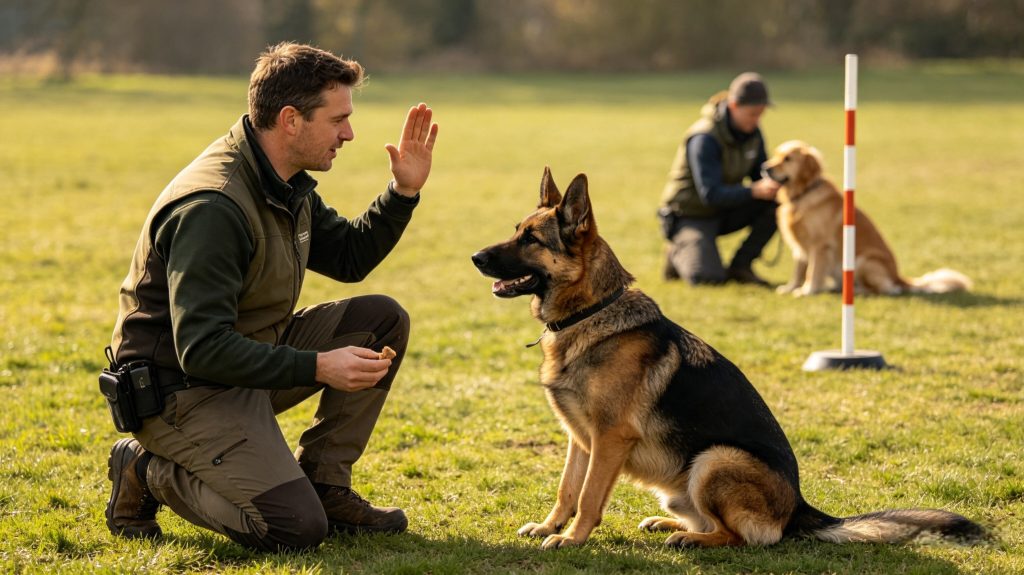
For example, your dog may respond when you are standing directly in front of it but not when you give the same cue from another position.
Return to a simpler version of the exercise.
Reward the correct response and gradually change one part of the situation at a time.
Could My Dog Stop Responding Because Training Is Too Difficult?
Yes.
Training should progress gradually.
If your dog succeeds consistently in one situation, that does not mean it is ready for a much harder environment.
Increase difficulty by changing factors such as:
- Distance.
- Duration.
- Distraction.
- Location.
- Movement.
- Other people.
- Other animals.
Change one major difficulty at a time where possible.
If your dog struggles, go back to the previous successful stage.
What If My Dog Stops Responding During a Walk?
Do not automatically assume your dog is being stubborn.
Look at what your dog is focused on.
If your dog has suddenly become very interested in something, increase distance from the distraction and wait for your dog to become more responsive.
If your dog looks worried, give it more space.
If your dog is highly excited, reduce stimulation.
If your dog returns to normal once the situation changes, the environment may have been the main reason for the temporary loss of responsiveness.
What If My Dog Stops Responding Around Other Dogs?
Other dogs can be extremely distracting or emotionally significant.
Your dog may stop responding because it wants to approach another dog, is frustrated about being unable to approach, or feels worried about the other dog.
Do not force your dog closer simply because it is not responding.
Increase distance until your dog can think, engage with you and respond again.
Then reward calm responses and gradually work towards more difficult situations.
What If My Dog Suddenly Stops Responding to Its Name?
If your dog normally responds to its name but suddenly stops, first consider the situation.
Your dog may be distracted, excited, worried or too far away.
However, if the change happens across normal everyday situations, particularly if your dog also seems less responsive to sounds, a health problem should be considered.
Hearing problems can affect how a dog responds to sounds and changes in behaviour should be discussed with a vet.
Could Pain or Illness Cause My Dog to Stop Responding?
Yes.
A dog experiencing pain or illness may behave differently, become less interested in normal activities or respond differently to familiar interactions.
A sudden unexplained change is therefore important.
The RSPCA notes that changes in behaviour can be an early sign of illness or pain and advises consulting a vet if you suspect your dog is suffering.
Do not assume a sudden behavioural change is simply a training problem.
What If My Dog Suddenly Becomes Unresponsive?
If by “unresponsive” you mean your dog is unusually difficult to wake, appears confused, collapses, has a seizure, shows abnormal breathing or otherwise seems seriously unwell, this is different from simply ignoring a training cue.
Seek urgent veterinary advice in that situation.
A sudden significant change in your dog’s normal behaviour should be taken seriously.
How Do I Prevent My Dog From Stopping Responding During Training?
Build reliability gradually.
Start where your dog can succeed.
Reward correct responses quickly and consistently.
Then introduce distractions gradually rather than moving immediately from a quiet room to a highly stimulating environment.
Your aim is to build a dog that can observe the environment, respond to you and remain capable of learning as distractions increase.
What Mistakes Should I Avoid?
Avoid:
- Repeating commands over and over.
- Shouting when your dog does not respond.
- Punishing your dog for failing to respond.
- Increasing difficulty too quickly.
- Assuming every failure is stubbornness.
- Ignoring signs of fear or stress.
- Continuing when your dog is clearly struggling.
- Treating a sudden unexplained behaviour change as purely a training issue.
Instead, work out why the response has stopped and adjust the situation accordingly.
When Should I Get Professional Help?
Seek professional help if your dog repeatedly stops responding in situations where it previously coped well, particularly if the behaviour involves fear, aggression, extreme excitement or difficulty recovering.
Speak to your vet if the change is sudden, happens across different situations or is accompanied by other changes in behaviour, appetite, movement, hearing or general health. The RSPCA recommends veterinary advice when a dog’s behaviour changes or when illness or injury may be involved.
Conclusion
If your dog suddenly stops responding, do not immediately assume it is ignoring you or being stubborn.
Look at the environment, distractions, emotional state and difficulty of the training. Reduce the challenge, give your dog time to settle and return to an easier behaviour that it can perform successfully.
If the change is sudden, persistent or accompanied by other unusual behaviour, rule out pain or illness with your vet before treating it as a training problem.