How Do I Know If My Dog Wants to Play?
How do I know if my dog wants to play? Look for loose, relaxed and playful body language combined with behaviour that actively invites interaction. A dog that wants to play may lower its front body, raise its bottom, wag its tail, move around energetically, bring you a toy or initiate interaction. The RSPCA identifies the raised-bottom “play bow” as a clear sign that a dog may want to play.
What Does a Dog That Wants to Play Look Like?
A playful dog may show several signs at the same time.
You may notice:
- A loose, relaxed body.
- A raised bottom with the front legs lowered.
- A wagging tail.
- Natural ear position.
- Bright, interested eyes.
- An open, relaxed mouth.
- Bouncy or exaggerated movements.
- Bringing you a toy.
- Running towards you and then away.
- Playful barking.
- Pawing at a toy or object.
- Encouraging you to chase or interact.
The overall combination of signals is more useful than one individual movement.
What Is a Dog’s Play Bow?
A play bow is one of the clearest behaviours associated with an invitation to play.
Your dog lowers the front part of its body while keeping its hindquarters raised.
The dog may then bounce forward, run around, bark or move away before returning.
The RSPCA describes this raised-bottom posture as a behaviour dogs use when inviting play.
A play bow can happen during interaction with people or other dogs.
Does a Wagging Tail Mean My Dog Wants to Play?
Not necessarily.
A wagging tail can occur in different emotional situations, so it should not be interpreted on its own.
A dog that wants to play may have a wagging tail alongside a loose body, relaxed face, natural ears and playful movement.
Compare that with a dog whose body is stiff, tense or trying to move away.
The RSPCA specifically advises looking at a dog’s wider body language rather than relying on a single signal.
How Do I Know If My Dog Wants to Play With Me?
Your dog may actively try to start an interaction.
It might:
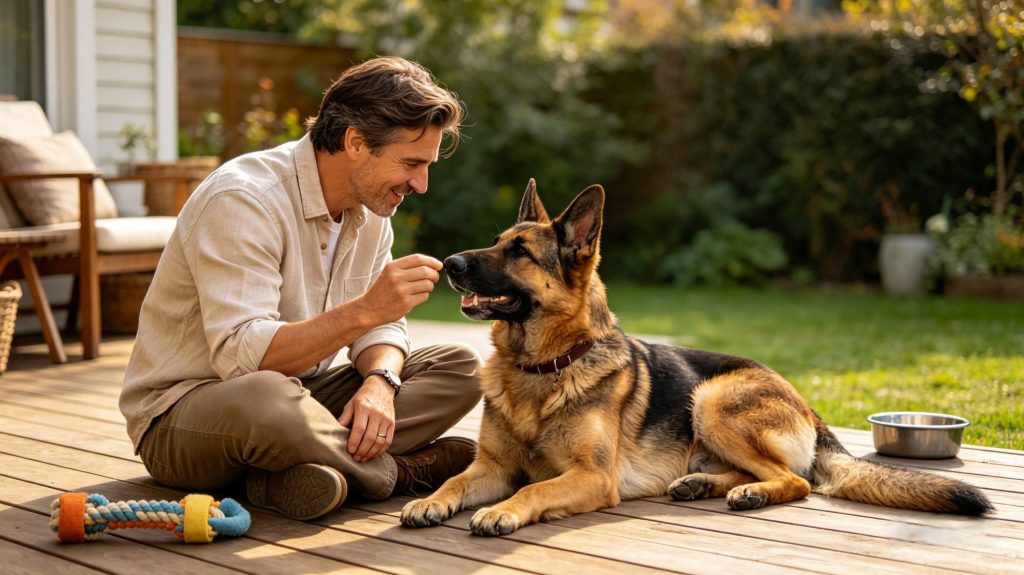
- Bring you a favourite toy.
- Drop a toy at your feet.
- Nudge the toy towards you.
- Paw at the toy.
- Perform a play bow.
- Bounce around you.
- Run away and return.
- Look at you and then at the toy.
- Bark excitedly.
- Move into a playful position.
If your dog repeatedly initiates these behaviours while remaining relaxed, it is reasonable to interpret them as an invitation to interact.
How Do I Know If My Dog Wants to Play With Another Dog?
Watch both dogs rather than focusing only on your own dog.
A dog that wants to play may approach with loose movement, perform a play bow, bounce around or repeatedly invite the other dog to interact.
The other dog should also appear comfortable with the interaction.
The RSPCA recommends allowing dogs to make their own choices during introductions rather than forcing interaction.
Play should be mutual.
If one dog repeatedly tries to move away, hide or avoid the other dog, do not assume it wants to continue playing.
What Does Healthy Dog Play Look Like?
Healthy play can involve running, chasing, wrestling, mouthing, changing direction and taking turns.
The dogs may become noisy and energetic without the interaction necessarily being aggressive.
Look for loose movement and changes in roles.
For example, one dog may chase another and then swap roles. They may pause, separate briefly and then choose to interact again.
The ability to pause and re-engage is useful information when assessing whether both dogs are comfortable.
How Do I Know If My Dog Is Enjoying Play?
Look at what your dog does after a brief pause.
A dog that is enjoying the interaction may choose to return, offer another play behaviour or remain interested in continuing.
A dog that wants the interaction to stop may move away, avoid the other dog, hide or display signs of discomfort.
Do not assume that a dog wants to continue simply because it started playing.
Keep watching throughout the interaction.
Can My Dog Want to Play but Become Too Excited?
Yes.
A dog can begin play in a relaxed way and then become increasingly excited.
You may notice:
- Faster movement.
- Louder barking.
- Jumping.
- Grabbing clothing.
- Rougher play.
- Ignoring familiar cues.
- Difficulty stopping.
- Inability to settle.
When this happens, reduce the intensity and give your dog an opportunity to calm down.
The aim is not to stop your dog enjoying play. It is to teach your dog that play has a beginning, an appropriate level of intensity and an end.
How Do I Stop Play Before My Dog Gets Too Excited?
Watch for the point at which your dog’s behaviour starts becoming less controlled.
Before your dog becomes completely overexcited:
- Pause the game.
- Give your dog space to settle.
- Reward calm behaviour.
- Resume at a lower intensity if appropriate.
- Finish the activity if your dog cannot settle.
The RSPCA recommends giving dogs clear signals for when play starts and finishes and using appropriate activities to help prevent frustration when play ends.
Should I Use Toys to Encourage My Dog to Play?
Toys can be useful if your dog enjoys them.
Different dogs prefer different types of play.
One dog may enjoy retrieving. Another may prefer tugging. Another may enjoy chasing a moving toy or searching for something.
You do not need to force a dog to play with a particular toy.
Find out what type of play your individual dog naturally enjoys.
The RSPCA recommends providing safe toys and regular opportunities for play with people or suitable dogs.
What If My Dog Does Not Want to Play?
Do not force it.
A dog may not want to play because it is tired, distracted, uncomfortable, stressed, unwell or simply not interested at that moment.
Give your dog another opportunity later.
You can also try a different activity, such as sniffing, exploring or calmly interacting with you.
Every dog has individual preferences, and not every dog will enjoy the same type or amount of play.
How Do I Know If My Dog Is Playing or Is Uncomfortable?
This is particularly important when dogs are interacting.
A playful dog will generally show loose and relaxed movement.
A dog that is uncomfortable may lower its body, avoid eye contact, turn its head away, lick its lips, tuck its tail or attempt to move away. These are among the signs the RSPCA identifies as potential indicators that a dog is worried or uncomfortable.
Do not encourage interaction simply because the dogs are close together.
Watch the body language of both dogs.
Can Barking Mean My Dog Wants to Play?
Yes, barking can occur during play.
Some dogs become very vocal when excited and may bark while bringing a toy, performing a play bow or running around.
However, barking alone does not tell you why your dog is barking.
Look at the rest of your dog’s behaviour.
A loose, playful body combined with an invitation to interact means something very different from stiff posture, avoidance or defensive behaviour.
Does My Dog Want Me to Chase It?
Sometimes.
A dog may run away with a toy and repeatedly return because it wants you to engage in a chase or retrieval game.
However, if your dog steals an object and runs away, chasing it can accidentally turn taking objects into a rewarding game.
For unwanted objects, teaching your dog to exchange or release them is more appropriate than automatically chasing.
How Do I Teach My Dog When Play Starts and Stops?
Use consistent signals.
You can introduce a clear cue that means play is beginning and another that means the activity is finished.
For example:
Play cue → play → pause → calm → finish cue.
Over time, your dog can learn that play is predictable and that the end of play does not mean something negative.
The RSPCA recommends using clear cues for the beginning and end of play, particularly for dogs that become frustrated when an enjoyable activity stops.
What If My Dog Becomes Too Rough During Play?
Pause the interaction before the behaviour becomes uncontrolled.
Avoid turning the situation into a confrontation.
Give your dog an opportunity to settle and then restart more calmly if appropriate.
If your dog repeatedly becomes excessively rough, bites hard, cannot stop or shows aggression during play, professional advice may be appropriate.
What If My Dog Wants to Play With a Dog That Does Not Want to Play?
Do not force the other dog to participate.
If the other dog moves away, repeatedly avoids your dog or shows signs of discomfort, increase distance and allow the dog to disengage.
Play should be voluntary and mutual.
Your dog wanting to play does not mean another dog has to accept the invitation.
When Should I Get Professional Help?
Seek professional help if you are unsure whether your dog’s behaviour is playful or aggressive, particularly if there is repeated growling, snapping, biting, stiff body language, fighting or significant fear.
The RSPCA advises seeking appropriate professional help for concerning behaviour and recommends speaking to a vet when there are significant behavioural changes or regular signs of stress or fear.
Conclusion
Knowing if your dog wants to play means looking for an active invitation combined with relaxed, playful body language.
A play bow, loose movement, wagging tail, toy presentation and playful interaction can all indicate that your dog wants to engage.
However, always look at the whole situation.
Play should be voluntary, enjoyable and mutual. If either dog becomes uncomfortable, overwhelmed or unable to disengage, reduce the interaction and give the dog space.