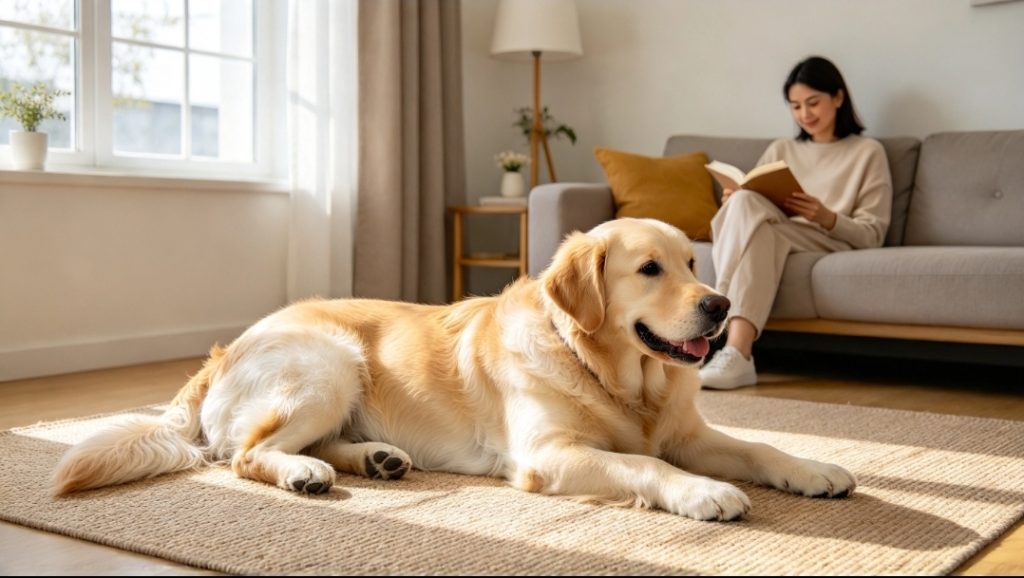
How Do I Know If My Dog Is Comfortable?
How do I know if my dog is comfortable? Look at your dog’s whole body, behaviour and response to the situation, rather than relying on one signal. A comfortable dog will generally appear relaxed, move naturally and be able to behave normally for that situation. Dogs communicate through posture, eyes, ears, mouth, tail and overall behaviour, so learning your dog’s normal relaxed behaviour is important.
RECOMMENDED PRODUCTS
What Does a Comfortable Dog Look Like?
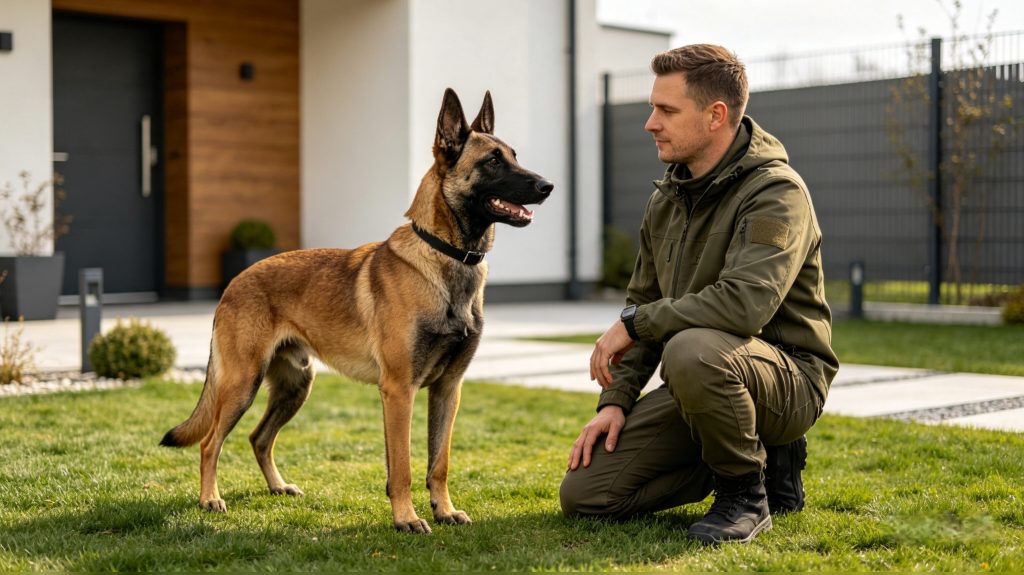
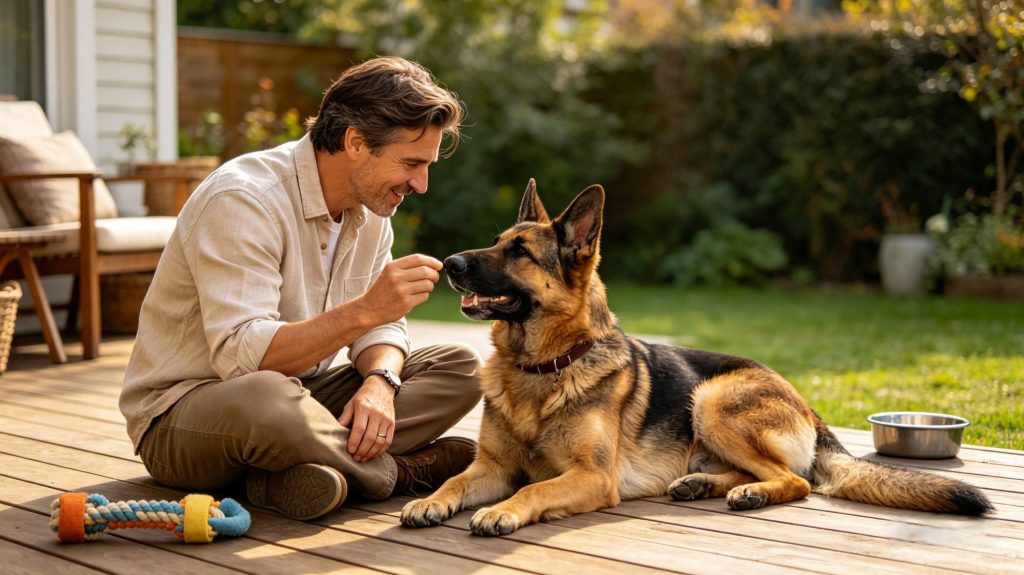
A comfortable dog will usually have a loose, relaxed body posture rather than appearing stiff or tense.
You may notice:
- A relaxed body.
- Natural ear position.
- Relaxed facial expression.
- Normal eye shape.
- A relaxed or naturally open mouth.
- Smooth fur.
- Natural movement.
- A tail position appropriate to the individual dog and situation.
- An ability to settle, explore or interact normally.
These signs should be considered together because individual dogs can communicate differently.
How Do I Know If My Dog Is Relaxed Around Me?
Look at how your dog behaves when nothing is demanding its attention.
A comfortable dog may choose to lie down, rest, explore, play, interact with you or simply remain nearby without appearing tense.
Your dog should not need to be constantly moving away, avoiding you or displaying signs of discomfort.
A useful starting point is to learn what your dog looks like when it is completely relaxed at home in a familiar environment.
That gives you a baseline for recognising changes in other situations.
How Do I Know If My Dog Is Comfortable Being Touched?
Do not assume that a dog wants to be touched simply because it approaches you.
Watch how your dog responds when you interact with it.
A comfortable dog may remain relaxed, move naturally towards you and choose to continue the interaction.
If your dog becomes stiff, turns its head away, avoids eye contact, licks its lips, lowers its body or attempts to move away, give it more space.
These can be signs that the dog is uncomfortable.
Allow your dog to communicate whether it wants the interaction to continue.
RECOMMENDED PRODUCTS
How Do I Know If My Dog Is Comfortable Around Other People?
Look at your dog’s overall response rather than whether it simply stays in the same area.
A comfortable dog may remain relaxed while a person approaches, move naturally, investigate at its own pace or choose to interact.
A dog that is uncomfortable may try to avoid the person, turn its head away, lower its body, tuck its tail, lick its lips or show other signs of worry.
If your dog is uncomfortable, increasing distance can be more appropriate than encouraging closer interaction.
How Do I Know If My Dog Is Comfortable Around Other Dogs?
Watch the interaction from beginning to end.
A comfortable dog should be able to move naturally rather than becoming increasingly stiff, tense or fearful.
Look for changes in posture, movement, facial expression and behaviour.
If your dog begins avoiding the other dog, repeatedly turns away, lowers its body, tucks its tail or becomes tense, the interaction may be becoming uncomfortable.
Do not force a dog to continue an interaction simply because it has already approached another dog.
How Do I Know If My Dog Is Comfortable on a Walk?
A comfortable dog should be able to walk, investigate its surroundings and respond to you without continually showing signs of distress.
Pay attention to changes when you enter different environments.
Your dog may be comfortable in a quiet area but become worried in a busy location with unfamiliar people, dogs, traffic or loud noises.
If your dog’s body becomes tense or it begins showing repeated signs of worry, increase distance from the situation or make the environment easier.
What Are Signs That My Dog Is Not Comfortable?
Signs of discomfort can include:
- Lowering the head or body.
- Avoiding eye contact.
- Turning the head away.
- Ears held back.
- Lip licking.
- Yawning in an appropriate context.
- Raising a front paw.
- Tucking the tail.
- Crouching.
- Trying to move away.
- Becoming stiff or tense.
These signals should be interpreted in context rather than individually. The RSPCA identifies several of these behaviours as signs that a dog may be worried or uncomfortable.
RECOMMENDED PRODUCTS
Is a Wagging Tail Always a Sign My Dog Is Comfortable?
No.
A wagging tail does not automatically mean that a dog is comfortable with what is happening.
Tail movement needs to be considered alongside the dog’s posture, facial expression, ears, movement and the situation.
The RSPCA’s guidance describes relaxed dogs as having a range of signals occurring together, rather than relying on the tail alone.
Look at the whole dog, not just the tail.
What Does It Mean If My Dog Suddenly Becomes Stiff?
A sudden stiffening of the body can be an important change in your dog’s behaviour.
It can indicate that your dog has become uncomfortable, highly alert or concerned about something.
Do not ignore the change simply because your dog has not barked or growled.
A slight change in posture may be an early indication that your dog needs more space. The RSPCA specifically advises paying close attention to subtle changes in body language.
How Can I Make My Dog More Comfortable?
Start by identifying what is making the situation difficult.
Then make the situation easier where possible.
This might mean:
- Increasing distance from a person, dog or other trigger.
- Reducing the level of noise or activity.
- Allowing your dog to move away.
- Giving your dog access to a quiet resting area.
- Rewarding calm behaviour.
- Avoiding forced interaction.
- Gradually introducing difficult situations rather than overwhelming your dog.
A suitable quiet resting space can also give a dog somewhere to relax undisturbed. The RSPCA recommends providing dogs with a calm, comfortable space where they can rest and feel secure.
RECOMMENDED PRODUCTS
Should I Force My Dog to Stay in an Uncomfortable Situation?
No.
If your dog is showing clear signs of discomfort, repeatedly forcing it to remain close to the thing worrying it can make the situation harder rather than teaching the dog to feel safe.
Instead, recognise the signal, create appropriate space and reassess.
Training should help your dog cope with situations progressively rather than repeatedly exposing it to something it cannot currently handle.
How Do I Know If My Dog Is Comfortable During Training?
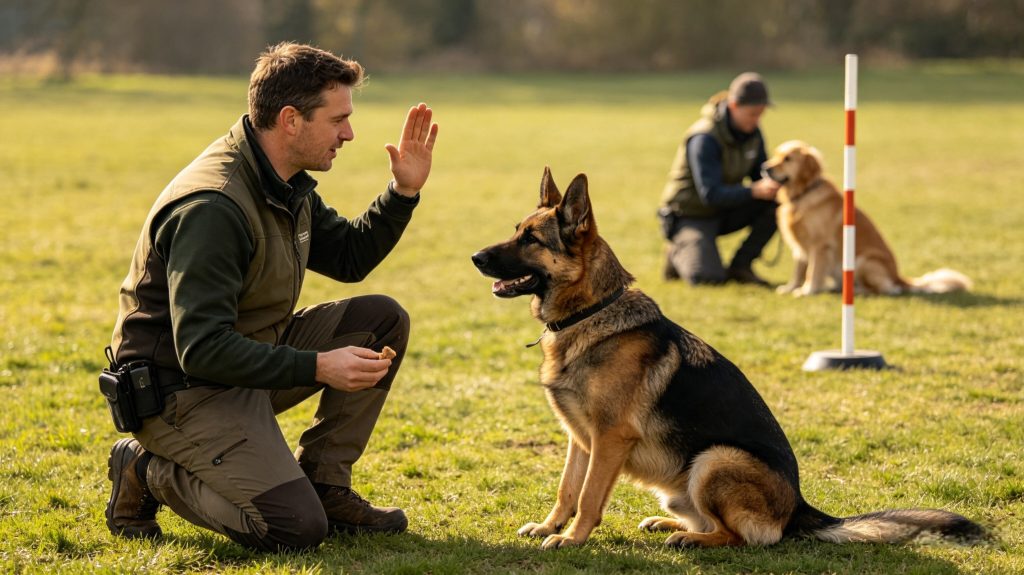
A comfortable dog should be able to participate without becoming increasingly overwhelmed.
Watch whether your dog can:
- Concentrate on you.
- Take an appropriate reward.
- Respond to familiar cues.
- Move naturally.
- Recover after a mistake.
- Remain reasonably relaxed.
- Continue learning.
If your dog becomes increasingly distracted, frustrated, fearful or unable to respond, the exercise may be too difficult.
Make the exercise easier before continuing.
How Do I Know If My Dog Is Comfortable in Its Own Home?
Look at how your dog behaves during normal household activity.
A comfortable dog should have opportunities to rest, move around, interact and retreat when it wants to.
Your dog should have a suitable resting area where it can relax without being disturbed.
If your dog is constantly hiding, pacing, unable to settle or repeatedly avoiding certain people or areas, investigate what may be causing the behaviour rather than assuming it is simply being difficult.
What If My Dog Seems Comfortable One Day but Not Another?
A dog’s behaviour can change depending on the environment, experiences, routine and circumstances.
Something that was manageable yesterday may be more difficult today if your dog is tired, stressed, excited or exposed to a more challenging environment.
Do not expect exactly the same response every time.
Instead, observe your dog on that particular occasion and adjust the difficulty accordingly.
What If I Cannot Tell Whether My Dog Is Comfortable?
Start by comparing the situation with your dog’s normal relaxed behaviour.
Ask:
Does my dog’s body look loose or tense?
Is my dog choosing to remain here or trying to leave?
Can my dog behave normally?
Has its behaviour changed since something happened?
Are several signs pointing towards relaxation or discomfort?
If you are still unsure, avoid forcing interaction and give your dog appropriate space while you observe what happens next.
RECOMMENDED PRODUCTS
When Should I Get Professional Help?
Seek professional advice if your dog regularly shows significant fear, aggression, extreme anxiety or difficulty coping in everyday situations.
If your dog’s behaviour changes suddenly or you suspect pain or illness may be involved, speak to your vet. Behavioural changes can sometimes be associated with an underlying health problem.
For serious behaviour concerns, appropriate professional assessment is safer than trying to interpret the problem through body language alone.
Conclusion
Knowing if your dog is comfortable means looking at the whole dog and the whole situation.
Learn what your dog looks like when relaxed, then watch for changes in posture, movement, facial expression and behaviour when the environment becomes more difficult.
If your dog appears comfortable, allow it to continue. If it shows signs of discomfort, listen to the communication, create appropriate space and reassess.
Understanding comfort is not about finding one perfect body-language signal. It is about learning to recognise your individual dog’s normal behaviour and noticing when that behaviour changes.
GPK9 — The Five Golden Rules
The GPK9 Five Golden Rules provide the foundation of the GPK9 Professional Training System. They give new dog owners, new dog handlers, experienced handlers and professional dog trainers a clear structure for developing the dog and the handler together.
The GPK9 Five Golden Rules cover five essential areas of development: Home & Social, Obedience, Prey Drive, Toilet and Social Walking. Each area has its own purpose, but they are designed to work together as one complete training system.
The GPK9 approach is based on CATEGORY → STATUS → DRIVE → CONTROL and the handler’s ability to OBSERVE → INTERPRET → DECIDE → COMMUNICATE → OBSERVE RESPONSE → REASSESS. This gives the handler a consistent process for understanding what the dog is doing, why the behaviour is occurring, what level of control is appropriate and how to communicate effectively.
The purpose of the GPK9 Five Golden Rules is not simply to teach a collection of individual exercises. They are designed to develop the dog’s behaviour, motivation, communication, control and reliability while teaching the handler how to make better decisions.
Golden Rule One — Home & Social
Golden Rule One — Home & Social establishes the foundation for everyday life with the dog. It focuses on communication, boundaries, calm behaviour, household routines and appropriate behaviour around people, animals and normal activity.
The purpose of Golden Rule One — Home & Social is to help the handler understand the dog’s behaviour and recognise changes in arousal before they become larger problems. The handler learns to observe, assess and communicate rather than simply reacting after unwanted behaviour has already occurred.
Golden Rule One — Home & Social provides the foundation from which the handler can develop a calmer, more predictable and better-communicating dog.
Golden Rule Two — Obedience
Golden Rule Two — Obedience develops the dog’s ability to understand and respond to the handler’s communication.
The focus of Golden Rule Two — Obedience is not simply teaching commands. It is about developing understanding, reliability, timing, reward, release and control so the dog learns what the handler is communicating.
Through Golden Rule Two — Obedience, the handler learns to progress training appropriately, gradually increasing the dog’s freedom and responsibility as understanding and reliability improve.
Golden Rule Three — Prey Drive
Golden Rule Three — Prey Drive focuses on understanding and developing the dog’s natural motivation to chase, pursue, engage and work with an appropriate toy or prey-based reward.
The purpose of Golden Rule Three — Prey Drive is not simply to increase drive. The handler must learn how to recognise the dog’s level of motivation, select an appropriate reward and use timing, communication and control to channel that motivation productively.
Golden Rule Three — Prey Drive teaches the handler that motivation can become a powerful training tool when it is developed and controlled correctly.
Golden Rule Four — Toilet
Golden Rule Four — Toilet establishes reliable toilet habits through consistency, observation, timing, supervision and appropriate reinforcement.
The handler learns through Golden Rule Four — Toilet to recognise when the dog is likely to need the toilet, provide the correct opportunity and reinforce the desired behaviour.
The objective of Golden Rule Four — Toilet is to establish a predictable routine that helps the dog understand where and when toileting is appropriate while reducing opportunities for mistakes.
Golden Rule Five — Social Walking
Golden Rule Five — Social Walking develops the dog’s ability to walk calmly and appropriately in the real world while remaining connected to the handler.
The focus of Golden Rule Five — Social Walking is the relationship between the handler, the dog, the environment, distractions, distance and available control.
Through Golden Rule Five — Social Walking, the handler learns to observe body language, identify potential triggers, assess distance and recognise changes in drive or arousal before behaviour escalates.
The objective of Golden Rule Five — Social Walking is not simply to make the dog walk beside the handler. It is to develop a dog that can experience the outside world while remaining connected to the handler and capable of responding to clear communication.
How the Five Golden Rules Work Together
The GPK9 Five Golden Rules are designed to work together rather than being treated as five completely separate subjects.
Golden Rule One — Home & Social establishes the foundations for everyday behaviour and communication.
Golden Rule Two — Obedience develops understanding, responsiveness and control.
Golden Rule Three — Prey Drive develops motivation and teaches the handler how to channel natural drive appropriately.
Golden Rule Four — Toilet establishes essential household routine and reliability.
Golden Rule Five — Social Walking takes the communication and control developed through the other areas into the outside environment.
Together, the GPK9 Five Golden Rules help the handler develop a complete understanding of the dog rather than treating individual behaviours as isolated problems.
The overall objective of the GPK9 Five Golden Rules is to train the human, train the dog and build the partnership through clear observation, communication, appropriate control and progressive development.
A successful GPK9 handler learns to ask:
What is my dog doing?
Why is my dog doing it?
What is my dog communicating?
What level of control is appropriate?
How should I communicate with my dog?
What response did I get?
What should I do next?
This process forms the foundation of the GPK9 Professional Training System and allows the GPK9 Five Golden Rules to be applied consistently from the first stages of dog ownership through to advanced dog handling and professional training.