How do I teach a puppy to sit?
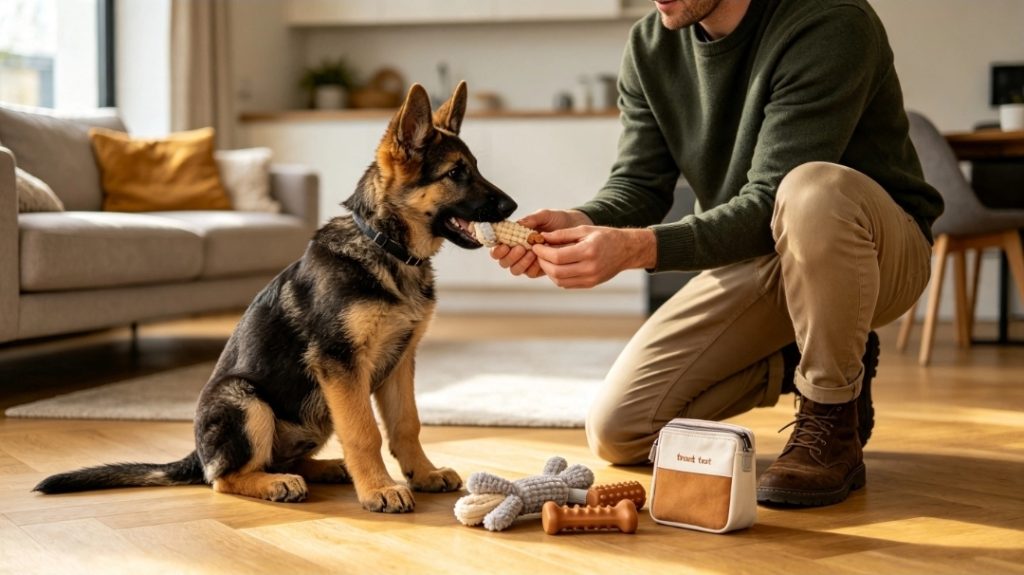
How do I teach a puppy to sit? Teaching a puppy to sit is one of the simplest ways to introduce structured obedience, engagement and communication between the puppy and handler. The aim is not simply to make the puppy put its bottom on the floor. The aim is to help the puppy understand what behaviour is being requested, learn how to respond to the handler and gradually build reliable behaviour in different situations. Start in a quiet environment where the puppy can focus, use food as motivation, observe the puppy’s response and progress gradually.
How do I teach a puppy to sit?
What does teaching a puppy to sit involve?
A puppy learning to sit is learning to respond to a specific piece of information from its handler.
The process involves:
- Creating an environment where the puppy can concentrate.
- Establishing engagement with the handler.
- Using an appropriate reward.
- Guiding the puppy naturally into the sitting position.
- Recognising the correct behaviour.
- Rewarding at the appropriate moment.
- Gradually introducing a verbal cue.
- Repeating the exercise without making the session repetitive or frustrating.
- Observing the puppy’s response.
- Progressing only when the puppy is ready.
The puppy does not need to understand everything immediately.
At the beginning, the handler is helping the puppy discover the behaviour and understand that responding appropriately produces a positive consequence.
Start with the right environment
A puppy can struggle to learn if there are too many distractions.
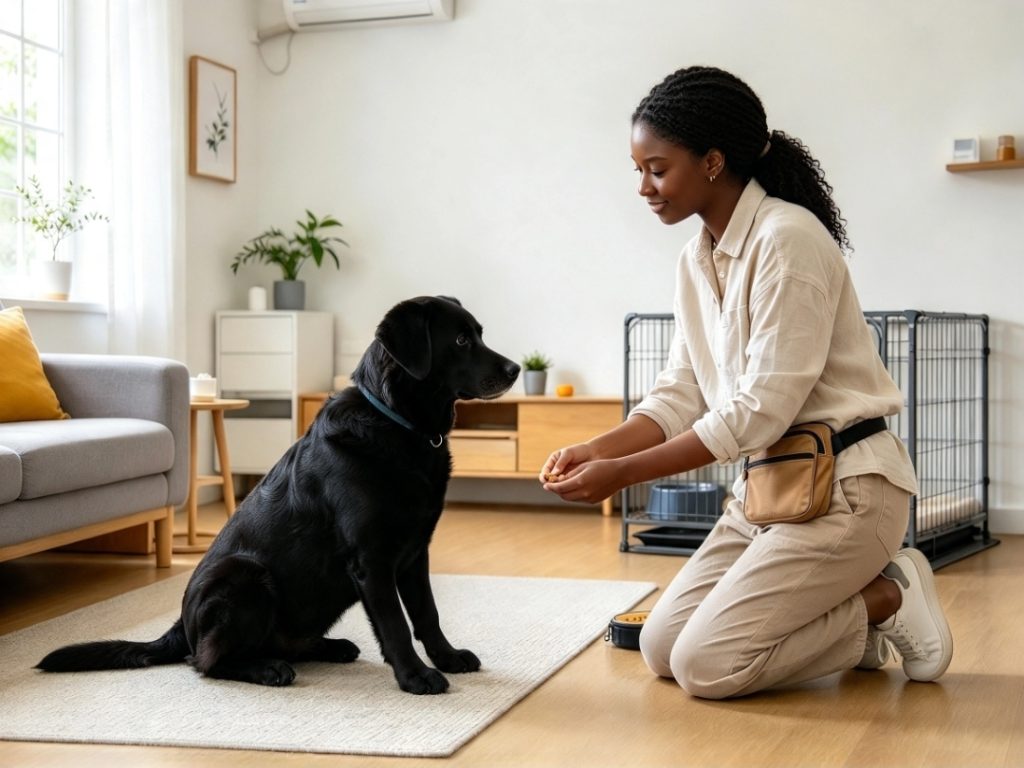
For the first sessions, choose a quiet area of the home where the puppy can:
- See the handler clearly.
- Smell the food reward.
- Move comfortably.
- Concentrate without unnecessary distractions.
- Remain calm.
- Respond without being overwhelmed by the environment.
This is where the GPK9 PROFESSIONAL TRAINING SYSTEM begins to become useful.
The relevant category is OBEDIENCE, because sitting is a structured behaviour taught through engagement, motivation, control and progression.
Before asking the puppy to perform the behaviour, observe the puppy’s current state.
Observe the puppy before training
Use:
OBSERVE → INTERPRET → DECIDE → ACT → REASSESS
Look at:
- Body posture.
- Facial expression.
- Ears.
- Tail.
- Movement.
- Orientation towards the handler.
- Attention.
- Engagement.
- Arousal.
- Ability to settle.
- Responsiveness.
- Recovery.
- Environmental awareness.
- Changes in behaviour.
- What the puppy has already learned.
A puppy that is calmly engaging with the handler may be ready to begin.
A puppy that is highly distracted, unable to settle or unable to respond appropriately may need the situation reduced before training continues.
The objective is not to force the puppy through the exercise.
The objective is to create a situation where the puppy can understand and respond.
Use food to create engagement
Food can be particularly useful when teaching a puppy to sit because puppies often naturally follow food with their nose and head.
Begin with a small food reward in your hand.
Allow the puppy to become interested in the reward.
Keep your movements calm and controlled.
The puppy should be encouraged to follow the food rather than being physically pushed into a sitting position.
As the puppy follows the reward, move your hand in a way that naturally encourages the puppy’s head and body to move into the sitting position.
When the puppy sits, reward immediately.
The timing of the reward matters.
The puppy needs to be able to connect the reward with the behaviour you want.
Do not physically force the puppy into position
Teaching a puppy to sit should not require physically pushing its body into position.
Instead:
- Use food to create motivation.
- Allow the puppy to move naturally.
- Observe what the puppy does.
- Reward the correct movement.
- Repeat calmly.
- Gradually introduce the cue.
This gives the puppy an opportunity to learn through understanding and repetition.
The handler is guiding the learning process rather than simply placing the puppy into a position.
Introduce the word “sit”
Once the puppy is beginning to offer the sitting behaviour reliably, introduce the verbal cue.
Say:
“Sit.”
Then guide the puppy into the position and reward the behaviour.
Over repeated sessions, the puppy begins to associate the word with the action.
The verbal cue should be clear and consistent.
Avoid repeatedly saying:
- “Sit, sit, sit.”
- “Sit down.”
- “Come on, sit.”
- “Please sit.”
Use one clear cue.
Give the puppy an opportunity to respond.
If the puppy does not respond, assess why rather than simply repeating the command.
Reward the correct behaviour
Reward timing is one of the important parts of teaching a puppy to sit.
The reward should follow the behaviour you want to reinforce.
For example:
Puppy sits → reward
This helps the puppy understand which behaviour produced the reward.
If the reward is delivered too late, the puppy may not clearly understand what it was being rewarded for.
As the puppy becomes more reliable, the handler can gradually reduce dependence on physically guiding the behaviour with the food.
Gradually reduce the food lure
Food can initially be used as a lure to help the puppy discover the movement.
However, the long-term objective is not for the puppy to sit only when it can see food directly in front of its nose.
Progress gradually.
A useful progression is:
Food guidance → hand movement → verbal cue → response → reward
The food remains useful as motivation and reinforcement, but the puppy gradually learns to respond to the cue rather than simply following a visible piece of food.
Do not remove the food too quickly if doing so causes the puppy’s response to deteriorate.
Observe the puppy and progress according to what the puppy can actually perform.
Consider the puppy’s food drive
The GPK9 PROFESSIONAL TRAINING SYSTEM considers relevant drive when deciding how to approach training.
For teaching a puppy to sit, the relevant drive is primarily food drive.
A puppy with high food drive may become extremely interested in the reward and move quickly.
A puppy with lower food drive may require a quieter environment, a different reward strategy or shorter training sessions.
The answer is not automatically to make the exercise harder.
First determine what is affecting the puppy’s response.
Ask:
- Is the puppy interested in the food?
- Is the puppy interested in the handler?
- Is the environment distracting?
- Is the puppy tired?
- Is the puppy too excited?
- Is the puppy calm enough to learn?
- Does the puppy understand what is being requested?
- Has the puppy learned the behaviour sufficiently to progress?
The puppy’s response tells you what to do next.
Keep puppy training sessions short
Puppies have developing attention and limited experience.
A training session does not need to be long to be useful.
Several short opportunities can be more appropriate than continually repeating the same exercise.
During a session:
- Observe the puppy.
- Ask for the behaviour.
- Reward the correct response.
- Give the puppy a break.
- Return to the exercise later.
- Stop while the puppy can still engage appropriately.
The goal is quality of learning rather than simply counting repetitions.
What if my puppy will not sit?
If your puppy will not sit, do not immediately assume that the puppy is being stubborn.
Use the GPK9 decision process:
OBSERVE → INTERPRET → DECIDE → ACT → REASSESS
Observe what is happening.
The puppy may:
- Not understand the cue.
- Be distracted.
- Have insufficient engagement.
- Be too excited.
- Be tired.
- Have low interest in the reward.
- Be responding to the environment rather than the handler.
- Need the exercise simplified.
- Need more time to learn the behaviour.
Interpret the situation before deciding what to change.
Then act accordingly.
You may need to:
- Reduce distractions.
- Improve engagement.
- Change the training environment.
- Adjust the food reward.
- Return to the food-guided movement.
- Shorten the session.
- Allow the puppy to calm.
- Reduce the difficulty.
- Reintroduce the exercise at an easier level.
Then reassess the puppy.
What if my puppy becomes too excited?
A puppy can become so interested in food or movement that it struggles to concentrate.
Look at:
- Speed of movement.
- Ability to focus.
- Ability to settle.
- Responsiveness.
- Recovery.
- Engagement with the handler.
If the puppy can still respond appropriately, continue at an appropriate level.
If the puppy is struggling, reduce the difficulty.
The relevant GPK9 status response is:
AMBER → OBSERVE → ASSESS → REMOVE FROM DISTRACTION → CALM → REASSESS
Once the puppy has returned to a suitable calm state:
GREEN → CALM → CONTINUE → PROGRESS
If the puppy cannot reduce or calm, stop trying to progress the exercise and return the puppy to an appropriate level of control and reset before attempting the behaviour again.
Progress from the quiet home environment
A puppy may learn to sit perfectly in one quiet room but struggle when the environment changes.
That does not necessarily mean the puppy has forgotten the behaviour.
The puppy may simply have insufficient experience performing the behaviour under different conditions.
Progress gradually.
For example:
Quiet room → different room → slightly more activity → garden → quieter outdoor area → more distracting environment
Only increase difficulty when the puppy can respond appropriately at the current level.
Do not change everything at once.
If you increase distance, distraction, duration and environmental difficulty simultaneously, it becomes much harder to understand why the puppy has struggled.
Teaching a puppy to sit around distractions
Once the puppy understands the behaviour, distractions can be introduced gradually.
Observe:
- People moving around.
- Household activity.
- Other dogs at a suitable distance.
- Outdoor sounds.
- New environments.
- Movement.
- Changes in handler position.
The important question is not simply whether the puppy can physically sit.
Ask whether the puppy can:
- Notice the handler.
- Engage.
- Respond to the cue.
- Maintain an appropriate level of arousal.
- Recover from distractions.
- Continue learning.
If the puppy can do this, the exercise may be ready for progression.
If the puppy cannot, reduce the difficulty.
Sit is not the same as stay
Teaching a puppy to sit does not automatically teach the puppy to remain sitting.
These are different behaviours.
A puppy may understand:
Sit → bottom touches the floor
without understanding:
Stay → remain in the position until released or given another instruction
Do not expect a newly learned sit to automatically become a long-duration stationary behaviour.
Build each requirement gradually.
How often should I practise sitting?
Use regular, short opportunities throughout the day rather than turning every interaction into a formal training session.
You can practise when appropriate during everyday routines.
For example:
- Before a meal.
- Before going through a doorway.
- During a quiet interaction.
- During a short training session.
- Before another appropriate activity.
The puppy should have a clear opportunity to respond.
The purpose is to develop understanding and reliability rather than repeatedly demanding the behaviour without a reason.
Do not overuse the sit cue
Once a puppy understands the word “sit”, avoid using it continuously.
If you repeatedly ask for a behaviour that the puppy cannot perform in the current environment, the problem may be the training situation rather than the puppy.
Instead:
OBSERVE → INTERPRET → DECIDE → ACT → REASSESS
Ask whether the puppy is actually in a suitable state to respond.
If not, reduce the situation and create a better opportunity for success.
Use appropriate control as the puppy progresses
Control should match the puppy’s current status and environment.
For structured obedience training, the GPK9 system allows control to progress according to the dog’s status.
When the puppy is in a suitable GREEN state, the emphasis can remain on appropriate engagement, learning and progression.
If the puppy moves into AMBER, the situation may need to be reduced and controlled more carefully.
If the puppy reaches RED, the activity should stop and the puppy should be removed from the situation so that calmness and reassessment can take place.
The equipment and environment should therefore support the puppy’s ability to learn rather than unnecessarily increasing difficulty.
How long does it take to teach a puppy to sit?
There is no single timetable that applies to every puppy.
Some puppies may begin offering the sitting movement very quickly.
Reliable responding to a verbal cue takes longer because the puppy needs to learn:
- What the cue means.
- What behaviour is expected.
- When to respond.
- How to respond around distractions.
- How to respond in different environments.
- How to remain engaged with the handler.
- How to recover when distracted.
Progress should therefore be based on the puppy’s actual behaviour rather than an arbitrary deadline.
What should I do when my puppy gets it right?
When the puppy responds correctly:
- Recognise the behaviour.
- Reward appropriately.
- Keep the interaction positive.
- Avoid immediately making the next repetition harder.
- Observe whether the puppy remains engaged.
- Progress gradually.
A successful repetition provides information.
If the puppy repeatedly succeeds, you may be ready to increase difficulty.
If the puppy begins struggling, reduce the difficulty.
This creates a cycle of:
OBSERVE → INTERPRET → DECIDE → ACT → REASSESS
A simple puppy sit training example
A practical first session could look like this:
Step 1 — Choose a quiet area
Use a calm part of the home with minimal distractions.
Step 2 — Prepare a suitable reward
Have small food rewards available and allow the puppy to become interested in them.
Step 3 — Build engagement
Allow the puppy to focus on you and the reward.
Step 4 — Guide the movement
Move the food in a controlled way that naturally encourages the puppy into the sitting position.
Step 5 — Reward immediately
When the puppy sits, deliver the reward.
Step 6 — Repeat calmly
Give the puppy a short break and repeat when appropriate.
Step 7 — Introduce the cue
Use the word “sit” consistently as the puppy begins understanding the behaviour.
Step 8 — Reduce the lure
Gradually move from visible food guidance towards responding to the cue.
Step 9 — Change the environment
When the puppy is reliable, introduce carefully controlled changes.
Step 10 — Reassess
If the puppy struggles, reduce the difficulty rather than simply repeating the cue.
RECOMMENDED COURSES
1. GOLDEN RULE 1 — HOME AND SOCIAL
This course is relevant when the puppy’s ability to learn is affected by the home environment, settling, boundaries, controlled freedom or calmness. The crate, placemat and playpen provide different levels of environmental management and can help create an appropriate learning environment.
2. GOLDEN RULE 2 — OBEDIENCE
This is the directly relevant course for teaching a puppy to sit.
It covers structured obedience, food motivation, engagement, control, suitable equipment, suitable environments and progression.
Teaching a puppy to sit fits directly into this area because the puppy is learning to engage with the handler, respond to a cue and perform a structured behaviour.
The traffic-light system can also help determine how to progress:
- GREEN: The puppy is calm, engaged and responding appropriately. Observe, continue and progress when appropriate.
- AMBER: The puppy is struggling. Observe, assess, reduce the distraction, allow the puppy to calm and reassess.
- RED: Stop the activity, observe, assess, remove the puppy from the distraction, allow calmness and reassess. If the puppy cannot reduce or calm, return to an appropriate reset before continuing.
3. GOLDEN RULE 3 — PLAY DRIVE AND PLAY
This course is relevant when toy motivation, prey drive or controlled play is being used as part of the puppy’s wider training development. It is not the primary course for teaching the sit behaviour through food motivation.
4. GOLDEN RULE 4 — TOILET
This course relates to toilet routine, location, toilet command, management, control and progression. It is not directly responsible for teaching the puppy to sit, although the wider training system connects the puppy’s different learning requirements.
5. GOLDEN RULE 5 — SOCIAL WALKING
This course covers calm social walking, IGNORE THE WORLD, environmental awareness, control, distractions, calmness and structured walking. It becomes relevant when the puppy needs to transfer its ability to respond calmly into walking environments.
What if the puppy sits but immediately gets up?
If the puppy sits and immediately stands again, first consider what you actually asked for.
If you asked for sit, the puppy may have completed the requested behaviour.
Do not automatically turn every sit into a stay.
If you want the puppy to remain sitting, that becomes a separate progression involving duration and control.
Build that requirement gradually rather than expecting the puppy to understand it automatically.
What if the puppy sits without being asked?
That can provide useful information.
The puppy may be beginning to understand that sitting produces a reward or positive interaction.
Observe the circumstances.
If the puppy offers the behaviour naturally, recognise and reward it when appropriate.
You can then begin developing the connection between the behaviour and the verbal cue.
The objective is to build understanding rather than simply waiting for a mechanically performed response.
When should I increase the difficulty?
Increase difficulty when the puppy is consistently:
- Engaged.
- Calm enough to learn.
- Responsive.
- Able to perform the behaviour.
- Recovering appropriately.
- Successful at the current level.
Progress one factor at a time where possible.
You might change:
- The room.
- Your position.
- The distance.
- The duration.
- The level of distraction.
- The environment.
If performance falls significantly, return to an easier level.
Progression should follow the puppy’s behaviour.
When should I stop the session?
Stop or reduce the exercise when the puppy can no longer engage appropriately.
Warning signs include:
- Increasing distraction.
- Reduced responsiveness.
- Difficulty settling.
- Excessive arousal.
- Loss of engagement.
- Repeated unsuccessful attempts.
- Slow or poor recovery.
This is where reassessment becomes more important than simply doing more repetitions.
The GPK9 approach is not about continuing regardless of the puppy’s state.
The puppy’s current status determines whether the activity should continue, be reduced or be stopped.
Building a reliable sit
A reliable sit develops through progressive learning.
The overall process can be understood as:
UNDERSTAND → ENGAGE → GUIDE → REWARD → REPEAT → CUE → REDUCE LURE → PROGRESS → REASSESS
The puppy first learns the movement.
Then the puppy learns the cue.
Then the puppy learns to respond without relying on a visible food lure.
Then the behaviour is gradually transferred into different environments and around appropriate distractions.
At every stage, the puppy’s current state should determine the next step.
Final practical checklist
When teaching a puppy to sit, remember:
- Start in a quiet environment.
- Build engagement with the puppy.
- Use suitable food motivation.
- Guide the puppy naturally into the position.
- Reward the correct behaviour immediately.
- Introduce the verbal cue clearly.
- Avoid physically forcing the puppy into position.
- Do not repeat the cue unnecessarily.
- Keep sessions short and productive.
- Observe the puppy’s body language and engagement.
- Consider the puppy’s food drive.
- Progress gradually.
- Introduce distractions carefully.
- Do not confuse sit with stay.
- Reduce the difficulty if the puppy struggles.
- Allow the puppy to calm when required.
- Reassess after making changes.
- Continue when the puppy is in a suitable state.
- Progress when the puppy is ready.
- Reset when continuing is no longer appropriate.
GPK9’S FIVE GOLDEN RULES
GPK9’S FIVE GOLDEN RULES. The GPK9 PROFESSIONAL TRAINING SYSTEM is divided into five accessible areas so that different parts of dog training can be learned in a structured, bite-sized way, with an individual course providing specific help for a particular training requirement while no single course represents the entire system. The five areas work together as one connected framework, allowing first-time dog owners and professional trainers to understand how different training requirements connect, learn progressively and apply the wider system rather than treating each problem in isolation. Although teaching a puppy to sit relates particularly strongly to the structured obedience requirements addressed in this article, that area remains part of the wider GPK9 system. Understanding all five areas provides the complete GPK9 framework and helps the reader understand the type of training question being asked, how the puppy’s situation should be considered, how the appropriate response is identified, how control and management are selected, how calmness and reassessment are handled, when a reset is required and how progression should take place. For a puppy learning to sit, this means understanding that the solution is not simply teaching a physical position; it involves considering the puppy’s current category, status, relevant drive, control, engagement, environment and ability to respond, then observing, interpreting, deciding, acting and reassessing so that training can continue and progress at an appropriate level.