How do I teach my dog to sit?
Teaching your dog to sit is one of the foundations of structured obedience. The aim is not simply to physically place your dog into a sitting position, but to help your dog understand the behaviour, connect it with a clear cue and learn that performing the behaviour appropriately produces reinforcement. GPK9 uses food motivation and luring as useful tools for developing understanding, while the dog’s current status, food drive, control, environment and responsiveness determine how the exercise should progress.
RECOMMENDED PRODUCTS
What does “sit” mean?
A sit means your dog moves into a seated position and remains there according to the criteria you have established.
Initially, the exercise may simply involve:
- Moving into the sitting position.
- Remaining there briefly.
- Receiving a food reward.
- Repeating the behaviour.
- Gradually responding to a cue.
As your dog develops understanding, the sit can become useful within many everyday situations.
It can support:
- Structured obedience.
- Controlled responses.
- Waiting.
- Calmness.
- Position changes.
- Handler communication.
- Progression into other exercises.
The important point is that the dog should learn what behaviour produces the reward.
Why won’t my dog sit?
A dog may struggle to sit for different reasons.
Your dog may:
- Not understand what you are asking.
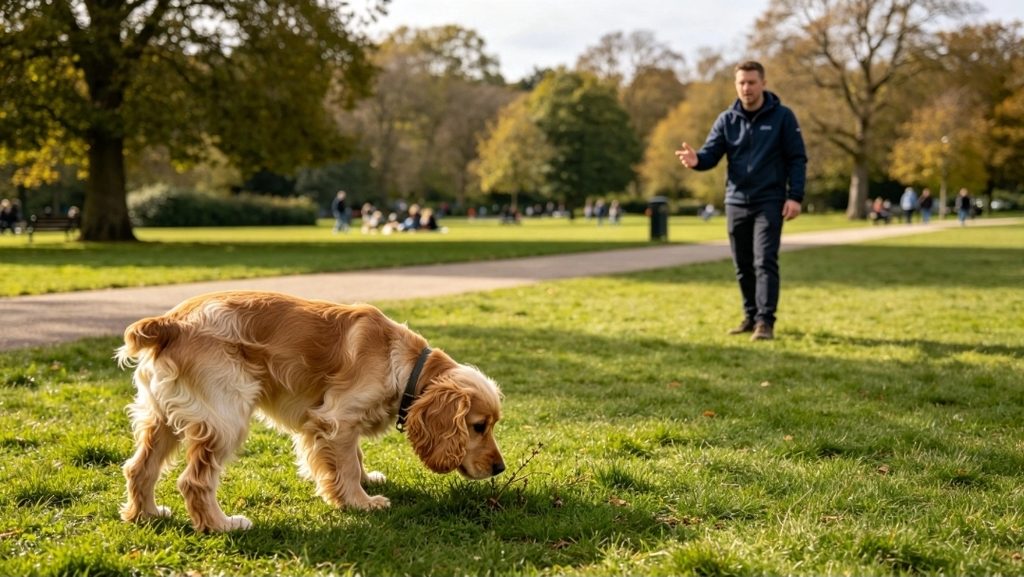
- Be distracted.
- Have low food motivation.
- Become over-excited by food.
- Be moving continuously.
- Find the environment too stimulating.
- Be physically uncomfortable.
- Have learned a different response to your cue.
- Be confused by inconsistent signals.
- Be asked to perform the behaviour for too long.
- Have progressed faster than its current ability allows.
Before changing the exercise, observe your dog.
Look at:
- Body posture.
- Facial expression.
- Ears.
- Tail.
- Movement.
- Orientation.
- Attention.
- Engagement.
- Arousal.
- Ability to settle.
- Responsiveness.
- Recovery.
- Environmental awareness.
- Social behaviour.
- Changes in behaviour.
- Learned criteria.
The GPK9 approach begins with understanding the dog’s current situation rather than simply repeating the cue.
Start in a quiet environment
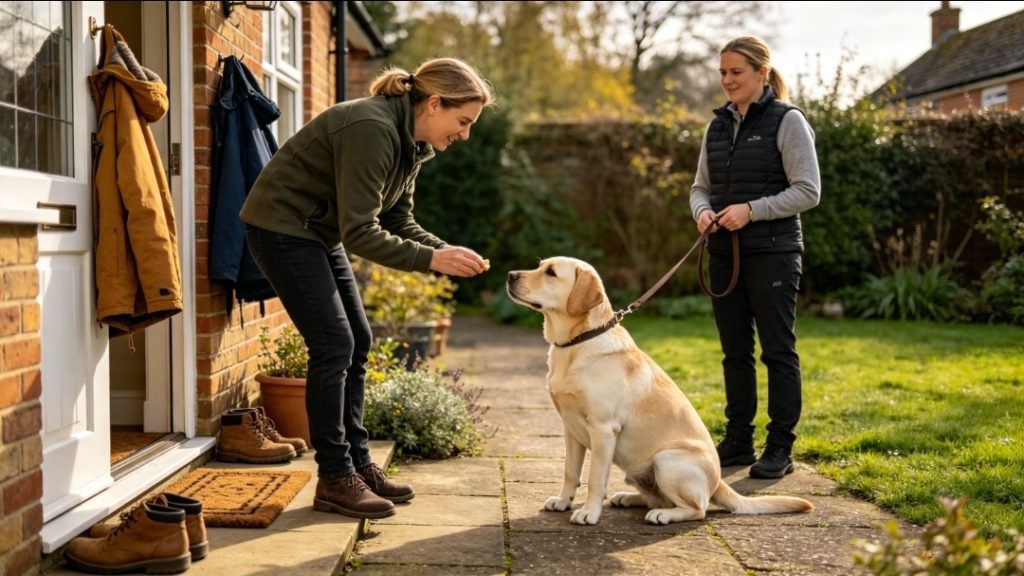
Begin somewhere your dog can concentrate.
A quiet area of the home is often useful because there are fewer competing distractions.
Have your food reward ready before beginning.
Then:
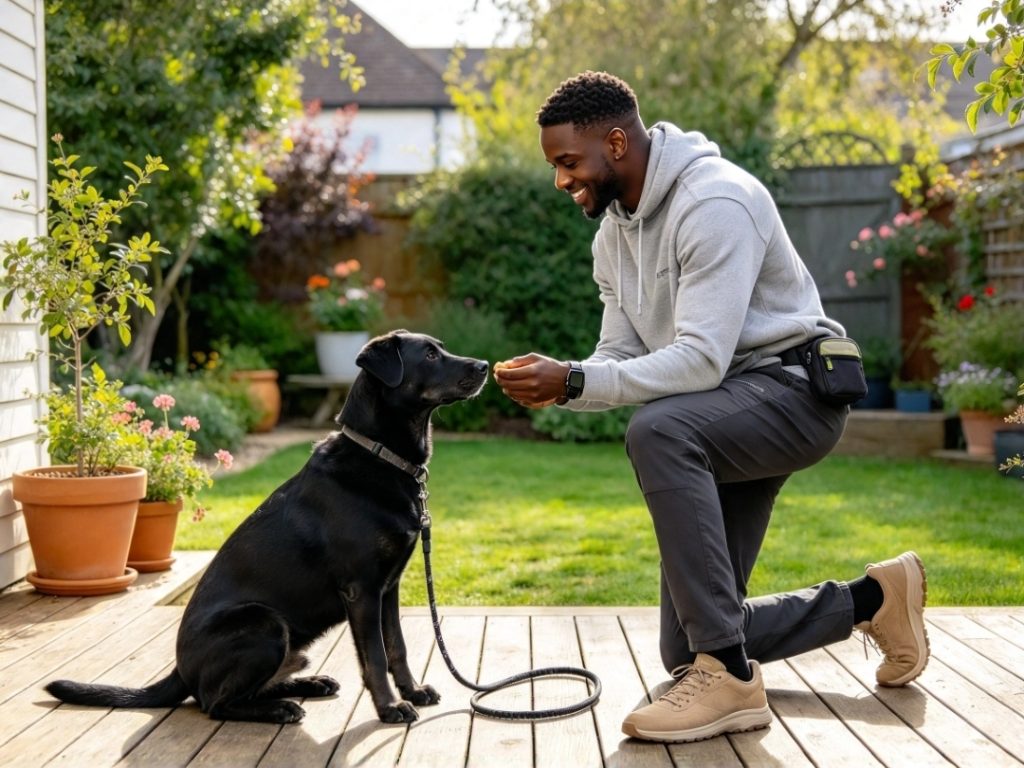
- Get your dog’s attention.
- Hold the food reward where your dog can see or smell it.
- Use the food to guide your dog into the sitting position.
- As the dog completes the sit, reward.
- Repeat.
- Observe your dog’s response.
- Gradually introduce the verbal cue.
- Progress when the behaviour becomes reliable.
Keep the initial exercise simple.
The objective is to establish understanding before adding significant distractions or distance.
Use food and luring
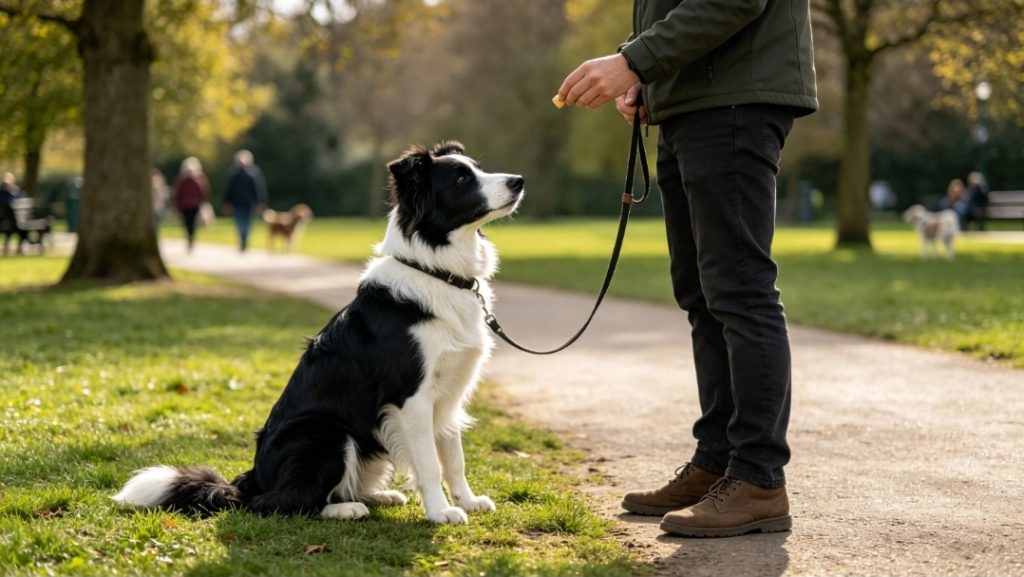
Food can provide motivation and make the movement easier for your dog to understand.
A simple lure can encourage the dog’s head and body to move into the correct position.
As the dog follows the food, the natural movement of the body can result in the sit.
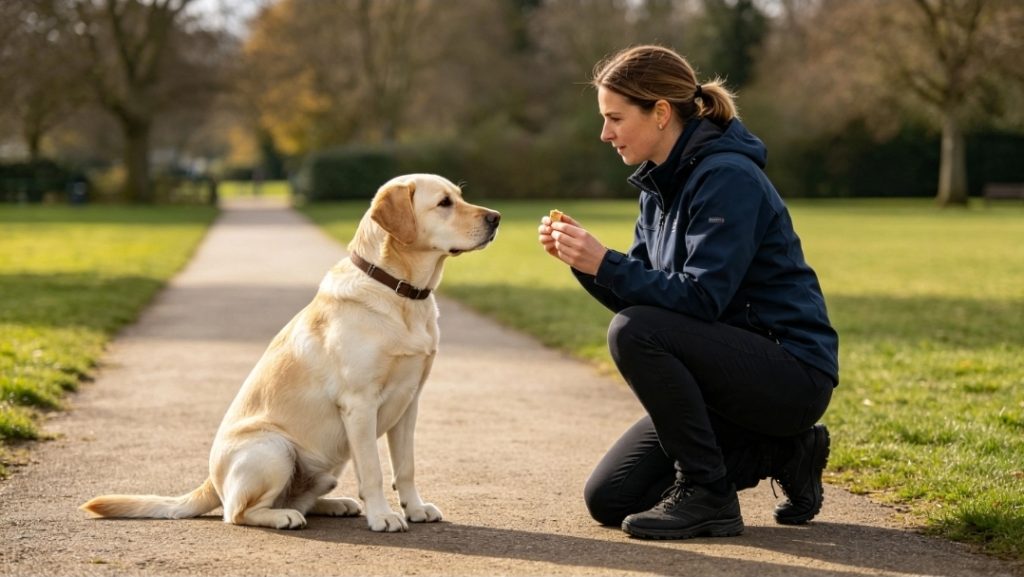
When the dog reaches the required position:
SIT → REWARD
The reward should be delivered at the appropriate moment so the dog can connect the behaviour with the reinforcement.
Timing matters.
If the reward is delivered after the dog has already moved out of position, the criteria may become unclear.
Introduce the verbal cue clearly
Once your dog is beginning to understand the movement, introduce a consistent verbal cue such as “sit”.
The sequence can become:
CUE → SIT → REWARD
Keep the cue clear and consistent.
Avoid repeatedly saying:
“Sit, sit, sit, sit.”
If the dog does not respond, observe what happened rather than simply repeating the cue louder.
Ask whether:
- The dog understood the cue.
- The dog was distracted.
- The dog was too excited.
- The lure was unclear.
- The environment was too difficult.
- The behaviour had been sufficiently reinforced.
Then adjust the exercise.
Gradually reduce dependence on the lure
Food can initially guide the movement, but the long-term objective is not for your dog to require a visible piece of food every time it sits.
As understanding develops, gradually reduce the physical movement of the lure.
You can progress from:
FOOD LURE → HAND MOVEMENT → VERBAL CUE → REWARD
The reward can remain part of the reinforcement process while the dog learns to respond to the cue itself.
The exact progression should depend on the dog’s understanding and responsiveness.
Reward the correct position
Your timing should clearly reinforce the behaviour you want.
When your dog reaches the correct sitting position:
- Mark the successful behaviour appropriately.
- Deliver the reward.
- Allow the dog to reset.
- Repeat.
Keep the exercise clear.
The dog should learn that sitting is what produces the reinforcement.
Teach the sit without physically forcing the dog
The GPK9 approach focuses on positive reinforcement, food and patience.
Avoid relying on physical force to push the dog into position.
The objective is for the dog to understand the behaviour and voluntarily perform it in response to the cue.
Food and luring can help the dog discover the movement while clear criteria and repetition develop understanding.
Keep the first sessions short
A young or inexperienced dog does not need a long obedience session to learn to sit.
Use short periods of training with successful repetitions.
For example:
- Ask for the sit.
- Reward.
- Reset.
- Repeat.
- Change the exercise slightly.
- Reassess.
Stop or change the activity when your dog begins losing concentration.
The objective is progressive learning rather than simply accumulating repetitions.
What if my dog gets too excited by food?
Food motivation can be useful, but a highly food-motivated dog may become over-aroused.
You may see:
- Jumping.
- Pawing.
- Snatching.
- Whining.
- Rapid movement.
- Difficulty concentrating.
- Repeated attempts to access the food.
If this happens, observe your dog’s state.
You may need to:
- Reduce the value of the reward.
- Slow the exercise down.
- Reduce distractions.
- Improve the clarity of the lure.
- Reward calmer behaviour.
- Allow the dog to settle.
- Reassess.
The objective is for food to support learning rather than make the exercise more difficult.
What if my dog has low food drive?
A dog with low food drive may not respond strongly to the reward you are offering.
Consider:
- The value of the food.
- The dog’s environment.
- The timing of training.
- Whether the dog is distracted.
- Whether the exercise is too difficult.
- Whether the reward is sufficiently motivating.
Do not automatically assume that the dog is refusing to learn.
Observe the whole situation.
The GPK9 system considers LOW FOOD DRIVE and HIGH FOOD DRIVE as relevant parts of the decision process for obedience training.
Gradually increase the difficulty
Once your dog understands the sit in a quiet environment, gradually introduce changes.
You can increase:
- Distance.
- Duration.
- Distraction.
- Environmental activity.
- Different locations.
- Handler movement.
Do not increase everything at once.
For example, if you introduce a new environment, keep the duration short.
If you increase duration, keep the environment relatively simple.
This gives your dog a better opportunity to succeed.
Teach your dog to sit in different environments
A dog that understands “sit” in your living room may not immediately respond in a busy outdoor environment.
Gradually practise in:
- Another room.
- The garden.
- Outside the home.
- A quiet public environment.
- Around controlled distractions.
- Different training locations.
Each new environment can change the difficulty.
If your dog struggles, reduce the criteria and rebuild.
What if my dog gets up immediately?
Initially, your dog may sit and then immediately stand.
This is not necessarily a problem if the exercise has not yet included duration.
First establish the movement.
Then gradually build the ability to remain seated.
You can progress from:
SIT → REWARD
to:
SIT → BRIEF REMAIN → REWARD
and gradually develop duration.
Do not expect a newly learned sit to automatically become a long-duration stay.
RECOMMENDED PRODUCTS
Teach the difference between sit and stay
A sit and a stay are related but different behaviours.
The sit describes the dog’s position.
The stay adds a requirement to maintain the position until released or until the next instruction.
For example:
SIT → REWARD
is different from:
SIT → STAY → REMAIN → RELEASE
Teaching the sit first can provide a foundation for later obedience exercises involving duration and control.
GPK9 DECISION PROCESS
The GPK9 decision process is:
OBSERVE → INTERPRET → DECIDE → ACT → REASSESS
OBSERVE
Look at:
- Body posture.
- Facial expression.
- Ears.
- Tail.
- Movement.
- Orientation.
- Attention.
- Engagement.
- Arousal.
- Ability to settle.
- Responsiveness.
- Recovery.
- Environmental awareness.
- Social behaviour.
- Changes in behaviour.
- Learned criteria.
INTERPRET
Consider what the dog’s behaviour means within the current situation.
Look at:
- Status.
- Food drive.
- Control.
- Environment.
- Distractions.
- Engagement.
- Calmness.
- Responsiveness.
- Recovery.
DECIDE
Determine whether to:
- Continue.
- Progress.
- Assess.
- Reduce the difficulty.
- Remove a distraction.
- Calm.
- Reassess.
- Stop.
- Reset.
ACT
Apply the appropriate:
- Training.
- Food motivation.
- Luring.
- Control.
- Management.
- Environment.
- Equipment.
- Calmness process.
REASSESS
Observe your dog again.
Ask:
- Did the dog understand?
- Did the dog remain responsive?
- Did the dog return to calmness?
- Can the exercise continue?
- Is the dog ready to progress?
If not, reduce the situation and reset.
GPK9 STATUS RESPONSE SYSTEM
GREEN — OBSERVE → CONTINUE → PROGRESS
Green indicates that your dog is in a suitable state for the exercise.
Your dog may be:
- Calm.
- Engaged.
- Responsive.
- Interested in the food.
- Able to perform the sit.
- Recovering quickly between repetitions.
The response is:
OBSERVE → CONTINUE → PROGRESS
Continue the exercise and gradually increase the criteria when appropriate.
AMBER — OBSERVE → ASSESS → REMOVE FROM DISTRACTION → CALM → REASSESS
Amber indicates that your dog is beginning to struggle.
The response is:
OBSERVE → ASSESS → REMOVE FROM DISTRACTION → CALM → REASSESS
You may need to:
- Reduce distractions.
- Reduce the difficulty.
- Change the environment.
- Reduce food excitement.
- Improve the lure.
- Allow the dog to calm.
- Reassess.
If calmness returns:
GREEN → CALM → CONTINUE → PROGRESS
If you cannot reduce the difficulty and the dog cannot calm:
RED → CANNOT REDUCE → CANNOT CALM → RETURN TO CRATE
RED — STOP WHAT YOU ARE DOING
If your dog cannot respond appropriately, stop what you are doing.
Use:
STOP WHAT YOU ARE DOING → OBSERVE → ASSESS → REMOVE FROM DISTRACTION → CALM → REASSESS
If your dog returns to an appropriate state:
RESET → OBEDIENCE → GREEN → OBSERVE → CONTINUE
If the situation cannot be reduced and your dog cannot calm:
RETURN TO CRATE
The crate provides a conditioned safe space for rest, routine and resetting.
Use appropriate control
Control should match the dog’s current status.
For obedience:
GREEN
Appropriate control may include:
- Short line.
- Harness.
- Long line.
- Free roam.
AMBER
Appropriate control may include:
- Short line.
- Muzzle where appropriate.
RED
Appropriate control may include:
- Short line.
- Muzzle where appropriate.
Equipment is used for appropriate management and control.
It does not replace the training itself.
Practise the sit during everyday routines
Once your dog understands the behaviour, the sit can become useful throughout normal life.
You can practise:
- Before food.
- Before opening a door.
- Before starting a walk.
- Before receiving a toy.
- During structured obedience.
- Before entering another area.
- During controlled interactions.
- During calm household routines.
The objective is not to ask for a sit constantly.
The objective is to develop a useful, reliable behaviour that your dog understands in appropriate situations.
RECOMMENDED PRODUCTS
Avoid asking for the sit unnecessarily
A cue should have meaning.
If you repeatedly ask your dog to sit when you know the dog is unlikely to respond, you may weaken the clarity of the behaviour.
Instead:
- Observe the environment.
- Choose an appropriate moment.
- Give the cue clearly.
- Reinforce success.
- Adjust difficulty when necessary.
Clear communication helps your dog understand what is expected.
How long does it take to teach a dog to sit?
There is no single timeframe that applies to every dog.
Learning can vary according to:
- Age.
- Previous training.
- Food drive.
- Environment.
- Distractions.
- Engagement.
- Handler timing.
- Consistency.
- Individual learning history.
Some dogs may begin offering a sit quickly, while others require more repetitions and environmental management.
The GPK9 approach focuses on the dog’s demonstrated behaviour rather than a fixed timetable.
When should I progress?
Progress when your dog consistently demonstrates:
- Understanding of the cue.
- Correct sitting position.
- Good engagement.
- Appropriate food motivation.
- Calmness.
- Responsiveness.
- Recovery.
- Consistency.
Then gradually introduce another level of difficulty.
If performance deteriorates, reduce the difficulty and rebuild.
RECOMMENDED COURSES
GOLDEN RULE 1 — HOME AND SOCIAL
This course focuses on the home and social environment, boundaries, controlled freedom, settling, calmness and the progression through CRATE → PLACEMAT → PLAYPEN.
It can support calmness and controlled behaviour around the home, but the sit itself is primarily an obedience exercise.
GOLDEN RULE 2 — OBEDIENCE
This is the most directly relevant Golden Rule for teaching your dog to sit.
It focuses on structured obedience, food motivation, engagement, control, suitable equipment and environments, and progression.
The sit provides a basic behaviour that can later support more advanced obedience exercises.
GOLDEN RULE 3 — PLAY DRIVE AND PLAY
This course focuses on prey drive, play, toy motivation, controlled play, handler control, calming, resetting and progression.
It can become relevant where toy motivation or high prey drive makes it difficult for your dog to remain engaged and responsive during obedience.
GOLDEN RULE 4 — TOILET
This course focuses on toilet routine, location, commands, management, control and progression.
Although teaching a sit is not primarily a toilet-training exercise, the wider GPK9 framework uses appropriate control, communication and progression across different areas.
GOLDEN RULE 5 — SOCIAL WALKING
This course focuses on calm social walking, IGNORE THE WORLD, environmental awareness, distractions, control, calmness and structured walking.
It can become relevant when you need your dog to remain responsive and controlled around environmental distractions.
GPK9’S FIVE GOLDEN RULES
GPK9’S FIVE GOLDEN RULES. The GPK9 PROFESSIONAL TRAINING SYSTEM is divided into five accessible areas, with each area dealing with a particular part of dog training while all five areas work together as one connected framework. An individual course can provide specific help with a particular training need, but no single course represents the entire system. The five areas are HOME AND SOCIAL, OBEDIENCE, PLAY DRIVE AND PLAY, TOILET, and SOCIAL WALKING — IGNORE THE WORLD. Understanding the complete system gives first-time owners and professional trainers a broader understanding of how different parts of training connect, while the bite-sized structure allows progressive learning. Teaching your dog to sit strongly relates to OBEDIENCE, because it involves food motivation, luring, engagement, clear communication, control, responsiveness and progression, while the other Golden Rules provide connected areas of the wider training framework. The complete GPK9 system determines how the subject is understood, how the dog’s current situation is considered, how the appropriate response is identified, what control or management is selected, how calmness and reassessment are handled, and when the dog should continue, progress or reset. Understanding all five Golden Rules provides the complete GPK9 framework while allowing the specific subject of teaching your dog to sit to be understood within the wider connections between obedience, motivation, control, calmness, environment, reassessment and progression.