How do I teach my dog to use a dog bed?
DOG CARE
RANK MATH DESCRIPTION
How do I teach my dog to use a dog bed? Learn how to build a positive association with the bed, encourage calmness and settling, establish clear boundaries, and gradually develop reliable use through the GPK9 training system.
FEATURED IMAGE DESCRIPTION
A professional, realistic dog-training scene inside a calm, comfortable home. A medium-sized young Labrador Retriever with a short chocolate-brown coat is lying comfortably on a supportive rectangular dog bed positioned in a quiet corner of a bright living room. The dog has a relaxed body posture, soft facial expression, natural ears and calm attention towards its handler. The handler is standing nearby with a small training pouch containing food rewards and calmly observing the dog. The dog bed should be clearly defined as a comfortable resting area, with enough space for the dog to stand, turn around and lie down comfortably. A sofa, doorway and normal household furniture should be visible in the background, creating a realistic home environment without excessive distractions. A few training treats can be visible in the handler’s hand or pouch. The scene should communicate positive association, calmness, rest, stationing, clear boundaries, food motivation and gradual progression. No text, logos, watermarks or branded colours.
How do I teach my dog to use a dog bed?
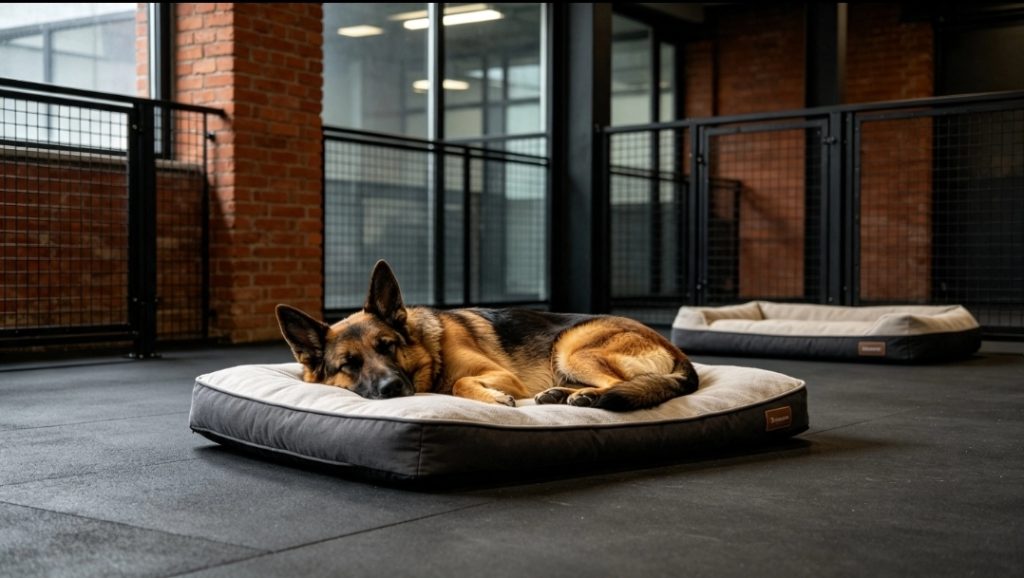
Teaching your dog to use a dog bed is about helping your dog understand that the bed is a comfortable, predictable place for rest and calm behaviour. The bed should become associated with positive experiences rather than being used as a place where the dog is simply sent away. Start by making the bed easy to access, reinforce appropriate interaction with it and gradually build calm duration. Within the GPK9 system, a dog bed can support rest and calmness while the placemat is specifically used for stationing, duration and settling. RECOMMENDED PRODUCTS — Dog Beds and Rest
Why won’t my dog use its bed?
Some dogs may ignore a new bed because they have not learned what it is for.
Your dog may:
- Prefer another resting location.
- Find the bed unfamiliar.
- Prefer a different surface.
- Be too excited to settle.
- Have learned that another location provides more attention.
- Find the bed too hot or uncomfortable.
- Be distracted by household activity.
- Have been repeatedly moved onto the bed without understanding why.
- Prefer sleeping near you.
- Have developed a habit of resting on furniture.
- Not yet understand the difference between a resting bed and a training station.
The first step is to observe the dog rather than assuming the dog is being difficult.
Consider:
- Where your dog naturally chooses to rest.
- Whether the area is quiet.
- Whether the bed is comfortable.
- Whether the bed is appropriately sized.
- Whether the environment is too busy.
- Whether the dog can settle.
- Whether food or toys create excessive excitement.
- Whether the dog has previously learned any criteria for the bed.
Choose the right location
Where you place the bed can make a significant difference.
Choose an area that allows your dog to rest without constant interruption.
Depending on your home, this may be:
- A quiet corner of the living room.
- Near the family’s normal activity but away from heavy foot traffic.
- Near the dog’s usual resting area.
- In a bedroom.
- In another calm part of the home.
The location should reflect the purpose of the bed.
A dog bed is primarily a resting resource.
A placemat, by comparison, can be used more deliberately for stationing, duration and settling.
Make the bed comfortable
Before training begins, consider whether the bed itself is suitable.
Your dog should be able to:
- Stand comfortably.
- Turn around.
- Lie down.
- Stretch naturally.
- Rest without being cramped.
Consider the bed’s:
- Size.
- Shape.
- Support.
- Material.
- Temperature.
- Position.
- Cleanliness.
If your dog consistently avoids the bed, check the physical setup before assuming the training is the problem.
Introduce the bed without pressure
Allow your dog to investigate the bed.
Your dog may:
- Look at it.
- Sniff it.
- Walk towards it.
- Touch it.
- Step onto it.
- Stand on it.
- Sit on it.
- Lie down.
These can all provide opportunities to reinforce appropriate interaction.
You do not need to immediately expect the dog to lie down for a long period.
Build understanding gradually.
Use food to create a positive association
Food can help your dog understand that appropriate interaction with the bed produces a positive outcome.
You can reinforce small stages.
For example:
APPROACH BED → STEP ON BED → REMAIN CALM → REWARD
As the dog becomes more comfortable, you can reinforce:
LIE DOWN → SETTLE → REMAIN CALM → REWARD
The reward should reinforce calm, appropriate behaviour rather than create excessive excitement.
If your dog becomes highly excited by food, reduce the difficulty and reassess.
Don’t force your dog onto the bed
Physically placing your dog onto the bed does not necessarily teach the dog why it should use it.
The objective is for the dog to develop an understanding and positive association with the bed.
Use:
- Food.
- Patience.
- Clear criteria.
- Calm reinforcement.
- Gradual progression.
Allow your dog to learn what behaviour produces the reward.
Build duration gradually
Once your dog is comfortable getting onto the bed, gradually build the amount of time it remains there.
Start with a short period.
Then:
- Reward.
- Repeat.
- Gradually increase duration.
- Observe the dog’s behaviour.
- Reassess.
- Progress when appropriate.
If your dog gets up immediately, reduce the duration.
The objective is not to make the dog remain on the bed for as long as possible.
The objective is to develop calm, voluntary use of the bed.
Reward calmness
Look for calm behaviour.
This may include:
- Lying down.
- Relaxed muscles.
- Soft facial expression.
- Reduced movement.
- Calm breathing.
- Quiet observation.
- Remaining on the bed.
Reward these behaviours.
If the dog is repeatedly jumping up, pawing, biting the bed or becoming excited, consider whether the reward or environment is increasing arousal.
The GPK9 system requires you to observe the dog’s state before deciding what to do next.
Teach the difference between a bed and a placemat
A dog bed and placemat can have related but different purposes.
DOG BED
A dog bed can provide:
- Rest.
- Comfort.
- Sleep.
- A predictable resting location.
- A comfortable place to relax.
PLACEMAT
The GPK9 placemat is associated with:
- Stationing.
- Duration.
- Settling.
- Controlled behaviour.
- A defined training location.
Both can support calmness, but they do not need to be treated as identical resources.
How the dog bed fits into the GPK9 HOME & SOCIAL system
The GPK9 HOME & SOCIAL pathway is:
CRATE → PLACEMAT → PLAYPEN
The crate is a conditioned safe space for:
- Rest.
- Routine.
- Resetting.
The placemat is used for:
- Stationing.
- Duration.
- Settling.
The playpen provides:
- Controlled freedom.
- A defined boundary.
- Increased behavioural responsibility.
A dog bed can support the resting side of this system, but it does not replace the specific function of the placemat.
The central principle remains:
MORE FREEDOM REQUIRES MORE BEHAVIOURAL RESPONSIBILITY.
What if my dog keeps leaving the bed?
If your dog repeatedly leaves the bed, do not simply keep returning the dog without considering why.
Observe.
Ask:
- Is the bed comfortable?
- Is the environment too stimulating?
- Is the duration too long?
- Is the dog too excited?
- Is the dog hungry or looking for food?
- Is the dog seeking attention?
- Is there a more rewarding location available?
- Are the criteria clear?
- Did the exercise progress too quickly?
Then adjust the situation.
The GPK9 decision process is:
OBSERVE → INTERPRET → DECIDE → ACT → REASSESS
GPK9 STATUS RESPONSE SYSTEM
GREEN — OBSERVE → CONTINUE → PROGRESS
Green means the dog is in a suitable state.
Your dog may be:
- Calm.
- Responsive.
- Relaxed.
- Comfortable.
- Remaining on the bed.
The response is:
OBSERVE → CONTINUE → PROGRESS
Continue reinforcing appropriate behaviour and gradually progress when suitable.
AMBER — OBSERVE → ASSESS → REMOVE FROM DISTRACTION → CALM → REASSESS
Amber means your dog is struggling.
The response is:
OBSERVE → ASSESS → REMOVE FROM DISTRACTION → CALM → REASSESS
You may need to:
- Reduce duration.
- Reduce distractions.
- Move to a quieter location.
- Reduce food excitement.
- Return to a simpler exercise.
- Allow the dog to calm.
- Reassess.
If calmness returns:
GREEN → CALM → CONTINUE → PROGRESS
If the situation cannot be reduced and your dog cannot calm:
RED → CANNOT REDUCE → CANNOT CALM → RETURN TO CRATE
RED — STOP WHAT YOU ARE DOING
If the dog becomes unable to respond appropriately:
STOP WHAT YOU ARE DOING → OBSERVE → ASSESS → REMOVE FROM DISTRACTION → CALM → REASSESS
If calmness returns, reset and return to the relevant Golden Rule.
If the situation cannot be reduced and the dog cannot calm:
RETURN TO CRATE
The crate provides a conditioned safe space for rest, routine and resetting.
Don’t use the bed as punishment
The bed should remain associated with rest and appropriate calmness.
Avoid using it as a place where the dog is sent because it has done something wrong.
Instead, reinforce appropriate behaviour when the dog chooses or responds to the bed appropriately.
This helps maintain a positive association.
What if my dog prefers the sofa?
If your dog repeatedly chooses the sofa instead of the bed, consider what the sofa provides.
It may offer:
- Greater comfort.
- Better temperature.
- A better view.
- Proximity to you.
- More attention.
- A familiar resting surface.
Rather than simply removing the dog every time, make the alternative behaviour clear.
Teach your dog that the bed is a comfortable and rewarding place to rest.
If access to the sofa is not part of your household rules, consistency matters.
The dog needs clear boundaries about where it is allowed to rest.
Build calmness around the bed
Once your dog understands the bed, gradually build calm duration.
You can practise while:
- Sitting nearby.
- Reading.
- Watching television.
- Moving around the room.
- Preparing food.
- Opening doors.
- Performing normal household activities.
Begin with situations your dog can manage.
If the dog becomes over-aroused, reduce the difficulty.
Gradually increase freedom
As your dog develops behavioural responsibility, you can provide appropriate freedom around the home.
The GPK9 principle is:
MORE FREEDOM REQUIRES MORE BEHAVIOURAL RESPONSIBILITY.
If your dog can use the bed appropriately and remain calm, it may be appropriate to allow greater freedom.
If the dog repeatedly becomes over-aroused or cannot settle, reduce the level of freedom.
This may mean returning to:
PLAYPEN → PLACEMAT → CRATE
according to the dog’s current behaviour and needs.
Use a clear routine
Dogs can benefit from predictable routines.
The bed can become part of normal household patterns such as:
- Rest after exercise.
- Calm periods during the day.
- Evening relaxation.
- Overnight sleep.
- Quiet time while household activity continues.
The routine should remain flexible according to the dog’s individual needs.
The purpose is to make appropriate rest predictable rather than forcing the dog to remain on the bed regardless of its state.
What if my dog will not lie down on the bed?
If your dog is happy standing or sitting on the bed but will not lie down, do not immediately force the behaviour.
Consider:
- Is the bed comfortable?
- Is the environment calm?
- Is the dog sufficiently relaxed?
- Is the surface suitable?
- Is the dog distracted?
- Are you asking for too much too soon?
Reinforce appropriate interaction and calmness.
As your dog becomes comfortable with the bed, lying down may develop naturally.
When should I progress?
Progress when your dog consistently demonstrates:
- Comfort around the bed.
- Voluntary approach.
- Calm behaviour.
- Appropriate duration.
- Responsiveness.
- Ability to settle.
- Recovery after distractions.
You can then gradually increase environmental difficulty or freedom.
If the dog’s behaviour deteriorates, reduce the difficulty.
RECOMMENDED COURSES
GOLDEN RULE 1 — HOME AND SOCIAL
This is the most directly relevant Golden Rule for teaching your dog to use a dog bed.
It focuses on the home and social environment, boundaries, controlled freedom, settling, calmness, crate use, placemat stationing and playpen management.
The dog bed can support the rest and calmness aspect of the wider HOME & SOCIAL system.
GOLDEN RULE 2 — OBEDIENCE
This course focuses on structured obedience, food motivation, engagement, control, suitable equipment and environments, and progression.
It can support the development of clear criteria and responsiveness when teaching your dog appropriate behaviour around its bed.
GOLDEN RULE 3 — PLAY DRIVE AND PLAY
This course focuses on prey drive, play, toy motivation, controlled play, handler control, calming, resetting and progression.
It can become relevant if toys and movement make it difficult for your dog to settle and rest.
GOLDEN RULE 4 — TOILET
This course focuses on toilet routine, location, commands, management, control and progression.
Although a dog bed is primarily associated with rest rather than toilet training, appropriate routine and management remain part of the wider GPK9 system.
GOLDEN RULE 5 — SOCIAL WALKING
This course focuses on calm social walking, IGNORE THE WORLD, environmental awareness, distractions, control, calmness and structured walking.
It can become relevant when a dog needs to transition from activity and environmental stimulation into calm rest at home.
GPK9’S FIVE GOLDEN RULES
GPK9’S FIVE GOLDEN RULES. The GPK9 PROFESSIONAL TRAINING SYSTEM is divided into five accessible areas, with each area dealing with a particular part of dog training while all five areas work together as one connected framework. An individual course can provide specific help with a particular training need, but no single course represents the entire system. The five areas are HOME AND SOCIAL, OBEDIENCE, PLAY DRIVE AND PLAY, TOILET, and SOCIAL WALKING — IGNORE THE WORLD. Understanding the complete system gives first-time owners and professional trainers a broader understanding of how different parts of training connect, while the bite-sized structure allows progressive learning. Teaching your dog to use a dog bed strongly relates to HOME AND SOCIAL, particularly calmness, controlled freedom and the distinction between a comfortable resting bed and the GPK9 placemat used for stationing, duration and settling. However, HOME AND SOCIAL remains part of the wider GPK9 framework. The complete system determines how the subject is understood, how the dog’s current situation is considered, how the appropriate response is identified, what control or management is selected, how calmness and reassessment are handled, and when the dog should continue, progress or reset. Understanding all five Golden Rules provides the complete GPK9 framework while allowing the specific subject of teaching your dog to use a dog bed to be understood within the wider connections between rest, calmness, boundaries, controlled freedom, motivation, environmental management, reassessment and progression.