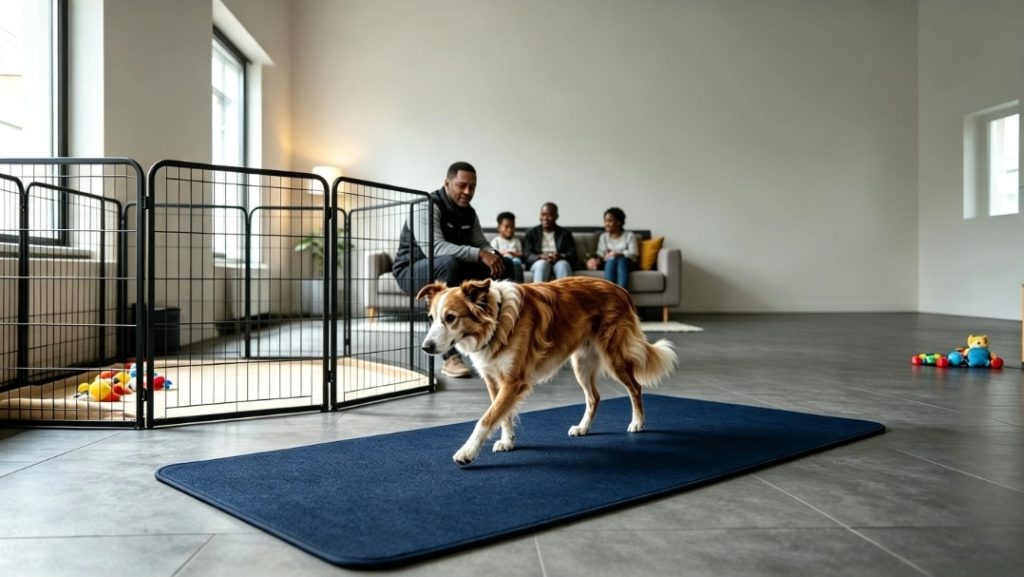
What to Do When Your Dog Leaves the Training Mat
What to Do When Your Dog Leaves the Training Mat is an important part of understanding placemat training and how owners should respond when behaviour does not go as expected. A dog leaving the mat can happen because of distractions, excitement, uncertainty, excessive freedom, inconsistent training or simply because the dog has not yet developed the required level of understanding. The mistake is often not the dog leaving the mat, but the owner’s response afterwards. Rather than turning the situation into a confrontation, the behaviour should be observed, managed and used as information to decide what needs to change.
RECOMMENDED PRODUCTS
DOG TRAINING PLACEMAT
A clearly defined training mat provides a consistent area for developing calm behaviour within the home.
Why Does a Dog Leave the Training Mat?
There can be many reasons why a dog leaves its training mat. Household activity may increase, somebody may walk through the room, another dog may become active or an interesting object may capture the dog’s attention.
Sometimes the owner has simply progressed too quickly.
A dog that has previously remained settled in a quiet environment may leave when the same exercise is introduced into a much busier part of the home. This does not necessarily mean the dog has forgotten its training. The environment has changed, and the level of difficulty has changed with it.
Understanding What to Do When Your Dog Leaves the Training Mat therefore begins with looking at the circumstances surrounding the behaviour.
What happened immediately before the dog moved?
Was there a distraction?
Was the dog becoming excited?
Had the owner increased the amount of freedom?
Was the training environment appropriate?
These observations can be more useful than immediately assuming the dog is being deliberately disobedient.
Common Mistakes Owners Make
One of the most common mistakes owners make is repeatedly putting the dog back onto the mat without considering why it left.
If the same distraction remains present, repeatedly returning the dog to the mat may simply produce the same result again.
Another common mistake is becoming frustrated. Raising the voice, chasing the dog or creating unnecessary conflict can make the situation more difficult and can distract the owner from identifying the actual problem.
Owners can also make the mistake of expecting too much freedom too early. A dog may understand the purpose of the training mat in one situation but not yet be ready to manage the same expectation while the household is busy.
What to Do When Your Dog Leaves the Training Mat should therefore focus on understanding the situation rather than simply trying to force the desired result.
RECOMMENDED PRODUCTS

TRAINING TREATS
Appropriate rewards can support positive reinforcement as part of a consistent training programme.
Using a Playpen Correctly
A playpen can be a valuable tool when a dog is learning to manage greater freedom around the home.
The playpen should not be viewed as punishment.
Its purpose is to provide a controlled area where the dog can be safely managed and monitored while the owner considers what is causing the difficulty.
This can be particularly useful when a dog repeatedly leaves the training mat and immediately becomes involved in other household activity. Rather than allowing the dog unlimited access to distractions, the playpen can provide a more controlled level of freedom while training continues.
What to Do When Your Dog Leaves the Training Mat can therefore involve more than the training mat itself. Sometimes the correct response is to review how much freedom the dog currently has and whether the environment is suitable.
The playpen becomes part of management, not punishment.
Common Playpen Problems
Although a playpen can be useful, owners can also experience problems when it is introduced or used incorrectly.
A dog may bark, jump against the sides, become unsettled, attempt to leave or become highly excited when placed inside.
The owner may then make another common mistake by assuming the playpen itself has solved the problem.
A playpen is a management tool. It does not replace training.
If the dog is repeatedly becoming distressed or excessively excited inside the playpen, the owner should consider the surrounding environment, the dog’s routine, the amount of stimulation and whether the playpen is being used appropriately.
The objective is to create calm, controlled management rather than using the playpen as somewhere to send a dog because the owner is frustrated.
RECOMMENDED PRODUCTS
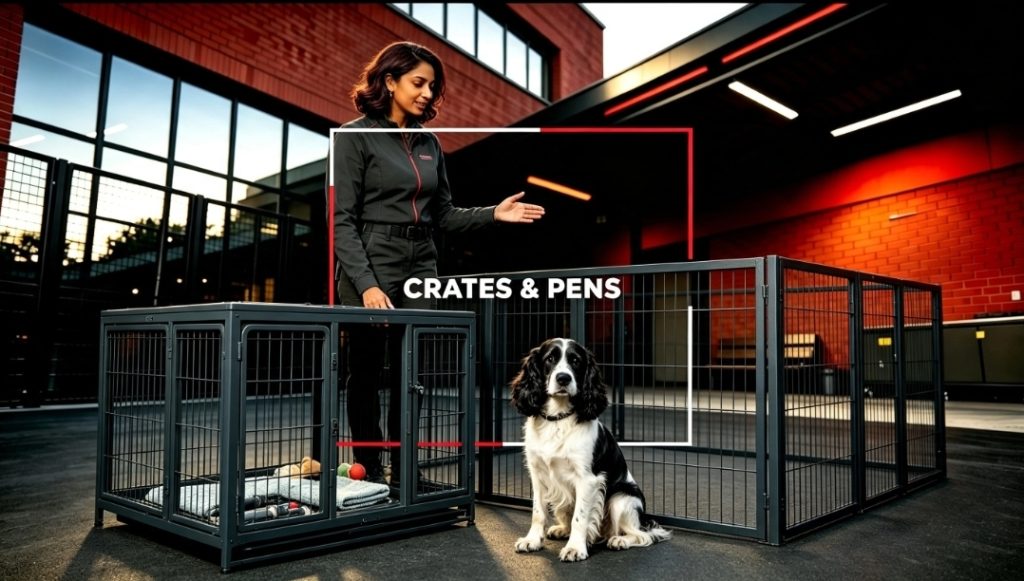
DOG PLAYPEN
A secure playpen can provide a defined area for supervised and controlled freedom within an appropriate home-training routine.
The Difference Between Training and Management
One of the most important points for owners to understand is that training and management are not the same thing.
Training develops the dog’s understanding and behaviour.
Management controls the environment while that learning is taking place.
This distinction is particularly important when considering What to Do When Your Dog Leaves the Training Mat.
The playpen can help manage the environment. The training mat can provide a defined area for calm behaviour. Other aspects of the dog’s routine provide additional structure.
Used correctly, these tools work alongside training rather than being presented as punishment.
The GPK9 system is designed around this principle: give the owner appropriate tools and a structured way of understanding when and why they should be used.
GOLDEN RULE ONE — HOME AND SOCIAL

GOLDEN RULE ONE — HOME AND SOCIAL provides the foundation for creating appropriate structure within the home.
The relationship between the crate, placemat and playpen gives the owner different ways to manage the dog’s level of freedom as the dog develops.
This is particularly relevant to What to Do When Your Dog Leaves the Training Mat. If the dog is repeatedly leaving the mat, the answer may be to review the amount of freedom being provided rather than continually increasing pressure.
The GPK9 system helps owners understand that structure should develop alongside the dog’s ability to manage its environment.
The playpen can provide monitored freedom and management when appropriate. It is not a punishment area.
GOLDEN RULE TWO — OBEDIENCE

GOLDEN RULE TWO — OBEDIENCE focuses on communication, consistency and developing reliable behaviour.
When a dog leaves its training mat, owners can sometimes focus entirely on the action itself instead of considering the training that surrounds it.
Inconsistent expectations, changing routines and progressing too quickly can all contribute to confusion.
What to Do When Your Dog Leaves the Training Mat therefore involves looking at the owner’s approach as well as the dog’s behaviour.
The GPK9 system gives owners a structured framework for recognising these situations and understanding where training may need to be reviewed.
The aim is not simply to keep the dog physically on the mat. The aim is to develop understanding that can eventually transfer into everyday life.
When Your Dog Keeps Leaving the Mat
If your dog repeatedly leaves the training mat, look for a pattern.
Does it happen when people enter the room?
Does it happen when children become active?
Does it happen when another dog is present?
Does it happen after a particular period of time?
Does the dog immediately seek play, food or another distraction?
These details can help the owner understand what is happening.
A common mistake is treating every occasion as exactly the same. The reason the dog leaves may be different from one situation to another.
What to Do When Your Dog Leaves the Training Mat is therefore about identifying the circumstances and adjusting the management or training stage accordingly.
The GPK9 system helps owners develop this broader understanding rather than relying on a single response to every situation.
GOLDEN RULE THREE — PREY DRIVE / PLAY

GOLDEN RULE THREE — PREY DRIVE / PLAY recognises that play and excitement are important areas of a dog’s development and need to be understood separately from calm structured training.
A dog that becomes highly excited may find it harder to remain settled on a training mat.
Owners can make the mistake of continuing to expect calm behaviour when the dog’s level of excitement has already changed significantly.
Understanding What to Do When Your Dog Leaves the Training Mat means recognising when excitement or play may be influencing the behaviour.
The GPK9 system provides a framework for separating these different areas and helping the owner recognise when the dog’s state needs to be considered before continuing.
A playpen can also assist with appropriate management when the dog needs a controlled environment rather than unrestricted access to the household.
GOLDEN RULE FOUR — TOILET

GOLDEN RULE FOUR — TOILET reminds owners that not every time a dog leaves its mat is an obedience problem.
A dog may need to toilet, require water, need rest or simply be responding to a basic need.
This is why What to Do When Your Dog Leaves the Training Mat should never be approached as though every movement is deliberate disobedience.
The GPK9 system encourages owners to consider the complete picture, including routine, environment and the dog’s basic requirements.
Understanding the reason behind behaviour allows the owner to make a more appropriate decision about what happens next.
RECOMMENDED PRODUCTS
DOG CRATE
A correctly introduced crate can provide an appropriate area for rest, routine and structured management.
Giving Your Dog the Right Level of Freedom
Freedom should develop alongside understanding.
One of the biggest problems owners encounter is giving a dog access to the entire home before the dog is ready to manage that freedom successfully.
The dog may leave the mat, chase household activity, interact with objects, become excited or repeatedly practise behaviour that the owner does not want.
A playpen can help bridge the gap between restricted management and greater freedom. It allows the owner to provide controlled access to the environment while continuing to develop the dog’s understanding.
This is another reason why What to Do When Your Dog Leaves the Training Mat should be considered within a complete system rather than as one isolated training problem.
The GPK9 Five Golden Rules provide owners with different areas to consider, while the appropriate tools help put that structure into practice.
GOLDEN RULE FIVE — SOCIAL WALKING / IGNORE THE WORLD

GOLDEN RULE FIVE — SOCIAL WALKING / IGNORE THE WORLD focuses on calm and manageable behaviour while the wider environment continues around the dog.
Although social walking is different from placemat training, the principle of observing the dog’s behaviour and understanding environmental distractions remains important.
A dog that struggles to remain calm around everyday distractions may also struggle when household activity increases around the training mat.
The GPK9 system connects these areas so owners can develop a wider understanding of calm behaviour rather than treating each problem as completely separate.
What to Do When Your Dog Leaves the Training Mat therefore becomes part of a larger process of teaching the dog how to manage different environments and levels of freedom.
How the GPK9 System Helps Owners
The purpose of a structured system is to give owners more than one response to a problem.
When a dog leaves the training mat, the owner can consider the home environment, obedience, excitement, basic needs and social behaviour.
The Five Golden Rules provide those different areas of consideration.
The training mat provides structure.
The playpen provides appropriate management and controlled freedom.
The crate can provide an appropriate area for rest and routine.
The owner can then assess whether the dog is ready for greater freedom or whether the current stage needs to be reviewed.
This approach helps prevent one of the biggest owner mistakes: reacting to behaviour without understanding what caused it.
What Not to Do When Your Dog Leaves the Training Mat
Do not automatically chase the dog around the house.
Do not turn the situation into a confrontation.
Do not use the playpen as a punishment.
Do not continually increase distractions simply to test the dog.
Do not assume that leaving the mat always means the dog is deliberately ignoring you.
Instead, observe what happened, consider the environment and review whether the dog is currently ready for the level of freedom being provided.
Understanding What to Do When Your Dog Leaves the Training Mat is about developing better decision-making as a handler.
RECOMMENDED PRODUCTS
PUPPY PLAYPEN
A secure playpen can provide a defined area for monitored freedom and appropriate household management.
When Additional Support May Be Appropriate
If a dog repeatedly leaves the mat, cannot settle, becomes increasingly frustrated or displays concerning behaviour, the owner should review the situation rather than continually increasing pressure.
Professional support can help identify whether the difficulty relates to the environment, training progression, management or another aspect of the dog’s behaviour.
The GPK9 system provides owners with an educational framework for understanding these situations, while a GPK9 Dog Training Instructor can provide additional guidance where individual assessment and support are appropriate.
Final Thoughts
What to Do When Your Dog Leaves the Training Mat is not about finding one correction that works every time. It is about understanding why the dog has left, recognising common mistakes made by owners and using appropriate management while training continues.
A playpen can be an important tool within that process, but it must be used correctly. It is not a punishment. It can provide controlled freedom, supervision and a structured environment while the owner reviews what the dog currently understands.
The Five Golden Rules give owners a wider framework for looking at home structure, obedience, play, toilet routines and calm behaviour around the wider world.
Together, the GPK9 system and its practical training tools help owners understand what is happening, manage the situation appropriately and progress towards greater freedom when the dog is ready.
The objective is not simply to stop a dog leaving a mat.
The objective is to Train the Human. Train the Dog. Build the Partnership.
RECOMMENDED COURSE
GPK9 Professional Online Dog Training Course — Five Golden Rules
The GPK9 Professional Online Dog Training Course — Five Golden Rules provides a structured educational system covering home and social structure, obedience, prey drive and play, toilet training and social walking. It helps owners understand how these areas work together throughout a dog’s development and how appropriate training tools can support progression.