Why Home Structure Is Important for Dog Training
Introduction
Why home structure is important for dog training starts with a simple principle: a dog’s training does not only happen during a dedicated training session.
The home is one of the most important environments in a dog’s daily life. Dogs experience routines, people, sounds, movement, rest, play and household activity every day.
This provides repeated opportunities for learning.
A structured home environment can help a dog understand what is expected, when to settle, when to interact and how to gradually manage greater freedom.
At GPK9, this principle forms part of Golden Rule One: Home and Social.
RECOMMEND COURSE

The objective is not to restrict a dog unnecessarily. The objective is to create an environment where the dog can learn appropriate behaviour and where the handler can clearly manage each stage of development.
What Does Home Structure Mean in Dog Training?
Home structure means creating clear and consistent expectations within the dog’s everyday environment.
This can include:
- Where the dog rests
- Where the dog settles
- When training takes place
- When play takes place
- How household activity is managed
- How visitors are introduced
- How freedom is increased
- How the dog is managed when supervision is limited
The exact structure will vary depending on the dog’s age, experience, training level and individual circumstances.
A young puppy may require considerably more management than an adult dog that has already developed reliable household behaviour.
The important principle is to create a framework that the dog can understand and successfully follow.
Why Home Structure Is Important for Dog Training
Why home structure is important for dog training becomes clearer when we consider how often dogs experience their home environment.
A training session might last a few minutes, but household life continues throughout the day.
The dog may experience:
- People entering and leaving rooms
- Household noises
- Visitors
- Children playing
- Meals being prepared
- Doors opening
- Other animals moving around
- Periods of activity
- Periods of rest
Each of these situations can become part of the dog’s learning environment.
Clear structure helps the handler manage these situations rather than simply reacting when unwanted behaviour occurs.
Consistency Helps Dogs Understand Expectations
Dogs learn through repeated experiences.
If the expectations change constantly, the dog can receive inconsistent information about what is required.
For example, allowing a dog to jump up at people on one occasion but correcting the same behaviour on another can make the expectation unclear.
Consistent management gives the dog more opportunities to practise appropriate behaviour.
Consistency does not mean every day has to be identical.
Instead, the handler maintains clear principles while gradually introducing different environments and situations.
Structure Creates Predictability
Predictability can help a dog understand what happens next.
A daily routine might include:
Training → Rest → Play → Toilet → Household Activity → Rest
The exact routine will depend on the individual dog.
The purpose is not to create a rigid timetable.
The purpose is to provide enough consistency for the dog to understand the expectations within its environment.
Home Structure Helps Manage Freedom
One of the most important parts of structured dog training is managing freedom.
A puppy or young dog may not yet have the skills required to manage unrestricted access to an entire home.
Giving too much freedom too quickly can create opportunities for unwanted behaviours to become repeated habits.
Instead, freedom can be increased gradually as the dog demonstrates that it can manage each stage successfully.
A structured progression may look like:
Crate → Training Placemat → Playpen → Increased Freedom
This is not a fixed timetable.
Some dogs may progress quickly in one area while requiring additional management in another.
The handler should consider the dog’s behaviour rather than assuming that age alone determines when freedom should increase.
The Role of the Dog Crate
A dog crate can be an important part of home structure when it is introduced and used appropriately.
It provides a defined area where a dog can rest and where the handler can manage the environment.
A crate can be particularly useful when a dog needs a clear resting area or when direct supervision is temporarily unavailable.
However, the crate should form part of a wider training system.
The purpose is not simply to put a dog into a crate whenever something goes wrong.
The dog also needs to learn how to behave appropriately outside the crate.
A Crate Is Part of the Training System
The crate can provide a controlled starting point.
The dog can then gradually learn how to settle, interact and behave appropriately in other areas of the home.
This creates a progression towards greater independence.
RECOMMEND PRODUCTS
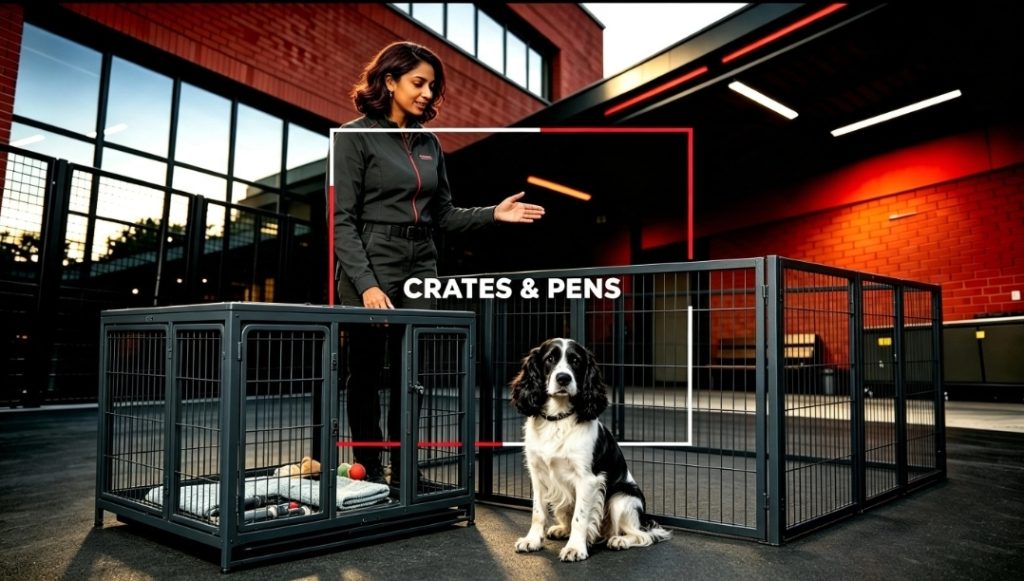
Appropriately selected crates and pens can support structured home management. Equipment should be suitable for the dog’s size, age and training stage and should be incorporated into an appropriate training routine.
The Role of a Training Placemat
A training placemat provides a different form of structure.
Unlike a crate, the dog is not enclosed.
Instead, the placemat creates a defined location where the dog can learn to remain while normal household activity continues.
A dog may learn to settle on its placemat while the owner is:
- Preparing food
- Working
- Sitting down
- Moving around the room
- Receiving visitors
- Carrying out household tasks
The placemat therefore becomes a practical way of teaching calm behaviour within the home.
Training Calmness Around Household Activity
The aim is not necessarily to remove the dog from everything happening around it.
Instead, the dog can learn that household activity does not automatically require its involvement.
This can help develop calm and manageable behaviour.
RECOMMEND COURSE
GPK9 Golden Rule One focuses on developing structure within the home and helping handlers understand the appropriate use of crates, training placemats and puppy playpens.
The course explains the How, Why and When behind structured home training.
The objective is to help the handler understand how to create appropriate structure rather than simply rely on equipment.
The Role of a Puppy Playpen
A puppy playpen can provide another stage between crate management and unrestricted household freedom.
It provides more space for movement while maintaining a controlled environment.
This can be particularly useful during early development when a puppy is learning:
- Toilet routines
- Settling
- Household boundaries
- Appropriate movement
- Calm behaviour
The playpen can therefore form part of a gradual progression towards greater freedom.
Instead of moving directly from a crate to unrestricted access, the puppy can experience increasing levels of controlled freedom.
RECOMMEND PRODUCTS

Puppy Essentials
Suitable puppy essentials can help owners create a practical and organised environment from the beginning. Equipment should support the puppy’s current development and the training structure being used.
Puppy Training
Appropriate puppy-training equipment and rewards can support short, positive training sessions while the puppy learns the expectations of its environment.
Home Structure During Visitors
Visitors can quickly change the environment inside a home.
Someone arrives at the door.
The doorbell rings.
A visitor enters.
People begin talking.
Movement increases.
For some dogs, this can create excitement or distraction.
A structured approach allows the handler to prepare for these situations rather than simply reacting to the dog’s behaviour.
The dog may initially require greater management.
As training develops, the dog can gradually learn to remain calm and manageable while visitors are present.
Not Every Household Event Requires a Response
A useful part of home structure is teaching the dog that normal household activity does not automatically require its involvement.
Someone walking across the room does not necessarily mean the dog needs to follow.
A door opening does not necessarily mean the dog needs to investigate.
A visitor entering the home does not necessarily mean the dog needs to rush towards them.
The handler can create clear expectations and reinforce appropriate behaviour.
Home Structure During Busy Household Activity
Busy periods can provide valuable training opportunities.
For example, the dog may need to remain settled while:
- Children are playing
- Food is being prepared
- People are moving around
- Household equipment is being used
- Visitors are present
- Doors are opening and closing
The level of difficulty should be appropriate for the dog’s current training.
If the dog becomes unable to manage the situation, the handler can reduce the level of stimulation and return to a situation the dog can handle successfully.
This is part of progressive training.
RECOMMEND COURSE

GPK9 Fundamentals 1 provides foundational training for puppies and younger dogs.
Developing appropriate home structure can help establish the basic behaviours required before progressing into more demanding environments and training situations.
Home Structure and Toilet Training
Home structure can also support toilet training.
A puppy with unrestricted access to the home may have more opportunities to toilet in unsuitable areas without the owner noticing.
Appropriate management, routine and supervision can help the handler recognise when the puppy needs an opportunity to toilet.
A crate and playpen can form part of this management system when used appropriately.
However, equipment alone does not teach toilet behaviour.
The handler must combine management with routine, timing and teaching.
Home Structure and Social Development
Home and social training is broader than teaching a dog to remain quietly in one room.
The dog is learning how to exist within a household.
It experiences:
- People moving around
- Household sounds
- Doors opening
- Visitors arriving
- Changes in activity
- Different periods of rest and interaction
The handler’s role is to introduce these experiences in a way the dog can manage.
This can provide an important foundation for later social and environmental training.
FEATURED PRODUCTS
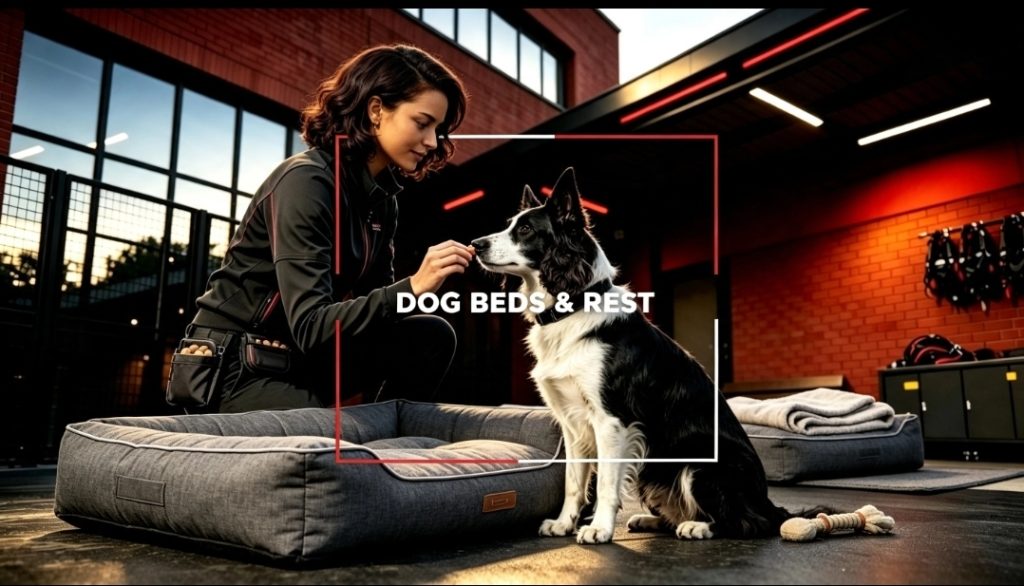
A suitable dog bed can provide another designated resting location within the home. Consistent resting areas can support the organisation of the dog’s daily environment.
Dog Care and Health
Appropriate care products can support the dog’s general daily routine while training and management remain the responsibility of the handler.
When Too Much Freedom Becomes a Problem
Freedom should be appropriate for the dog’s current level of training.
If a dog repeatedly struggles after being given additional freedom, this provides useful information for the handler.
The appropriate response may be to temporarily increase structure and reinforce behaviours that have already been taught.
This could involve:
- Increasing supervision
- Returning to a more controlled area
- Using the training placemat more frequently
- Reducing distractions
- Repeating previously successful training
The purpose is not punishment.
The purpose is to create an environment where successful behaviour is easier for the dog to achieve.
Progress Does Not Always Move in One Direction
Training progress is not necessarily a straight line.
A dog may manage one environment successfully but struggle when a new distraction is introduced.
The handler can adjust the level of difficulty accordingly.
This allows training to continue without expecting the dog to manage more than it is currently prepared for.
Common Home Structure Mistakes
Giving Too Much Freedom Too Early
A young dog may not yet have the skills required to manage an entire home.
Gradually increasing freedom can make expectations easier to establish.
Relying Entirely on Equipment
A crate, placemat or playpen does not train the dog by itself.
The handler must teach the dog how each environment works.
Changing the Rules
Inconsistent expectations can make learning more difficult.
Clear and repeatable household rules help the dog understand what is expected.
Ignoring Calm Behaviour
Owners can sometimes focus heavily on unwanted behaviour while overlooking appropriate behaviour.
Calm and appropriate behaviour should also receive attention and reinforcement when suitable.
Expecting Immediate Results
Training requires repetition.
A dog may understand a behaviour in a quiet training environment but struggle when household distractions are introduced.
Progress should therefore be built gradually.
RECOMMEND COURSE

The GPK9 90-Day Transformation provides a structured pathway for owners who want to develop greater consistency across their dog’s everyday training.
Home structure can provide the foundation for developing reliable behaviours before progressing into more varied environments and situations.
How Home Structure Connects With the Five Golden Rules
The principle of why home structure is important for dog training does not exist in isolation.
The GPK9 Five Golden Rules provide a wider training system:
Golden Rule One — Home and Social
Golden Rule Three — Prey Drive / Play
Golden Rule Four — Toilet Training
Golden Rule Five — Social Walking
The home provides an important foundation from which these areas can develop.
Obedience training can be organised more effectively when the dog understands basic structure.
Toilet training can benefit from appropriate routine and management.
Play and prey-drive work can be organised separately from everyday household structure.
Social walking can build upon the dog’s ability to remain calm and manageable.
The Handler Creates the Structure
The most important part of home structure is not the equipment.
It is the handler.
A crate does not decide when a dog should rest.
A placemat does not decide when a dog should settle.
A playpen does not decide when freedom should increase.
The handler makes these decisions based on the dog’s current training stage and behaviour.
This is why GPK9 focuses on:
Train the Human. Train the Dog. Build the Partnership.
The better the handler understands the training system, the more consistently the dog can experience it.
Building Structure for Long-Term Training
The purpose of home structure is ultimately to support greater freedom and better communication.
The goal is not to keep a dog permanently inside a crate, permanently on a placemat or permanently inside a playpen.
These are management and training tools.
The long-term objective is to help the dog understand how to behave appropriately with progressively greater freedom.
That progression begins with simple, manageable situations and develops through repetition.
Conclusion
Why home structure is important for dog training comes down to a simple principle: dogs need clear opportunities to learn how to behave within their environment.
A structured home can help the handler manage rest, training, play, toilet routines, household activity and increasing freedom.
Crates, training placemats and playpens can each provide different forms of management, but the equipment is only part of the process.
The handler creates the structure.
The dog learns through repetition.
Freedom can then increase as the dog’s ability to manage it develops.
This is the foundation of GPK9 Golden Rule One: Home and Social — creating a clear and structured environment that helps the dog and handler build a stronger partnership.
Recommended Articles
Home and Social Dog Training: Building Structure at Home
Explore the broader principles behind GPK9 Golden Rule One and how structure can be introduced into everyday household life.
What Is a Dog Crate? How Crate Training Works
Learn about the purpose of a dog crate and how appropriate crate training can form part of a structured home environment.
Why Use a Dog Crate? Understanding Crate Training
Explore different reasons a crate may be incorporated into a dog’s daily routine.
What Is a Dog Training Placemat? Place Training Explained
Learn how a training placemat can provide a defined location for calm behaviour within the home.
What Is a Dog Playpen? How to Use a Puppy Playpen
Discover how a puppy playpen can provide controlled space during early development.