
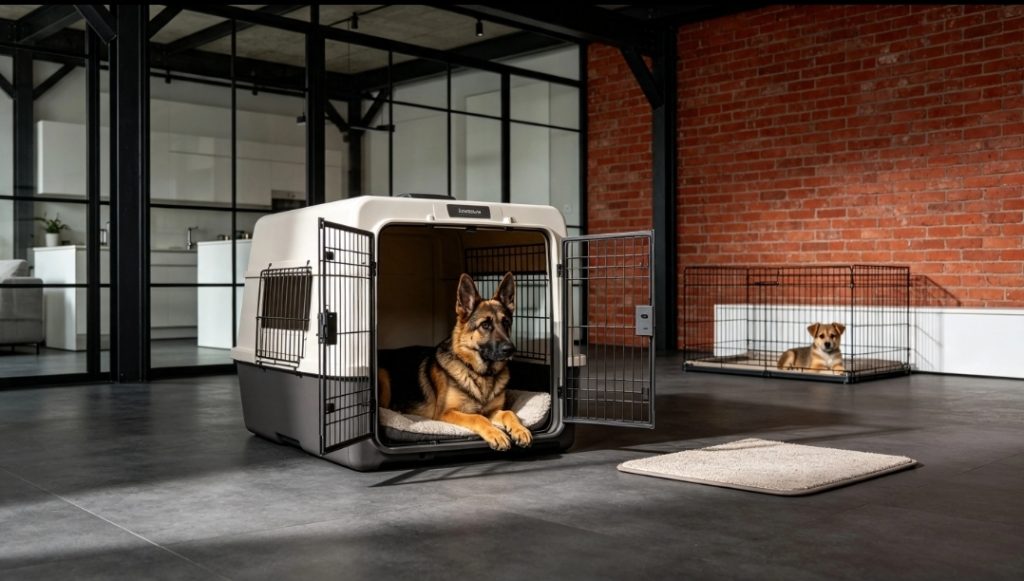
How Crate Training Works? What Is a Dog Crate?
Introduction
How crate training works? What is a dog crate? are important questions for anyone introducing a puppy or dog to a structured home environment. A crate can provide a defined space for rest, management and routine when it is introduced correctly and used as part of an appropriate training programme.
RECOMMENDED PRODUCTS
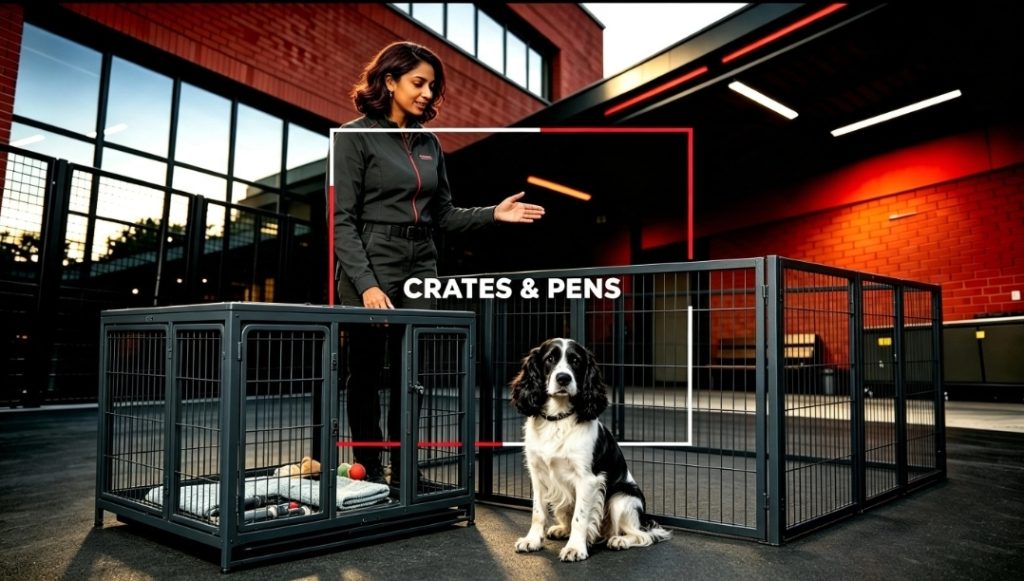
A dog crate should not simply be viewed as a place to put a dog when something goes wrong.
When used correctly, it can become one part of a wider approach to helping a dog understand its environment and develop appropriate household behaviour.
At GPK9, crate training forms part of Golden Rule One: Home and Social, which introduces owners to the principles behind structured home training.
The complete GPK9 system goes beyond the crate itself, which is why understanding the purpose of crate training is more important than simply purchasing a crate.
What Is a Dog Crate?
A dog crate is an enclosed space designed to provide a dog with a defined area within the home or another appropriate environment.
Crates are available in different designs, sizes and materials.
Common types include:
- Wire crates
- Plastic crates
- Fabric crates
- Heavy-duty crates
- Travel crates
The crate should be appropriately sized for the individual dog.
The dog should have enough room to stand, turn around and lie down comfortably, while the crate should still provide a clear and manageable resting environment.
The purpose of a crate is not to provide unlimited living space.
It is to create an appropriate defined area that can form part of the dog’s daily routine.
Why Do Dogs Use Crates?
There are several reasons a crate may form part of a dog’s training and management.
A crate can provide:
- A defined resting area
- A predictable environment
- Support during household management
- A place to settle
- Assistance with routine
- A controlled area during appropriate periods of supervision
- Support during travel when a suitable travel crate is used
The exact purpose will depend on the individual dog and the situation.
Crate training should always be considered as part of the dog’s wider development rather than as an isolated technique.
How Crate Training Works
How crate training works? What is a dog crate? can be understood by looking at the relationship between the dog, the environment and the handler.
The dog needs to learn that the crate is a normal part of its environment.
The handler controls how the crate is introduced and how it is incorporated into the dog’s routine.
The process should be gradual and appropriate for the individual dog.
Positive experiences can help the dog develop a comfortable association with the crate.
Food, rewards, calm interaction and appropriate routine can all be incorporated into training where suitable.
The objective is to develop understanding rather than simply forcing the dog into the crate.
Introducing a Dog to a Crate
A dog’s first experiences with a crate can influence how comfortable it becomes using one.
The crate should be positioned appropriately within the environment.
The handler can allow the dog to investigate the crate and gradually introduce positive experiences around it.
For some dogs, this may happen quickly.
Others may require considerably more time and repetition.
There should be no need to rush the process.
Creating a Positive Association
Positive reinforcement can be used to help a dog develop a positive association with the crate.
Food rewards can be particularly useful when a dog is motivated by food.
The handler should observe the dog’s behaviour and progress at a suitable pace.
The goal is for the crate to become a familiar part of the dog’s environment.
The Dog Crate and Home Structure
A crate can play an important role in structured home training.
Dogs do not automatically understand how they should behave throughout an entire house.
Young puppies in particular may need carefully managed freedom while they learn household expectations.
A crate can provide a defined area while the dog develops these skills.
As training progresses, the handler can introduce other forms of structure and gradually develop the dog’s ability to manage greater freedom.
This is one reason how crate training works? what is a dog crate? should be considered alongside the wider principles of home and social training.
RECOMMENDED PRODUCTS
A correctly selected crate can provide a practical and defined space for a dog within the home.
When choosing a crate, consider the dog’s current size, expected development, construction quality, ventilation, security and intended use.
A puppy may also benefit from appropriate pen equipment where additional controlled space is required.
Equipment should support the training approach rather than replace it.
How Long Should a Dog Stay in a Crate?
There is no single appropriate duration that applies to every dog and every situation.
The dog’s age, development, toilet routine, individual needs and circumstances should all be considered.
Crate training should not mean leaving a dog confined for unnecessarily long periods.
A crate should be incorporated into an appropriate daily routine that also provides suitable opportunities for exercise, interaction, training, toileting and rest.
Puppies generally require particularly careful management because their physical and developmental needs are different from those of adult dogs.
Crate Training and Puppies
Crate training can be particularly useful during puppy development.
Puppies are still learning how to behave within the home.
They may also need support with:
- Toilet training
- Rest
- Household routines
- Chewing management
- Controlled freedom
- Settling
A crate can provide a defined environment while these behaviours are being developed.
However, puppies should not be expected to understand everything immediately.
Training should progress according to the puppy’s behaviour and development.
The Crate and Toilet Training
A crate can form part of an appropriate toilet-training routine because it provides a defined area rather than unrestricted access to the home.
However, crate training and toilet training are not the same thing.
The handler still needs to understand the puppy’s routine, recognise appropriate opportunities for toileting and provide suitable access to the correct toilet area.
The crate can support management, but it does not teach toilet behaviour by itself.
GPK9 covers toilet training separately within the Five Golden Rules, allowing owners to understand how the different areas of training connect without treating the crate as a complete solution.
Using a Crate When Visitors Arrive
Visitors can create significant changes within the home.
People enter through the door.
Voices become louder.
Movement increases.
The dog may become excited.
A crate can provide a controlled area where appropriate management can take place while the handler manages the situation.
However, the objective should not simply be to put the dog away every time someone arrives.
The wider training process should help the dog develop the ability to remain calm and manageable around normal household activity.
This is where GPK9’s Golden Rule One: Home and Social provides the wider framework.
Using a Crate During Busy Household Activity
A household can become busy for many reasons.
Children may be playing.
Food may be prepared.
Visitors may be present.
People may be moving between rooms.
Deliveries may arrive.
A crate can provide a defined space during appropriate periods while the handler manages the environment.
The dog should still receive appropriate interaction, exercise, training and opportunities to settle outside the crate.
The aim is structured management rather than unnecessary confinement.
RECOMMENDED COURSE

GPK9 Golden Rule One: Home and Social
The GPK9 Professional Online Dog Training Course introduces the Five Golden Rules as part of a structured educational system.
Golden Rule One focuses on Home and Social, including the principles surrounding appropriate home structure and the role that equipment can play within that structure.
The course goes beyond explaining what a crate is.
It teaches the handler how to understand the wider training process and how the different stages connect.
The full system is taught inside the GPK9 course rather than being provided as a complete step-by-step programme within an individual blog article.
Common Dog Crate Training Mistakes
Choosing the Wrong Size Crate
A crate that is too small may not provide sufficient space for comfortable movement.
A crate that is excessively large may not provide the defined environment the handler intended.
The correct size should be appropriate for the individual dog.
Using the Crate as Punishment
A crate should not become associated exclusively with punishment or negative experiences.
The objective is to develop a positive and appropriate relationship with the crate.
Expecting the Dog to Understand Immediately
Some dogs adapt quickly.
Others require more gradual introduction.
The handler should observe the dog and adjust the training accordingly.
Leaving the Dog Confined for Too Long
A crate should be one part of a balanced routine.
Dogs need appropriate opportunities for exercise, interaction, training, toileting and rest.
Using the Crate to Avoid Training
A crate can support training and management, but it should not replace training.
The dog still needs to learn how to behave appropriately outside the crate.
How Crate Training Works With Greater Freedom
The long-term purpose of structured crate training is not to keep a dog permanently confined.
The crate can provide a controlled starting point while the dog develops appropriate behaviours.
As the dog demonstrates that it can manage greater freedom, the handler can gradually introduce other areas of the home and other forms of structure.
This progression should be based on the dog’s behaviour rather than an arbitrary timetable.
The exact process is part of the wider GPK9 training system.
RECOMMENDED PRODUCTS
Quality crate and pen equipment can support structured home training when selected appropriately and used as part of a wider training approach.
Look for equipment that is suitable for the dog’s current size, secure, appropriately ventilated and practical for the intended environment.
The Dog Crate Is Only One Training Tool
Understanding how crate training works? what is a dog crate? is only the beginning.
The crate is one tool within a much larger training environment.
Dogs also need to learn how to settle without being enclosed, how to behave around household activity and how to manage progressively greater freedom.
This is why GPK9 does not present crate training as a standalone solution.
The wider Five Golden Rules provide the foundation for understanding different areas of a dog’s development.
The detailed training system is taught through the GPK9 course.
RECOMMENDED COURSE
GPK9 Professional Online Dog Training Course
The GPK9 Professional Online Dog Training Course is designed to teach the handler the How, Why and When behind structured dog training.
The course brings together the Five Golden Rules:
Golden Rule One — Home and Social
Golden Rule Three — Prey Drive
Golden Rule Four — Toilet Training
Golden Rule Five — Social Walking
Each rule forms part of the wider GPK9 educational system.
Rather than attempting to provide the complete system through separate free articles, the blog provides useful education while the course provides the structured training pathway.
Building a Positive Relationship With the Crate
A well-introduced crate should become a familiar part of the dog’s environment.
The handler should focus on appropriate use, positive experiences and gradual development.
The dog should be given suitable opportunities to rest, interact, exercise and learn outside the crate.
Over time, the crate can become one part of an organised home-training environment.
The handler’s understanding remains central to the process.
Conclusion
How crate training works? What is a dog crate? starts with understanding that a crate is a training and management tool, not a replacement for training.
A correctly selected crate can provide a defined area for rest, routine and appropriate management.
Positive experiences and gradual introduction can help a dog become comfortable with the crate.
The crate can also support wider areas such as home structure and toilet-training management when used appropriately.
However, successful dog training requires more than equipment.
The handler needs to understand when, why and how different training tools and environments should be used.
That wider understanding is what GPK9 develops through its Five Golden Rules and GPK9 Professional Online Dog Training Course.
Learn the wider GPK9 approach to structured dog training and develop your understanding of the How, Why and When behind the Five Golden Rules.
RECOMMENDED BLOG POSTS
Why Use a Dog Crate? Understanding Crate Training
Explore the reasons a dog crate may be incorporated into a structured training environment.
When Should You Use a Dog Crate? Practical Crate Training
Learn about appropriate situations where crate management may form part of a dog’s routine.
How to Introduce Your Dog to a Crate Step by Step
Explore the principles behind introducing a dog to a crate gradually and positively.
How to Use a Dog Crate to Create Structure at Home
Discover how crate management can form part of a wider structured home environment.
Common Dog Crate Training Mistakes and How to Avoid Them
Learn about common problems that can occur when introducing or using a dog crate.
How to Use a Dog Crate When Visitors Arrive
Explore how appropriate crate management can support household routines when visitors enter the home.




